Moving Sidewalks

The instructions are clear. If you choose the moving sidewalk at the airport, you need to step carefully on and off. If you want to stand on the moving sidewalk, please stand on the right, so that others may pass you on the left. I think this is good counsel. After all, they are SIDEWALKS, not SIDESTANDS. So if you want to stand, at least stand to the side so that the walkers can actually MOVE on the MOVING sideWALK. The calm and soothing voice of the announcement that plays over and over is non-confrontational, polite, and instructive.

If this same announcement played in other parts of the country, it might sound different. I grew up in South Jersey, where I imagine it would sound a little more assertive. Think The Sopranos-assertive. If Tony Soprano recorded the announcement it could sound like, “YO! Youze are on the moving SIDEWALK. I SAID SIDEWALK, as in MOVE A-SIDE so that others can WALK. What bozo doesn’t know to move ovuh? WHADDYAZ think this is, the turnpike for cryin’ out loud?? Ah, fuhgeddaboutit.”

Traveling through the magnificent Atlanta airport recently, I encountered several opportunities to observe the moving sidewalks. They connect the ticketing lobbies, baggage claims, and all of the terminals, spanning miles. If I have time, I prefer to walk on the non-moving concourse, but the sidewalks are a good alternative if you have just enough time to use them, and you don’t have to default to the train. You just hope that you can move forward quickly and people won’t get in your way. ATL is huge, with multiple concourses. It processes about 300,000 people a day. A DAY. That’s a lot of moving sidewalk violations right there.

In his letter to the Philippians, Paul writes about moving sidewalks. OK, he writes about metaphorical moving sidewalks:

Philippians 3 (The Message)

Focused on the Goal

13-14 Friends, don’t get me wrong: By no means do I count myself an expert in all of this, but I’ve got my eye on the goal, where God is beckoning us onward—to Jesus. I’m off and running, and I’m not turning back.

15-16 So let’s keep focused on that goal, those of us who want everything God has for us. If any of you have something else in mind, something less than total commitment, God will clear your blurred vision—you’ll see it yet! Now that we’re on the right track, let’s stay on it.

17-18 Stick with me, friends. Keep track of those you see running this same course, headed for this same goal. There are many out there taking other paths, choosing other goals, and trying to get you to go along with them. I’ve warned you of them many times; sadly, I’m having to do it again. All they want is easy street.

Paul encourages us to keep moving forward with our eyes on the goal. He warns us that others, who are looking for the easy sidewalk, will block us and stand in our way. But we are to walk forward and NOT TURN BACK.

I know a woman who is struggling with two significant family relationships. She can’t move forward with the situation as it is, and so she has addressed it with them. They are a stumbling block to her, blocking her spirit, her joy, and her goal of pursuing a life that reflects her relationship with God. She has chosen sobriety, while they have chosen to take other paths. She has chosen honesty, while they have chosen avoidance. As she keeps her eye on the way forward, she has no choice but to not look back. If she were to do so, she would surely fall off the moving sidewalk.

Does this resonate with you? Is God calling you to a way forward that means you have to leave the past behind? Is God inviting you to pursue him at the cost of everything else? Do you need to shed toxic relationships in order to attain the goal of the abundant life offered by Christ?

Wherever your moving sidewalk is headed, step on with care. Keep your eyes always looking forward. Carefully make your way around others who try to block your progress. And no matter what, don’t look back.

Passing on the Left in Concourse B.

Surround Yourself

The founder and creator of LARABARS shared her secret to success on NPR recently. After telling her story of how she made protein bars in small batches in her kitchen with her father, she goes on to explain that bringing in revenue of over five million dollars in the second year (!) was due to the fact that all the way along, she “surrounded herself with people who believed in her.”

That really hit home for me. All of my life’s joys and moments of feeling accomplished were times when I felt the tangible support of people who believed in me. I am blessed to have a family who believes in me. They might not always agree with me, or believe in the same things I believe in, but they believe in me. I am also blessed with two best friends who have run alongside of me for ten years who believe in me. I have a third who walks dogs with me and uplifts me in the same way. They have gotten me through some very rough times when I was under attack professionally, personally, and spiritually. They also don’t always agree with me, but they have stood by me through thick and thin. Their steadfast faith in me carried me through times when I felt weak, unsure, and insecure. I would have just up and quit several times, had it not been for all these blessings.

I often think of Jesus and his devotion to his disciples. They were a motley crew, who at moments really came through for our Lord, and at other times, failed miserably.

We all know the story of Peter’s heartbreaking denial of Jesus the night before his crucifixion. Lest we be hasty to judge, do you think you would have done any better? With soldiers and swords challenging you, with the impossibility of who Jesus REALLY was looking more incredible by the moment, wouldn’t you have wanted to flee as well? Doubt is a part of the faith journey. It helps us get to where we are going.

So let’s take a look at Peter’s redemption, and see if we can recall a time when we, too, were doubtful, and then believed:

John 21:15-25 New International Version (NIV)

Jesus Reinstates Peter

15 When they had finished eating, Jesus said to Simon Peter, “Simon son of John, do you love me more than these?”

“Yes, Lord,” he said, “you know that I love you.”

Jesus said, “Feed my lambs.”

16 Again Jesus said, “Simon son of John, do you love me?”

He answered, “Yes, Lord, you know that I love you.”

Jesus said, “Take care of my sheep.”

17 The third time he said to him, “Simon son of John, do you love me?”

Peter was hurt because Jesus asked him the third time, “Do you love me?” He said, “Lord, you know all things; you know that I love you.”

Jesus said, “Feed my sheep.

These words reinstated Peter, and he went on to become the rock and the foundation of the church. They gave him a chance to reclaim himself as someone who DID believe in Jesus, even though he let Jesus down in the final hour. You see, Peter didn’t always believe in Jesus, but Jesus always believed in Peter. And he believes in you, too.

This causes us to reflect on the fact that even our closest supporters can fail us. They can miss a cue, misread a moment, respond out of a selfish place, or just not see our need.

Love them anyway. Forgive them anyway. Offer a way back with open arms. And surround yourself with others who do believe in you.

People who are close to you who don’t believe in you can be a millstone around your neck. It’s up to you to shed them, or forgive them. But in either case, keep on keeping on, aligning yourself with those who uplift you and cheer you on no matter what. And better yet, be an encourager for those whom you believe in. It makes all the difference in the world.

Friends on the Beach by David Bevel Jones.

Crowdsourcing

Crowdsourcing is a way of outsourcing a task or obtaining information for a project by using the input of a large group of people, typically on the internet. Social media, smartphone apps, and electronic surveys are just some of the means by which interested parties can source work or gather information. People are invited to collectively contribute ideas, time, expertise, or funds to a common goal. For example, traffic tracking apps such as Waze use driver/rider generated reports to communicate accidents, objects in the road, construction, and police on your journey. Uber pairs drivers with people who need a ride, an example of crowdsourced transportation.

Lays Potato Chips has really maximized the concept of crowdsourcing in its campaign “Do Us a Flavor,” where they asked people to submit ideas for potato chip flavors. Then the public was invited to vote on the flavors they would like to try. The top four submissions became actual products. So new flavors such as Crispy Taco, Flamin’ Hot Dill Pickle, and Beer Cheese have been crowdsourced from inception to having the final selection available at your local Wawa. I don’t know who came up with the idea of Flamin’ Hot Dill Pickle potato chips, but I want some.

At the heart of crowdsourcing is the notion of people coming together to help each other. I once traveled to Florida using Waze, and saved close to two hours in traffic. Others ahead of me reported a crash that had shut down the highway, and WAZE suggested a faster route.

Crowdsourcing existed in the early church, but they didn’t call it that. Martin Luther was an original crowd-sourcer. His frustrations with the institutional Church led him to write his “Ninety-Five Theses: A Disputation on the Power of Indulgences” and nail them on the door of the church in Wittenberg, which was located in the heart of the city on the public square. People read it, printed it, translated it, and shared its ideas with others throughout Germany and the rest of Europe, and thus the Reformation began.

But Jesus, of course was THE original crowd SOURCE. He spent a good deal of his ministry among the crowds. In the wonderful miracle known as the “Feeding of the Five Thousand,” we see him at his crowdsourcing best:

Matthew 14 (The Message)

Supper for Five Thousand

13-14 When Jesus got the news, he slipped away by boat to an out-of-the-way place by himself. But unsuccessfully—someone saw him and the word got around. Soon a lot of people from the nearby villages walked around the lake to where he was. When he saw them coming, he was overcome with pity and healed their sick.

15 Toward evening the disciples approached him. “We’re out in the country and it’s getting late. Dismiss the people so they can go to the villages and get some supper.”

16 But Jesus said, “There is no need to dismiss them. You give them supper.”

17 “All we have are five loaves of bread and two fish,” they said.

18-21 Jesus said, “Bring them here.” Then he had the people sit on the grass. He took the five loaves and two fish, lifted his face to heaven in prayer, blessed, broke, and gave the bread to the disciples. The disciples then gave the food to the congregation. They all ate their fill. They gathered twelve baskets of leftovers. About five thousand were fed.

Did you notice how that went? The disciples were expecting Jesus to come up with the meal. Jesus told the twelve to figure something out. They came up with five loaves and two fish, and lunch was served on the lawn. So Jesus sourced the miracle, and the crowd sourced the “re-source.”

What resource are you holding onto that would be better shared with the crowd? Where can you offer your expertise, your ideas, or your opinions in a way that constructively benefits others? Where is God calling you to take the Good News out into the public square and re-form the people?

Whatever your resource may be, God calls us to break our loaves and fish open and offer them to the world. And whenever you have served the least of these with whatever you have, you have served the Lord. And don’t forget to pick up the leftovers.

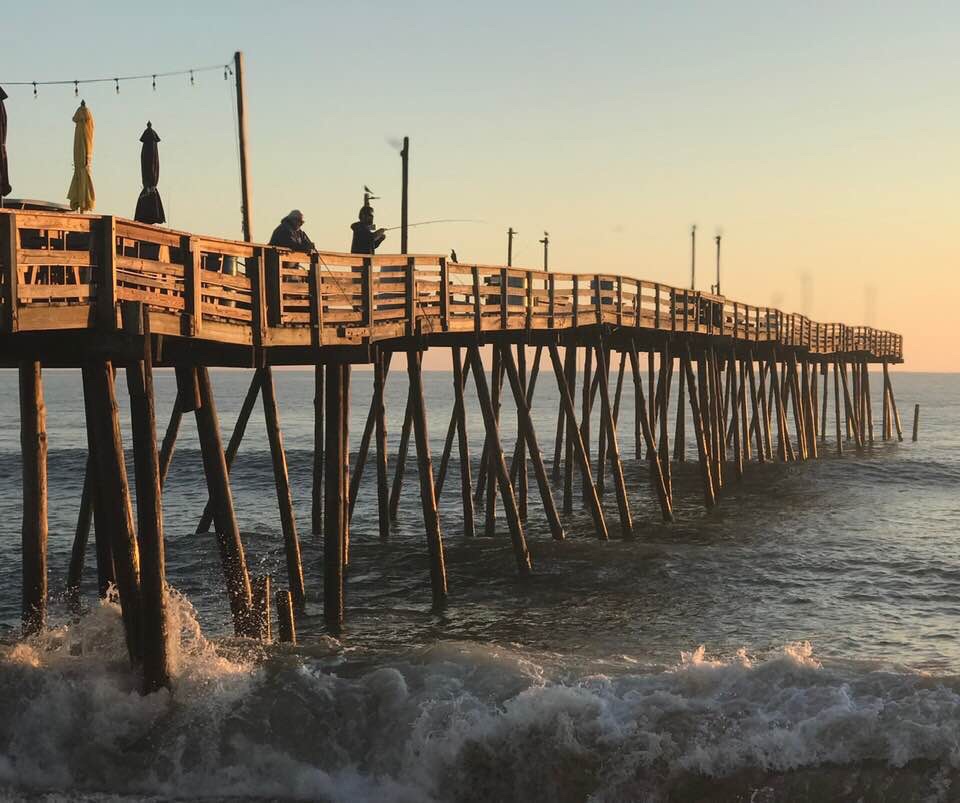
Fishing off Avalon Pier by Michelle Robertson