Scars

 Many of you know that my daughter is a cancer survivor. She was diagnosed when she was a junior in college and like many cancer patients, she had a series of surgeries as part of her treatment. Each one left a scar, and surely there are emotional and spiritual scars that went along with the physical ones. We were vacationing together a few years after it was over, and we noticed a young man on the beach with large scars on his neck running up the back of his head. As we speculated about the cause, she leaned over to me and said, “You know, Mom, scars are like tattoos. They just tell better stories.”

Scars that brought healing indeed do tell of hope and redemption. The stories they tell of survival, triumph, and victory become a badge of honor to the wearer.

In our passage in Isaiah today, we read about the future Messiah’s scars. His will be so deep that he will appear disfigured and even somewhat inhuman. Yet while his appearance will be unlike any other human, it will astonish and silence everyone. His scars will tell a much, much better story.

Isaiah 52:13-15

Look, my servant will succeed.
    He will be exalted and lifted very high
.
14 Just as many were appalled by you,
    he too appeared disfigured, inhuman,
    his appearance unlike that of mortals.

15 But he will astonish many nations.
    Kings will be silenced because of him,
    because they will see what they haven’t seen before;
    what they haven’t heard before, they will ponder.

As I read that today, it made me wince. I was taken back in time to the severe beating that Jesus endured on our behalf before they forcibly nailed his broken bones to a rough wooden cross. I saw a picture of our lovely savior so damaged that his disciples might have had to look twice to pick him out from among the three who hung there that day. I grieve my sins that put him there.

But Isaiah didn’t just put him there and leave him in this passage. Indeed, he began with the bold promise that this suffering servant would not only succeed but would be exalted and lifted very high. When Jesus ascended back to his Father, the story was complete and the good news was delivered once and for all. This is why our crosses in United Methodist churches are empty. Our broken, battered Lord is no longer there, but was made whole and beautiful again in his resurrection.

What scars do you bear that can help you tell your story of hope and redemption to others? Did Jesus come into your life to lift you up and make you whole again? We have an opportunity to be wounded healers if we are willing to share our stories with others so that they might find him, too.

Our sins may have put Christ on the cross, but they didn’t keep him there. Because of the resurrection, we all are invited to participate in the greatest story ever told. Do you believe that? Do you believe in the resurrection?

If you do, go and tell. By his wounds we all will be healed.

Exalted by Michelle Robertson

Citizenship

In 2008, Pixar Studios released a cautionary tale called “WALL-E.” It was a love story about two robots who were left behind to work on what remained of earth after humanity fled on starships. As we journey through their relationship issues, we see a startling portrayal of what has become of humankind. With robots available to do every kind of work, people have become debilitatingly obese and are confined to lounge chairs, living their lives through screens and artificial intelligence.

In Biblical terms, they have “allowed their god to be their stomach” and are now suffering from the pursuit of earthly pleasures and indulgences. This dystopian look at humanity’s future was also predicted by Paul, who warned against such things in our reading today. Even as he addressed the church at Philippi, he was very forward thinking, wasn’t he?

Philippians 3:17-21 (Common English Bible)

17 Brothers and sisters, become imitators of me and watch those who live this way—you can use us as models. 18 As I have told you many times and now say with deep sadness, many people live as enemies of the cross.19 Their lives end with destruction. Their god is their stomach, and they take pride in their disgrace because their thoughts focus on earthly things. 20 Our citizenship is in heaven. We look forward to a savior that comes from there—the Lord Jesus Christ. 21 He will transform our humble bodies so that they are like his glorious body, by the power that also makes him able to subject all things to himself.

Paul was deeply distressed over these “enemies of the cross” who lived lives that were complacent and content in the wrong-headed assumption that once salvation of the soul had occurred, the body could pursue earthly delights with abandon. This type of thinking was called Gnosticism and it became the bane of Paul’s ministry throughout his life. He encouraged them to follow his example and the example of others who were imitating the life of Christ.

And we know that the life of Christ was a life of self-denial. The Gnostics practiced a life of self-indulgence, and it grieved Paul to his core.

We, too, are to imitate Christ as Paul did. One of the best things about the season of Lent when it comes around is the deliberate resetting of our priorities as we reevaluate the quality of our spiritual health. Practicing self-denial for 40 days goes a long way toward recalibrating our hearts and minds toward Christ. Perhaps we should practice Lent as a daily lifestyle all year long.

Paul reminds us that we are citizens of heaven and should focus our thinking as those who are merely foreigners here. Earthly delights will fade away in the light of heaven’s rewards, and if heaven is our true home, we will be strengthened against any temptation this “colony” has to offer.

God has promised to transform us into the likeness of Christ when we join him there. Our challenge today is to transform our thoughts, actions, words, and deeds into his image in such a way that others will see and know that we don’t belong here but are just passing through. How is God calling you to respond to this text today? Do you need to give something up in order to claim your heavenly citizenship? Save your own soul and follow Paul’s example.

Just Passing Through by Michelle Robertson

Limp Hands and Rubbery Knees

Do you ever experience anxiety? Anxiety is a biological reaction to external and internal pressures and threats. It is the body’s way of alerting you to hunker down or flee a threatening situation. It is a feeling of fear, dread, and uneasiness that can cause you to sweat, feel restless and tense, and have a rapid heartbeat. It can be a normal reaction to stress.     

Two months ago my dog suddenly collapsed and had to be hospitalized for three days. We didn’t know what was wrong, and while she was gone from the house, I experienced a constant pain and pressure in my chest that was so pervasive, I could not relax or sleep. It hurt. It went away when we were able to bring her home, but for people with anxiety disorders, the reaction is not temporary and can be overwhelming.

Our passage from Isaiah today speaks directly to those who have an anxious heart. It is a beautiful reminder that God is always with us in every situation, and we can count on God to come and save us. We can offer our limp hands and rubbery knees to our mighty God and find strength and help there.

Isaiah 35:1-4 (The Message)

1-2 Wilderness and desert will sing joyously,
    the badlands will celebrate and flower—
Like the crocus in spring, bursting into blossom,
    a symphony of song and color.
Mountain glories of Lebanon—a gift.
    Awesome Carmel, stunning Sharon—gifts.
God’s resplendent glory, fully on display.
    God awesome, God majestic.

3-4 Energize the limp hands,
    strengthen the rubbery knees.
Tell fearful souls,
    “Courage! Take heart!
God is here, right here,
    on his way to put things right
And redress all wrongs.
    He’s on his way! He’ll save you!”

 The times we are living in right now are filled with anxiety. You can’t go through a day without experiencing some anxiety over the latest news, driving in heavy traffic, the climate crisis, violence in our streets and across the world, mass shootings, worry over the economy and jobs, raising children, marriages falling apart … the list is endless.

 A friend shared that after several life-challenging events, she is struggling so much with anxiety that she realizes she needs to find help. She said that this gave her a sense of shame and disappointment. I know that those feelings are real, but I countered that if she were experiencing symptoms of diabetes, she would see a specialist and possibly go on insulin. It is the same with anxiety … getting professional help puts no shame in that game. That is the smart move.

When anxious thoughts overwhelm you, close your eyes and imagine Isaiah’s vision of God’s power and presence in your life. To those who are anxious, Isaiah says, “Courage! Take heart! God is here”. Take a few deep breaths, pray and meditate, and go for a walk. And if anxiety is persistent and pervasive, a good therapist is in order, just as you would seek help for a heart condition. God can use ALL things for your good if you open yourself to help.

God is here, right here, on his way to put things right.

Orange Sunset Glowdog

Perfecting Imperfection

Our journey through Hebrews continues this week as the writer again makes the case for Jesus’ superiority as the once-and-for-all sacrifice for our sins. He points out the futile efforts of the human priests, who can’t make a dent in the sin problem, and the single sacrifice made by Jesus that wipes out sin forever. 

Hebrews 10:11-18 (Common English Bible)

11 Every priest stands every day serving and offering the same sacrifices over and over, sacrifices that can never take away sins. 12 But when this priest offered one sacrifice for sins for all time, he sat down at the right side of God. 13 Since then, he’s waiting until his enemies are made into a footstool for his feet, 14 because he perfected the people who are being made holy with one offering for all time.

15 The Holy Spirit affirms this when saying,

16 This is the covenant that I will make with them.
After these days, says the Lord,
I will place my laws in their hearts
and write them on their minds.
17 And I won’t remember their sins
and their lawless behavior anymore.[a]
18 When there is forgiveness for these things, there is no longer an offering for sin

In Eugene Peterson’s The Message, verse 14 reads like this:

 “It was a perfect sacrifice by a perfect person to perfect some very imperfect people” (Hebrews 10:14 The Message). Preach it, Eugene! We are indeed some very imperfect people. The Holy Spirit affirms our condition of imperfection and points us toward a new plan. This new covenant will be placed in our hearts and written on our minds. Thanks be to God!

The imagery of God’s new plan being written in our hearts goes a long way toward a deeper understanding of the depth of God’s plan. God desires this covenant to be engraved not just on our hearts, but in our hearts… in other words, the deepest, inside part … of our hearts. God does not desire a superficial relationship with us but wants us to present the most inner part of our souls. We are invited to love God from the “inside-out.”

 Let’s take this in a different direction now. If God provided the perfect sacrifice for the forgiveness of sins, can we really be unforgiving toward each other’s sin? And if we continue to hold grudges and refuse to forgive one another, what does that say about the power of the cross? It seems to say that our stubbornness is greater than the blood that was shed there. Everyone loves to be forgiven but we sure can be measly when it comes to forgiving others. Does that make sense? In this passage, God promises to not remember our sins and our lawless behavior anymore. This is the way we are to respond to one another, even in those situations where the offender has not asked for forgiveness.

 God calls us to forgiveness and Jesus made it conditional in the Lord’s Prayer when he said, “Forgive us our trespasses AS WE FORGIVE those who trespass against us.” The phrase “as we forgive” means that we must give as good as we have gotten. And sometimes that is very, very hard.

 Is God calling you to forgive someone today? Remember that often the burden of unforgiveness is hardest on you, not the one who hurt you. Jesus’ perfect offering wiped your slate clean. Maybe it is time for you to wipe clean all the other slates in like manner..

Old Buoy by Michelle Robertson

Streams in the Desert

Have you ever been so discouraged that you began to question your faith? Have things ever hit you so hard that you suddenly felt uncertain about everything in your life? This happened to John the Baptizer when he was in jail. He began to question Jesus’ messiahship in that dark and foreboding place. When Jesus heard this, he sent a message through a friend to say that indeed, he was the Messiah, and he quoted today’s passage from Isaiah as proof.

Jesus responded, “Go, report to John what you hear and see. Those, who were blind, are able to see. Those who were crippled are walking. People with skin diseases are cleansed. Those who were deaf now hear. Those who were dead are raised up. The poor have good news proclaimed to them. 6 Happy are those who don’t stumble and fall because of me” (Matthew 11:4-6, Common English Bible).

 John was soothed in his dismay when he heard these familiar words from the prophet Isaiah. They were a foretelling of a future Messiah, which John realized had now arrived in Jesus. 

Isaiah 35:5-10 (Common English Bible)

Then the eyes of the blind will be opened,
and the ears of the deaf will be cleared.
6 Then the lame will leap like the deer,
and the tongue of the speechless will sing.
Waters will spring up in the desert,
and streams in the wilderness.

7 The burning sand will become a pool,
and the thirsty ground, fountains of water.
The jackals’ habitat, a pasture;[a]
grass will become reeds and rushes.

8 A highway will be there.
It will be called The Holy Way.
The unclean won’t travel on it,
but it will be for those walking on that way.[b]
Even fools won’t get lost on it;
9 no lion will be there,
and no predator will go up on it.
None of these will be there;
only the redeemed will walk on it.

10 The Lord’s ransomed ones will return and enter Zion with singing,
with everlasting joy upon their heads.
Happiness and joy will overwhelm them;
grief and groaning will flee away.

As we read these words, they are a reminder that God provides for our needs in the dry places. They are an assurance that God’s saving power is strong enough to ignite miracles such as sight and hearing in the blind and deaf. They bring hope. As is often the case in Isaiah’s writings, we are invited to visualize things such as streams in bleak deserts and the thirsty ground turning into a pool of clear water. These word-pictures tell of illusions turning into reality through the power of God. Indeed, the translation of the word pool in the seventh verse is translated as “mirage,” a further reminder of the illusion of water that God transforms into fountains that feed the thirsty ground.

Isaiah invites us today to travel on a highway called the “Holy Way.” It is a place for the redeemed to safely walk in righteousness and holiness in pursuit of the Lord. This causes us to ponder where we are. Are you walking the Holy Way, or have you lost your way? Are you pursuing Zion and its promises of redemption, or are you chasing after worldly things? Wealth, fame, fortune, and leisure are things that people pursue that aren’t offered on the Holy Way. What do you need to do to get back on the highway?

 We are offered “everlasting joy upon our heads” and are assured that happiness and joy will overwhelm us when we travel this way. Grief and groaning are not part of this path. 

As you meditate on these words, ask yourself this: is it time to get back on track? God always makes a way.

Walking the Highway by Sallie Williams

The Real Thing

For twenty years I lived in a town just south of Atlanta, Georgia, which gave me a deep appreciation for a man named Asa Candler. Candler was the founder of a soft drink company known as Coca-Cola, but what many people don’t know is that he was a generous philanthropist who donated millions of dollars to Emory University and what later became the Candler School of Theology, a Methodist seminary. I am a blessed recipient of that generosity, as Candler was where I attended seminary. To borrow a slogan from Coke, Asa Candler was the “real thing” when it came to giving generously.

In our reading today, we see a well-articulated treatise on why the world should accept Christ as the real thing when it comes to the sacrificial messiah that God had promised, and the prophets had foretold. Prior to Jesus’ arrival, animal sacrifices were made in an attempt to blot out one’s sins and transgressions. But the best that could happen was that the animal blood “covered” the sin but could not erase the sin … thus the adherence to the Law that required such sacrifice was only a shadow-form of a much greater atonement yet to come. It needed to be repeated once a year, thus proving its inefficiency in actually making sin go away. 

Hebrews 10:1-10 (Common English Bible)

10 The Law is a shadow of the good things that are coming, not the real things themselves. It never can perfect the ones who are trying to draw near to God through the same sacrifices that are offered continually every year. 2 Otherwise, wouldn’t they have stopped being offered? If the people carrying out their religious duties had been completely cleansed once, no one would have been aware of sin anymore. 3 Instead, these sacrifices are a reminder of sin every year, 4 because it’s impossible for the blood of bulls and goats to take away sins.

5 Therefore, when he comes into the world he says, You didn’t want a sacrifice or an offering,
but you prepared a body for me; 6 you weren’t pleased with entirely burned offerings or a sin offering.

7 So then I said,
“Look, I’ve come to do your will, God.
This has been written about me in the scroll.”


8 He says above, You didn’t want and you weren’t pleased with a sacrifice or an offering or with entirely burned offerings or a purification offering, which are offered because the Law requires them.

9 Then he said, Look, I’ve come to do your will. He puts an end to the first to establish the second. 10 We have been made holy by God’s will through the offering of Jesus Christ’s body once for all.

 Beginning in verse 5, the writer recalled a time when Christ quoted Psalm 40:6-8 and drew out the validation of his own sacrifice on the cross as the final and complete offering for the sins of the world. “Here I am—it is written about me in the scroll—I have come to do your will, my God.” Jesus made the case that God never desired burnt sacrifices and sin offerings from humanity, but rather a heart that was obedient and redeemed by the shed blood of the real atonement of his crucifixion. 

Obedience versus shallow offerings is the lesson for us today. When you offer your time, talent, and tithe, do you do so out of a sense of obligation, or as an act of obeisance? Do you mentally calculate the cost of your service and your witness before you respond? Do you nitpick the “law” regarding Christian behavior or are you all in?

 The book of Hebrews is a study in why Christ was the ultimate offering on our behalf, and it calls us to respond accordingly. We acknowledge that Jesus was indeed the “real thing” and recognize that his death and resurrection means that our response as Christ followers should be just as real and meaningful.     

Ponder this today as you go about your routines. Is God calling you to “get real” about your behaviors, attitudes, actions, and thoughts? Jesus gave it all on the cross. May we do likewise.

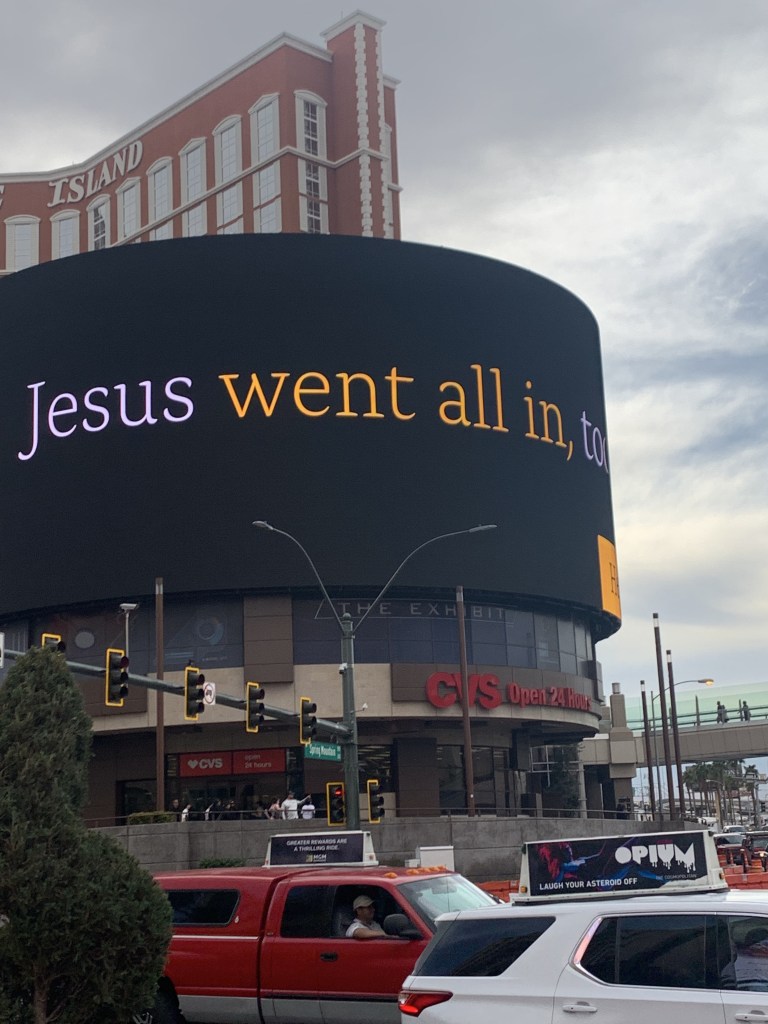
Jesus went all in, too.

Where East Meets West

 I live on a small island off a narrow strip of land known as the Outer Banks in North Carolina. These barrier islands are so narrow at parts that you can easily see the Atlantic Ocean to the east and the Pamlico Sound to the west without turning your head. At its most narrow part, the “east” is separated by the “west” by only 150 yards. When a storm hits, east waters meet west waters and close down the narrow two-lane road, cutting off the southern part of the island from the rest of civilization. This area may be one of the only places on earth where “east meets west” as it were.

The reality of east meeting west of course is that it never happens. If you travel east, you will continually be heading east around the globe. Such is the basis of David’s metaphor in our psalm today, as he celebrates that fact that “As far as east is from west—that’s how far God has removed our sin from us” (verse 12).

Psalm 103 (Common English Bible)

God won’t always play the judge;
he won’t be angry forever.
10 He doesn’t deal with us according to our sin
or repay us according to our wrongdoing,
11 because as high as heaven is above the earth,
that’s how large God’s faithful love is for those who honor him.
12 As far as east is from west—
that’s how far God has removed our sin from us.
13 Like a parent feels compassion for their children—
that’s how the Lord feels compassion for those who honor him.

Our sins have been banished to a place that doesn’t exist; thus we suffer them no longer. This reminder of the infinite nature of God’s saving love is a blessing when we have strayed from God’s will for our lives. David’s beautiful psalm is a strong assurance of the power of the cross to obliterate our sins. The price that Jesus paid with his life is our guarantee that past sins won’t inform our present relationship with God. As David says, God won’t be angry with us forever and doesn’t deal with us according to our sin. Indeed, God deals with us according to the measure of our confession and repentance. The power of the shed blood of the atonement is the criteria upon which we will be judged … thanks be to God! Mercy reigns.

But do we believe that, or do we cling to past sins and use them as a way of beating ourselves up over and over again? It is so easy to lay our sin at the foot of the cross and then pick it up again the next day. Repeated self-condemnation of past transgressions becomes the devil’s playground, as he whispers in our ears that we aren’t worthy.

God’s faithful love says otherwise. As far as heaven is above the earth, that is the measure of God’s forgiveness and love for us.

If you are caught in a cycle of unforgiveness of your past, ask yourself this: is your sin actually greater than Christ’s crucifixion? Do you really have that much power? Isn’t holding on to past regret a form of arrogance?

God invites us to truly let go of our past and walk cleanly into the future with hope for which his Son died. Anything less diminishes the cross.

As Far as the East is to the West by Amanda Williams

Life’s Too Short

 Life’s too short. 

How many times have you heard that or said that? 

Life’s too short, so eat dessert first. 

Life’s too short to stay angry at your spouse. 

Life’s too short, so spend the money now for that trip you’ve always wanted to take.

Life’s too short to be miserable all the time, so change your situation.

In this Psalm written by Moses, we see this theme in a different context. In his view, life’s too short and then you die. In the meantime, we experience God’s wrath and anger. Now that’s a sobering and discouraging thought! According to this Psalm, we toil and trouble all of our lives and in the end, we just fly away. Yikes!

Psalm 90 (Common English Bible)

Lord, you have been our help,
    generation after generation.
Before the mountains were born,
    before you birthed the earth and the inhabited world—
    from forever in the past
    to forever in the future, you are God.

You return people to dust,
    saying, “Go back, humans,”
    because in your perspective a thousand years
    are like yesterday past,
    like a short period during the night watch.
You sweep humans away like a dream,
    like grass that is renewed in the morning.
True, in the morning it thrives, renewed,
    but come evening it withers, all dried up.
Yes, we are wasting away because of your wrath;
    we are paralyzed with fear on account of your rage.
You put our sins right in front of you,
    set our hidden faults in the light from your face.
Yes, all our days slip away because of your fury;
    we finish up our years with a whimper.
10 We live at best to be seventy years old,
    maybe eighty, if we’re strong.
But their duration brings hard work and trouble
    because they go by so quickly.
    And then we fly off.
11 Who can comprehend the power of your anger?
    The honor that is due you corresponds to your wrath.
12 Teach us to number our days
    so we can have a wise heart.

13 Come back to us, Lord!
    Please, quick!
    Have some compassion for your servants!
14 Fill us full every morning with your faithful love
    so we can rejoice and celebrate our whole life long.
15 Make us happy for the same amount of time that you afflicted us—
    for the same number of years that we saw only trouble.
16 Let your acts be seen by your servants;
    let your glory be seen by their children.
17 Let the kindness of the Lord our God be over us.
    Make the work of our hands last.
    Make the work of our hands last!

But take a look again at the first two verses of this Psalm, which describe the image of God as our help in all generations. This indeed is a word of comfort. What does it mean to you to have God as your help? Moses assures us that from forever in the past to forever in the future, God doesn’t change. In the midst of toil and trouble, remembering that God is God (and we are not) helps tremendously. And his final plea for the kindness of the Lord to be over us ends this reading with a note of hope. We indeed want God’s glory to be seen by our children and to know that the labor of our hands and hearts will last. Even while feeling God’s wrath, Moses is aware of God’s mercy.

Moses appropriately calls attention to the “life’s too short” conundrum and brings a certain focus to the situation. It begs the question of what you intend to do with this too-short life. Can you answer that today? Life is too short. How are you going to number your days wisely? What changes should you make today to honor your commitment to the Lord before you go? Notice that Moses points out that God is angry when we sin and are disobedient…

The sobering tone of this Psalm is a call to self-examination and reflection. We are reminded to double check our sins and do some spiritual heart surgery where needed. We need to observe the acts of God and look for God’s glory in the midst of our behaviors. The brevity of our existence on earth need not be marred by God’s anger at our sin, especially when the remedy of repentance and forgiveness is so close at hand through Jesus Christ. Life is too short to carry the burden of unconfessed sin. We join Moses’ prayer that God’s kindness would be over us and allow our works to outlive our lives. We can count on God to be kind, even when we have not been.

So in this too-short life, we need to count our days and use them well. In this too-short life, we should seek wisdom and righteousness. Having acknowledged the anger that follows sin, we should strive every day of this too-short life to walk in holiness. Life’s too short for regrets.

What are you doing with your too-short life? Spend it well.

And eat the dessert first!

Come Back to us, Lord by Michelle Robertson

Hardness of Heart

A good friend is going through a difficult divorce, and she grieves the loss of her marriage, the loss of her friendship with her husband, and the loss of man he was when they married. As is the case in some hard breakups, her pleas for counseling and reconciliation are rejected. He has set his face on a course away from her and there is no turning back. In biblical terms, he has become calloused, and has “hardened his heart” against her.

This phrase comes up often in the Scriptures, as the people of God hardened their hearts against the law, the Word, the love, and the mercy that God extends. We are a stubborn lot, aren’t we? Isaiah describes it as the people “growing dull” and becoming hard of hearing, and what they do hear, they refuse to understand (Isaiah 6:9-10). God must feel like it is akin to raising rebellious teenagers all the time. 

There are few things in life that sting as hard as rejection. I’m sure you have felt that sting. I know I have! Paul dealt with rejection all the time and today’s reading is no exception. He had just delivered a day-long impassioned speech about the good news of Jesus Christ as the “hope of Israel,” and some believed … but some did not. Arguing ensued, and he was reminded of the prophet Isaiah’s words that described the same rejection of God’s Word thousands of years before.

Acts 28:25-31 (Common English Bible)

25 They disagreed with each other and were starting to leave when Paul made one more statement: “The Holy Spirit spoke correctly when he said to your ancestors through Isaiah the prophet,

26 Go to this people and say:
You will hear, to be sure, but never understand;
    and you will certainly see but never recognize what you are seeing.
27 This people’s senses have become calloused,
    and they’ve become hard of hearing,
    and they’ve shut their eyes
        so that they won’t see with their eyes
        or hear with their ears
        or understand with their minds,
            and change their hearts and lives that I may heal them.

28 “Therefore, be certain of this: God’s salvation has been sent to the Gentiles. They will listen!”

Both men concluded that we don’t receive God and all of God’s benefits because we don’t want to turn away from our lives and be healed of our sin. We don’t want to change our hearts and behaviors. Is this true in our world today? I think the evidence is there.

Is this true in your life?

Even committed, church-going Christians can reject God, if only in little ways. While we don’t reject our belief in Jesus as the Messiah-Savior, we reject God’s call to live in unity in our churches. We reject God’s call to love our neighbors as ourselves, with an emphasis on the neighbor who doesn’t look like us. We reject the Bible’s instruction to welcome the immigrant into our homes. We reject our responsibility to take care of the widows and orphans. We reject the invitation to have the mind of Christ when we post polarizing political rants on social media. We reject the command to obey the law when we speed, cheat on our taxes, and litter. Let’s face it … we reject God’s call to change our lives every day.

Today’s passage is a wakeup call for the heart. Is Paul describing us? Where is God calling us to change our hearts so that we may be healed?

May the Holy Spirit convict us so that we might repent and be pleasing in God’s sight.

Wake Up Call by Kathy Schumacher

Vow Renewal

 “To have and to hold from this day forward, for better, for worse, for richer, for poorer, in sickness and in health, to love and to cherish …” These common marriage vows form the foundation of a life-long solemn promise that two people make at an altar before God. There are other times in life where we take vows: doctors vow to do no harm; ministers vow to take God’s authority to preach the gospel; folks joining secret societies vow to hold things in confidence, etc.. Vows are serious business and should not be made lightly, but with integrity and a firm commitment.

In today’s reading, we see Paul taking and confirming the vow of a Nazarite. This was a unique consecration to God of one’s life and included abstinence from wine, not cutting one’s hair for a specified period of time, and never touching a dead body. Paul completed part of this vow and shaved his head in preparation for going to Jerusalem to burn his hair at the altar there. 

Acts 18:18-23 (Common English Bible)

18 After Paul stayed in Corinth for some time, he said good-bye to the brothers and sisters. At the Corinthian seaport of Cenchreae he had his head shaved, since he had made a solemn promise. Then, accompanied by Priscilla and Aquila, he sailed away to Syria. 19 After they arrived in Ephesus, he left Priscilla and Aquila and entered the synagogue and interacted with the Jews. 20 They asked him to stay longer, but he declined. 21 As he said farewell to them, though, he added, “God willing, I will return.” Then he sailed off from Ephesus. 22 He arrived in Caesarea, went up to Jerusalem and greeted the church, and then went down to Antioch.

23 After some time there he left and traveled from place to place in the region of Galatia and the district of Phrygia, strengthening all the disciples.

This put Paul in a very unique position with the Jews to whom he was preaching the Gospel. They understood the vows of the Nazarite as outlined in Numbers 6 and Paul’s actions were familiar and comforting. In a way, he was reminding them that he would always be a Jew but was now a Jesus-following Jew. His argument that Gentiles should not be required to perform Jewish rituals was balanced by his own respect and adherence to Jewish tradition, reinforcing that Jews could remain traditional while becoming followers of the Way of Christ.

Paul was a master diplomat!

What a wonderful example for us today as we join Paul in an effort to “strengthen all the disciples” (verse 23). Paul used every bit of his history, personality, and background to woo others to Christ. We can do the same.

 I am a former Navy wife, a Jersey girl, a runner, a reader, and a foodie. These are the tools I use to connect with people to make myself approachable. How about you? What is in your toolbox?

If you are a member of a United Methodist church, you took vows. You promised to support the church with your prayers, your presence, your gifts, your service, and your witness. That last vow is God’s invitation to use all that you have to witness to others about the good news of Christ in your life. Just as Paul witnessed to Jews and Gentiles alike, we are called to witness to people of all backgrounds in an effort to share this wonderful gift of Christ.

How are you living up to your vows? Are you faithful? God calls us to live out our vows with sincerity and joy. May we be faithful to the One who invited us.

Commitment by Kathy Schumacher