Psalm 95 The Warning

And now, the warning.

The first 7 lines of Psalm 95 are a joyful rendering of what it is like to gather together in an assembly of worshippers and bow humbly before God in worship and adoration. Indeed, God created us for worship and this natural outpouring of admiration and appreciation for our maker is the very least we can do. David highlights the blessings that come when we sing and shout for joy to our incomparable God.

Then his tone shifts with the admonition to “listen to God’s voice right now.” He refers to Meribah and Massah, two places where the children of Israel displayed open rebellion and mistrust of God’s plan to deliver them to the Promised Land. After the miracles God had bestowed on them, after helping them escape Egypt, after bringing them through the Red Sea, destroying Pharaoh and his army as they tried to pursue them, after everything God did through Moses to save the people, their response was rebellious, unbelieving, and dismissive. They rejected God’s intervention, complaining that they should have been allowed to either die in Egypt where at least they had food, or die right there in the wilderness.

God offered them the choice to take the Promised Land by faith, and they responded with hearts that were hard with unbelief.

Psalm 95 (Common English Bible)

If only you would listen to his voice right now!
    “Don’t harden your hearts
    like you did at Meribah,
    like you did when you were at Massah,
        in the wilderness,
    when your ancestors tested me
        and scrutinized me,
    even though they had already seen my acts.

God won’t suffer our rejection for long. Refusing God’s ways is a sign of a twisted heart that has gone astray. As Spurgeon put it, “be not willful, wanton, or repeatedly and obstinately rebellious.” God honored their choice and left them to perish in the wilderness as Joshua and Caleb entered the Promised Land.

10 For forty years I despised that generation;
    I said, ‘These people have twisted hearts.
    They don’t know my ways.’
11 So in anger I swore:
    ‘They will never enter my place of rest!’”

The question this poses for us today is, are you resisting God’s will for your life? Are you rebelling against his voice and refusing to hear him? Are you putting God to the test? Take a page from Israel’s book. Bow down in trusting acceptance and sing songs of joy, or rebel against God at your own risk. Listen to God’s voice right now.

The Promised Land by Lola Hilton

Trampling the Needy

Today’s lectionary passage is a bleak and resonant warning about neglecting the poor and need in our communities. Amos was called to rebuke and prophecy against this societal downfall. He was an 8th Century prophet who had been a fig farmer and shepherd before his calling. Israel had split into the Northern (Israel) and Southern (Judah) kingdoms by this time and he warned the people of the impending fall and destruction that was about to occur to both. He called out the ungodly practices that the people were engaging in with a denouncement of the breaking of God’s Law and God’s will.

In this passage, God’s instructions in Deuteronomy to take care of the poor and needy are specifically addressed. The people had become callous to those who lived on the fringes of society, whining and complaining about not being able to make money during the New Moon festival or the Sabbath. Their greed extended into cheating people by changing the weight of ephahs and shekels, deceiving folks with false balances on the scales.

Amos 8 (Common English Bible)

    Hear this, you who trample on the needy and destroy
        the poor of the land, saying,
    “When will the new moon
        be over so that we may sell grain,
        and the Sabbath
        so that we may offer wheat for sale,
        make the ephah smaller, enlarge the shekel,
        and deceive with false balances,
        in order to buy the needy for silver
        and the helpless for sandals,
        and sell garbage as grain?”

    The Lord has sworn by the pride of Jacob:
        Surely I will never forget what they have done.

The message is clear: God watches, God sees. And God will not forget. Indeed, both Israel and Judah fell to the Assyrians and the Babylonians, and many generations passed before they were restored to the land.

Now before we think more highly of ourselves than we should (to quote Paul), take a look again at this passage in The Message translation and see if any of it fits today’s society:

Listen to this, you who walk all over the weak,
    you who treat poor people as less than nothing,
Who say, “When’s my next paycheck coming
    so I can go out and live it up?
How long till the weekend
    when I can go out and have a good time?”
Who give little and take much,
    and never do an honest day’s work.
You exploit the poor, using them—
    and then, when they’re used up, you discard them.

7-8 God swears against the arrogance of Jacob:
    “I’m keeping track of their every last sin.”

Does God swear against us as well? Are we guilty of focusing on our Friday paycheck for our weekend indulgence while we ignore the poor around us? Are we as a people walking all over the weak and using up the poor just to discard them? What does this say about migrant workers, people on welfare, our funding of Medicare, and our care of the vulnerable?

God’s word is clear. He is keeping track.

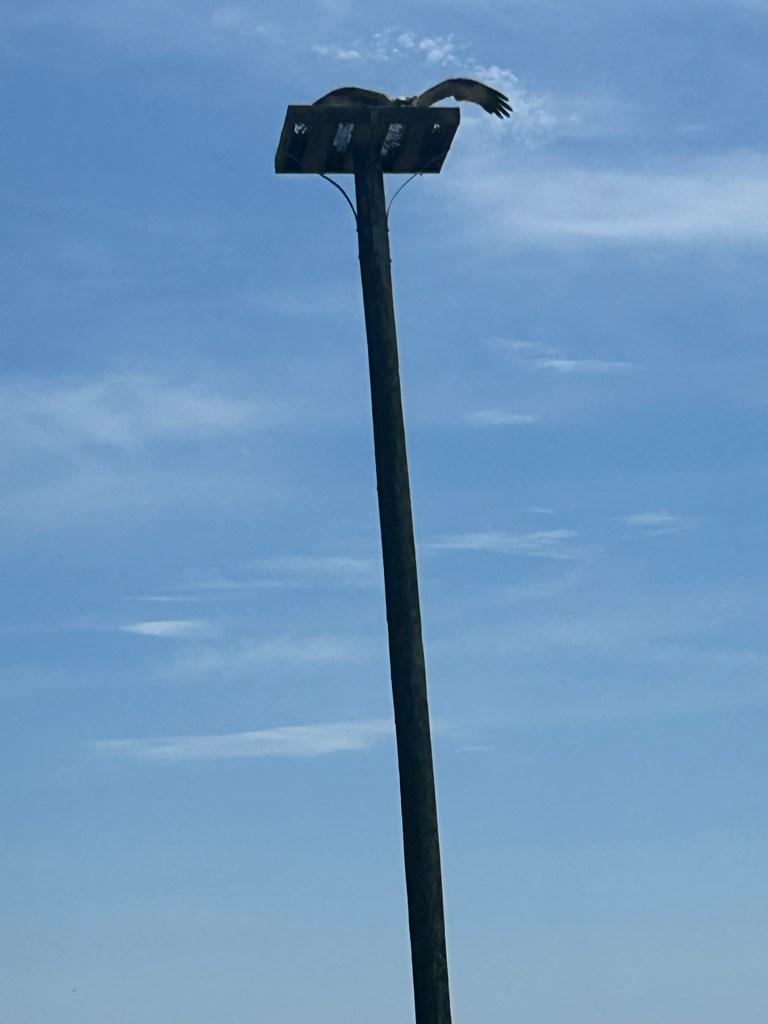
Osprey Watching Over Colington

Watch Out

Last week I went for a run down a wide path that borders a golf course. I spotted a sign placed beneath a row of tall trees that warned, “WATCH OUT! Aggressive nesting hawks overhead!” Well, that will catch your attention! It was hard to keep my eyes on my feet (I am well known for tripping on a run) and on the trees overhead as I watched for these alleged aggressive hawks. I’m happy to report that I did not encounter any on the run, but it did make me very alert until I got out into the open again. Then I began to wonder what happened that made the golf course post such a sign….yikes!

In our passage in Jeremiah today, the prophet begins with a very clear warning:

Jeremiah 23 (Common English Bible)

23 Watch out, you shepherds who destroy and scatter the sheep of my pasture, declares the Lord. This is what the Lord, the God of Israel, proclaims about the shepherds who “tend to” my people: You are the ones who have scattered my flock and driven them away. You haven’t attended to their needs, so I will take revenge on you for the terrible things you have done to them, declares the Lord. 

This is far worse than attacking hawks. God ain’t playin’.

I myself will gather the few remaining sheep from all the countries where I have driven them. I will bring them back to their pasture, and they will be fruitful and multiply. I will place over them shepherds who care for them. Then they will no longer be afraid or dread harm, nor will any be missing, declares the Lord.

As scary as this warning sounds, it is actually a hopeful message from the prophet. Let’s put it into context. Biblegateway.com offers this word of explaination:

The prophet Jeremiah saw Israel morally disintegrating and being destroyed militarily by its enemies. He saw Babylon attack Jerusalem in 586 BC and many of its people exiled to foreign lands. According to the NIV Quest Study Bible, Jeremiah’s grim prophecies, in both poetry and prose, continually warned Judah about God’s approaching judgment because of the people’s constant, willful disobedience.

Yet intermingled with all the dark messages were words of hope about Judah’s future redemption. Watch for Jeremiah’s encouragement—prophecies that are still being fulfilled today whenever sinful hearts are transformed by God.

And so the warning becomes a promise that things will be restored according to God’s plan for restoration:

Promise of a righteous and just king

The time is coming, declares the Lord, when I will raise up a righteous descendant from David’s line, and he will rule as a wise king. He will do what is just and right in the land. During his lifetime, Judah will be saved and Israel will live in safety. And his name will be The Lord Is Our Righteousness.

And then came Jesus.

God will always restore his children to righteousness. When those who are chosen to lead fail to protect their flocks, they will be removed and replaced. This is a vital warning today to all of our leaders, including our elected officials, bishops, pastors, Bible Study teachers, etc. Shepherding the people of God is serious business, and those who are greedy, immoral, or abuse their power for personal gain will receive the wrath of the Lord. And the sheep need to behave themselves, too.

Whenever our sins put us in a season of destruction or judgment, remember this word of hope. God is actively working in our situation to bring us to full restoration…you can count on that! Jesus is the restoration-giver. Open your heart and let him in, and you will be saved. He will give you a future with hope.

Hawk Cloud by Bonnie Bennett