Advocacy

Have you ever found yourself in a situation where you had to speak out as an advocate for justice? I recently talked with a mother who attended several meetings at her son’s school in an attempt to be his advocate. Taking a stand against preexisting rules and calling for fairness was a challenge for her. But there are times when we cannot be silent and must take action.

The United Methodist Church has a long history of justice advocacy. John and Charles Wesley visited prisoners and tutored local neighborhood children. As the early church grew, our work shifted to opposing things like slavery, smuggling, inhuman prison conditions, alcohol abuse, and child labor. Today you can find United Methodists working, marching, and speaking out on current justice issues such as environmental care, racial justice, and full-inclusion matters.

We take our example from the work of our Lord. Today’s passage reveals Jesus going up against the establishment in order to advocate for a man’s health and well-being. Notice that the Pharisees were watching him closely as he did this.

Luke 14 (Common English Bible)

14 One Sabbath, when Jesus went to share a meal in the home of one of the leaders of the Pharisees, they were watching him closely. A man suffering from an abnormal swelling of the body was there. Jesus asked the lawyers and Pharisees, “Does the Law allow healing on the Sabbath or not?” But they said nothing. Jesus took hold of the sick man, cured him, and then let him go.He said to them, “Suppose your child or ox fell into a ditch on the Sabbath day. Wouldn’t you immediately pull it out?” But they had no response.

The fact that Jesus was in the home of the Pharisee leader and the man with dropsy was also there suggests that he was a guest as well. Do you think it might have been a set up to see if Jesus would break the sabbath law? I do. What they failed to realize was that Jesus was much more conversant in the commandments than they were. There was no prohibition against healing on the Sabbath or pulling your ox out of a ditch for that matter. The “law” was something the establishment had conjured up. Jesus was right and righteous in this matter. He questioned their understanding of the law, but they refused to respond. He answered them by responding to the question and taking action in one single moment. That’s what advocates do: They answer and act.

Where are you being called to answer to justice and act in advocacy? How can you respond to this text today the way Jesus would respond? Whatever God tells you to do, go and do it. That’s exactly what Jesus did.

New Day Rising by Michelle Robertson

Holy Bread

I recently visited the church I served for 16 years and ran into a young woman who had been a child when I was there. She and my daughter were friends and often hung around after church to help clean up. She smiled as she shifted her new baby to her other hip and told me she remembered how much she loved helping me clean up communion, since they got to finish all the bread that was left over. Because the elements had been consecrated at the altar, we had a practice of either eating the rest of it or offering it to the birds outside the sacristy door. Our holy bread was never thrown away. When the communion coordinator switched to Hawaiian Bread, the birds got left out. I had more kids helping “clean up” than I needed! A wonderful core memory was made for all of them, and many of them still worship in that church today as adults.

In our Scripture today, David is on the run from Saul, who has descended into a delusional paranoia and is out to have David killed. David knew where to go when he was in trouble. He went straight to the house of God and sought the assistance from the priest Ahimelech. He told a lie to get in, though, by pretending that he was on the king’s mission rather than running for his life away from the king.

1 Samuel 21 (Common English Bible)

21 David came to Nob where Ahimelech was priest. Ahimelech was shaking in fear when he met David. “Why are you alone? Why is no one with you?” he asked.

David answered Ahimelech the priest, “The king has given me orders, but he instructed me, ‘Don’t let anyone know anything about the mission I’m sending you on or about your orders.’ As for my troops, I told them to meet me at an undisclosed location.Now what do you have here with you? Give me five loaves of bread or whatever you can find.”

David knew that the Tabernacle had a table that held 12 loaves of “show bread” that was a symbol of God’s continuing fellowship with Israel. “Show Bread” is also known as the “bread of faces” or the “bread of presence.” It was to be eaten in front of God as a guest and friend of God’s hospitality. It was typically consumed by the priests, but Ahimelech offered the bread to David because he and his troops were hungry. But first the priest inquired about the ceremonial cleanliness of the troops, as this was holy bread and not to be consumed casually. David assured them that none of them had been with women while on their holy mission, and so the bread was given. This brings up a question for us today. Do you prepare yourself for communion by cleansing yourself of your sins first? Do you offer confession and pray for forgiveness? So often the ritual overtakes us and communion just becomes something we do on the first Sunday of the month.

So the priest gave David holy bread, because there was no other bread except the bread of the presence, which is removed from the Lord’s presence and replaced by warm bread as soon as it is taken away.

Jesus mentioned David eating the showbread when he and his disciples were criticized by the Pharisees for plucking and eating raw grain on the sabbath. In Matthew 12, he reminded the Pharisees that the priests carry out their Temple duties on Sabbath just as any other day and are still innocent.

We are reminded in this passage today that meeting human needs as they arise is more important than adhering to religious observances and rituals. Eating together, especially when people are truly hungry and need to be fed, is the way we form bonds of friendship that are sacred and can become permanent. Like the young mother who was back in church with her child remembering the sweet flavor of left-over communion, we can make life-long connections with people over a shared morsel. How will you share your bread with someone today?

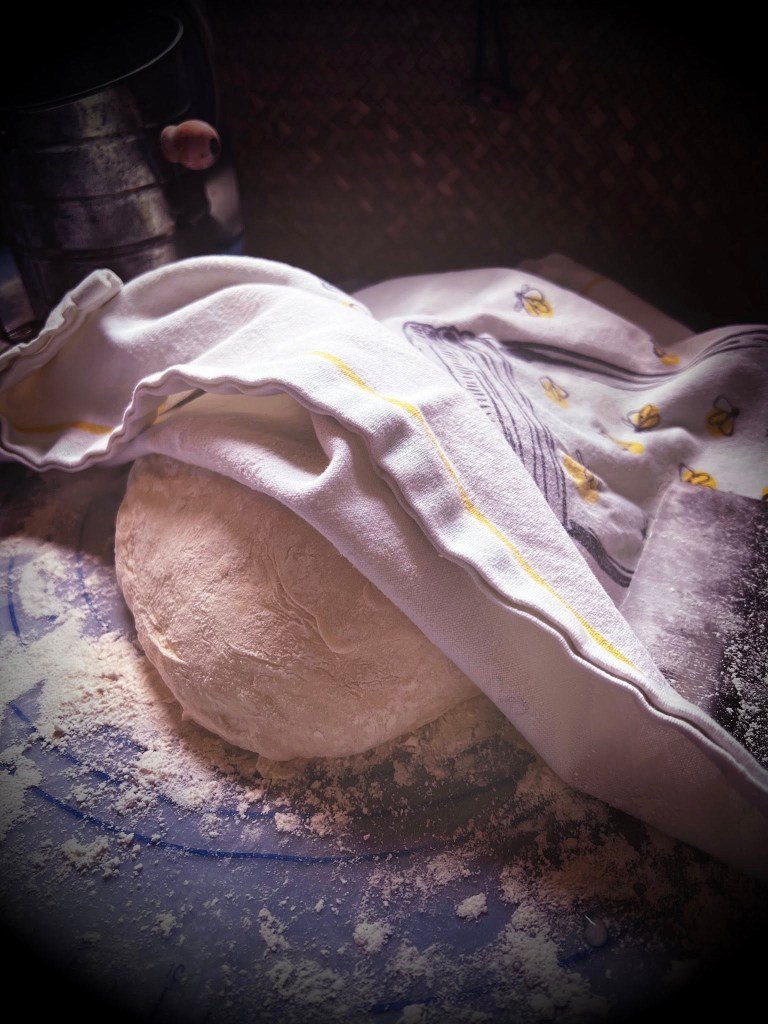
Show Bread by Becca Ziegler