First of All

When I was pregnant with my first child I craved two things: Fresh grapes and orange soda. Luckily for me, we lived in California at the time, so both were readily available. I had a friend in my church choir named David who was still an active private pilot at age 80. One Sunday he arrived at the church with a large bag of grapes, freshly picked from a vineyard about 100 miles north of us. He had remembered my crazy desire for grapes and had flown up the day before to visit his friend’s vineyard and bring some back for me. It was an act of pure, sacrificial love and I have never tasted grapes that were as fresh, good, juicy, and satisfying. They tasted like sweet balls of liquid sunshine. Those grapes were the Firstfruit of the harvest of our friendship and the memory of that offering still blesses me today.

Paul likened Jesus to the Firstfruit of the harvest of those who died in our passage today. We remember from Leviticus 23:9-14 that the nation of Israel was directed to bring the Firstfruit of offering to the temple in the form of a single, perfect sheaf of wheat. This grain offering represented and anticipated the rest of the harvest and sacrifices to come. The Feast of Firstfruits was established to be observed on the day after the sabbath following Passover as a reminder to the people that everything they had was a provision given by God. Returning back to God a small but flawless portion of the harvest fruits was a way of demonstrating their appreciation for God’s goodness in all things. 

1 Corinthians 15:20-24 (Common English Bible)

2But in fact Christ has been raised from the dead. He’s the first crop of the harvest of those who have died. 21 Since death came through a human being, the resurrection of the dead came through one too. 22 In the same way that everyone dies in Adam, so also everyone will be given life in Christ. 23 Each event will happen in the right order: Christ, the first crop of the harvest, then those who belong to Christ at his coming, 24 and then the end, when Christ hands over the kingdom to God the Father, when he brings every form of rule, every authority and power to an end.

Jesus’ resurrection represents the Firstfruit of the Second Coming, as Jesus will return in his resurrection body to claim those who belong to him. Not coincidentally, Jesus’ resurrection fell on the first day of the Feast of the Firstfruit.

At his Second Coming, all who are dead will rise and share in his resurrection (Romans 6:5). When all things are restored through him, our Lord will then present his Kingdom to God, bringing all earthly authority and power to an end. Oh, how we long for that day! This will fulfill God’s eternal purpose of re-establishing fellowship with God as we are gathered, heaven and earth, into one people. Finally we will be home with our Lord and under his reign.

Meanwhile, we wait. What first fruit of your resources, time, and effort can you bring to the altar? Where will you offer your gift of sacrifice so that the Kingdom of God might grow and flourish until Jesus returns? Is God calling you into the harvest?

Say yes.
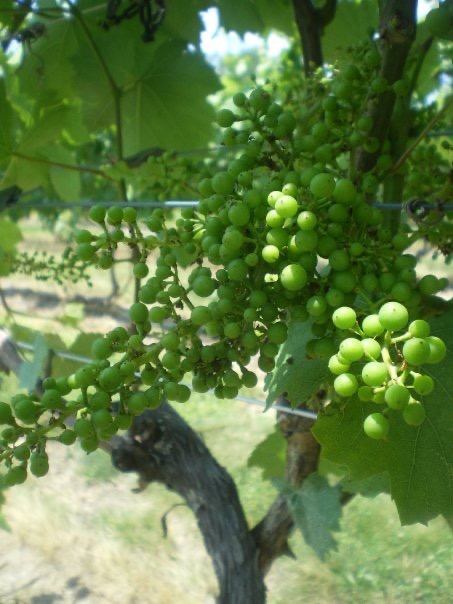
Let There Be Grapes by Becca Ziegler

The Promise of Joy

Let’s start today’s devotional with a riddle. Question: A cowboy rides into town on Friday and stays for three days. He rides out on Friday. How is this possible?

Answer: His horse’s name is Friday.

Groan!

Today’s reading is like a stepping into a riddle that Jesus gave his disciples just before the events of the crucifixion took place. Question: How can Jesus promise that in a little while they will no longer see him but then again in a little while they will see him? Answer: Jesus will be crucified and die, and so they won’t see him. But then he will be resurrected, so they will see him again, and their joy will be made complete. That joy will be so sure, nobody will be able to take it away from them, or us, ever again.

John 16:17-22 (Common English Bible)

17 Some of Jesus’ disciples said to each other, “What does he mean: ‘Soon you won’t see me, and soon after that you will see me’ and ‘Because I’m going to the Father’? 18 What does he mean by ‘soon’? We don’t understand what he’s talking about.”

19 Jesus knew they wanted to ask him, so he said, “Are you trying to find out from each other what I meant when I said, ‘Soon you won’t see me, and soon after that you will see me’? 20 I assure you that you will cry and lament, and the world will be happy. You will be sorrowful, but your sorrow will turn into joy. 

21 When a woman gives birth, she has pain because her time has come. But when the child is born, she no longer remembers her distress because of her joy that a child has been born into the world. 22 In the same way, you have sorrow now; but I will see you again, and you will be overjoyed. No one takes away your joy.

 Of all of God’s promises to us, this promise of eternal life through the birth, death, and resurrection of Christ is the one we can count on the most. There is no riddle to this. This promise comes with a washing away of our sins that is so complete we are made into a new creation. This promise comes with the guarantee that the troubles and the burdens of this world will be lifted from us, and we will walk in the purity of God’s grace. This promise comes with the certainty that we will sit at Jesus’ feet in eternity and bask in the glow of his teachings. This promise seals us as children of God. 

And so the sorrows of the world will be turned into joy. Notice that the promise is not that sorrow is replaced by joy, but it will be changed into joy, which carries with it the promise of being able to forget what the sorrow even was once it is no more. Like a mother in labor, the pain and sorrow of giving birth turns into the joy of holding a new life in your arms. This was my experience, and I was grateful for the “obstetrical amnesia” that turned pain into joy, … which was the only reason I had a second child!

What does this say to you today? Are you carrying a deep sorrow that you desperately need to turn over to the Lord? Jesus’ promise that he would see his disciples again turned out to be true. When he appeared to them in the Upper Room and on the shore of the sea of Tiberias, they were filled with a permanent joy that obliterated all of their sadness and confusion at his death. It is important to note that none of them ever wrote about Jesus’ death with regret. Their words reflect the great joy that the resurrection brought to the world. There is no riddle in that.

One of Jesus’ last promises was that he will be with us always, even to the end of the earth. That is one promise we can count on. Jesus is here; Jesus is near; bring your sorrow to him that you may find joy.

Waves of Joy by Michelle Robertson