Remnant Theology

Someone long ago planted a group of jonquils in front of my mailbox. It predates my arrival here, which happened eleven years ago. Every spring they pop up with their cheerful faces and strong pronouncement that winter is over and we can turn our faces toward summer. This gift of foresight on someone else’s part is always welcome. For most of the year, that patch of ground is empty and desolate. My neighbor once told me that the entire mailbox was once ringed with jonquils. Now only this one patch remains, and I am grateful.

In reading the Bible from Genesis to Revelation, we encounter something known as “remnant theology.” This describes God’s practice of taking a land, a society, or a whole nation down to almost nothing and then restoring a small percentage back after a period of desolation. Think of Noah’s family after the flood…it was up to them to replenish and repopulate the world when they finally came upon dry land. They were God’s remnant.

In the sixth chapter of Isaiah, we see God preparing Isaiah to speak a word of doom into a hopeless situation. The nation had fallen hard into apostasy, and their impending disaster was upon them. Isaiah was called to preach to a group of people who were too calloused and hard-headed to hear him, and the length of his service would be determined by how long it would take for them to turn with their hearts and seek God’s healing:

Isaiah 6 (Common English Bible)

God said, “Go and say to this people:

Listen intently, but don’t understand;
    look carefully, but don’t comprehend.
10 Make the minds of this people dull.
    Make their ears deaf and their eyes blind,
    so they can’t see with their eyes
    or hear with their ears,
    or understand with their minds,
    and turn, and be healed.”

But even in the midst of this proclamation, God offers the hope of a remnant that would provide a holy seed for the rebuilding of Israel.

11 I said, “How long, Lord?”

And God said, “Until cities lie ruined with no one living in them, until there are houses without people and the land is left devastated.” 12 The Lord will send the people far away, and the land will be completely abandoned. 13 Even if one-tenth remain there, they will be burned again, like a terebinth or an oak, which when it is cut down leaves a stump. Its stump is a holy seed.

The dichotomy of a God who destroys and a God who restores is striking. His mercy is always balanced with his judgment, and remnant theology teaches us that mercy always prevails, thanks be to God! God always leaves behind a holy seed.

If you are in a season of desolation and judgment, remember Isaiah. In the beginning of this passage, he declares that seeing God seated on the throne surrounded by flying seraphs had rendered him “undone.” Sometimes it takes a holy undoing before we can be restored to what we were are meant to be…holy, cleansed, called, and redeemed.
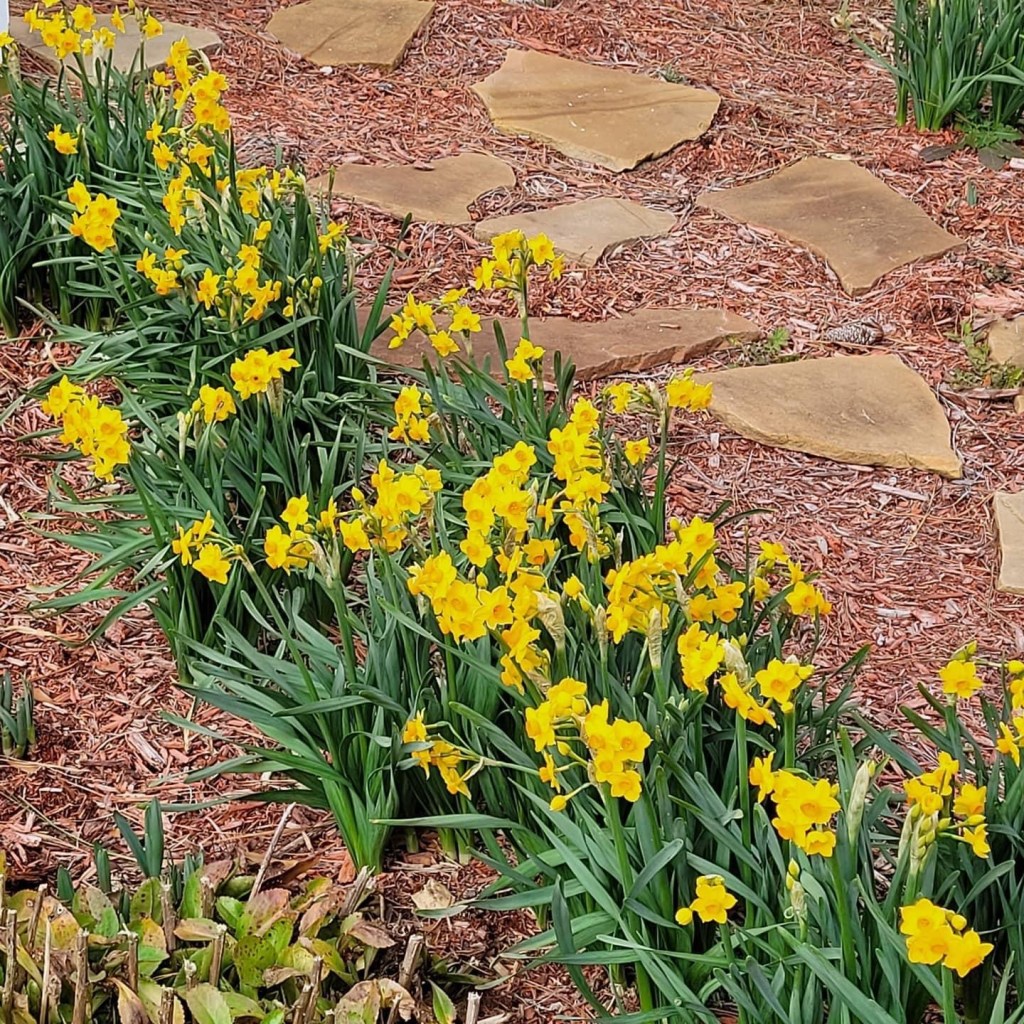
Gold Daffodils by Jan Wilson

The 120

A few years ago I became enamored of a television show called The 100. I love all things science fiction and this really captured my imagination. The premise was based on the earth’s apocalypse and the survival of humankind. After a devastating nuclear event rendered earth uninhabitable, a group of people fled to an orbiting space station. Three generations later, the space station’s life support system began to fail, and so a plan was devised to send one hundred delinquent juveniles back to earth to see if life can now be maintained. From this small number, civilization begins to regroup. They are eventually successful after seven seasons of twists and turns.

This premise is biblical in two ways. First, it supports “remnant theology,” which teaches us that God always preserves a remnant of humanity for the future. We see this from the Genesis flood narrative to the diaspora stories in the Old Testament. The New Testament picks up the theme when a band of twelve becomes a global movement. Second, it reminds us that God uses small seeds to reap great harvests. His faithfulness to us is evident all throughout the Bible.

This show came to mind this morning when I read the scripture assignment for today. Right away the number one hundred twenty jumped out at me. I love reading about the early formative days of the church, and today is no exception to the wonderment of it all. Think of it: at one point, we were only one hundred twenty strong as a church of Christ-followers. A quick Google search reports that the number today is 2.3 billion.

From tiny beginnings, great things grow!

Acts 1 (Common English Bible)

15 During this time, the family of believers was a company of about one hundred twenty persons. Peter stood among them and said, 16 “Brothers and sisters, the scripture that the Holy Spirit announced beforehand through David had to be fulfilled. This was the scripture concerning Judas, who became a guide for those who arrested Jesus. 17 This happened even though he was one of us and received a share of this ministry.”

I appreciate the Common English Bible’s use of the word “family.” It is comforting to remember that at one time, those who loved Jesus and his message were a family. I doubt that the same thing would be said of us today. Our extreme denominationalism has fractured us into disparate entities. Competition, resistance to opposing view points, and our tendency to erect walls around our doctrinal beliefs have rendered us incapable of functioning as a whole unit of believers.

21 “Therefore, we must select one of those who have accompanied us during the whole time the Lord Jesus lived among us, 22 beginning from the baptism of John until the day when Jesus was taken from us. This person must become along with us a witness to his resurrection.” 23 So they nominated two: Joseph called Barsabbas, who was also known as Justus, and Matthias.

24 They prayed, “Lord, you know everyone’s deepest thoughts and desires. Show us clearly which one you have chosen from among these two 25 to take the place of this ministry and apostleship, from which Judas turned away to go to his own place.” 26 When they cast lots, the lot fell on Matthias. He was added to the eleven apostles.

In selecting a new apostle, the eleven prayed for discernment and left the decision to God. They knew that he would examine the thoughts and desires of the candidates and would reveal his choice in the casting of lots. By this method, the integrity of their group would be maintained…and from that tiny band of twelve, many would join and the numbers would grow.

The challenge for us today is to realize that in our warring of ideologies, we would do well to simply pray for discernment and leave the decisions to God. People too quickly weigh in on all kinds of issues that are better left to prayer. Where is God calling you to water, rather than uproot, the seeds he has planted? Do you really have the full picture of the garden he laid out thousands of years ago? Who is the Master Gardener?

It is a matter of “trust, and obey.” And pray.

Lemon Tree by Bev Mineo