The Value of Zero

A young mother was teaching her preschool age son about the value of zero by showing him apples. “If you have zero apples and I give you two, how many apples do you have?” “Two!” he exclaimed. “Yes, and if you have two apples and I take away two apples, how many apples do you have?” He frowned. “No apples?” “Right,” she replied. “Two take away two is zero.” He went off to play for a while and came back about ten minutes later. “But Mama, ” he said with some urgency, “why did you take away all my apples?”

Why, indeed?

I wonder if this is how the people of Israel felt about the Promised Land. God led them out of slavery in Egypt and into the Promised Land after clearing away all the Canaanites so that Israel could prosper. Like a vine, they had been transplanted there to take deep root and flourish for many years:

Psalm 80 (Common English Bible)

8You brought a vine out of Egypt.
    You drove out the nations and planted it.
You cleared the ground for it;
    then it planted its roots deep, filling the land.
10 The mountains were covered by its shade;
    the mighty cedars were covered by its branches.
11 It sent its branches all the way to the sea;
    its shoots went all the way to the Euphrates River.

This is one of several instances in the Old Testament when Israel is referred to as a vine (see Deuteronomy 32: 32-33, Isaiah 5:1, Jeremiah 2:21, and Hosea 10:1). Jesus referred to himself as the True Vine in John 10:15. (Read my devotional on this passage here.) Psalm 80 begins with a celebration of the power of the vine’s growth, but it’s dominance over the land is short-lived.

The vine’s devastation began with the fall of the southern Kingdom in 586BC, and soon the northern kingdom would fall in 721BC. This psalm is written between the two events, and we can feel the anguish of the psalmist as he watched his beloved Israel plucked up, torn down, and scattered far away:

12 So why have you now torn down its walls
    so that all who come along can pluck its fruit,
13     so that any boar from the forest can tear it up,
    so that the bugs can feed on it?

The great sin of the nation caused this to happen. They had turned their backs on God and worshipped false idols. Because of their apostasy, God allowed invading nations to come and take them from plentiful abundance to absolute zero. The vine that had been planted by God’s own hand was chopped down into nothing.

14 Please come back, God of heavenly forces!
    Look down from heaven and perceive it!
Attend to this vine,
15     this root that you planted with your strong hand,
    this son whom you secured as your very own.
16 It is burned with fire. It is chopped down.
    They die at the rebuke coming from you.
17 Let your hand be with the one on your right side—
    with the one whom you secured as your own—
18     then we will not turn away from you!

The psalmist reminds us where we can go when our sin has left us with nothing and our life has taken on the quality of zero. Just as he reminded God of the fact that God had loved Israel enough to call them his own, he reminds us that we, too can approach the throne of grace in humble repentance and ask for restoration.

Revive us so that we can call on your name.
19     Restore us, Lord God of heavenly forces!
    Make your face shine so that we can be saved!

Only God could revive the nation, and only God can revive us. He is the Shepard of Israel who can replant and restore the vine in us. God’s deliverance comes through his son, Jesus Christ, the True Vine. We are Christ’s branches and we bear witness to the strength of God’s forgiving grace. When we come before him and ask to be saved, God forgives us. After all, the True Vine was born to take away the sins of the world.

And that is the best take away of all.

Sunshine Vine by Michelle Robertson
Rescue Me

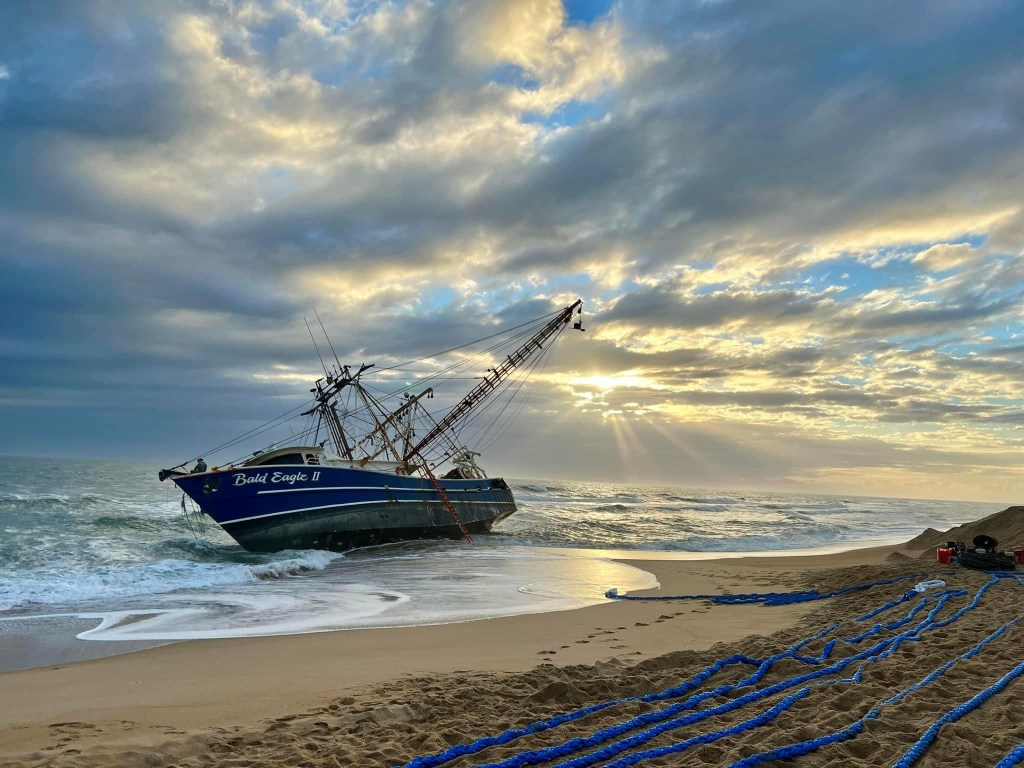
As you look at this picture, you will instantly notice that something has gone very wrong. A shrimp trawler named Bald Eagle II, traveling north from our neighboring town in Wanchese, lost its engines a week ago and drifted onto the shoals of this sandbar that we live on. The tide carried it right to the water’s edge, where it remained stuck on our beach for days.

Our heroic Coast Guard performed a dramatic rescue of the four crew members, pulling them from the dangerous boat one by one, by helicopter. Four men were saved. Then came the arduous task of having to carefully remove over 6500 gallons of fuel and an additional 1000 gallons of a watery oil mixture.

Think for a moment of the difficulty of saving this boat. Look at how it sits on the sand. Now think about how difficult it was to save humanity. The prophets remind us that people had fallen into sin and darkness beginning with Adam and Eve in the garden. This darkness overcame the world, and we needed a miracle to save us.

Today’s lectionary passage is a pre-Christmas reminder of why Jesus came to save us. In this Psalm, God is portrayed as both the Shepherd of Israel and the One whose face shines “so that we may be saved.” It is a good prayer for us as we slowly approach the birth of Christ and recall once again why he came. Christ was born to rescue us … because we could not rescue ourselves.

Psalm 80 (New Revised Standard Version)

Give ear, O Shepherd of Israel,
    you who lead Joseph like a flock!
You who are enthroned upon the cherubim, shine forth
    before Ephraim and Benjamin and Manasseh.
Stir up your might,
    and come to save us!

This is a psalm of Asaph which is thought to be written after the separation of the Northern Kingdom of Israel and the Southern Kingdom of Judea. The references here make it clear that the psalmist is asking God to save Israel, and so it is believed to have been written prior to the Assyrian take over in 721BC.

Restore us, O God;
    let your face shine, that we may be saved.

When God’s face shines, darkness and despair are obliterated. When Jesus came, he was described as the ”Light of the World,” dispelling darkness forever.

O Lord God of hosts,
    how long will you be angry with your people’s prayers?
You have fed them with the bread of tears,
    and given them tears to drink in full measure.
You make us the scorn of our neighbors;
    our enemies laugh among themselves.

Asaph knows that the apostasy and sin of the people have brought about their predicament. He senses God’s anger in what is about to happen, as Israel will fall into the hands of the enemy.

Restore us, O God of hosts;
    let your face shine, that we may be saved.

I am happy to report that the story of the Bald Eagle II has a much better ending. A small tug boat was dispatched, and it was able to move the trawler at high tide, taking it out to sea to a safe harbor where it can be repaired. Don’t you just love a happy ending?

You can have a happy ending, too. God is waiting for you to be fed up enough with your own darkness to cry out for rescue. Are you stuck in bad habits, inappropriate choices, or just plain out of hope? Call out for Jesus to come and rescue you. Your savior is on the way.

Rescue Me by Jennifer Thompson

Bread of Tears

Have you ever been down about something and then instantly felt better when you learned that a friend experienced the same thing? When you’re upset, it feels good to know that you’re not alone. A brief exchange of “yeah, me too” can result in a healing catharsis. I recently had a conversation with a colleague who was responding to a crisis with calm assurance. His response aligned with my perspective on the issue. It greatly lessened my anxiety to know I was not alone in my thinking.

I had a catharsis this morning when I read Psalm 80. We have just turned the church calendar over and this is the first week of the new year. Readings are now coming from Year B, in case you are keeping track.

This Sunday is the first Sunday in Advent. Our worship would normally be filled with lights, carols, acolytes, special readings, Advent wreath candle lighting, etc. as we prepare for Christmas. But many of our sanctuaries are still closed, or operating at half-capacity with a lot of Covid modifications, including no singing. Nothing feels the same.

I don’t know where the psalmist was when he penned these words, but emotionally, he was right where we are this week:

Psalm 80 (New Revised Standard Version)

Give ear, O Shepherd of Israel,
    you who lead Joseph like a flock!
You who are enthroned upon the cherubim, shine forth
    before Ephraim and Benjamin and Manasseh.
Stir up your might,
    and come to save us!

Restore us, O God;
    let your face shine, that we may be saved.

This is a poignant prayer for right now. We long to be restored and saved.

In the next line, the psalmist responds to what he perceives is God’s anger against the nation of Israel. Do you relate to this? Do you think the pandemic and all of our nation’s issues are a result of God’s anger?

O Lord God of hosts,
    how long will you be angry with your people’s prayers?
You have fed them with the bread of tears,
    and given them tears to drink in full measure.
You make us the scorn of our neighbors;
    our enemies laugh among themselves.

I don’t think that God is punishing us, but I have felt as though we have been eating a steady diet of bread made of tears. I just wish we could push back from the table and leave. I know that this will end…of that, I am sure. But how long, Lord?

Restore us, O God of hosts;
    let your face shine, that we may be saved.

Friends, God’s face is already shining on us. Even with the rising numbers, we are seeing advancements in medical science. Hope is at hand. Our race toward a vaccine, combined with staying home, is bringing us closer to the end. The God of hosts is in the process of saving us. And guess what? We’re one day closer to the end of this thing.

God’s Face Will Shine by Kathy Schumacher