Do Not Disturb
Kids really do say the darnedest things.
We took our grandkids to LEGOLAND in Florida while their mother started school a week before they did. This has been our family tradition for four years now. We stay in a large room with a kid side with bunkbeds and an adult side with a big bed. The kid side is near the door.
We showed them how we put the DO NOT DISTURB sign on the door at night to let housekeeping know in the morning that we are still inside. After the first night, the oldest came to us with a major complaint; nobody had obeyed the sign. At first I thought housekeeping had knocked early in the morning and we didn’t hear it from our side of the room but he want on to explain that all night long he could hear kids running up and down the halls and being noisy. “They did not obey our DO NOT DISTURB sign!!’
Oh, my. If only it was that easy.
Do you ever wish you could hang a big Do Not Disturb sign on the doorknob of your life?
I think we’re disturbed all the time. We are disturbed by the cacophony of the upcoming mid-term elections, election tampering, threats to our democracy, mudslinging political ads, and outright bullying, forgetting that God honors truth and fairness among his children.
We are disturbed by the horrific images of mistreatment of vulnerable immigrants, forgetting that we, too, were once slaves in Egypt and that God so loved the entire world that he sent his son to save the entire world, not just a select few.
We are disturbed by the despicable actions of seven entitled frat boys who viciously helped themselves to a young woman’s unconscious body, forgetting that all people are made in the image of God. Even women.
We are disturbed by seeing evidence of pollution and climate change that are destroying our world, forgetting that it was God who created this beautiful earth for the benefit of all humanity, trusting us with its care and stewardship.
We are disturbed by the thoughtless, careless, biting and wounding words slung like fiery arrows on social media, forgetting that Scripture teaches us to tame our tongues.
We are disturbed.
During David’s reign, the Sons of Korah served as a liturgical choir, expressing the distress of being disturbed by their circumstances. They wrote and sang this psalm with the calm reassurance that even in the darkest moments, God is still our saving presence:
Psalm 42 ( Common English Bible)
Just like a deer that craves streams of water,
my whole being craves you, God.
2 My whole being thirsts for God, for the living God.
When will I come and see God’s face?
3 My tears have been my food both day and night,
as people constantly questioned me,
Where’s your God now?”
4 But I remember these things as I bare my soul:
how I made my way to the mighty one’s abode,
to God’s own house,
with joyous shouts and thanksgiving songs—
a huge crowd celebrating the festival!
5 Why, I ask myself, are you so depressed?
Why are you so upset inside?
Hope in God!
Because I will again give him thanks,
my saving presence and my God.
Hope in God. It is all we can do. And God never, ever fails.
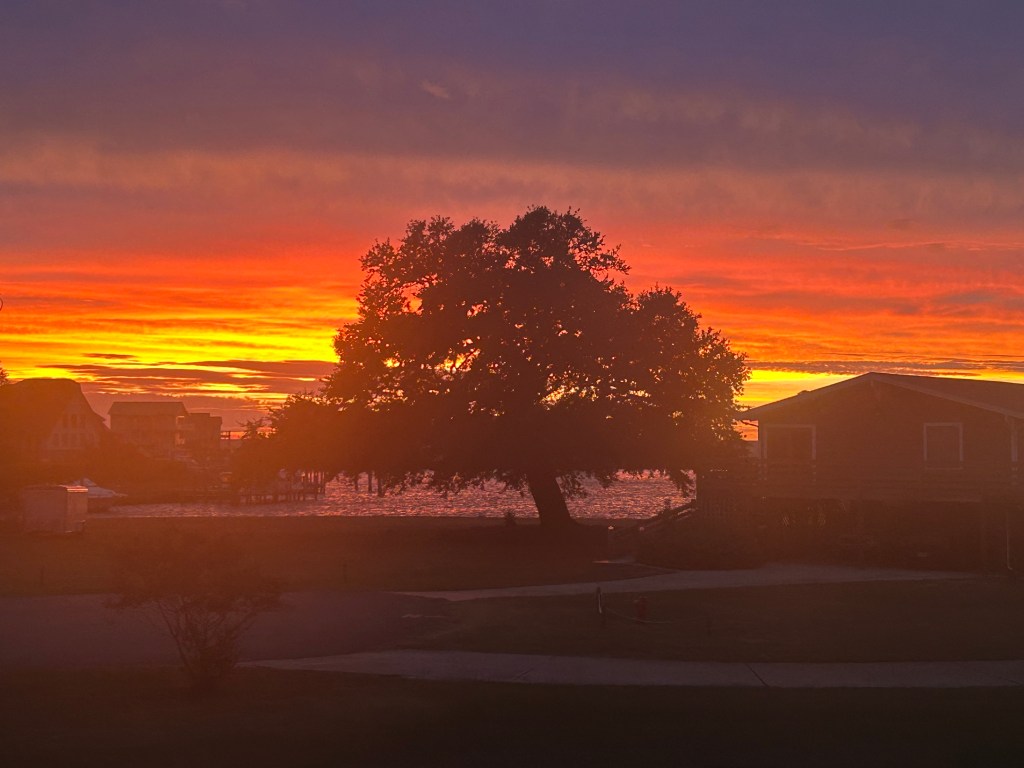
Sunset after the Nor’ Easter