Perkatory

Back before Keurigs, way before Starbucks, even before drip coffee makers with automatic shut-off switches, there was an ancient device known as a percolator. You might run across this historical artifact today in an antique store, the pawn shop, or any local church’s kitchen.

It was a thing of beauty and simplicity. A basket that holds the coffee grounds sits atop a long, thin metal cylinder. This unit is inserted into a metal coffee pot. Water is poured into the pot, and the attached cord is plugged in. As the water heats, it bubbles and percolates up through the cylinder and over the basket, running through the coffee grounds and magically, you have coffee. You couldn’t pre-set it the night before, and you had to unplug it to turn it off, but hey, if it was good enough for the original Apollo astronauts, it was good enough.

I love the idea of percolating. Heating something up, bringing it to boil, channeling the bubbles, and then watching it produce something well-considered is a joy. Good things come when we percolate. Sermons, ideas, stories, arguments, speeches, hanging wallpaper with your spouse, new ventures, movies … all manner of things benefit from taking the time to percolate.

Percolating should precede any major decision we make. Thinking about divorce? Percolate. Contemplating a move? Percolate. Ready to pop the question? Percolate. About to send an angry email/post a snippy retort/yell at your teenager? PERCOLATE.

The reason percolating is so effective is that it gives you time to step away from your immediate and emotional response and allows the Holy Spirit to weigh in with other ways to go about doing the same thing.

Opening ourselves to God’s guidance always pays off. I learned the hard way not to immediately fire off an email when I was deeply aggravated. I learned that after a time when I fired off an email when I was deeply aggravated. I regret it to this day. How about you? Ever wish in hindsight that you had waited for the right words to come to you?

Matthew 10 (The Message)

17-20 “Don’t be naive. Some people will impugn your motives, others will smear your reputation—just because you believe in me. Don’t be upset when they haul you before the civil authorities. Without knowing it, they’ve done you—and me—a favor, given you a platform for preaching the kingdom news!

And don’t worry about what you’ll say or how you’ll say it. The right words will be there; the Spirit of your Father will supply the words.

That’s why percolating is such a helpful practice. In the slow warming up of an idea, in the increasing heat of a completed thought, and in the bubbles of the Holy Spirit rising up in your spirit, your finished product will be soooo much better. Like the best cup of brewed Sumatra with heavy cream, it will be a delight rather than a thin and possibly nasty version of what it should have been.

So take a beat. Stop and breathe. Suspend your need for instant gratification and sloooow yourrrr rolllll. Give God a chance to enter in and let percolation have its way. The right words will be there; The Spirit of your Father will supply them. You’ll never regret letting God percolate inside you.

Get Perky

Even a Cup

Have you ever felt like you were empty of hope, resources, energy, strength, or provisions? Trusting God means you will be open to receiving grace by whatever means God chooses to use. Often this comes in the form of another person’s generosity.

In our passage from Matthew this morning, Jesus instructed his disciples to find places of hospitality and generosity as they traveled throughout the countryside. Being welcome in someone’s home was an important indication of how receptive they might be to hearing and living out the Good News.

Matthew 10 (Common English Bible)

11 Whatever city or village you go into, find somebody in it who is worthy and stay there until you go on your way. 12 When you go into a house, say, ‘Peace!’ 13 If the house is worthy, give it your blessing of peace. But if the house isn’t worthy, take back your blessing. 14 If anyone refuses to welcome you or listen to your words, shake the dust off your feet as you leave that house or city.

Last Sunday I had the opportunity to share a story from my family about how God provides for us when we feel as though all of our provisions have run out. My grandfather was employed by the Pennsylvania Railroad, so even during Great Depression he had an income because the trains always ran. As the country slid into a terrible economy, men looking for work would ride the trains by jumping in and out of boxcars as they slowed down as they went through stations. These fellows were known as hobos, and they went between Pittsburgh and Philadelphia in search of farm or factory work. My grandparents lived in railroad station towns like Huntingdon and Altoona, right in the center of the state, and so often times a man would come to the door of the little house they rented near the station and ask for a piece of bread and a cup of water.

My Grandmother was a solid Christian woman who believed in God’s promises, and she also understood the biblical call to practice hospitality. So if a hobo appeared at the door asking for bread, they received a sandwich. If they came in the afternoon, Grandmother would insist they come in and sit at her kitchen table and eat their sandwich while she worked on supper. If they happened to come by at supper, they were seated at the dining room table with the rest of the family. Many refused to come in, preferring to eat on the back steps. But Grandma insisted and she was hard to resist!

Matthew 10 (Common English Bible) continued

40 “Those who receive you are also receiving me, and those who receive me are receiving the one who sent me. 41 Those who receive a prophet as a prophet will receive a prophet’s reward. Those who receive a righteous person as a righteous person will receive a righteous person’s reward. 42 I assure you that everybody who gives even a cup of cold water to these little ones because they are my disciples will certainly be rewarded.”

One night a gentleman who had been there before came back through, and grandmother welcomed him in. As they were saying goodbye, she remarked  that there had been a steady stream of hobos at the table each night, and she wondered if other families in Altoona were receiving guests as well. “Probably not, Ma’am, we all know to come to you,” he replied. “How do you know that?” she asked. He pulled a piece of chalk out of his vest. “You see, whenever we get into a town and a nice Christian lady such as yourself offers us something to eat, we mark the curb by the house, so the other fellows know they are welcome there.” Grandmother was amused at this and then asked, “What kind of mark?” And he knelt down and drew the sign of the fish, an ichthus, on her back step. He said, “We make the sign of Jesus, Ma’am, so that the others know that this is a house where God lives.”

Is God calling you to practice radical hospitality with someone whose provisions have run out? May we live our lives in such a way that someone would chalk the fish, the sign of Jesus, on our front curb.

Jesus’ Sign by Lynne Mathis

Weeds of Worry

Let’s talk about parables today. These simple stories were told in order to illustrate a moral or spiritual lesson and were a favorite way of communicating for Jesus. Scholars disagree about the number of parables he told, with the numbers ranging from anywhere from 30 to 50. When his disciples asked him why he so often spoke in parables, he responded by saying that he was trying to create a readiness to receive him in the hearts and minds of the hearers:

Matthew 13:10 (The Message)

10 The disciples came up and asked, “Why do you tell stories?”

11-15 He replied, “You’ve been given insight into God’s kingdom. You know how it works. Not everybody has this gift, this insight; it hasn’t been given to them. Whenever someone has a ready heart for this, the insights and understandings flow freely. But if there is no readiness, any trace of receptivity soon disappears. That’s why I tell stories: to create readiness, to nudge the people toward a welcome awakening. In their present state they can stare till doomsday and not see it, listen till they’re blue in the face and not get it.

They asked him this question after he told a crowd of people a harvest story, which later would be known as the Parable of the Sower:

13 1-3 At about that same time Jesus left the house and sat on the beach. In no time at all a crowd gathered along the shoreline, forcing him to get into a boat. Using the boat as a pulpit, he addressed his congregation, telling stories.

3-8 “What do you make of this? A farmer planted seed. As he scattered the seed, some of it fell on the road, and birds ate it. Some fell in the gravel; it sprouted quickly but didn’t put down roots, so when the sun came up it withered just as quickly. Some fell in the weeds; as it came up, it was strangled by the weeds. Some fell on good earth and produced a harvest beyond his wildest dreams.

“Are you listening to this? Really listening?”

We get to listen in now as Jesus explains the meaning of this beautiful little story to his disciples. God, of course, is the farmer and we are the ground:

18-19 “Study this story of the farmer planting seed. When anyone hears news of the kingdom and doesn’t take it in, it just remains on the surface, and so the Evil One comes along and plucks it right out of that person’s heart. This is the seed the farmer scatters on the road.

20-21 “The seed cast in the gravel—this is the person who hears and instantly responds with enthusiasm. But there is no soil of character, and so when the emotions wear off and some difficulty arrives, there is nothing to show for it.

22 “The seed cast in the weeds is the person who hears the kingdom news, but weeds of worry and illusions about getting more and wanting everything under the sun strangle what was heard, and nothing comes of it.

23 “The seed cast on good earth is the person who hears and takes in the News, and then produces a harvest beyond his wildest dreams.”

Road, gravel, weeds, or good earth. It is obvious what type of ground Jesus wants us to be. Only in good soil can a seed be planted, watered, and grown to a full harvest.

Have you ever been gravel? Has your need to pursue your own self-interests left your heart as solid as the surface of a road? Are you so busy with worldly concerns that God’s seed falls among your weeds of worry?

Be good soil today. Open your heart and mind to receive God’s word and his instruction for your life. Insights and understanding will flow from your very being, and you will be ready to do as God instructs. When we do that, the harvest is full and plentiful.

And that’s the good news.

Weeds of Worry by Michelle Robertson

How Do You Eat an Elephant?

I have a saying that I use quite often in counseling, especially in those cases where “whatifitis” has completely taken over. You know what whatifitis sounds like, right? “But what if the surgery doesn’t work and the hospital won’t treat him and kicks him out and we get a bill we can’t pay?” “But what if my daughter isn’t paying attention and spins out of control in the car and lands in a ditch upside down and the ditch has an alligator, and her window is down?” Whatifitis has robbed many a person of peace with its cacophony of scenarios. Whatifitis can keep us cautious, but it can also paralyze us.

My mother was a very successful school business administrator in a large school district. She oversaw a multi-million budget. I remember a time when she came home from a school board meeting completely frustrated. She had finally lost her cool with the nay-sayers who were trying to shut down a much needed but expensive project. She told the board that their whatifitis was going to kill the school and she said they could what-if themselves to death, but that wouldn’t move the school forward in the direction it needed to go or fix the immediate problem. The project passed.

So the thing I say to people who are struggling under the weight of “what ifs?” is “How do you eat an elephant? One bite at a time.” It is a reminder to us to not take on the enormity of a big problem, but instead to choose one small part of it to tackle and move methodically through it, one bite at a time. By focusing on a small, achievable part, we can avoid being overwhelmed by things.

In our Scripture today, Jesus is addressing the newly recruited disciples and laying out his plan for the harvest work of making disciples that they will undertake. It is a huge mission, and these former fishermen and a tax collector are becoming overwhelmed with the size and scope of their new calling. So Jesus advises them to start small:

Matthew 10 (The Message)

40-42 “We are intimately linked in this harvest work. Anyone who accepts what you do, accepts me, the One who sent you. Anyone who accepts what I do accepts my Father, who sent me. Accepting a messenger of God is as good as being God’s messenger. Accepting someone’s help is as good as giving someone help. This is a large work I’ve called you into, but don’t be overwhelmed by it. It’s best to start small. Give a cool cup of water to someone who is thirsty, for instance. The smallest act of giving or receiving makes you a true apprentice. You won’t lose out on a thing.”

What good advice, regardless of the project! In the aftermath of a tragedy, start small. In the new beginning of a venture, start small. If you want to make a change in your lifestyle, start small. Nobody ever ran a marathon on the first day.

If you are trapped in a sticky web of what ifs, try to break the project down into manageable bites. Jesus reminds us that the smallest act of giving or receiving makes you his apprentice. He is intimately linked with us in our work, and we are never alone. Thanks be to God!

Start Small by Michelle Robertson

Harvest Hands

I truly admire those of you who love to garden. My husband and I were walking around our community and noticing the hard work of our neighbors who put in beautiful flower beds, raised vegetable gardens, flourishing bushes, etc. We walked back to our house and noticed the stark contrast. We have not planted one single thing in the fourteen years that we’ve been here. We just aren’t gardening types, but we do admire our neighbors’ hard work. The truth is, I am struggling right now to keep a basil plant alive in little pot in my kitchen. Plants fear me, with good reason.

I do like to think that I have been involved in a different type of gardening, though. I water the seeds of Scripture that the Holy Spirit has planted in people’s hearts. My life’s vocation has been attending to a harvest of a different sort. This is the kind of gardening we are all called to do.

In our Scripture today, we see Jesus calling his 12 disciples and giving them their cultivation tools. In the Message version, he called them his “harvest hands.”

Matthew 10 (The Message)

35-38 Then Jesus made a circuit of all the towns and villages. He taught in their meeting places, reported kingdom news, and healed their diseased bodies, healed their bruised and hurt lives. When he looked out over the crowds, his heart broke. So confused and aimless they were, like sheep with no shepherd. “What a huge harvest!” he said to his disciples. “How few workers! On your knees and pray for harvest hands!”

The Twelve Harvest Hands

10 1-4 The prayer was no sooner prayed than it was answered. Jesus called twelve of his followers and sent them into the ripe fields. He gave them power to kick out the evil spirits and to tenderly care for the bruised and hurt lives.

I love the language here. We are called to tenderly care for the bruised and hurt lives around us. My mind instantly goes to the Stephen Ministers in my church and the lovely Care Team that delivers delicious casseroles to homebound people. Wouldn’t it be nice if they also volunteered to do some gardening for the gardening-challenged? I might bring this up at our next meeting!

This is the list of the twelve he sent:

Simon (they called him Peter, or “Rock”),

Andrew, his brother,

James, Zebedee’s son,

John, his brother,

Philip,

Bartholomew,

Thomas,

Matthew, the tax man,

James, son of Alphaeus,

Thaddaeus,

Simon, the Canaanite,

Judas Iscariot (who later turned on him).

5-8 Jesus sent his twelve harvest hands out with this charge:

“Don’t begin by traveling to some far-off place to convert unbelievers. And don’t try to be dramatic by tackling some public enemy. Go to the lost, confused people right here in the neighborhood. Tell them that the kingdom is here. Bring health to the sick. Raise the dead. Touch the untouchables. Kick out the demons. You have been treated generously, so live generously.

Here is the charge to us as well. Go to the lost, confused people right in your neighborhood. Touch the untouchables. Live generously. And proclaim the good news of Jesus’ kingdom come. We are God’s harvest hands, and it’s time to get down in the dirt and get the work done.

What is God calling you to do today? Plant some seeds? Water what has been planted? Prune some over-growth? The charge is clear. May we pick up our tools and follow him.

Huge Harvest by Kathy Schumacher

Losing Yourself

According to scientists, the average human head has approximately 100,000 hairs and about as many follicles. You are born with all your follicles and do not develop more as you age. Hair grows at a rate of half an inch per month, and we lose between 50-100 strands of hair each day … unless you are the parent of a teenager, in which case you can double that.

If you are wondering why we are talking about hair today, our Scripture makes the wonderful statement that God numbers the very count of hairs on your head. Isn’t that amazing? Granted he gets to skip over the baldies, but still, to think that he can know us in such finite detail is something to marvel.

Matthew 10 records Jesus’ instructions, encouragement, and admonitions to the disciples when they encountered great resistance to their public proclamations that Jesus is Lord. They were being bullied and persecuted for their faith and they struggled to stand up for their beliefs among all the nay-sayers around them. Has that ever happened to you? Have you ever been put down for being a Christian? Take heart and read on.

Matthew 10 (The Message)

29-31 “What’s the price of a pet canary? Some loose change, right? And God cares what happens to it even more than you do. He pays even greater attention to you, down to the last detail—even numbering the hairs on your head! So don’t be intimidated by all this bully talk. You’re worth more than a million canaries.

God loves the tiny canary but he loves you even more. Read that again. He is the author of all creation and gave his only Son for our salvation, which proves his love for us. He pays attention to what we do and knows us down to the last detail. Does that encourage you or intimidate you? If intimidation is your answer, what are you trying to hide?

32-33 “Stand up for me against world opinion and I’ll stand up for you before my Father in heaven. If you turn tail and run, do you think I’ll cover for you?

34-37 “Don’t think I’ve come to make life cozy. I’ve come to cut—make a sharp knife-cut between son and father, daughter and mother, bride and mother-in-law—cut through these cozy domestic arrangements and free you for God. Well-meaning family members can be your worst enemies. If you prefer father or mother over me, you don’t deserve me. If you prefer son or daughter over me, you don’t deserve me.

This part of the Scripture takes a sudden turn. We’ve gone from the gentleness of being reassured of our worth to what feels suddenly threatening, as Jesus makes it clear that however we have treated him in our lifetime on earth will determine how he will treat us in eternity. Do you pretend you don’t know him when the going gets tough? Do you remain silent when your beliefs are ridiculed and disparaged by a secular society that has turned its back on God?

Are you in or are you out?

38-39 “If you don’t go all the way with me, through thick and thin, you don’t deserve me. If your first concern is to look after yourself, you’ll never find yourself. But if you forget about yourself and look to me, you’ll find both yourself and me.

It is important to note that this section of Scripture is peppered with an instruction to not be intimated by the world. In fact, in the passages that surround it, Jesus says “do not fear” three times in six verses. If we chose him over every other relationship on earth, there will be nothing to fear. The sharp knife that divides earthly relationships is Jesus’ way of helping us understand that we are called to make a radical commitment to him and learn to die to self so that we might live with him. Devotion to Christ must come before devotion to any person, place, or thing.

Where are you on this spectrum of public belief? Is God calling you to make your faith known?

Pick up your cross, and follow him.

God Loves us More than These by Michelle Robertson

Gaining and Losing

My grandson is fascinated with what my life was like when I was growing up. He thinks about this a lot, and he has a million questions about my childhood. He wants to know things like what my favorite Marvel movie was when I was a child, or did we have cars. (Geeze kid, I’m not THAT old!!) Recently he asked me, “Nana, what do you miss the most about being a kid?” I quickly responded, “My metabolism.” Gone are the days when I could eat anything I wanted and not carry it around with me for the rest of my life!

Who among us has not gained and lost weight over the years? Did you ever wonder what that the total poundage in each category would be? Speaking for myself, the numbers fluctuate daily. And as I’ve aged, I have had to accept that the ideal weight of my youth is not a realistic or attainable goal anymore. I have had to accept a new plateau. (Somehow that makes it sound better, right? “Plateau.” If you throw a little French accent on it, it almost sounds delicious.) In our younger years, it seems as though a few weeks of self-denial is all that it would take to get things back on track. Not so in the latter years. It’s the battle of the bulge, and the bulge is winning.

Jesus had an interesting conundrum to present to his disciples. It was also a matter of gain verses loss. But in this case, a few instances of self-denial would not be enough to turn things around. He was asking them for a life of a total abandonment of self:

Matthew 10 (Common English Bible)

39 Those who find their lives will lose them, and those who lose their lives because of me will find them.

Matthew 16 (Common English Bible)

24 Then Jesus said to his disciples, “All who want to come after me must say no to themselves, take up their cross, and follow me. 

When Jesus stated that coming with him not only meant saying “no” to themselves, but also taking up their own cross, he wasn’t playin’. The disciples would have instantly recognized what that meant. The cross was an instrument of torture. It was a place of humiliation. It was an invitation to join Jesus on death row.

25 All who want to save their lives will lose them. But all who lose their lives because of me will find them. 26 Why would people gain the whole world but lose their lives? What will people give in exchange for their lives?

But oh, the benefits of that choice! The reward for total self-emptying is the fullness of grace. The plateau that we reach when we take up our crosses and follow Jesus is a place of eternal life that is filled with joy, devoid of pain, and there is not a weight scale in sight. Heaven has no calories, hallelujah! Tacos, here I come.

We are invited to this same promise. Following Jesus means walking away from our sinful selves and walking toward a Savior who leads by example. This life is filled with service to others, obedience, compassion, kindness, worship, prayer, imitating the mind of Christ, and loving as he loves.

Want to come along? You have everything to gain.

Heaven to Gain by Wende Pritchard

Hospitable

The quality of hospitality was highly prized in Jesus’ time. People had to depend on the hospitality of a stranger when they needed to travel, as there were no Holiday Inns or Expedia services that made finding accommodations easy. From Abraham, who taught us that sometimes we entertain angels unaware, to the admonition to church leaders in the books of 1 Timothy and Titus, hospitality has been viewed as an attribute of God and thus a practice that all God-followers should embrace.

Do you know somebody who is especially adept at making others feel welcome in their home? Are you that kind of person?

I have a sister-in-law who is gifted this way. She has hosted several of the family bridal and baby showers, and each time she manages to completely anticipate her guests’ every need. It is a pleasure to see how her days of intense preparation come together. Heirloom dishes are beautifully laid out with homemade delicacies, tables are dressed with festive tablecloths and napkins, desserts and drinks are separated to accommodate traffic flow, and comfortable seating is ready to receive weary travelers. She has a heart for her guests that expresses itself in a well-organized and festive celebration. Everyone who walks through her door feels welcomed and loved.

When I grow up, I want to be just like her.

Matthew 10 (The Message)

40 Anyone who welcomes you welcomes me. And anyone who welcomes me also welcomes the one who sent me. 41 Anyone who welcomes a prophet, just because that person is a prophet, will be given the same reward as a prophet. Anyone who welcomes a good person, just because that person is good, will be given the same reward as a good person. 

This passage says it all. Anyone who welcomes another welcomes the Lord. And in so doing, they welcome God. Welcoming others in the name of Jesus is like opening your door to Jesus and inviting him in to “set a spell” with a glass of cold ice tea and a slice of hummingbird cake.

And Jesus takes it one step farther:

42 And anyone who gives one of my most humble followers a cup of cool water, just because that person is my follower, will surely be rewarded.

Here we are instructed to go one step beyond normal hospitality and extend ourselves to people in need. Jesus’ most humble followers need what we can provide: cold water, warm food, dry accommodations, and most importantly, compassion.

The pandemic has forced many people to close their businesses and has rendered a large part of our workforce food-insecure. More and more people are becoming shelter-insecure. And we still have a way to go.

Where is God calling you to extend your hospitality beyond your family and friends and welcome the stranger?

Check with your local food bank and see where the needs are. People in your community need a cup of cold water that demonstrates the love, compassion, and hope of Jesus himself.

And when you serve the least of them, you have served Christ.

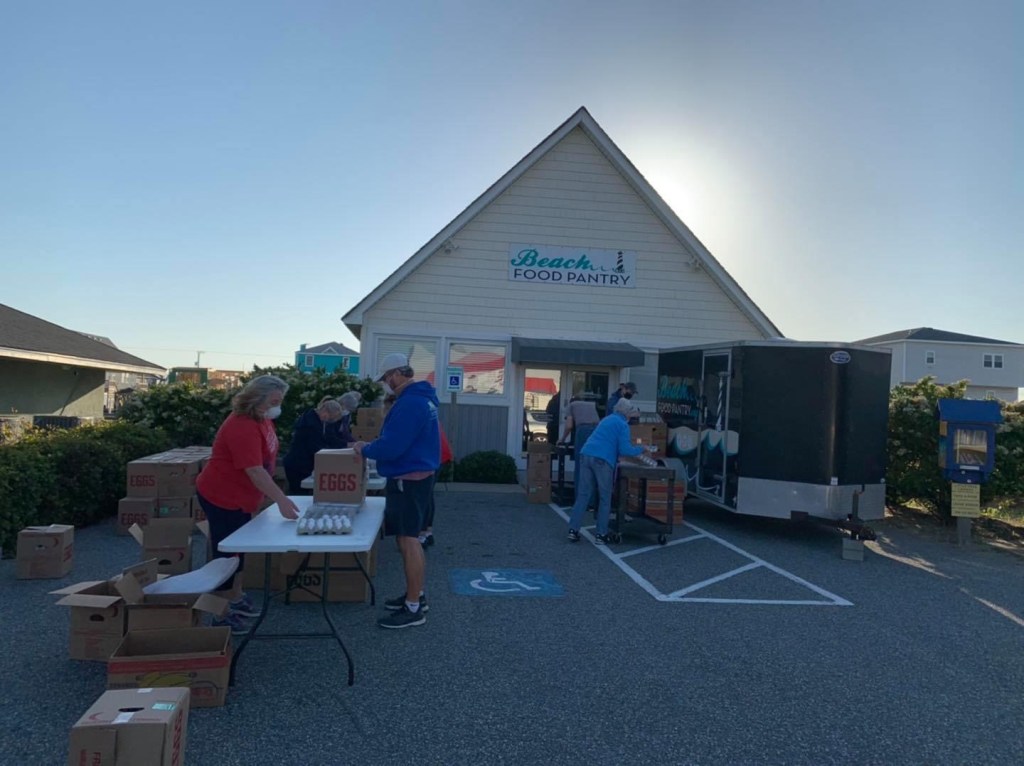
OBX’s Beach Food Pantry. Photo via Facebook.

Persecution

There are places in our world where owning a bible, going to church, or proclaiming your faith could result in imprisonment, beatings, or even death. It is hard for people living in free countries to fathom that there are countries where being a Christ-follower is dangerous. North Korea, Afghanistan, Somalia, and Iraq rank among the top nations where practicing Christianity is punishable by death. It is estimated that one in eight Christians world-wide lives in a country where practicing their faith is outlawed. (You can read more about this here)

When free people read the following passage in Matthew 10, we think about the rejection and ridicule we might experience for sharing our faith. We don’t think about danger if we are privileged enough to live in a country where such activity is permissible.

But today, I challenge you to read it with the lens of the persecuted church in mind:

Matthew 10 (Common English Bible)

26 “Therefore, don’t be afraid of those people because nothing is hidden that won’t be revealed, and nothing secret that won’t be brought out into the open. 27 What I say to you in the darkness, tell in the light; and what you hear whispered, announce from the rooftops.28 Don’t be afraid of those who kill the body but can’t kill the soul. Instead, be afraid of the one who can destroy both body and soul in hell. 29 Aren’t two sparrows sold for a small coin? But not one of them will fall to the ground without your Father knowing about it already.30 Even the hairs of your head are all counted. 31 Don’t be afraid. You are worth more than many sparrows.

Don’t be afraid. The stark reality that some could could kill the body but have no power over the soul is shocking when set in the context of countries who literally are torturing and executing Christians for their faith. Yet Jesus boldly proclaims three times not to be afraid, because the Father knows your situation down to the very last hair on your head.

Friends, we must pray for the persecuted church.

32 “Therefore, everyone who acknowledges me before people, I also will acknowledge before my Father who is in heaven. 33 But everyone who denies me before people, I also will deny before my Father who is in heaven.

Do you ever deny or downplay your faith? When you’re at a party or meeting someone for the first time, do you play it cool until you know if your faith will be accepted? Do you change the subject at family gatherings rather than suffer someone’s sarcasm?

Those of us who live in free nations must not hesitate to go and tell the good news of Christ. If ridicule is the worst weapon that might be formed against us, bring it on. We have brothers and sisters all over the world who can’t even possess a bible. Maybe we could open ours and do what it says on their behalf.

Free to Tell By Michelle Robertson