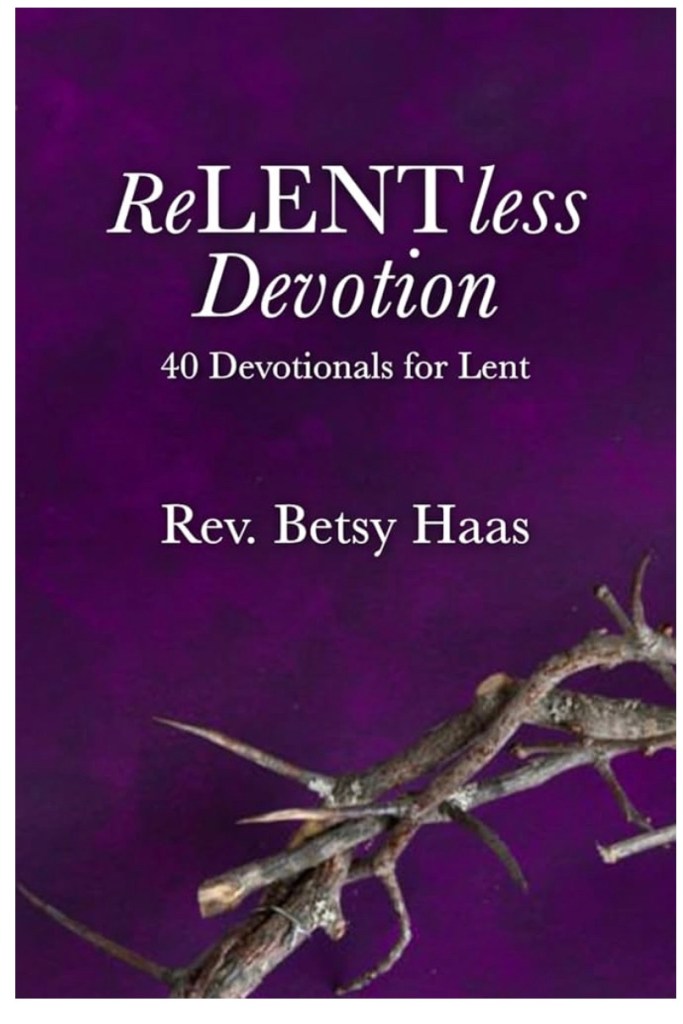
I am very happy to announce that my book, ReLENTless Devotion, has just been published. This book contains 40 days of Lent devotionals and a special Easter Sunday meditation. Lent begins on February 14th this year.
The season of Lent is a time of reflection, renewal, and re-examination. God invites us to do “heart surgery” during the time between Ash Wednesday and Easter Sunday in an effort to move deeper in our relationship with Christ. As we contemplate the journey to the cross that Jesus made on our behalf, we will learn and grow through our time spent in God’s word.
God invites us to walk through these days together and remember and read the Messianic prophesies, the poetic voices of the Psalms, hear from the Gospel writers of their first-hand observations of their friend and teacher, and contemplate Jesus’ own words. Each day’s reading offers a brief Scripture, an engaging reflection, and a daily prayer. It is hoped that by the time Easter arrives, we will be rededicated in our Lenten disciplines of study, meditation, fasting, service, prayer, repentance, and self-examination.
Lent is a time to come clean with God.
I hope you will join me as we endeavor to observe a Holy Lent together this year.
“Step by step, inch by inch…” this phrase from an old Three Stooges movie reminds me of how some people approach faith. There is nothing wrong with a methodical process, says the Methodist minister! Did you know that the term “Methodist” was given to the Wesley brothers at Oxford? The other students used it as a term of derision, noting how methodical the brothers were in their piety. Centuries later, it is still our identifying characteristic. We proudly approach our faith in a methodical way. Pursuing incremental progress toward a goal ensures that you continue to move forward, and that’s a good thing.
We are invited to practice spiritual disciplines as we participate in the serious work of moving step by step, inch by inch toward the goal of growing closer to God. Lent is not quite over yet!
Today’s reading introduces us to a step-by-step approach to prayer.
Philippians 1:1-6 (Common English Bible)
1 From Paul and Timothy, slaves of Christ Jesus.
To all those in Philippi who are God’s people in Christ Jesus, along with your supervisors and servants.
2 May the grace and peace from God our Father and the Lord Jesus Christ be with you.
3 I thank my God every time I mention you in my prayers. 4 I’m thankful for all of you every time I pray, and it’s always a prayer full of joy. 5 I’m glad because of the way you have been my partners in the ministry of the gospel from the time you first believed it until now.
6 I’m sure about this: the one who started a good work in you will stay with you to complete the job by the day of Christ Jesus.
Paul was methodical in his prayers and always started with thanksgiving, as we see here. This is key, as it focuses us on God’s activity in our lives and in the lives of the people for whom we pray. When we concentrate on thanking God first for the blessings that are poured out, it helps us focus on God’s power before we even begin with our list of wants and needs. Giving thanks at the beginning of each prayer puts us in a spirit of praise, joy, gratitude, and humility. We remember how good God is.
The second step is intercession, where we “mention others” and petition God for the needs of others and ourselves. We ask God to intervene in our lives and our situations to bring healing, mercy, comfort, and grace. We are reminded that we exist in fellowship and connection with others. By putting the needs of others before our own, we focus on the mercy of God, and practice the type of humility Jesus taught from the cross.
A natural third step is confession, a necessary part of every prayer. We confess our distance from the righteousness to which we are called. We confess our willfulness. We confess our sins. We confess it all in the sure and certain knowledge that God hears our confessions and cleanses us of our sins. Confession focuses our attention on the forgiveness of God.
And then we finish with a doxology, or a word of praise. God is worthy of our praise every day, and it’s important to let God know that! We praise God, from whom all blessings flow, and that moment reminds us that we are not self-reliant, but indeed we rely on God for everything that we have and need. Praise focuses us on the joyfulness of worshipping God.
Try this pattern in your prayer time this week. Remember that God always answers our prayers, so be persistent. Prayer changes things…mostly it changes us.
Praise God from Whom all Blessings Flow by Michelle Robertson
Let’s start today’s devotional with a riddle. Question: A cowboy rides into town on Friday and stays for three days. He rides out on Friday. How is this possible?
Answer: His horse’s name is Friday.
Groan!
Today’s reading is like a stepping into a riddle that Jesus gave his disciples just before the events of the crucifixion took place. Question: How can Jesus promise that in a little while they will no longer see him but then again in a little while they will see him? Answer: Jesus will be crucified and die, and so they won’t see him. But then he will be resurrected, so they will see him again, and their joy will be made complete. That joy will be so sure, nobody will be able to take it away from them, or us, ever again.
John 16:17-22(Common English Bible)
17 Some of Jesus’ disciples said to each other, “What does he mean: ‘Soon you won’t see me, and soon after that you will see me’ and ‘Because I’m going to the Father’? 18 What does he mean by ‘soon’? We don’t understand what he’s talking about.”
19 Jesus knew they wanted to ask him, so he said, “Are you trying to find out from each other what I meant when I said, ‘Soon you won’t see me, and soon after that you will see me’? 20 I assure you that you will cry and lament, and the world will be happy. You will be sorrowful, but your sorrow will turn into joy.
21 When a woman gives birth, she has pain because her time has come. But when the child is born, she no longer remembers her distress because of her joy that a child has been born into the world. 22 In the same way, you have sorrow now; but I will see you again, and you will be overjoyed. No one takes away your joy.
Of all of God’s promises to us, this promise of eternal life through the birth, death, and resurrection of Christ is the one we can count on the most. There is no riddle to this. This promise comes with a washing away of our sins that is so complete we are made into a new creation. This promise comes with the guarantee that the troubles and the burdens of this world will be lifted from us, and we will walk in the purity of God’s grace. This promise comes with the certainty that we will sit at Jesus’ feet in eternity and bask in the glow of his teachings. This promise seals us as children of God.
And so the sorrows of the world will be turned into joy. Notice that the promise is not that sorrow is replaced by joy, but it will be changed into joy, which carries with it the promise of being able to forget what the sorrow even was once it is no more. Like a mother in labor, the pain and sorrow of giving birth turns into the joy of holding a new life in your arms. This was my experience, and I was grateful for the “obstetrical amnesia” that turned pain into joy, … which was the only reason I had a second child!
What does this say to you today? Are you carrying a deep sorrow that you desperately need to turn over to the Lord? Jesus’ promise that he would see his disciples again turned out to be true. When he appeared to them in the Upper Room and on the shore of the sea of Tiberias, they were filled with a permanent joy that obliterated all of their sadness and confusion at his death. It is important to note that none of them ever wrote about Jesus’ death with regret. Their words reflect the great joy that the resurrection brought to the world. There is no riddle in that.
One of Jesus’ last promises was that he will be with us always, even to the end of the earth. That is one promise we can count on. Jesus is here; Jesus is near; bring your sorrow to him that you may find joy.
One of the joys of raising babies is teaching them simple forms of expression. When a baby can imitate smiling, waving, and clapping, you know they are on their way toward higher forms of communication.
I play the “clappity clap clap” game with my grandbabies and I love to sing and clap with them. They take this skill into other places, and soon learn to clap when food is presented, when a sibling is being silly, or when they simply are happy. Our youngest set of twins are almost one, and I can envision that joyful first birthday party with its colorful balloons, their first messy bites of cake, and a lot of clapping … mostly by me.
Why don’t we clap more? Clapping is a natural response to something that feels good. We clap and shout at football games, at the end of a great theater performance, and when the bad guy gets caught in a movie, but many of us were taught that clapping and shouting in church are things we shouldn’t do.
I think the Scriptures say otherwise. Today’s reading starts with the direction to “Clap your hands, all you people!” It could hardly be clearer than this! The psalm was written for the music leader and the sons of Korah, who were Levite priests. We can assume that this joyful song of victory was presented in the tabernacle and temple ceremonies as victories were being celebrated. Thus the people of God were invited to clap, shout, and sing in the context of worship.
Psalm 47
Clap your hands, all you people! Shout joyfully to God with a joyous shout! 2 Because the Lord Most High is awesome, he is the great king of the whole world. 3 He subdues the nations under us, subdues all people beneath our feet. 4 He chooses our inheritance for us: the heights of Jacob, which he loves. Selah
5 God has gone up with a joyous shout— the Lord with the blast of the ram’s horn. 6 Sing praises to God! Sing praises! Sing praises to our king! Sing praises 7 because God is king of the whole world! Sing praises with a song of instruction!
8 God is king over the nations. God sits on his holy throne. 9 The leaders of all people are gathered with the people of Abraham’s God because the earth’s guardians belong to God; God is exalted beyond all.
Worship should always be a joyful experience. In verses 6 and 7 the phrase “sing praise” is used five times, just so we get the point. We have so much to celebrate! God is the king over all the earth. God has subdued the nations under Israel. God sits on the holy throne and reigns from on high. Everyone and everything belongs to God.
How easy it is to see the messianic prophecy in this psalm, and easier still to see Jesus as the fulfillment. Jesus went up with a “joyous shout” (verse 5) at his ascension and will come again to be “king over the nations” (verse 8). For this alone, we rejoice.
I think worship should feel like a child’s first birthday party. Noise makers, hand clapping, singing, and joy should be a part of our experience whenever we gather together as God’s assembly. Every week!
How do you worship? Do you go into a service with anticipatory joy or a sense of obligation? Do you feel the pure happiness that comes from being in God’s presence, or are you distracted by your worries as you sit down?
We are invited to praise God with joy. God is worthy of our praise! We can’t praise enough.
I type that with the certainty of a person who thought it was Wednesday all day yesterday. I got up, edited and published my Wednesday devotional and then suddenly remembered it was Tuesday. I went to my Tuesday staff meeting (thank God for that brief moment of clarity!) and then went to pick up my dog from the vet in the afternoon. Then at 5:00 I told my husband that it was time for our Wednesday night family ZOOM call. But it was still Tuesday.
Lest you think I was having a day-long senior moment, (a reasonable guess) I need to explain my lack of focus. On Sunday morning as I was getting ready for church, my 13 -year-old Labrador Retriever collapsed. I called some friends to help me get her in the car. I was able to check her in to an Animal Hospital, and with the very kind and knowledgeable help of Dr. Grossman, she was diagnosed with Vestibular Disease, and we brought her home late Tuesday afternoon. She is wobbly but well.
Those three days were a nightmare for me. I got a harsh reminder of what grief and anxiety feel like. From Sunday morning until she wobbled through the door yesterday, I was in physical and emotional pain. My chest and stomach actually hurt, and I could not keep my mind from going to all of the worst situations. I could not sleep, nor could I eat. Driving up the driveway knowing she would not be running to greet me at the door rendered me paralyzed to the point that I could not get out of the car for fifteen minutes that first day.
Yesterday morning, on my Wednesday/your Tuesday, I woke up to a much too quiet house and proceeded to upload my Wednesday devotional. My mind was spinning, but luckily, I had written it last week. As I worked on it, a large robin red breast perched on the railing right outside my window and sang his beautiful song to me. I stopped and watched him, thanking God for this gift of rare beauty in the midst of my emotional tsunami fog.I felt my heart lift just a tiny bit and I allowed my mind to envision bringing Georgia home and things returning to normal.
In other words, I began to feel hope.
We finally got the call that she had recovered enough to be brought home and I began to feel the deep knot unknot itself. Hope was then affirmed by spotting another red-breasted robin sitting on a hedge outside the vet’s office. God had been with me all along and these two bird sightings were like a sweet tap on the shoulder as he reminded me that he had never left me in those long hours of uncertainty.
Hope is the antidote to grief. Hope stands in the boxing ring with anxiety with its gloved fists raised and yells, “Give me your best shot.” Hope wipes out the fear of the worst thing happening. In the end, hope wins. Even if the worst thing had happened and we lost Georgia, I was reminded that thanks to the hope we have in Jesus Christ’s death and resurrection, I could look forward to that day of seeing her again, whole and restored. And ornery. Always ornery.
When we first got Georgia as a thirteen-week-old puppy, a vet told us that large pure bred dogs like her had a life expectancy of 8 to 12 years. She is thirteen and I know we are living on bonus time. The last three days were just a dress rehearsal for her inevitable curtain call. But somehow, I know that when it happens, peace will come at some point as I anticipate the reality of being reunited again.
Isaiah wrote a lot about hope, and this Scripture describes how I felt … except instead of eagles, I got robins:
Isaiah 40:31 (New Revised Standard Version)
But those who wait for the Lord shall renew their strength; they shall mount up with wings like eagles; they shall run and not be weary; they shall walk and not faint.
I don’t know what battles of hopelessness you are facing today, but I pray you will take this Scripture to heart. It is hard to wait when you don’t know the outcome, but Jesus reminded us that he is with us wherever we go, even to the land of hopelessness. So hang on! Your Redeemer comes.
The practice of art restoration is fascinating. Normal decay, neglect, pollution, and the ravages of time take their toll on paintings, making them dull and even hard to see. Trained restorers can bring a painting back to life by slowly and carefully cleaning and removing layers of dirt and grime in order to reveal the details and colors of the artwork underneath.
The restorer must be careful in their work. Using the wrong solvent to remove varnish might also remove the paint. It can take up to six months to restore just one inch of a painting.
Scripture study works in much the same way. A trained instructor can help us uncover layers of meaning by revealing the history, culture, and conditions of the time that the Scripture was written, giving clarity and understanding.
This is the work of the Holy Spirit when we read a Bible passage. How many times do you sit down to read something you’ve heard and read a hundred times and suddenly you hear something new? This happens all the time to me. Daily Bible study is imperative for bringing the fresh word of God into our lives. Like a master restorer, God reveals meaning and nuance to us with each reading.
And sometimes, it hurts. Sometimes that fresh reading brings a new word of conviction or rebuke that must be dealt with in our lives. 2 Timothy 3:16 tells us that every Scripture is useful for teaching, revealing mistakes, correcting, and for training character.
When we are convicted by the Holy Spirit that it is time to repent, it would be good to remember what the people of Israel experienced when the Law was read once again after a long silence. When they heard God’s instruction and understood it, it caused them to weep. But the Levites and the priests who taught them instructed them to not be sad, but to rejoice. They were told that joy of the Lord was their strength (verse 10). A second chance was at hand. The day was proclaimed to be holy, and weeping and grieving were to cease. God’s word had been revealed and all who heard it could see and understand it clearly.
Nehemiah 8:7-12
7 The Levites—Jeshua, Bani, Sherebiah, Jamin, Akkub, Shabbethai, Hodiah, Maaseiah, Kelita, Azariah, Jozabad, Hanan, and Pelaiah[a]—helped the people to understand the Instruction while the people remained in their places. 8 They read aloud from the scroll, the Instruction from God, explaining and interpreting it so the people could understand what they heard.
9 Then Nehemiah the governor, Ezra the priest and scribe, and the Levites who taught the people said to all of the people, “This day is holy to the Lord your God. Don’t mourn or weep.” They said this because all the people wept when they heard the words of the Instruction.
10 “Go, eat rich food, and drink something sweet,” he said to them, “and send portions of this to any who have nothing ready! This day is holy to our Lord. Don’t be sad, because the joy from the Lord is your strength!”
11 The Levites also calmed all of the people, saying, “Be quiet, for this day is holy. Don’t be sad!” 12 Then all of the people went to eat and to drink, to send portions, and to have a great celebration, because they understood what had been said to them.
We who read the Word that was God in Christ Jesus have even more reason to rejoice. While our sin is great and causes us to weep, his salvation is even greater, bringing us joy. Every time we sit down and study God’s word, we are given an opportunity for a new beginning, and that indeed is a cause for celebration.
Having heard the word revealed, the people chose to rejoice and feasting and sharing commenced. So too should it be for us today, as we celebrate the Scripture made new in our lives and go forth to reveal it to others. God is the master painter! May his work be revealed in us.
One of the most important things we teach our children is manners. At an early age they learn to parrot back the proper response to “What do you say?” when they have been given something. Please and thank you are ingrained in them, and the smart ones realize as they grow up that a heartfelt please and thank you will help them go far in life.
At the dedication of David’s palace, he remembered his manners. He invited others to join in with a hearty “thank you” to God for the gift of this place. David was acutely aware of God’s power and provision in his life and this special celebration was no exception. He marked with day with gratitude, joy, dancing, and revelry, making sure that God got all the praise and attention.
David had known a lot of sadness in his life. From the falling out with his hero Saul, to the death of his firstborn, David had experienced grief.
Psalm 30 (Common English Bible)
4 You who are faithful to the Lord, sing praises to him; give thanks to his holy name! 5 His anger lasts for only a second, but his favor lasts a lifetime. Weeping may stay all night, but by morning, joy!
11 You changed my mourning into dancing. You took off my funeral clothes and dressed me up in joy 12 so that my whole being might sing praises to you and never stop. Lord, my God, I will give thanks to you forever.
I love the beautiful set of contrasts in this passage. Anger and favor, night and morning, weeping and joy … we can see David’s grasp on the ups and downs of life, and it is a relief when he lands on singing praise at the end.
It is good to remember that joy follows weeping when we are grieving the loss of someone or something important. There is a certainty in the rising of the sun every morning that brings comfort to the dark 3:00 am moments when we are so troubled, we can’t sleep. Hang on, this psalm advises. Joy will come.
This passage literally says, “weeping will spend the night.” We are reminded of that houseguest we barely tolerate as we look forward to their departure. Have you ever counted the days until a houseguest leaves? I have! The good news is that grief has an appointed check-out time, and we can anticipate finding joy when it finally begins to abate. Grief may return again, but with God’s help we learn to accommodate it in better ways as time goes on. God’s word in this psalm is a reminder that sadness can turn into gladness with the passing of time and the remembering of God’s great works …and with good grief counseling. When you’re sad, it really helps to talk to someone.
It also helps to remember that the sorrow of the night of the crucifixion was followed by the joy that came on Easter morning when the tomb was found to be empty. Facing grief with the surety of the resurrection can soothe even the most troubled heart.
Focusing on the greatness of God helped David get through the tough moments of his life. That can help us, too. Psalm 30 reminds us that God can help us take off our funeral clothes and dress us up in joy if we yield our sadness to the power of the Holy Spirit.
May joy come in your mourning as you seek God’s face.
As a pastor who lives in a popular beach town, there are two words that terrify me: wedding season. The Outer Banks of North Carolina have become one of the East Coast’s most popular wedding destinations, and I get my fair share of requests to officiate.
All weddings involve a certain amount of complexity, but these destination weddings are even more challenging for the officiant. You don’t know the people. You are dealing with outdoor venues; thus you have weather concerns. You have to travel to large beach rental houses in heavy Saturday traffic that are impossible to find due to our house numbering system here. And there may be a dog involved in the ceremony. One never knows. But when the details are sorted, every event is filled with happiness, feasting, gifts, food, and blessings. Joy abounds, God smiles down, and even the dog is happy.
I imagine the party that David threw after returning the ark to the temple was like a huge wedding reception. Everyone ate, danced, sang, and shared the joy of his victory. Our passage from 1 Chronicles today positively overflows with happiness. Can you feel it?
1 Chronicles 16 (Common English Bible)
23 Sing to the Lord, all the earth! Share the news of his saving work every single day! 24 Declare God’s glory among the nations; declare his wondrous works among all people 25 because the Lord is great and so worthy of praise. He is awesome beyond all other gods 26 because all the gods of the nations are just idols, but it is the Lord who created heaven! 27 Greatness and grandeur are in front of him; strength and joy are in his place. 28 Give to the Lord, all families of the nations— give to the Lord glory and power! 29 Give to the Lord the glory due his name! Bring gifts! Enter his presence! Bow down to the Lord in his holy splendor! 30 Tremble before him, all the earth! Yes, he set the world firmly in place;[a] it won’t be shaken. 31 Let heaven celebrate! Let the earth rejoice! Let the nations say, “The Lord rules!” 32 Let the sea and everything in it roar! Let the countryside and everything in it celebrate! 33 Then the trees of the forest will shout out joyfully before the Lord, because he is coming to establish justice on earth! 34 Give thanks to the Lord because he is good, because his faithful love endures forever.
And did you notice that we are not just invited to celebrate, but are actually commanded to rejoice? Words like sing, declare, share, give, bring, bow, celebrate, shout, roar, etc. are action verbs that require a response on our part. We are not meant to be passive spectators at this party, but full participants.
God is worthy of our celebratory joy. We celebrate God’s “holy splendor,” reminding us that in God’s set-apart-ness, he created every big and small thing, and all of nations rejoice. We celebrate God’s presence among us as the generous host of this event. We celebrate God’s superiority over the manmade gods and idols, acknowledging that our God created the heavens and the earth. We celebrate nature’s ability to join us in our praise as further proof of God’s power.
We celebrate!
When I am standing on that beach or that sunset pier watching two people give their lives to each other, I appreciate their choice to take their vows in these beautiful settings. For every lovely church wedding I have performed, there is nothing like the sound of waves and seagulls adding their music to the ceremony. Indeed, creation rejoices in its Maker, and we get to bask in it all.
Do something good for yourself today. Go outside and look around. Study the sky, the clouds, the ground, the fresh air, and rejoice!
And then give thanks to the Lord, because God’s love endures forever.
My husband likened it to playing “Whack A Mole.” As his father was in the hospital struggling with medical issues after hip surgery, the issues started changing by the hour. Nausea and lack of appetite became hiccups that wouldn’t stop, which became a recurring throat spasm, which became a possible stroke … every time the doctors addressed one problem, another one popped up.
And then on the sixth day, as my husband was getting ready to return to the hospital for another day of “what now?” the house phone rang. His father , who couldn’t speak night before, was calling with very explicit instructions on how to check the exterior oil tank to measure and calculate the amount of oil left to run the furnace. And just like that, new mercies began to pop up and we were reminded once again that “all we have needed, God’s hand hath provided.” (Great is Thy Faithfulness, United Methodist Hymnal p. 140).
Our family’s joy from God’s saving help was palpable. Have you ever gone to bed thinking all was lost only to wake up in the morning to see God’s new mercies suddenly in place? When God steps in and rescues us, it is cause for great joy and celebration. Because God’s faithfulness is great, we can always rest assured that our troubles are not unnoticed or unimportant to our Maker.
In our psalm today, we find words of thanksgiving and praise that enable us express the joy we feel when we have been helped. We are invited to sing to the Lord a new song. God is pleased by our praise and celebrates among us with the presence of the Holy Spirit to guide us.
Psalm 149:1-4
Praise the Lord!
Sing to the Lord a new song; sing God’s praise in the assembly of the faithful! 2 Let Israel celebrate its maker; let Zion’s children rejoice in their king! 3 Let them praise God’s name with dance; let them sing God’s praise with the drum and lyre! 4 Because the Lord is pleased with his people, God will beautify the poor with saving help.
Our United Methodist communion liturgy includes this phrase: “It is right, and a good and joyful thing, always and everywhere to give thanks to you, Father Almighty, creator of heaven and earth.” I love the emphasis on “always and everywhere.” It is always right to give praise to God.
What would your new song be today? Is there anything in your life for which you have not properly given God thanks? Sometimes we overlook the small things, thinking that such triviality does not warrant attention. But God works in the small things, like the measure of oil in the tank that awakens a man in his hospital bed with urgency of purpose and new clarity of mind. There is nothing we can’t thank God for, as everything belongs to God and comes from heaven above.
So today, take a moment to share your joy in a new song of praise for the small things. Did you wake up? Praise God. Do your shoelaces work? Thank you, Jesus! Was there toothpaste in the tube? Hallelujah!
Many of us grew up thinking that certain things would always be the same. Summertime baseball, Grandmother’s homemade biscuits, going away to college, attending church every Sunday, and the nightly news brought to you by a serious anchorman in a suit were all things that we thought would last forever. Pretty much all of that has changed. Baseball lasts until November, biscuits are easier to pick up from a drive-thru, college can be done entirely online, the “news” … well, what serves as “news” today is all over the place. And then there was that terrible thing called a global pandemic shut everything down, including Sunday worship.
Do you remember how it felt to be away from your sanctuary for months? As a pastor, I felt as though I was in a really bad Twilight Zone episode. Nothing in life or in seminary prepared me for leading a church in a global pandemic. The disruption that shutting down in-person events brought has left many of us with some post-trauma stress. Let’s not even talk about schools being closed for months.
But then there came that wonderful Sunday when we could regather in our buildings and worship together. What joy filled our hearts, even with masks and social distancing! To be gathered in our familiar church was a tremendous relief and blessing. Some of us wept over the changes, but we were home.
As we read Ezra today, we can truly relate to the Israelites’ joy and sorrow as they laid the foundation of the new temple. Some had worshipped in the old temple, which was destroyed by the Babylonians many years before. As the rebuilding began in earnest, the older generation wept with the memories of Solomon’s grandiose glory days when an elaborate temple existed. But the new generation, having no burden of memory or expectation, shouted with joy to see the return of a permanent place of worship after such a long absence.
Some looked forward while others looked back.
Ezra 3:8-13 (Common English Bible)
8 In the second month of the second year after their arrival at God’s house in Jerusalem, Zerubbabel, Shealtiel’s son, and Jeshua, Jozadak’s son, and the rest of their kin—the priests and the Levites and all who had come from the captivity to Jerusalem—made a beginning. They appointed Levites 20 years old and above to oversee the work on the Lord’s house. 9 Then Jeshua with his sons and his kin, Kadmiel and his sons, Binnui and his sons, the sons of Judah, along with the sons of Henadad, the Levites, and their sons and kin, collaborated to supervise the workers in God’s house.
10 When the builders laid the foundation of the Lord’s temple, the priests clothed in their vests and carrying their trumpets, and the Levites the sons of Asaph with cymbals, arose to praise the Lord according to the directions of Israel’s King David. 11 They praised and gave thanks to the Lord, singing responsively, “He is good, his graciousness for Israel lasts forever.”
All of the people shouted with praise to the Lord because the foundation of the Lord’s house had been laid. 12 But many of the older priests and Levites and heads of families, who had seen the first house, wept aloud when they saw the foundation of this house, although many others shouted loudly with joy. 13 No one could distinguish the sound of the joyful shout from the sound of the people’s weeping, because the people rejoiced very loudly. The sound was heard at a great distance.
We are invited to look forward. In those moments of remembering the good ole days it is good to remember that not everything was so good. Nostalgia can haze our thoughts, but God has promised us a future with hope that is a guarantee of joy that helps us look forward. (see Jeremiah 29:11)
One thing we learned in the pandemic is that worship cannot be restricted to a building. We worshipped at a baseball field, the beach, the front lawn of the church, and even a graveyard on Easter. Ephesians 2:20 reminds us that we are built on a foundation of the patriarchs with Christ himself as our cornerstone. Our foundation is set and stable.








 At Water’s Edge