The Good Gate

I had spotted her at events we both are required to attend, and felt her discomfort. An episode in our past that involved her adult son but did not directly involve either one of us had created an awkward and uneasy divide. I don’t know how she had processed what happened, but I know we both have felt pain and discomfort since.

I spotted her again at a recent event and knew I had to approach her. I suppose I will never know how it felt on her end, but I felt the strong leading of the Holy Spirit to “break the ice” and hopefully make it so that when we encounter each other again, we can nod and say good morning rather than circle the room to avoid each other.

I cannot say it was a break-through moment. I could feel her body stiffen up as I approached her. I said good morning, asked her how she was, and let her know I was praying for her family. Her responses were polite and minimal, making me fear that my “drive-by compassion” had really caught her off guard and did nothing to bridge the awkwardness as I had hoped it would. Worse, I fear I may have caused her pain by speaking to her, something completely opposite of what I was hoping to do.

So then I did what we all do in that moment. I began to question whose leading I was truly following by approaching her….God’s, or mine?

I had a mom in my office last week who expressed the same confusion. Praying for her son for a very specific resolution of an issue had led her to believe that a situation would be resolved in one particular way. When that did not transpire, she naturally began to question whether she was hearing God’s voice or her own as she prayed.

God speaks to us in ways that we do not communicate with others. His Spirit speaks to our spirit and we “hear” what he is saying….but only if we are tuned in with fine precision. This requires spending a lot of time in his presence, so that the voice becomes clearer with each encounter. We tune in every time we pray, serve, worship, meditate, fellowship and sit with his word.

John 10 The Message (MSG)

He Calls His Sheep by Name

10 1-5 “Let me set this before you as plainly as I can. If a person climbs over or through the fence of a sheep pen instead of going through the gate, you know he’s up to no good—a sheep rustler! The shepherd walks right up to the gate. The gatekeeper opens the gate to him and the sheep recognize his voice. He calls his own sheep by name and leads them out. When he gets them all out, he leads them and they follow because they are familiar with his voice. They won’t follow a stranger’s voice but will scatter because they aren’t used to the sound of it.”

6-10 Jesus told this simple story, but they had no idea what he was talking about. So he tried again. “I’ll be explicit, then. I am the Gate for the sheep. All those others are up to no good—sheep stealers, every one of them. But the sheep didn’t listen to them. I am the Gate. Anyone who goes through me will be cared for—will freely go in and out, and find pasture. A thief is only there to steal and kill and destroy. I came so they can have real and eternal life, more and better life than they ever dreamed of.

14-18 “I am the Good Shepherd. I know my own sheep and my own sheep know me. In the same way, the Father knows me and I know the Father. I put the sheep before myself, sacrificing myself if necessary. You need to know that I have other sheep in addition to those in this pen. I need to gather and bring them, too. They’ll also recognize my voice. Then it will be one flock, one Shepherd.”

Recognizing God’s voice in the cacophony of all the sounds swirling in our minds and hearts takes practice, discernment and the constant abiding in God’s Word, God’s will and his presence. The good news is that he loves his sheep. All of his sheep. He is constantly calling, cajoling, rebuking, correcting, wooing, comforting, directing, and saying words of caring to us.

Are you trying to hear God today? Tune in, stay tuned, adjust your dial, and wait. The Good Shepherd is calling.
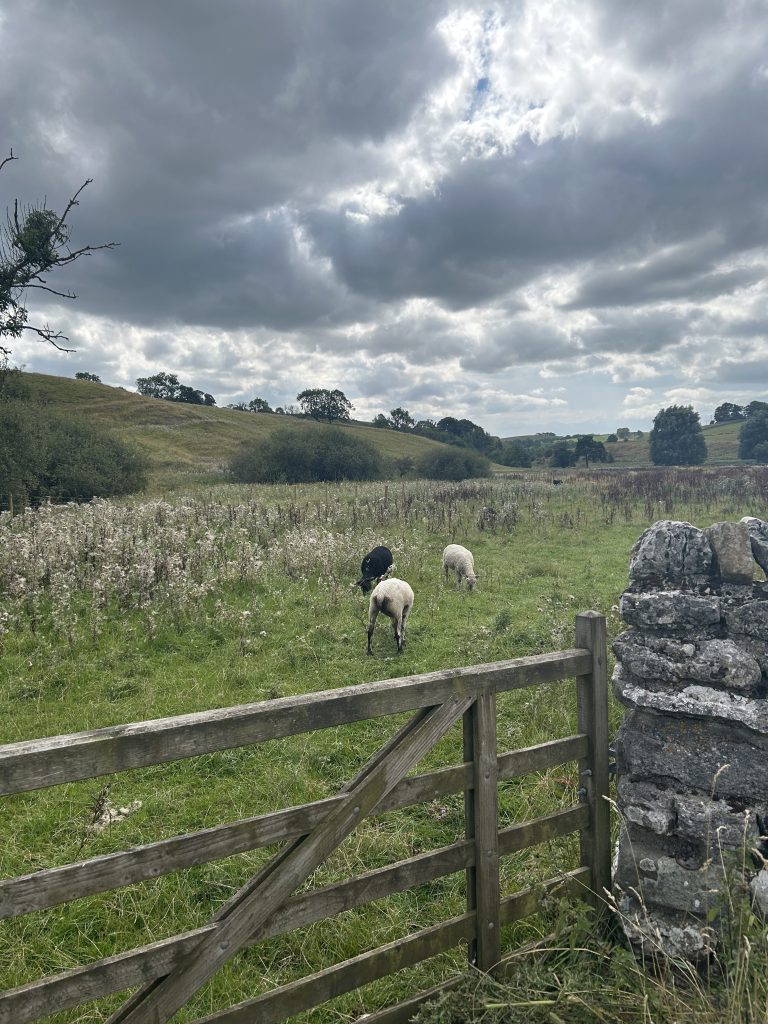
The Gate

Good Shepherds

I got pulled over by a Sheriff’s deputy last week. Yep, it happens. It was an unexpected encounter in many ways. First, when he put his flashy blue lights in my rear view mirror, I seriously thought he was trying to get around me to go bust a heroin ring or chase down a gunman. We were on a narrow, twisty, curvy two-lane road on the island where I live where passing is nigh impossible. So when this good citizen saw the lights go on, I assumed I was being asked to do my duty in cooperating with whatever chase he was about to start and get out of his way.

Turns out he was chasing me.

I pulled into a convenient side road and was startled when he pulled in behind me. I had checked my speedometer when the lights went on by reflex, and I had been driving 34 in a 35 MPH zone. What the heck!?!

We exchanged pleasantries through the open window and I still wasn’t sure why we were having such a lovely chat. Turns out that I had been doing 34 in a 25 MPH speed zone. This is what happens when you aren’t paying attention to which part of the curves you are traveling on. Most of the road is 35, except that small portion of extreme curviness where he caught me.

I deserved a ticket.

Our passage is a very familiar one from John which talks about the Jesus being the Good Shepherd. I want you to read this differently today and focus on the function of the sheep pen:

John 10 ( The Message)

11-13 “I am the Good Shepherd. The Good Shepherd puts the sheep before himself, sacrifices himself if necessary. A hired man is not a real shepherd. The sheep mean nothing to him. He sees a wolf come and runs for it, leaving the sheep to be ravaged and scattered by the wolf. He’s only in it for the money. The sheep don’t matter to him.

14-18 “I am the Good Shepherd. I know my own sheep and my own sheep know me. In the same way, the Father knows me and I know the Father. I put the sheep before myself, sacrificing myself if necessary. You need to know that I have other sheep in addition to those in this pen. I need to gather and bring them, too.

The sheep pen is a place of safety, just like speed limits. When we stay inside them, we are kept from harm. Just like playgrounds have fences, things that are designed to “contain” us are meant to be places where ravaging wolves and traffic accidents can’t threaten us. Jesus not only wants to keep us safe in his “pen” of commandments, he wants those who live outside the pen to come in.

They’ll also recognize my voice. Then it will be one flock, one Shepherd. This is why the Father loves me: because I freely lay down my life. And so I am free to take it up again. No one takes it from me. I lay it down of my own free will. I have the right to lay it down; I also have the right to take it up again. I received this authority personally from my Father.”

Our Good Shepherd acts completely for the good of the one flock. He is willing to freely lay down his life for the sheep…which in fact he did.

My encounter with the deputy reminded me that this man is also willing to lay down his life for my safety. All first responders do. They race into places where harm is happening, without any thought to their own safety. I am grateful for that.

I am also grateful that Officer Long did not give me a ticket or even a written warning that day. I deserved it, but he showed me some grace. He was my Good Shepherd on the road, and I am humbled to know that he is out there keeping my community safe.

Remember to pray for the first responders in your community. They need the protection of their Good Shepherd, too.

Slow Curves

Good Tidings

Can you remember a time in your life when you had really, really, REALLY good news to share? I can remember racing home to my college dorm the night I got engaged. I couldn’t wait to tell my parents…they were the first call I made. Then ran up and down the halls and told my dorm-mates. Finally I settled down in my room and called my friends from high school, my grandparents, my sister, and my cousins. I spent a few hours sharing my good tidings. I couldn’t help myself!

Today we finish the passage in Isaiah that we began yesterday. In this section, we read of the good tidings of God’s return to redeem Jerusalem:

Isaiah 40 (New Revised Standard Version)

9 Get you up to a high mountain, O Zion, herald of good tidings; lift up your voice with strength, O Jerusalem, herald of good tidings, lift it up, do not fear; say to the cities of Judah, “Here is your God!”

10 See, the Lord GOD comes with might, and his arm rules for him; his reward is with him, and his recompense before him.

Here we see a sign of what the Messiah will look like. Good news! He comes with might to save his people, and tends to them like a caring shepherd:

11 He will feed his flock like a shepherd; he will gather the lambs in his arms, and carry them in his bosom, and gently lead the mother sheep.

We tell this story over and over. Every Advent brings us back to these same good tidings. Why do we keep repeating the same story?

Paul R. Abernathy, rector of Trinity Episcopal Church in Washington, D.C., puts it like this:

“We do not recount the record of our redemption simply to recall ancient biblical texts. No. We retell the story so that it takes deeper root in us. We retell the story so that we become the story, the church seasons becoming active verbs in our lives.

We retell the story so that we always ‘advent,’ being alert to the coming of Jesus to us.
We retell the story so that we always ‘christmas,’ being animated by the birth of Jesus in us.
We retell the story so that we always ‘epiphany,’ being awake to the revelation of Jesus in us for the world.
We retell the story so that we always ‘lent,’ being aligned to the death of Jesus for us in our dying to sin.
We retell the story so that we always ‘easter,’ being alive to the resurrection of Jesus for us and in us.
We retell the story so that we always ‘pentecost,’ being afire with the empowering presence of the Holy Spirit.

Advent, then, is more than a mere revival of a repetitious cycle. Advent signals the renewal of a spiritual journey that wends its way to the very gate of glory of heavenly Jerusalem, the eternal city of God.”
(“When Will It End?” The African American Pulpit 1 [Fall 1998], 6.)

May you ‘advent’ and be alert to God-With-Us in new ways this year. Go and shout the good tidings of Christ’s birth from your own mountaintop! And may the story take deep root in you until you BECOME the story.

Go, and tell.

A High Mountain in Germany by Jessica Spiegelblatt

Sheeples

The phrase “sheeples” has become the dirty word of 2020. Used when people have opposing views, it is a derogatory way of saying one group is vapid enough to believe things that the other group finds offensive, false, or ridiculous. In this mindset, if you are “so stupid” that you hold a particular opinion, you might be called a sheeple by someone who holds the opposite opinion.

The underlying thought behind this put-down is that sheep are supposedly simple-minded. Come on now! Y’all are giving sheep a bad name. Sheep may be dumb, but they would never be mean enough to engage in name-calling. I’m here to stand up for the sheep!

In all seriousness, there is beautiful language in scripture that uses images of sheep-like behavior in a very positive ways. If you look closely, these scriptures usually end up being more about the shepherd than the sheep. When people are compared to a flock that is ready to follow the care and concern of a Shepherd, it is a comforting image and a humbling lesson.

Most Bible readers are familiar with the Good Shepherd imagery that Jesus used in John 11:

14 I am the good shepherd. I know my own and my own know me, 15 just as the Father knows me and I know the Father; and I lay down my life for the sheep. 

But today’s lectionary takes us back to Ezekiel, well before Jesus arrived. This was written during the time of Israel’s exile in Babylon, when the people were scattered all over the place. Note the connections between the prophet’s writings and Jesus’ own words:

Ezekiel 34 (Common English Bible)

11 The Lord God proclaims: I myself will search for my flock and seek them out. 12 As a shepherd seeks out the flock when some in the flock have been scattered, so will I seek out my flock. I will rescue them from all the places where they were scattered during the time of clouds and thick darkness. 13 I will gather and lead them out from the countries and peoples, and I will bring them to their own fertile land. I will feed them on Israel’s highlands, along the riverbeds, and in all the inhabited places.

Call me a sheeple, but this is exactly where I want to be. I want to be in the care of a gentle leader. I want to be sought out when I stray. I want to be rescued and led into the fertile land.

I want to be fed.

 14 I will feed them in good pasture, and their sheepfold will be there, on Israel’s lofty highlands. On Israel’s highlands, they will lie down in a secure fold and feed on green pastures. 15 I myself will feed my flock and make them lie down. This is what the Lord God says. 

16 I will seek out the lost, bring back the strays, bind up the wounded, and strengthen the weak. But the fat and the strong I will destroy, because I will tend my sheep with justice.

Your Shepherd is calling you, too. He himself is ready to feed you and provide you with rest.

Is the Lord seeking you? Are you lost? Wounded? Weak?

All you have to do is follow. God tends his sheep with love, mercy, kindness, and justice.

I don’t know about you, but I just wanna be a sheep.

He Leads Me Beside the Still Water by Wende Pritchard