House of Prayer

Does your church have a prayer room? One of the first things I did when I was appointed to my last church was clean out the unused library behind the sanctuary and have the Trustees designate it as a prayer room. The newly organized prayer ministry outfitted it with couches, a kneeler, and good lighting. We set up a table that held Sunday morning prayer requests and a sign-in book for prayer ministry volunteers so that we could gauge the use of the room. In no time we realized that people used the room all week long, enjoying a quiet space to pray deliberately for the concerns of the church, the town, the nation, and the world.

The importance of people praying regularly for their church, their staff, one another, and for concerns beyond the local congregation cannot be overstated. Since we opened the prayer room, we have gone through unexpected leadership changes, the pandemic, financial uncertainty, deaths of key leaders, painful disaffiliation conversations, and even hurricanes, yet we are still strong and standing.

That’s what prayer can do.

We continue our study of Isaiah 56 today. In this portion, Isaiah continued to prophesy about the place immigrants would have in God’s kingdom. God promised that those who serve and love him, keep the Sabbath holy, and who hold fast to his covenant will be brought into God’s holy mountain and enter God’s house of prayer.

Isaiah 56 (Common English Bible)

The immigrants who have joined me,
    serving me and loving my name, becoming my servants,
    everyone who keeps the Sabbath without making it impure,
    and those who hold fast to my covenant:
    I will bring them to my holy mountain,
    and bring them joy in my house of prayer.
    I will accept their entirely burned offerings and sacrifices on my altar.

If the phrase “house of prayer” sounds familiar, you may be remembering Jesus’ overturning of the marketplace tables in the Temple: “He said to them, “It’s written, My house will be called a house of prayer. But you’ve made it a hideout for crooks”  (Matthew 21:13). Yikes! Jesus ain’t playin’, friends. Those who sought to cheat the worshippers and profit by overcharging for the approved sacrificial animals were cast out from the Temple court. God does have a limit to how much will be tolerated.

The church is designed to be a house of prayer for all peoples. What are you doing to ensure that all peoples are welcomed in? Will you join God in the work of gathering up the outcasts?

   My house will be known as a house of prayer for all peoples,
        says the Lord God,
    who gathers Israel’s outcasts.
I will gather still others to those I have already gathered.

How can our churches be more open to strangers?

Maybe we should start with prayer.
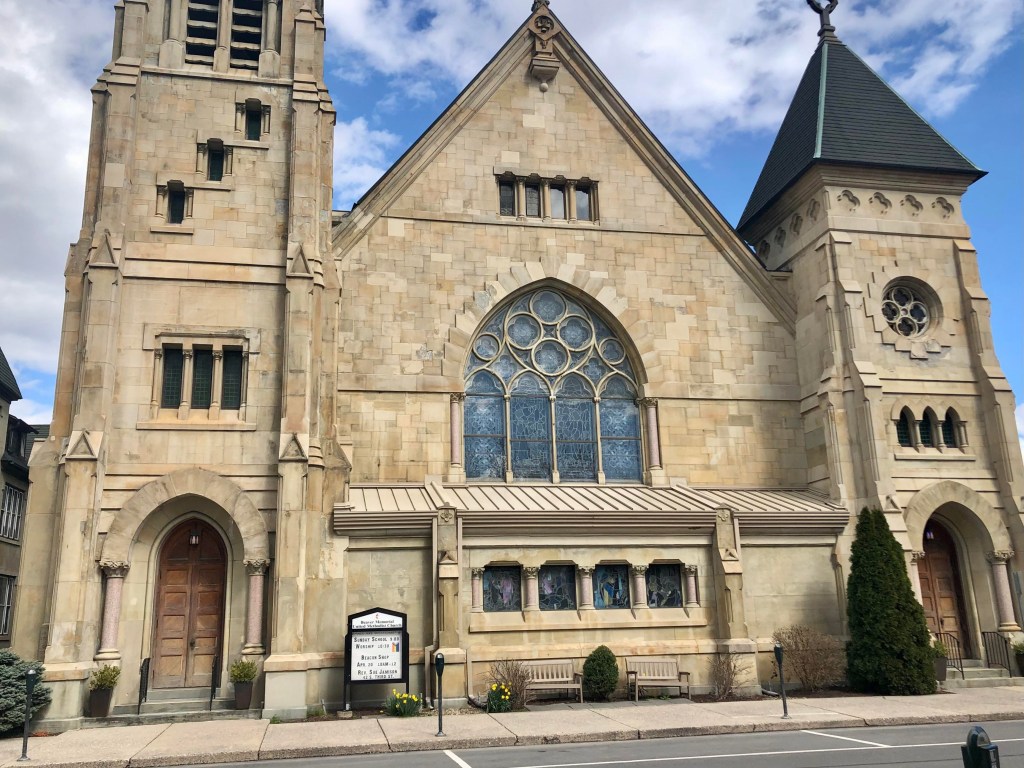
United Methodist House of Prayer, Lewisburg, PA by Alan Janesch


Recipe For Happiness

I met with a frustrated spouse last week who outlined a list of grievances that she is experiencing in her marriage and ended with, “I’m just not happy.” She and her husband are starting marriage counseling, so I feel hopeful that the issues will be discussed and resolved. But the conversation made me ponder the subject of happiness. I believe she was honest in what she said, but it made me concerned for folks who pin all their happiness on one relationship with another person. Are there things we can do apart from our relationships that would bring happiness into our lives so that when those relationships go through rough patches, we can still find joy?

What does the Bible say about happiness?

Then I stumbled upon this nugget from Isaiah. The Old Testament prophet spent his career warning Israel about apostasy and their standing as God’s people. But did you know he also offers a recipe for happiness?

Isaiah 56 (Common English Bible)

The Lord says:
    Act justly and do what is righteous,
    because my salvation is coming soon,
    and my righteousness will be revealed.
Happy is the one who does this,
    the person who holds it fast,
    who keeps the Sabbath, not making it impure,
    and avoids doing any evil.

Act justly. Do what is righteous. Anticipate the coming salvation. Hold fast to God’s promises. Keep the Sabbath holy. Avoid doing evil. If you meditate on that list of ingredients, you can see how happiness would follow. And God goes on to ensure that his listeners understood that this recipe is not just restricted to the Jews but is available to anyone.

Don’t let the immigrant who has joined with the Lord say,
    “The Lord will exclude me from the people.”
    And don’t let the eunuch say,
        “I’m just a dry tree.”
The Lord says:
    To the eunuchs who keep my sabbaths,
    choose what I desire,
    and remain loyal to my covenant.

We get a foretaste of the New Covenant in these verses regarding immigrants and eunuchs. These people certainly represented those outcast from Jewish society. Eunuchs were denied full participation in the temple rituals, according to Leviticus 21:17-20. God is saying very clearly that while society may deny them inclusion, all are welcome in God’s temple and courts. God is also saying that while you may feel outcast, the word of God is higher and stronger than your feelings.

Indeed when Jesus arrived, he opened up his ministry to the outcasts first.
    In my temple and courts, I will give them
    a monument and a name better than sons and daughters.
    I will give to them an enduring name
    that won’t be removed.

Isaiah’s prophecy of a time when all would be welcome at the temple found its home in Jesus. He ate with sinners, healed the Gentiles, fed the poor and marginalized, and died for us all. His Temple is for the world.

Have you ever felt outcast in your community? Have you ever been shunned by family, neighbors, or the church? Are you lacking happiness in your life? Check the recipe again and see if you can spot a missing ingredient, starting with keeping the Sabbath.

May we open the doors wide for all to come in and taste and see that the Lord is good.

Happiness Pancakes by Mary Anne Mong

Follow the Directions

Have you ever been led astray by your GPS? When the GPS first became popular there were several reports of people following GPS instructions and driving into a lake or going the wrong way on a one-way street. Even with outstanding advancements in technology, it can sometimes be hard to get to a place if the technology is faulty or if you enter the wrong address.

When I first moved to the Outer Banks eleven years ago there were parts of Southern Shores that were not on the satellite maps. I spent one frustrating afternoon trying to visit a church member only to have to return to the church to get directions. I was using one of the older free-standing GPS units and I had left my cell phone at the church, so I couldn’t call anyone for directions. By the time I got back to my office it was too late for the visit and I was in tears. So much for advanced technology!

Isaiah was an 8th Century prophet who was the voice of God’s concerns during the Babylonian exile. His basic function was to be a GPS to the Israelites. He gave words of direction, instruction, and hope during the dark time of exile from Israel. The people of the diaspora desperately wanted to return home. They were looking for a way back. They needed a GPS to direct them to the holy mountain. Then came good news: insiders and outsiders alike were called to come to worship.

Isaiah 56 (The Message)

“And as for the outsiders who now follow me,
    working for me, loving my name,
    and wanting to be my servants— All who keep Sabbath and don’t defile it,
    holding fast to my covenant—
I’ll bring them to my holy mountain
    and give them joy in my house of prayer.

The outsiders are us, folks. The Gentiles and outcasts who chose to follow God received an amazing offer to enter into the house of worship.

Here is the map for both insiders and outsiders to follow, laid out in two steps.

  1. Keep the Sabbath and don’t defile it.

2. Hold fast to my covenant.

Sabbath-keeping is so important to God. It is a mandatory respite from our busy life that directs us to intentionally stop everything and focus solely on God. Many of you will remember “blue laws” that required that everything shut down on Sundays. By removing all temptation, families couldn’t defile the Sabbath with distraction, leisure, or (worst of all) work.

God’s covenant was spelled out to the people in the Ten Commandments. By following God’s law, people could find their way into God’s house and remain there all of their days.

They’ll be welcome to worship the same as the ‘insiders,’
    to bring burnt offerings and sacrifices to my altar. Oh yes, my house of worship
    will be known as a house of prayer for all people.”

Here’s the best part. The house of worship becomes a house of prayer for ALL people. Imagine it! If we were to follow the directions laid out for us in this passage, we could be gathered together into a house of prayer for all people.

The Decree of the Master, God himself,
    who gathers in the exiles of Israel:
“I will gather others also,
    gather them in with those already gathered.”

What do you need to do today to re-direct your life so that you are headed in the right direction? What does God’s covenant mean to you? Are you loving God and loving neighbor in everything you do? Are you defiling the Sabbath or keeping it holy?

All are welcome to worship in the house of prayer, where there is plenty of joy to go around. Come! Now is the time to worship and pray.

Let Us Go Up to the Holy Mountain by Becca Ziegler