Survive or Thrive

Name something that you consume every day that you could not live without. Be honest! For me, it is coffee. Surely it is an addiction, as any abstinence from coffee gives me a terrific headache and I don’t feel well. I learned this during two pregnancies back in the dark ages when doctors (many of whom had never been pregnant) insisted that coffee was dangerous to the fetus. So each time, for nine months, I did not have a drop, which meant that in addition to morning sickness, I dealt with coffee withdrawn for the first two months. Modern thinking now allows for a cup of coffee in the morning for pregnant women, and for the sake of my coffee-loving daughters, I am grateful that they turned that thing around. It was brutal!

Your thing might be fruit, or cigarettes, or candy, or bread. I bet for a lot of us, bread is something we consume once a day. It would be missed if we were deprived of it. In ancient times, bread was essential to life, as grain was a main source of nutrition, and it was easily obtained. This was the case in Jesus’ time.

In our passage today, Jesus took advantage of the cultural norm of bread consumption to make a startling point about himself:

John 6:30 (Common English Bible)

30 They asked, “What miraculous sign will you do, that we can see and believe you? What will you do? 31 Our ancestors ate manna in the wilderness, just as it is written, ‘He gave them bread from heaven to eat.

32 Jesus told them, “I assure you, it wasn’t Moses who gave the bread from heaven to you, but my Father gives you the true bread from heaven. 33 The bread of God is the one who comes down from heaven and gives life to the world.”

34 They said, “Sir, give us this bread all the time!”

35 Jesus replied, “I am the bread of life. Whoever comes to me will never go hungry, and whoever believes in me will never be thirsty. 36 But I told you that you have seen me and still don’t believe. 37 Everyone whom the Father gives to me will come to me, and I won’t send away anyone who comes to me. 38 I have come down from heaven not to do my will, but the will of him who sent me. 39 This is the will of the one who sent me, that I won’t lose anything he has given me, but I will raise it up at the last day. 40 This is my Father’s will: that all who see the Son and believe in him will have eternal life, and I will raise them up at the last day.”

John used heavenly descent language to hammer home the point that while both manna and Jesus came down from heaven, Jesus is the true bread. Descent language is used to solidify the connection between the manna miracle and Jesus’ revelation of himself as the Bread of Life. The manna of Exodus 16 was bread that came down from heaven, but Jesus’ claims of his own heavenly descent, coupled with the “I am” statement of v.35, show him to be the true bread from heaven. Jesus, not the manna, is God’s life-giving gift to the world.

 What does this mean to you today? Jesus’ revelation that he was the Bread of Life is a sign of God’s sustaining and providing presence in our lives. It means we will never go spiritually hungry if we fill ourselves with God’s Word. We are assured that if we drink of the Living Water we will never thirst for salvation and forgiveness again. This is the word of hope that this starving, parched world needs! 

 Yet sadly, the world seeks to fill itself with the empty calories of popularity, politics, social media, hours filled watching Netflix, YouTube, and streaming services, mindless pleasure-seeking, greed, celebrity, and a host of other things that may fill us for a moment but won’t last enough to help us thrive. Even the church can be guilty of taking the pleasant short cuts of performance-based worship and personality-cult preachers who, like candy, might satisfy you for an hour on Sunday, but won’t last until Monday morning. A steady diet of such fluff leaves your soul malnourished and your teeth rotten. But Jesus offers us the kind of soul-sustenance that helps us to thrive. When we feast on the bread that is Jesus, through daily in-depth Bible study, meditation, prayer, giving, serving others, and true worship, we fill ourselves with the kind of wholesome nutrition that enables us to find happiness, peace, and contentment.

We thrive.

This is why it is important to keep doing what we are doing every morning. When we grab that first cup of coffee and sit down to consume Scripture, we are filling ourselves with good stuff that will last through eternity. Thank you so much for reading! May we thrive in God’s Word together.

Need a Lent devotional? ReLENTless Devotion is now available at Amazon. You can order one HERE.
Thrive by Becca Ziegler
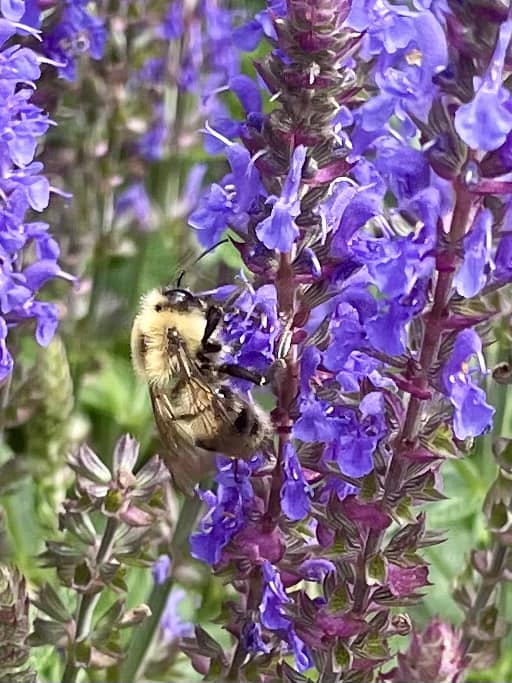
True Vine

I am working on a writing assignment for a publisher that has me exploring the seven “I am” statements of Jesus. You may have noticed this already! These statements are all found in the book of John and were Jesus’ way of revealing God to his followers in manageable metaphors. They speak to our spiritual needs as we seek to understand our Savior. In practical terms, these statements represent a kind of resume, or CV, that quickly outlines the attributes of our Lord. Of course as you experience each one, you delve farther and farther into the very heart and mind of God. Here are the seven “I am” statements:

I am the bread of life.

I am the light of the world.

I am the open gate.

I am the good shepherd.

I am the resurrection and the life.

I am the way, the truth, and the life.

I am the true vine.

When I read that last one, I immediately thought of the vines that keep threatening to overtake our house. We have a neglected and abandoned raised flower bed that grows vines and weeds with great purpose and vigor. Over the winter, I considered cutting it all back but then I noticed that it seemed to be filled with sleepy bees. I read that such places are wonderful habitats for bees in the cold weather, and you shouldn’t cut them back until after the temperature is over 50 degrees and the bees have somewhere to go. I even thought about getting a sign that read, “Betsy’s Bee Garden” to explain to the neighbors why this eyesore of a mess was bee-ing left alone. I’m not lazy, I’m simply doing my part for the environment!

Thinking of my wild and wayward vines as a dwelling place for the bees gave me comfort. It also falls into line with today’s Scripture. Notice that as Jesus described being the true vine, he invited us to remain (or dwell) in him:

John 15 (Common English Bible)

15 “I am the true vine, and my Father is the vineyard keeper. He removes any of my branches that don’t produce fruit, and he trims any branch that produces fruit so that it will produce even more fruit. You are already trimmed because of the word I have spoken to you. Remain in me, and I will remain in you. A branch can’t produce fruit by itself but must remain in the vine. Likewise, you can’t produce fruit unless you remain in me. I am the vine; you are the branches. If you remain in me and I in you, then you will produce much fruit. Without me, you can’t do anything. 

Jesus is very clear about what our purpose is. We are to produce fruit. If we stay attached to the vine, if we dwell with Jesus, we will perform our function as the branches from which the fruit grows. But woe unto us if we don’t remain in Jesus:

If you don’t remain in me, you will be like a branch that is thrown out and dries up. Those branches are gathered up, thrown into a fire, and burned. If you remain in me and my words remain in you, ask for whatever you want and it will be done for you. My Father is glorified when you produce much fruit and in this way prove that you are my disciples.

And what fruit are we to be producing? Paul gives us a beautiful list in Galatians 5:

22 But the fruit of the Spirit is love, joy, peace, patience, kindness, goodness, faithfulness, 23 gentleness, and self-control. There is no law against things like this.

Notice that love is the first thing on the list. Everything begins and ends with love. Read the rest of Jesus’ “I am the true vine” statement:

“As the Father loved me, I too have loved you. Remain in my love. 10 If you keep my commandments, you will remain in my love, just as I kept my Father’s commandments and remain in his love. 11 I have said these things to you so that my joy will be in you and your joy will be complete. 12 This is my commandment: love each other just as I have loved you. 13 No one has greater love than to give up one’s life for one’s friends. 14 You are my friends if you do what I command you. 15 I don’t call you servants any longer, because servants don’t know what their master is doing. Instead, I call you friends, because everything I heard from my Father I have made known to you. 16 You didn’t choose me, but I chose you and appointed you so that you could go and produce fruit and so that your fruit could last. As a result, whatever you ask the Father in my name, he will give you. 17 I give you these commandments so that you can love each other.

“I give you these commandments so that you can love each other.” In a world that spends so much time spewing hate, we need to grow the fruit of love everywhere we can, like a wild vine that has gone completely out of control. Where can you be the branches of love for someone today?

Go and bear fruit.

Bee-utiful by Kathy Schumacher

Everyday Bread

My husband and I switched to a low-carb diet several years ago, which means we don’t eat bread. We are actually quite fond of bread, so this was a major adjustment. We used to eat bread every day, and bread is something that makes life a little easier. Think about how easy it is to make toast in the morning and then throw a sandwich in a lunchbox and get on with your day! Bread is life. Occasionally we will allow ourselves a day off from our low carb adherence, and bread is the first thing I want. I recently had a wonderful pretzel roll in a restaurant and I was pretty sure I had expired right there at the table and gone straight to heaven. That roll was a taste of the bread of heaven, I’m telling you!

Bread plays a very important role in the Scriptures. It was something that sustained the people in the desert and in the towns. Bethlehem was known as the “house of bread” and look what it produced! Manna played a huge role in the Exodus story. Elijah gave a poor and desperate widow a miracle of a never-empty jugs of flour and oil so that she would have bread for the rest of her life. (1 Kings 17:7-16). Communion is a sacred act of remembrance where we break the bread just as Jesus’ body was broken, and drink from the cup, remembering his blood that was poured out for the forgiveness of sin.

In his first “I Am” statement in today’s reading, Jesus declares that he is the bread of life. John records seven “I am” statements that help us understand exactly who the son of God is. In Jesus’ time, it was not safe for him to speak too often about being the Messiah, as it riled the authorities. So as their rabbi, their teacher, and the Son of God, Jesus used these seven statements to reveal God to them, beginning with “I am the bread of life.” How clever to speak about something as essential as bread.

Jesus is essential to life.

John 6 (Common English Bible)

25 When they found him on the other side of the lake, they asked him, “Rabbi, when did you get here?”

26 Jesus replied, “I assure you that you are looking for me not because you saw miraculous signs but because you ate all the food you wanted. 27 Don’t work for the food that doesn’t last but for the food that endures for eternal life, which the Human One  will give you. God the Father has confirmed him as his agent to give life.”

The crowd had followed him to Capernaum just after he had fed the 5,000 with bread and fish. Jesus knew exactly what they were asking for. They wanted material bread from him. He was offering spiritual sustenance instead.

28 They asked, “What must we do in order to accomplish what God requires?”

29 Jesus replied, “This is what God requires, that you believe in him whom God sent.”

30 They asked, “What miraculous sign will you do, that we can see and believe you? What will you do? 31 Our ancestors ate manna in the wilderness, just as it is written, He gave them bread from heaven to eat.”

How clever of them to quote Psalm 105 to him. They were hoping to manipulate him into providing daily bread as Moses had in the wilderness in the form of manna. But Jesus wasn’t having it. Bread wasn’t a thing; it was a person.

32 Jesus told them, “I assure you, it wasn’t Moses who gave the bread from heaven to you, but my Father gives you the true bread from heaven. 33 The bread of God is the one who comes down from heaven and gives life to the world.”

34 They said, “Sir,  give us this bread all the time!

35 Jesus replied, “I am the bread of life. Whoever comes to me will never go hungry, and whoever believes in me will never be thirsty. 36 But I told you that you have seen me and still don’t believe. 37 Everyone whom the Father gives to me will come to me, and I won’t send away anyone who comes to me. 38 I have come down from heaven not to do my will, but the will of him who sent me. 39 This is the will of the one who sent me, that I won’t lose anything he has given me, but I will raise it up at the last day. 40 This is my Father’s will: that all who see the Son and believe in him will have eternal life, and I will raise them up at the last day.”

What does this mean to you today? Jesus being the bread of life is a sign of God’s sustaining and providing presence in our lives. It means we will never go spiritually hungry if we fill ourselves from his bread basket. We are assured that if we drink of his Living Water we will never thirst again. This is the word of hope this starving, parched world needs!

And to know that he won’t send anyone away who comes to him is a reminder that there is nothing that can separate anyone from God’s love. All we need to do is come. This is a reminder to the church to keep the doors open to everyone.

So today, when you have a bite of bread, think of Jesus, the bread of life. He is the only one who will fill us, satisfy us, and sustain us. Thanks be to God!

Heavenly Bread