Stuffed

I’m guessing you’re probably stuffed today. I certainly am! Yesterday it was the turkey that was stuffed, today it’s us! Thanksgiving is a day to indulge and over-indulge with the nation’s approval and permission. As you sat down to feast, what was your favorite dish? I bet it was some form of bread. Crescent rolls, yeast rolls, cornbread stuffing, green bean casserole with breaded crispy onions on top, pumpkin pie in a lovely crust … bread is the star at many dining room tables at Thanksgiving. Move over, turkey!

Humankind has loved bread from the very beginning. The very first reference of bread in Scripture occurs in Genesis 3:19:

“By the sweat of your face you shall eat bread.”

Poor Adam and Eve had just been expelled from the garden and learned that the thing they sought, bread, would now require a lot of growing, reaping, threshing, tilling, grinding, kneading, and then baking over an open fire. Sin, indeed, has its consequences.

In our lectionary passage today, John records a time when Jesus’ many followers demanded more bread. They had either been present or had heard about his miraculous feeding of the 5,000 and demanded that he perform his bread miracle again:

John 6 (New Revised Standard Version UE)

25 When they found him on the other side of the sea, they said to him, “Rabbi, when did you come here?” 26 Jesus answered them, “Very truly, I tell you, you are looking for me not because you saw signs but because you ate your fill of the loaves. 27 Do not work for the food that perishes but for the food that endures for eternal life, which the Son of Man will give you. For it is on him that God the Father has set his seal.” 

This occurred in Capernaum at a Sabbath service. Perhaps it was this setting that spurred Jesus to refocus their attention away from material sustenance to spiritual matters. He wanted them to be more impressed by his spiritual food than last week’s bread. But they were dull and they were hungry and demanded a sign.

28 Then they said to him, “What must we do to perform the works of God?” 29 Jesus answered them, “This is the work of God, that you believe in him whom he has sent.” 30 So they said to him, “What sign are you going to give us, then, so that we may see it and believe you? What work are you performing?

One of the problems in demanding a particular sign is that we can miss what God is actually doing in our midst. When we pray very specifically for something, we aren’t open to other possibilities of how God is answering. I have been praying without ceasing for a loved one to get a very specific job offer. Finally I realized that I should be praying for God to reveal his way and his will in this matter. It may end up that this opportunity wasn’t quite right, but the contacts made during the interviews will lead to exactly what God had planned all along. So while we are encouraged to pray the concerns of our heart to a Father who wants to hear our deepest needs, we should also add, “Thy will be done” as a way of acknowledging that God knows best. In our Scripture, Jesus is saying exactly that: The father is offering something so much better than a slice of bread that perishes. He is offering eternal life.

31 Our ancestors ate the manna in the wilderness, as it is written, ‘He gave them bread from heaven to eat.’ ” 32 Then Jesus said to them, “Very truly, I tell you, it was not Moses who gave you the bread from heaven, but it is my Father who gives you the true bread from heaven. 33 For the bread of God is that which comes down from heaven and gives life to the world.” 34 They said to him, “Sir, give us this bread always.”

35 Jesus said to them, “I am the bread of life. Whoever comes to me will never be hungry, and whoever believes in me will never be thirsty.

I think the invitation is two-fold. We are invited to receive the true Bread of Life that is Jesus Christ our Lord. Then we are invited to go out and offer this bread to others. How will you be the bread of life to someone today?

Still looking for an Advent Devotional book? Take a look.

On A Roll by Becca Ziegler

Where Are You?

My running partner and I ran the Flying Pirate Half Marathon a few months ago and we enjoyed reading the homemade signs that people held up along the route. People and local businesses really go out of their way to create fun and encouraging signs for the runners. Of all the great race signs I have read, the one that was outside the Kitty Hawk Police Department one year was the best. It read: You can run, but you can’t hide. Best of luck from the Kitty Hawk Police! Well played, officers! It is not only funny, it is biblical.

Today we go back to the beginning of everything and learn what happened when man tried to hide. This very familiar story of the “fall of man” takes us to the cool of the evening when fellowship with God in the garden was a regular thing. But right away we know that something is very wrong, as God called to the man and his wife and asked, “Where are you?” Surely God knew where they were and even what they had done. But the question was more theological than geographical. Where is your head? Where is your heart? What were you thinking?

Genesis 3 (Common English Bible)

During that day’s cool evening breeze, they heard the sound of the Lord God walking in the garden; and the man and his wife hid themselves from the Lord God in the middle of the garden’s trees.The Lord God called to the man and said to him, “Where are you?”

10 The man replied, “I heard your sound in the garden; I was afraid because I was naked, and I hid myself.”

A classic definition of the word sin is “separation from God.” They had eaten the fruit that had been forbidden and now they had to face the consequences of their actions, so they separated themselves from the Lord by trying to hide. But notice that the man compounded his sin with blame-casting. Not only does he blame the woman, he blames God for giving him the woman.

How often do we do this as well? Do you ever try to cover up your sins by blaming someone else? We spend a lot of time trying to teach our children to resist peer pressure, but many of us succumb to it. It is so easy to slip into backbiting, gossiping, name-calling, and hate speech when we see our friends and neighbors engaging in that kind of behavior. We live in a world where finger pointing has the favorite exercise of the day.

11 He said, “Who told you that you were naked? Did you eat from the tree, which I commanded you not to eat?”

12 The man said, “The woman you gave me, she gave me some fruit from the tree, and I ate.”

13 The Lord God said to the woman, “What have you done?!”

And the woman said, “The snake tricked me, and I ate.”

God’s gentle question, “Where are you?” is an effort to show the man how lost he had suddenly become. God is hoping to hear his confession so that he can offer repentance. We can almost sense God’s sorrow over the broken fellowship; no longer will the three of them walk in the garden together. This passage shows us that God will always pursue us, no matter what we have done. And we will always be found, thanks be to God! Yes, we all have to answer to God, but when we come clean, we are forgiven. God acted with patience and caring as he personally came along side of the man and woman to speak the truth in love to them.

The snake did not fare as well. It is the perfect image of Christ’s defeat over Satan. Look at verse 15. God puts enmity between Satan and the “woman’s offspring,” a prophecy of the virgin birth. Many regard this as the first Gospel preaching in the Bible, calling this verse the proto evangelium. But bearing those offspring would bring great hardship to women and men would now have to till the land. And while the land would be filled with thorns (NIV) and thistles, Christ would come in due time and wear those thorns as a crown on his head when he took the sins of the world upon him. All of the earth was redeemed by his death and resurrection.

14 The Lord God said to the snake,

“Because you did this,
    you are the one cursed
        out of all the farm animals,
        out of all the wild animals.
    On your belly you will crawl,
        and dust you will eat
        every day of your life.

15 I will put contempt between you and the woman,
    between your offspring and hers.
They will strike your head,
        but you will strike at their heels.”

16 To the woman he said,

“I will make your pregnancy very painful;
            in pain you will bear children.
You will desire your husband,
        but he will rule over you.”

17 To the man he said, “Because you listened to your wife’s voice and you ate from the tree that I commanded, ‘Don’t eat from it,’

cursed is the fertile land because of you;
        in pain you will eat from it
        every day of your life.
18 Weeds and thistles will grow for you,
        even as you eat the field’s plants;
19     by the sweat of your face you will eat bread—
        until you return to the fertile land,
            since from it you were taken;
            you are soil,
                to the soil you will return.”

So the question remains. Where are you? Where is your heart? What are you thinking? Remember, you can run, but you cannot hide. Maybe it’s time to be found.

Kitty Hawk Police Department Facebook page

Why I Don’t Like Snakes

I have a vegan friend who is a true animal lover. She has rescued many of God’s creatures. This woman dares to go where no sane person (speaking completely for myself) has gone before. She has rescued dogs, cats, a serval, owls, turtles, a pelican, and….wait for it…snakes.

Why did it have to be snakes?

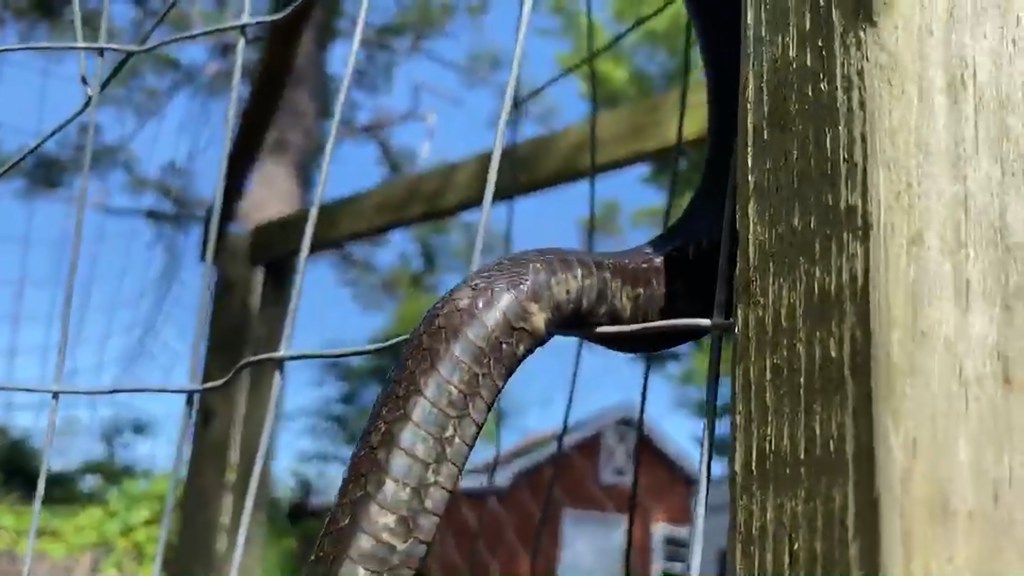
She keeps a chicken enclosure in her large back yard, and she loves and protects her chickens from all manners of evil. One morning at feeding time she realized that a snake, attracted by their eggs, had entrapped itself in the protective fence. Now any sane person would have called the local “Critter Gitter” (we have one on the Outer Banks) to remove said snake, or would have killed it and disentangled its lifeless body. Not this girl. She worked for an hour to slowly untangle it, and then she set it free.

My dislike of snakes is Biblical. I contend that after what happened in the Garden of Eden, we are all predisposed to not like snakes. Prove me wrong!

Genesis 3 (The Common English Bible)

During that day’s cool evening breeze, they heard the sound of the Lord God walking in the garden; and the man and his wife hid themselves from the Lord God in the middle of the garden’s trees. The Lord God called to the man and said to him, “Where are you?”

We have to stop there to observe a few things. First, how lovely that must have been! The evening offered a cool breeze, God was present, the man and the woman stood among the garden’s beautiful trees….and then came the question. “Where are you?” God inquires.

How many times has God asked you that? In the middle of some place where you should not have been, engaging in some activity you should not have participated in, have you not also heard God asking, “Where are you?” Of course it probably didn’t sound as much like God’s voice as it did your own, coming from somewhere in the back of your mind…which is much easier to ignore. God speaks to us through our conscience. When we rationalize and justify our sinful behavior, we are ignoring the voice of God.

Having been caught with their pants down (as it were), the man and the woman started the blame-casting:

10 The man replied, “I heard your sound in the garden; I was afraid because I was naked, and I hid myself.”

11 He said, “Who told you that you were naked? Did you eat from the tree, which I commanded you not to eat?”

12 The man said, “The woman you gave me, she gave me some fruit from the tree, and I ate.”

13 The Lord God said to the woman, “What have you done?!”

And the woman said, “The snake tricked me, and I ate.”

It’s God’s fault for giving the woman to the man. It’s the woman’s fault for giving the fruit to man. It’s the snake’s fault for tricking the woman….oy vey. Notice that neither the man nor the woman takes responsibility for having eaten the fruit.

One thing is certain: we haven’t evolved much since the Garden, have we? All you have to do is turn on the news and you’ll see a lot of finger-pointing that dominates the air time. Rarely do we see people taking responsibility for their own behavior.

14 The Lord God said to the snake,

“Because you did this,
    you are the one cursed
        out of all the farm animals,
        out of all the wild animals.
    On your belly you will crawl,
        and dust you will eat
        every day of your life.

15 I will put contempt between you and the woman,
    between your offspring and hers.
They will strike your head,
        but you will strike at their heels.”

So the snake takes the first fall, and humanity falls next. The concept of “original sin” points to the innate tendency we all have to sin, and traces back to Adam and Eve’s first sin and subsequent dismissal from the garden.

We also are asked, “Where are YOU?” God calls us to take responsibility for our actions and sinful behavior, and to stop trying to blame people or circumstances for our decisions. And when we do, the offer of absolution of our guilt is always there in the presence of Jesus. When you own up to your sins and ask for forgiveness, you are GUARANTEED to receive it.

Don’t let sin entrap you for one more day. Untangle yourself from its grip and let God set you free.

Snake Handlin’ by Wende Pritchard

Whatcha Lookin’ At?

If this were a Bible class and you were reading from the Bible in your hands, I would have you take out a highlighter and highlight every time the word “see” or “saw” appears in this passage. Since you are reading it online, use your imaginary highlighter instead!

Genesis 3 (The Message)

3 The serpent was clever, more clever than any wild animal God had made. He spoke to the Woman: “Do I understand that God told you not to eat from any tree in the garden?”

2-3 The Woman said to the serpent, “Not at all. We can eat from the trees in the garden. It’s only about the tree in the middle of the garden that God said, ‘Don’t eat from it; don’t even touch it or you’ll die.’”

4-5 The serpent told the Woman, “You won’t die. God knows that the moment you eat from that tree, you’ll see what’s really going on. You’ll be just like God, knowing everything, ranging all the way from good to evil.”

When the Woman saw that the tree looked like good eating and realized what she would get out of it—she’d know everything!—she took and ate the fruit and then gave some to her husband, and he ate.

Immediately the two of them did “see what’s really going on”—saw themselves naked! They sewed fig leaves together as makeshift clothes for themselves.

See/saw/sinned/sewed. It was a quick downhill slide! And that LYING snake, twisting God’s words for the first of many, many times. But I want us to focus on how “seeing” is the first step in the downhill slide of sinning.

When the Woman SAW that the tree LOOKED like good eating….it started with that. Eve looked at something she was told to pass by, but instead she stopped to contemplate it. Every sin we willingly participate in begins the same way. Adultery, lust, coveting, greed, stealing, killing, etc. all begins with looking at something we can’t have, and taking it anyway.

When the forbidden fruit was consumed, the two of them did “SEE what’s really going on-SAW themselves naked! So once the covenant with God was broken, the cover-up began. The lies took over, the shame took hold, and the trust was fractured. Sin replaced love as they tried to hide from the Father. Aren’t we just like that? When the threat of exposure of our sins takes hold, we lie through our teeth to try to prevent everyone knowing what we’ve done and who we truly are.

So the question for us this Lent morning is, what are you looking at? What’s in your hand? What temptation has Satan put in your view that is calling you to sin against God?

Look away. You can avoid the whole downward spiral right now by looking away, walking away, and telling Satan to beat it.

Tempting Apples by Becca Ziegler