Joseph Knew

Ann Weems is the author of a marvelous book of poetry called Kneeling in Bethlehem. It is one of my favorite Christmas reading resources. She looks at things from an angle that is unique and thoughtful. Of all the poems in her book, I like “Getting to the Front of the Stable” the best.

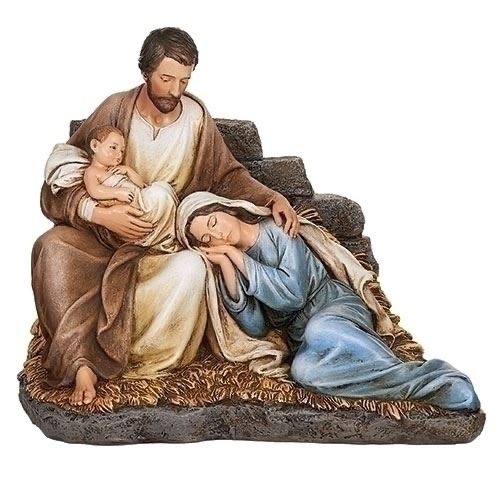
To set the stage for today’s devotional, take a look at your nativity set if you have one in the house. If not, remember or imagine ones you have seen in the past. Where is Joseph, the father of the son of God? Where stands this man who made the extraordinary decision to stay with Mary when the culture and the world said to divorce her and send her and the baby off to a life of shame? Most likely your Joseph is stuck at the back of the stable, upstaged by wise strangers, smelly shepherds, glory-blinding angels, and even barn animals.

Who put Joseph in the back of the stable? 
Who dressed him in brown, put a staff in his hand, 
and told him to stand at the back of the crèche, 
background for the magnificent light of the Madonna? 
(Ann Weems, “Getting to the Front of the Stable,” Kneeling in Bethlehem, pp. 52-53.)

We only get to talk about Joseph every three years in the lectionary cycle when we delve into Matthew’s account of the nativity. Read this with intention, as you won’t see it again for another 36 months:

Matthew 1:18-25 (Common English Bible)

18 This is how the birth of Jesus Christ took place. When Mary his mother was engaged to Joseph, before they were married, she became pregnant by the Holy Spirit. 19 Joseph her husband was a righteous man. Because he didn’t want to humiliate her, he decided to call off their engagement quietly. 20 As he was thinking about this, an angel from the Lord appeared to him in a dream and said, “Joseph son of David, don’t be afraid to take Mary as your wife, because the child she carries was conceived by the Holy Spirit.21 She will give birth to a son, and you will call him Jesus, because he will save his people from their sins.” 

Joseph had the right to outcast Mary and her unborn child. His decision to do so quietly speaks volumes of his integrity. The fact that he didn’t speaks to his faith in God.

One thing Joseph knew already was his own family lineage. Matthew gives us a neatly divided family tree from Joseph’s line, which includes women, of all things. Among those women listed were Rahab the prostitute and Bathsheba the adulteress. Perhaps Joseph knew that their inclusion in his family tree was evidence of God’s saving mercy and powerful forgiveness. Perhaps he knew that women hardly stood a chance in the patriarchal society that so easily cast them aside. Perhaps he knew God’s power and might in his own ordinary life and trusted that God would protect him and his little family if he just yielded this moment to the angel’s promise.

22 Now all of this took place so that what the Lord had spoken through the prophet would be fulfilled:

23 Look! A virgin will become pregnant and give birth to a son,
        And they will call him, Emmanuel.

(Emmanuel means “God with us.”)

24 When Joseph woke up, he did just as an angel from God commanded and took Mary as his wife. 25 But he didn’t have sexual relations with her until she gave birth to a son. Joseph called him Jesus.

One thing Joseph knew for sure was his Scriptures. So when the angel promised that this unborn child was the long-awaited messiah, he already had a vision of what that meant to the world. Was he startled to find himself at the center of the fulfillment of that prophecy? You betcha. But isn’t God always working in mysterious and startling ways?

It’s time to give Joseph the prominence he is due. Get up from your chair and move him to the front!

God-chosen, this man Joseph was faithful 
in spite of the gossip in Nazareth, 
in spite of the danger from Herod. 
This man, Joseph, listened to angels 
and it was he who named the Child 
Emmanuel. 

Is this a man to be stuck for centuries 
in the back of the stable? 
Actually, Joseph probably stood in the doorway 
guarding the mother and child 
or greeting shepherds or kings. 

When he wasn’t in the doorway, 
he was probably urging Mary to get some rest, 
gently covering her with his cloak, 
assuring her that he would watch the Child. 
Actually he probably picked the Child up in his arms 
and walked him in the night, 
patting him lovingly 
until he closed his eyes. 

This Christmas, let us give thanks to God 
for this man of incredible faith 
into whose care God placed the Christ Child. 
As a gesture of gratitude, 
let’s put Joseph in the front of the stable 
where he can guard and greet 
and cast an occasional glance 
at this Child 
who brought us life.

Joseph knew that his trust in God would be rewarded, reinforced, and protected. Do you trust God the same way? Maybe it’s time to yield.

Let Mum Rest available at Catholic Supply

So Long, Pluto

Back in ancient times when I was but a wee child in elementary school, our solar system had nine planets. We studied it by looking at a 3D model that our teacher had made from bent coat hangers and painted foam balls of varying sizes, and sure enough, there was Pluto chugging along in ninth place. Then suddenly my world was rocked in 2006 when the International Astronomical Union had the audacity to reclassify Pluto as a dwarf planet, taking it out of the place it had held for centuries in our system. How in the universe could this have happened? Yes, new technology and intense study revealed that Pluto was not what it was first presumed to be, but to have such a massive shift in our understanding was unsettling to say the least. I still have to remember when talking to my grandchildren that the solar system only has eight planets. Back in my day, we had nine!

I imagine that this was how the news of Christ’s resurrection hit the Jews during Paul’s many journeys. Having been raised in the permanent solidity of the Law, the very idea that the Law was no longer useful in obtaining salvation must have felt like someone just took a planet away.

Paul’s letter to the Galatians on this subject is a quintessential exposé of this true but startling discovery. We see him at his theological best in these verses, unpacking the complete reversal of traditional thinking about the Law bringing salvation. He aligns himself by identifying as a born Jew then quickly makes the bold statement that righteousness no longer comes by the works of the Law, but rather through the faithfulness of Christ.

Galatians 2 (Common English Bible)

15 We are born Jews—we’re not Gentile sinners. 16 However, we know that a person isn’t made righteous by the works of the Law but rather through the faithfulness of Jesus Christ. We ourselves believed in Christ Jesus so that we could be made righteous by the faithfulness of Christ and not by the works of the Law—because no one will be made righteous by the works of the Law. 17 But if it is discovered that we ourselves are sinners while we are trying to be made righteous in Christ, then is Christ a servant of sin? Absolutely not! 18 If I rebuild the very things that I tore down, I show that I myself am breaking the Law. 

Earlier in this Scripture, Paul had to rebuke Peter. The debate on whether or not Gentiles had to become Jews first before receiving Christ plagued the early church. Circumcision and keeping a Kosher table were part of this issue, and Peter had separated himself from the uncircumcised at meals while visiting the new church at Antioch. Paul was appalled. Peter knew better, but was fearful of “certain men from James” who strongly believed that adherence of Jewish Law was a step for Gentile inclusion. I often wonder if fear keeps many of us from saying and doing the things we know are true.

Paul never wavered in his understanding of the power of the cross. He died to his old life under the Law with Christ’s death. By his faith in the faithfulness of God’s son, he was able to move from an intellectual understanding of the power of grace to a personal heart-embrace of Jesus’ love for him. Much like John Wesley’s famous Aldersgate moment when he felt his “heart strangely warmed” and moved from thinker to believer, Paul declared himself all in for Jesus.

19 I died to the Law through the Law, so that I could live for God. 20 I have been crucified with Christ and I no longer live, but Christ lives in me. And the life that I now live in my body, I live by faith, indeed, by the faithfulness of God’s Son, who loved me and gave himself for me. 21 I don’t ignore the grace of God, because if we become righteous through the Law, then Christ died for no purpose.

How about you? Are you all in? Do you put your whole trust in his grace, or are you still trying to work out your own salvation through ritual and good deeds? Jesus invites us to die to ourselves so that we may live with him. Don’t miss your chance.

Many Moons Ago by Becca Ziegler

So Grand

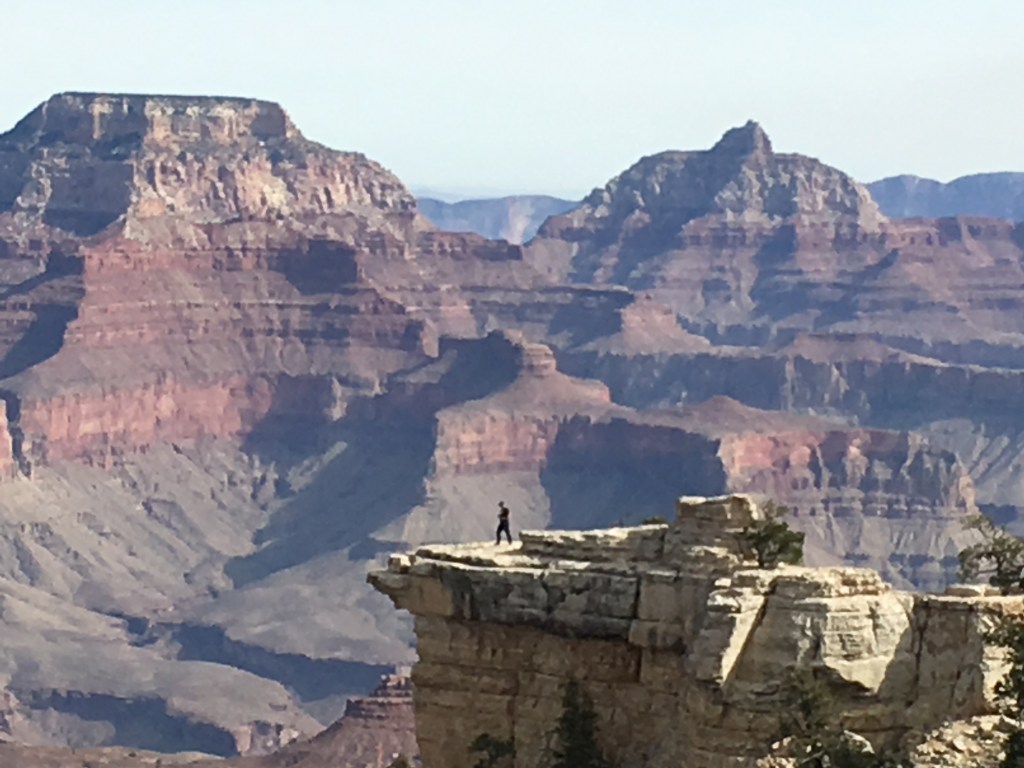
Even though I am surrounded daily by all of the natural beauty of the Outer Banks, my favorite experience of observing nature’s majesty was a trip I made to the Grand Canyon in Arizona. Have you ever seen it? It is absolutely breathtaking. The Canyon is bigger than the state of Rhode Island at 1,904 square miles. It contains over 1,000 caves, mostly unexplored. Native American tribes consider the Grand Canyon to be the gateway to the afterlife. Over 5 million visitors go every year to see this incredible phenomenon. Just to give you a sense of its size, the drive from the Visitor Center on the North Rim to the one on the South Rim is over 200 miles. One day I hope to see it by helicopter.

You may be wondering what the Grand Canyon has to do with today’s Scripture. I think our response to something as spectacular as this majestic place is much like the response of the people who believed in Jesus’ name only because they saw miraculous signs. We have a great admiration for the grand show of it all, but that superficial reaction is not sustainable.

John 2 (Common English Bible)

23 While Jesus was in Jerusalem for the Passover Festival, many believed in his name because they saw the miraculous signs that he did. 24 But Jesus didn’t trust himself to them because he knew all people. 25 He didn’t need anyone to tell him about human nature, for he knew what human nature was.

Jesus couldn’t entrust himself to this googly-eyed crowd. There was no depth of faith, no measure of understanding, and no sincere profession of faith here. In his way of having a divine knowledge of the situation, he knew that a crowd of followers looking for signs would soon burn out. He knew what human nature was, and it was fickle. Once the next conjurer or magician came along, their attention would be distracted away from him and his mission.

And yet, he still loves us. He completely understands the fallibility of human nature, and he still loves us! Jesus can read us like an open book, see us in our fallen state, and yet is able to perceive the image of God in which we were made. If that’s not amazing grace, I don’t know what is.

Light faith may be better than no faith, but not by much. God deserves a true, honest, deep faith from us, and that takes work and dedication. One quick look of admiration and awe won’t cut it, much like attending church only on Easter and Christmas can’t feed the soul.

Jesus is looking for sustainable followers who grow through prayer, Scripture study, weekly worship, and service. Which kind are you?

And Yet We’re So Small by Ann Wood

Fleeing

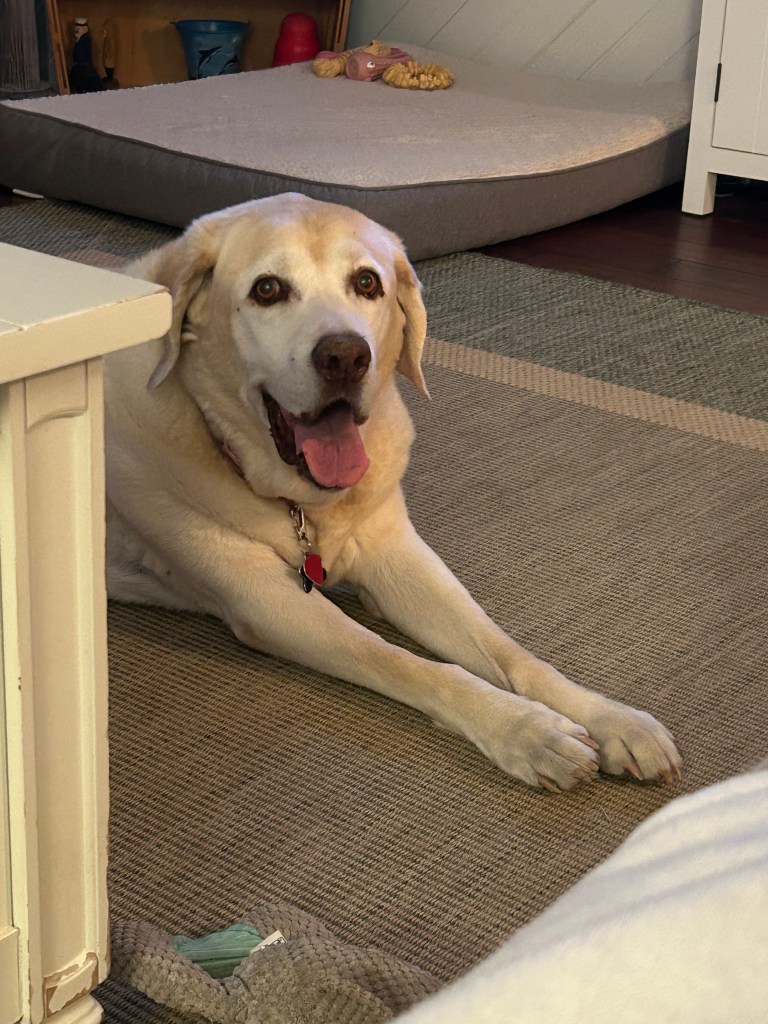
Many of you made nice comments about my recent picture of my writing partner Georgia, so today I thought I would share a Georgia story. When she was a younger girl and her hearing was intact, she was absolutely terrified by fireworks. Georgia is not bothered by storms, thunder, Nor ’easters, hurricanes, etc, but when that high whine of something about to explode happens, she takes her 100lb. body and tries to find the smallest place of safety in the house. We have spent many a July 4th huddled with her in the kneehole of the built-in desk of our guest room. On New Year’s Eves in the past, my husband has had to sit with her on the laundry room floor until the jubilation was finally over. Georgia will turn 15 in a few weeks and one of the mixed blessings of aging is that she is now completely deaf. Guess what? We had the most peaceful New Year’s Eve last week. The fireworks in our neighborhood went completely unnoticed by her, and for that, I am grateful. And by the way, dogs can figure out DSL (Dog Sign Language) pretty quickly, especially when you are announcing that dinner is ready.

Where do you go to escape? When the cacophony of stress threatens to deafen you, when your eyes have seen more tragedy than joy, when your heart breaks with the absence of your one true love, where do you flee?

I hope you flee to God. I pray that you know that in any circumstance, God is a sound-proof rock cave that can withstand any type of assault … whether it be physical, emotional, relational, or spiritual.

Listen to how the psalmist put it:

Psalm 71 (Common English Bible)

I’ve taken refuge in you, Lord.
    Don’t let me ever be put to shame!
Deliver me and rescue me by your righteousness!
    Bend your ear toward me and save me!
Be my rock of refuge
    where I can always escape.
You commanded that my life be saved
    because you are my rock and my fortress.

My God, rescue me from the power of the wicked;
    rescue me from the grip of the wrongdoer and the oppressor
    because you are my hope, Lord.
    You, Lord, are the one I’ve trusted since childhood.
I’ve depended on you from birth—
    you cut the cord when I came from my mother’s womb.
    My praise is always about you.

I don’t know what is about to explode in your life right now, but I do know where you can go for shelter. God’s power is available to deliver you and save you from all manner of evil, slander, wickedness, oppression, and harm. And explosions.

Flee to the Rock, and you will find hope.

Ready to Flee by Kathy Schumacher

Whenever I Feel Afraid

An old, old song from the musical “The King and I” kept floating through my mind during the recent hurricanes. As we were bombarded with images of charts and graphs showing the hurricanes increasing in intensity and coming closer and closer, this little song would replay itself. Sung by Anna as she is entering life as a teacher in the great palace of the fierce and intimidating King of Siam, the lyrics are a lighthearted reminder to try to project a brave countenance, even when you don’t feel it:

Whenever I feel afraid
I hold my head erect
And whistle a happy tune
So no one will suspect I’m afraid

I whistle a happy tune
And every single time
The happiness in the tune
Convinces me that I’m not afraid

Make believe you’re brave
And the trick will take you far
You may be as brave
As you make believe you are

The last verse is the best. You may be as brave as you make believe you are. Possibly the success in this lies in the fact that working to project a fearlessness that you don’t feel will distract you from the spinning cycle of despair that would like to swirl you downward deeper into your situation.

Today’s reading is from a time when David definitely felt afraid. The Philistines had seized him in Gath. He was alone, desperate, and very, very frightened. David was in great and constant danger from many enemies, both the Philistines and Saul’s servants. He cried out to God, knowing that divine help could rescue him from any man-made threat. He appealed to the mercy of God, not relying on what he may or may not deserve.

This is such a good place to start, whenever we feel afraid. Appealing to God’s mercy is exactly the right thing to do. David dove right into his petition, and addressed the attacks of his enemies who were “trampling” him.

You may or may not have “enemies” per se, but can you list people who oppose or oppress you? Are there people in your life who attack you on social media, family members who ignore or dismiss you, or rebellious teenagers who are working your last nerve? Who or what tramples you?

Psalm 56 (New International Version)

56 God, have mercy on me because I’m being trampled.
    All day long the enemy oppresses me.
My attackers trample me all day long
    because I have so many enemies.

Having made his petition David turned to his God on High, calling him “Exalted one.” This is David’s way of reminding both God and David that he understood the high and powerful nature of the God to whom he cried out. If you were writing this psalm, what name would you use for God? Who is God to you?
Exalted one, whenever I’m afraid,
    I put my trust in you—
        in God, whose word I praise.
        I trust in God; I won’t be afraid.
    What can mere flesh do to me?

David put his whole trust in God, and it made him feel less afraid. What would it mean to put your trust in God and leave all your fears there?

David now expressed his paranoia over his enemies ganging up against him. Have you ever felt that way? Can you recall a time when you felt ambushed or trapped by people or circumstances that you couldn’t overcome?

All day long they frustrate my pursuits;
    all their thoughts are evil against me.
They get together and set an ambush—
    they are watching my steps,
    hoping for my death.
Don’t rescue them for any reason!
    In wrath bring down the people, God!

But watch what comes next. David remembers and acknowledges where God has been all along. God has kept track of his misery. There is a tenderness in his statement “you put my tears into your bottle.” The tear bottle tradition dates back nearly 3,000 years, when mourners were said to collect their tears in a tear bottle, also called a lachrymatory. Tear bottles were buried with loved ones to express honor and devotion.

You yourself have kept track of my misery.
    Put my tears into your bottle—
    aren’t they on your scroll already?

What does it mean to you to know that God has numbered and kept every tear you have shed? For David, it gave him courage. It took his anxiety away and helped him see God’s activity in his situation. Then came this beautiful statement: “I know this because God is mine.” God is yours as well.

Then my enemies will retreat when I cry out.
    I know this because God is mine.
10     God: whose word I praise.
        The Lord: whose word I praise.
11 I trust in God; I won’t be afraid.
    What can anyone do to me?

When God is yours and you are God’s, what can anyone or any circumstance do to you, indeed?

12 I will fulfill my promises to you, God.
    I will present thanksgiving offerings to you
13     because you have saved my life from death,
    saved my feet from stumbling
        so that I can walk before God in the light of life.

God saves us from death and saves our feet from stumbling. We don’t have to be afraid! God enables us to walk in the light of life. Whenever you are afraid, God creates space for you. He counts, stores, and records everything about your fears and your tears.

And to know that the God of the universe cares about you makes everything all right. 

What, Me Worry?

It Depends on Faith

When you are at your darkest moment and you open your eyes in the morning and all you see is crushing despair, how strong is your faith?

Friends who are saddled with the unrelenting sadness of failed marriages, family members involved in criminal activity, terminal diagnoses, and watching a mother waste away in hospice are currently experiencing this right now. Maybe you are, too.

In the bleakest of our circumstances, Paul advises us to look to God’s promises to counter-balance the hopelessness that we feel. God’s promises are real. God’s promises are steadfast. God’s promises are eternal.

The promise made to Abraham in the form of a covenant of God’s abiding presence with his descendants is one of the most comforting promises we can rely on in times of trouble. God promises to always be WITH us, having claimed us for himself. This promise is not based on any law, but based solely on God’s faithfulness to his people.

Romans 4 (New Revised Standard Version)

13 For the promise that he would inherit the world did not come to Abraham or to his descendants through the law but through the righteousness of faith. 14 If it is the adherents of the law who are to be the heirs, faith is null and the promise is void. 15 For the law brings wrath; but where there is no law, neither is there violation.

16 For this reason it depends on faith, in order that the promise may rest on grace and be guaranteed to all his descendants, not only to the adherents of the law but also to those who share the faith of Abraham (for he is the father of all of us, 17 as it is written, “I have made you the father of many nations”)—in the presence of the God in whom he believed, who gives life to the dead and calls into existence the things that do not exist. 

The promise rests on grace. Hallelujah! It doesn’t rest on performance on our part, it doesn’t rest on the law, but solely on the grace of God. We understand grace to be the unmerited favor of our Lord. You can’t earn it, so you can’t lose it, thanks be to God. God’s grace is guaranteed.

18 Hoping against hope, he believed that he would become “the father of many nations,” according to what was said, “So numerous shall your descendants be.” 19 He did not weaken in faith when he considered his own body, which was already as good as dead (for he was about a hundred years old), or when he considered the barrenness of Sarah’s womb. 

And so we must be like Abraham, and hope against hope. No matter how awful your circumstance is, grace can come in such a way that your head will spin. God often does the unexpected in answer to our fervent prayers and unwavering faith. Even old Abraham and geriatric Sarah conceived a child!

20 No distrust made him waver concerning the promise of God, but he grew strong in his faith as he gave glory to God, 21 being fully convinced that God was able to do what he had promised. 22 Therefore his faith “was reckoned to him as righteousness.” 23 Now the words, “it was reckoned to him,” were written not for his sake alone, 24 but for ours also. It will be reckoned to us who believe in him who raised Jesus our Lord from the dead, 25 who was handed over to death for our trespasses and was raised for our justification.

May we have the faith of Abraham as we encounter the terrible. May we have the righteousness of Sarah as we pray for the impossible. And may we be raised in Christ as the final proof of our hope that “with God, all things are possible.”

New Mercies I See by Michelle Robertson

Second Wind

Have you ever had a never-ending week that turned into a never-ending weekend that suddenly became the middle of the next week, and you had not yet come up for air? And then it became a month, then a year, then a life of never ending-ness? I think this is why God created the second wind. Were it not for our ability to catch a second wind, we would have all burned out decades ago.

So let’s talk about second winds for a second. (See what I did there?) According to Grammerist.com, a second wind is defined as:

A second wind is a renewed sense of vigor after becoming fatigued, a fresh conviction that one is able to achieve one’s goal, a burst of energy following exhaustion. The word wind, in this case, refers to breath. The idea is that one becomes fatigued and is out of breath, and then becomes reinvigorated and catches one’s breath. The term second wind may be used to mean a burst of energy after one becomes physically fatigued, or it may mean a burst of energy when one is mentally or spiritually fatigued. The term second wind was first used in the 1830s, to mean a renewed sense of vigor when one has become tired from physical exertion.

I love the fact that this definition mentions becoming spiritually fatigued. Spiritual fatigue can happen just like any other fatigue. When we push hard at something, even the rewarding task of spiritual development, worship, sharing the good news with others, trying to be a light in the darkness, or just getting through the day without punching somebody in the throat, exhaustion can happen.

We are living in a time when hate, anger, hostility, rudeness, and viral vomiting are the norm. These things hurt our spirit. These things exhaust our souls. It is exhausting to be the light when people feel the freedom to bash, criticize, condemn, and bully others on every social media platform, news program, and radio show that we turn on. We are surrounded by a cacophony of negative noise that makes in impossible to hear anything good or wholesome. And that wears us out.

Are you worn out? Need a second wind?

I think there are two things to keep in mind when your will to go forward goes backward and you just want to sit down and stop.

First, sit down and stop. The whole reason God created the sabbath is so that we would stop everything and have a sabbath rest. Some days you just need a day of disconnected, unplugged solitude in order to recharge. Pushing when you have absolutely nothing left in your tank just means your engine will stop anyway, just farther down the road.

Second, consider what Paul says about second winds:

Hebrews 12 The Message (MSG)

Discipline in a Long-Distance Race

12 1-3 Do you see what this means—all these pioneers who blazed the way, all these veterans cheering us on? It means we’d better get on with it. Strip down, start running—and never quit! No extra spiritual fat, no parasitic sins. Keep your eyes on Jesus, who both began and finished this race we’re in. Study how he did it. Because he never lost sight of where he was headed—that exhilarating finish in and with God—he could put up with anything along the way: Cross, shame, whatever. And now he’s there, in the place of honor, right alongside God. When you find yourselves flagging in your faith, go over that story again, item by item, that long litany of hostility he plowed through. That will shoot adrenaline into your souls!

When you see yourself flagging in your faith, take a breath, stop to rest, wait for the second breath to come, and remember why you are doing this. Remember what Jesus plowed through. Remember the story, every step of the way, and how Jesus plowed through all the hate, anger, and hostility that he had to overcome.

YOU are the light of the world. YOU are the salt of the earth. You got this.

Take a breath, and then a second breath, recharge, and get back in the race. And keep your eyes on Jesus, who both began and finished this race we are running. God is at the finish line, so breathe.

Just breathe.

Resting Sun by Steve Hanf.