When You Forgive, You Love

One of our New Year’s traditions is to watch TMC’s annual tribute to the actors, writers, and directors who passed away in the previous year. It is a sentimental overview of each one’s life and contribution to the movie arts. Every year it makes us sad, but appreciative. This year there was a very brief tribute to the great Hal Holbrook that caught my attention. They showed a clip from a Jon Krakauer movie called Into the Wild. Holbrook was talking to a young man and said this amazing line: “When you forgive, you love. And when you love, God’s light shines on you.”

As we say in my industry, that will preach.

It occurs to me in this first week of the new year that many of us are going into 2022 with the same grudges we carried in 2021 … and perhaps longer. There is a certain hypocrisy in that for believers. We fully expect that God will forgive our sins … in fact, we are counting on it. We know that Christ died for our sins, and we believe that when we approach the throne of grace with repentant hearts, our sins will be forgiven. This is the Gospel promise.

But when it comes to forgiving others, we sometimes set a higher standard than the one God sets for us. We hold onto hurts and offenses like they are oxygen masks on a plane that is crashing. We tell them over and over to anyone who will listen. We hurl them in the face of the one who inflicted the pain every chance we get. We rarely let a new argument pass without bringing up these ancient wounds, using them like a weapon to re-inflict pain back into the relationship. But rather than give us life, grudge-holding and unforgiveness only take us down in flames with the burning plane.

Listen to the wisdom that Proverbs 17 offers:

Proverbs 17 (Names of God Bible)

Whoever forgives an offense seeks love,
    but whoever keeps bringing up the issue separates the closest of friends.

This is a hard lesson today. It will require some soul searching. When an offense has become a comfortable blanket in which we wrap ourselves as a defense against the coldness of the offender, we can easily forget that God calls us to a higher account. We are reminded to forgive, even in those awful moments where forgiveness is not being sought. We are reminded to stop throwing the sin in the face of the offender.

We are reminded to seek love.

But truly, God’s direction to forgive is really for your own benefit. When you forgive, YOU are released from the offense. When you forgive, the memory of it can finally be given over to God and you don’t have to carry its heavy burden anymore. When you forgive, the prison of hurt, anger, and pain that you were trapped in is finally opened wide. You were the prisoner of the offense, not your offender, and only forgiveness can make you free.

This is not a call to forget. Remembering the source of pain helps us avoid it the next time. No one is supposed to remain in an abusive relationship after forgiveness. That is not God’s plan. Forgiving and walking away without holding onto the grudge is the best way to set ourselves free.

Are you holding onto a grudge? Do you bring up old hurts when you argue with someone you love? Do you dwell so much on past offenses that you can’t see the beauty of today?

Set yourself free. Forgive the offense and seek love. And when you love, God’s light shines on you.

God’s Light Will Set You Free by Michelle Robertson

A Dawning Radiance

I have friends who religiously get up before dawn and make their way to the beach to watch the sunrise. I deeply admire their commitment to this. You have been the beneficiary of one particular friend, Michelle, who allows me to use her beautiful pictures in my devotionals. If we were dependent on just me for pictures, all you would get is sunset pictures. I am NOT a morning person! Just ask my family.

Epiphany is celebrated on January 6 every year. It is a day that recalls the arrival of the Wise Men in Bethlehem. They followed the glorious Epiphany star that had arisen over the town on the night of Jesus’ birth, and remained there as a guide in the darkness. It became symbolic of the light that beckoned people to step out of their own darkness into the glory of Christ.

When we say we have “had an epiphany,” we are letting others know that a lightbulb has gone off in our brain and we’ve had an enlightenment.

Today’s lectionary passage takes us back to Isaiah’s words, which foreshadow the Messiah’s arrival as a light that would come upon the darkness of the earth:

Isaiah 60 (Common English Bible)

Arise! Shine! Your light has come;
    the Lord’s glory has shone upon you.
Though darkness covers the earth
    and gloom the nations,
    the Lord will shine upon you;
    God’s glory will appear over you.
Nations will come to your light
    and kings to your dawning radiance.

Verse 3 places us squarely at the scene in Bethlehem, where we kneel in wonder with the kings. Isaiah describes the glory of Christ as a “dawning radiance”. Let’s pause there for just a moment. It is the daily dawning radiance that dispels the darkness of night. Imagine our world without the sun! We would not survive. We need its warmth, its brilliance, and its constant presence in our days to light up our pathways. That is exactly what Christ does. He is the constant presence in the darkness of today’s reality that lights our pathway … straight back to him.

Lift up your eyes and look all around:
    they are all gathered; they have come to you.
Your sons will come from far away,
    and your daughters on caregivers’ hips.
Then you will see and be radiant;
    your heart will tremble and open wide,
    because the sea’s abundance will be turned over to you;
    the nations’ wealth will come to you.

Isaiah reminds us that we can be radiant, too. God’s glory shines through us when we lift up one another in “care, prayer, and share.”

We are invited to care for the things God cares about … the marginalized, the hungry, the animals, the poor, the addicted, the imprisoned, the planet … these are the things God cares about.

We are invited to pray for the hurts and concerns of those around us, and pray for forgiveness of our sins. We can lift up our nation and pray for our future. We can pray for our leaders, our children, and those in far away places.

And God is counting on us to share our abundance with people who don’t have anything. Food banks, homeless shelters, nursing homes filled with lonely people … these are places where we can share ourselves and be a light in someone’s darkness.

Countless camels will cover your land,
    young camels from Midian and Ephah.
They will all come from Sheba,
    carrying gold and incense,
    proclaiming the Lord’s praises.

How will you respond to this call to be a dawning radiance today? Arise and shine! Your light has come.

Dawn’s Radiance by Michelle Robertson

Sheepishly Resolved

New Year’s Eve is my least favorite celebration. Too often in my younger years it meant staying out too late in high heels that were killing me and wearing a silly hat. The parties were always too noisy and too crowded. I really didn’t mind the hat, but the shoes … ugh! My husband and I adopted the tradition of his parents after awhile. We stay up as late as we can and go out on the front porch in our pajamas at “midnight” (which might be 10:15) and pop an air-filled brown paper lunch bag. Boom! Welcome New Year.

New Year’s resolutions aren’t my favorite thing either. Researchers tell us that within six weeks, most of our resolve fizzles out, and we are back to our old habits. Why bother?

I am much more in favor of making life changes based on the Scriptures that speak to us. In that vain, look at today’s lectionary passage. This calls us to change our lifestyle immediately in response to the Gospel … and become sheep.

Now for those of you who follow a certain political rhetoric that implies that sheep are mindless, subpar creatures who blindly follow what their leader tells them, you are right. And I, for one, just want to be a sheep. A Gospel sheep.

Matthew 25 (The Message)

The Sheep and the Goats

31-33 “When he finally arrives, blazing in beauty and all his angels with him, the Son of Man will take his place on his glorious throne. Then all the nations will be arranged before him and he will sort the people out, much as a shepherd sorts out sheep and goats, putting sheep to his right and goats to his left.

34-36 “Then the King will say to those on his right, ‘Enter, you who are blessed by my Father! Take what’s coming to you in this kingdom. It’s been ready for you since the world’s foundation. And here’s why:

I was hungry and you fed me,
I was thirsty and you gave me a drink,
I was homeless and you gave me a room,
I was shivering and you gave me clothes,
I was sick and you stopped to visit,
I was in prison and you came to me.’

37-40 “Then those ‘sheep’ are going to say, ‘Master, what are you talking about? When did we ever see you hungry and feed you, thirsty and give you a drink? And when did we ever see you sick or in prison and come to you?’ Then the King will say, ‘I’m telling the solemn truth: Whenever you did one of these things to someone overlooked or ignored, that was me—you did it to me.’

And BAM … there it is. There is the only New Year’s resolution you need. There is the Master’s instruction for self-improvement for 2022. Visit the prisoners. Drop in on the sick. (wear a mask!) Clothe the cold people. Volunteer and support your community homeless shelter. Feed the hungry through your community food bank. Be the change.

41-43 “Then he will turn to the ‘goats,’ the ones on his left, and say, ‘Get out, worthless goats! You’re good for nothing but the fires of hell. And why? Because—

I was hungry and you gave me no meal,
I was thirsty and you gave me no drink,
I was homeless and you gave me no bed,
I was shivering and you gave me no clothes,
Sick and in prison, and you never visited.’

44 “Then those ‘goats’ are going to say, ‘Master, what are you talking about? When did we ever see you hungry or thirsty or homeless or shivering or sick or in prison and didn’t help?’

Just as following the voice of the Master brings blessings into your life, refusing to do as he bids will result in consequences you don’t want to face. In the end, we will all be held accountable to the Gospel demands.

45 “He will answer them, ‘I’m telling the solemn truth: Whenever you failed to do one of these things to someone who was being overlooked or ignored, that was me—you failed to do it to me.’

46 “Then those ‘goats’ will be herded to their eternal doom, but the ‘sheep’ to their eternal reward.”

Let us covenant to do better in 2022 in all of these sheepish things. May we give of ourselves in ways we never have before, and may others be blessed by our efforts.

Happy New Year from At Water’s Edge!

Sun Setting on 2021

Dad

I have a friend who has four children, one of whom is adopted. I was with him once when he met someone for the first time and was answering questions about himself. When the question ”which one was adopted“ was asked, he gave his usual reply. With a dismissive wave of his hand he replied, ”Oh, I can’t remember.” It was his way of saying that all of his children were precious, equal, and loved.

Do you know that God feels the same way about you?

In Paul’s letter to the Galatians, he addressed a situation that had arisen between the “Judiazers”(Jewish converts) and the Gentile Christians. The Judiazers were insisting that converts to Christianity had to become Jewish (under the law) before becoming Christian. This involved many aspects of Judaism, including mandatory circumcision.

Can you imagine your Evangelism team going out door-to-door with that? That’s a hard pass, fellows.

Fortunately, Paul made the case that Jews and Gentiles were all adopted into the faith equally, and there was no need to go through the Law first:

Galatians 4 (Common English Bible)

But when the fulfillment of the time came, God sent his Son, born through a woman, and born under the Law. This was so he could redeem those under the Law so that we could be adopted. Because you are sons and daughters, God sent the Spirit of his Son into our hearts, crying, “Abba, Father!” Therefore, you are no longer a slave but a son or daughter, and if you are his child, then you are also an heir through God.

This passage gives us permission to call upon God as our Abba-Father. It speaks of a tender relationship between parent and child. It invites us to sit on Dad’s lap and tell him our troubles. It guarantees our inheritance in the Kingdom of God.

We are redeemed into the family of God, and God calls us his sons and daughters. Christ was sent in the fulfillment of time to level the playing field, giving us equal access to the Father. Like any family, we will have differences and squabbles with each other, but at the end of the day, Jesus calls us all in from the backyard, and we put our feet under the same table … one that he has prepared for us.

The next time you come to the table to receive communion, remember this. The body that was broken and the blood that was poured out for the forgiveness of sins are acts of redemption that were done for all of God’s adopted kids. May we be humbled, grateful, and ready to welcome our brothers and sisters there.

Come to the Table

Melting Mountains

I am one of those mothers who raised her children to not use the word hate. I was hoping to avoid that moment in middle school when one of them would yell ”I hate you!” at me. We use ”I don’t care for,” ”I don’t like,” etc. but ”hate” was on the bad-word list.

I recently completed a writing assignment on Ecclesiastes 3 where I had to affirm that there is a time for everything, even hate. After doing some research and praying for illumination, I realized that there are many things we should hate. Injustice. Prejudice. Evil. Abuse. Violence. Everything that opposes God.

I read something this morning on Twitter that I absolutely hated, and I don’t mind saying that. The question was asked, ”Who are your favorite women pastors, preachers, theologians, teachers, authors, etc.” A male pastor responded that actually, he preferred these women “hanged or burnt.” He later added ”or drowned.”

I realize that Twitterverse is full of ignorance, where cowards hide behind a wall and hurl hateful words under a guise of anonymity. This guy is so full of himself that he used his real name and the denomination he represents. His church eventually took down his hateful rhetoric, but his tweet had been screenshot and shared. I hope he loses his job. Some responders tried to defend him by explaining that this denomination was ”traditional.” Really? If you think that burning, hanging, and drowning women fit in with your tradition, I can’t help you.

Today’s Psalm comes at a good time for my heart. It reminds me that God is the ruler of everything, and he sits on a throne of righteousness and justice. There will be the burning of people, but it won’t be the women preachers. It will be the enemies of God on every side … and surely people who use their positions and pulpits to spew hatred that is antithetical to the Gospel will feel its heat, in due time.

Psalm 97 ( Common English Bible)

The Lord rules! Let the earth rejoice!
    Let all the islands celebrate!
Clouds and thick darkness surround God.
    His throne is built on righteousness and justice.
Fire proceeds before him,
    burning up his enemies on every side.
His lightning lights up the world;
    the earth sees it and trembles!

The mountains melt like wax before the Lord,
    before the Lord of the whole world!

Famous commentator Charles Spurgeon reminds us that God is the great Way-Maker: “Men cannot move the hills, with difficulty do they climb them, with incredible toil do they pierce their way through their fastnesses, but it is not so with the Lord, his presence makes a clear pathway, obstacles disappear, a highway is made, and that not by his hand as though it cost him pains, but by his mere presence, for power goes forth from him with a word or a glance.” If you are facing an insurmountable mountain this morning, go to the One who can melt it like wax.

Heaven has proclaimed God’s righteousness,
    and all nations have seen his glory.
All those who worship images,
    those who are proud of idols,
    are put to shame.
    All gods bow down to the Lord!
Zion has heard and celebrates,
    the towns of Judah rejoice,
    because of your acts of justice, Lord,
    because you, Lord, are the Most High
        over all the earth,
    because you are so superior to all other gods.

It was interesting to read the responses to the pastor’s tweet. Many encouraged others to speak out against his evil. While addressing the violence he advocated in his ”joke,” many people took this as an opportunity to speak out against prejudice and to promote the true Christian ideal of love, inclusivity, and justice.

10 Those of you who love the Lord, hate evil!
    God guards the lives of his faithful ones,
    delivering them from the power of the wicked.

While I hope this man is sanctioned for his words, I know that God is using this conversation to bring forth a justice of its own kind. The fact that his church removed the tweet gives me hope. Somebody is paying attention. Somebody is sowing a seed of righteousness that proclaims that this is not acceptable. Somebody is shining a light on his misogyny, and God will be his judge.
11 Light is planted like seed for the righteous person;
    joy too for those whose heart is right.
12 Rejoice in the Lord, righteous ones!
    Give thanks to his holy name!

This is good for us to remember today. We can rejoice in the Lord ALWAYS. We can rest in knowing that God is bringing justice and healing in his wings. No matter what injury you have suffered, no matter what injustice you have received, God will make it right in the end. Give thanks to his holy name!

Let the Earth Rejoice by Rev. Alice Rogers

Laid in a Manger

Luke’s description of what happened on that first Christmas is by far the sweetest rendition of the Nativity that you could ever read. Perhaps that is grounded in our many, many Christmas Eve services, where we heard it read aloud. Perhaps it was read to us in our homes by our grandmothers in the King James translation. There is a good chance that when you read it, the voice of a very serious little boy named Linus will speak in your memories of childhood Christmases gone by. (By the way, an article in The Smithsonian Magazine reveals that two of the co-creators of ”A Charlie Brown Christmas” balked at the inclusion of Scripture in the show, but Charles Schulz insisted that it remain.)

So let us read Luke 2 again, as the days until Christmas now number in single digits:

Luke 2 (New Revised Standard Version)

 In those days a decree went out from Emperor Augustus that all the world should be registered. This was the first registration and was taken while Quirinius was governor of Syria. All went to their own towns to be registered. Joseph also went from the town of Nazareth in Galilee to Judea, to the city of David called Bethlehem, because he was descended from the house and family of David. He went to be registered with Mary, to whom he was engaged and who was expecting a child. While they were there, the time came for her to deliver her child. And she gave birth to her firstborn son and wrapped him in bands of cloth, and laid him in a manger, because there was no place for them in the inn.

We will continue this passage in our last devotional before Christmas, but let us pause at the manger and ponder this. It is such a simple story, one that begins with a country’s routine taxation system and ends in glory. No wonder people were amazed. Who would have thought that the long-awaited Messiah would be born of unmarried parents in such ignominy? How could the world have envisioned its Savior being laid in a dirty manger used for feeding barnyard animals? This story is surprising at every turn. And the unfortunate location of Jesus’ birth raises the same question for us every year: is there room in your inn for the Christ Child? Is there room in your heart, room in your expectations, room in your bank account, and room in your compassion for an refugee infant born so far from home?

And so before we get to the awestruck shepherds and the glories of the heavenly host, let us renew our passion for making room for everything and everyone that Jesus came to save. Where is God calling you to shine his light in somebody’s darkness? Make room.

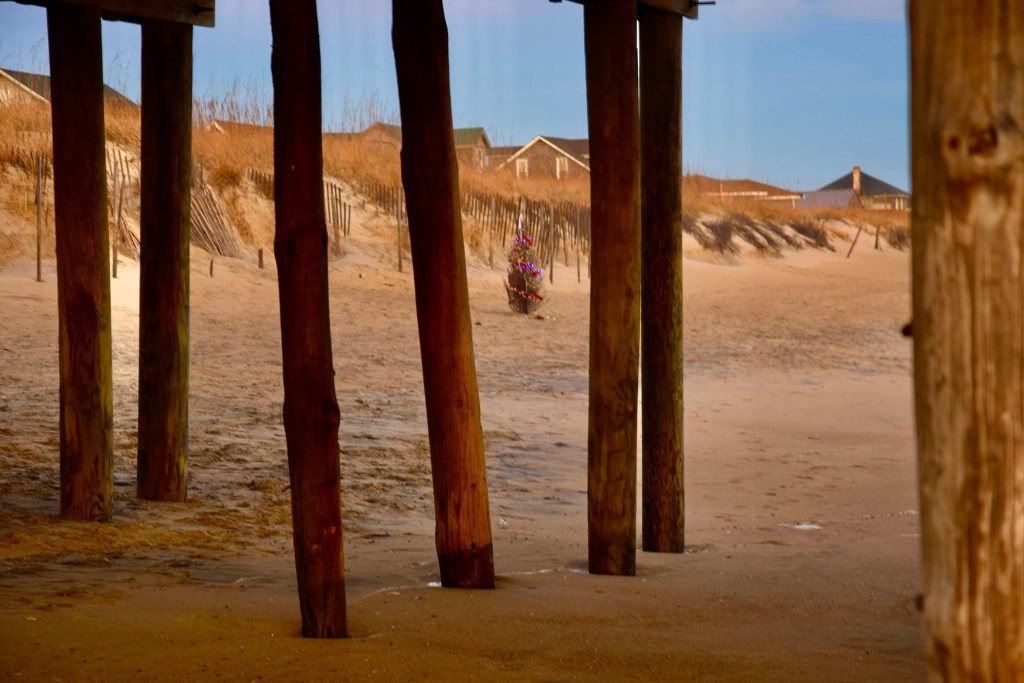
Beach Tree by Michelle Robertson

Walking in Darkness

The Gospel of John makes great use of dark and light imagery. John beautifully weaves metaphors of night and darkness with sin and death. Light becomes a symbol of Christ and hope. Even at the end of Judas’ betrayal story, John writes that Judas got up from the warmth of the supper in the upper room and went ”into the night.”

As we quickly approach Christmas this week, our neighborhoods, our trees, our banisters, and even our tacky sweaters are encased in light. We do this as a celebration of the Christ-child, who was born to be the ”Light of the World.” On Christmas Eve, we will finally light the Christ Candle in the center of our Advent Wreaths and proclaim that Christ is a Light that can never be extinguished. Amen!

John 8:12 says this: ”Then Jesus again spoke to them, saying, “I am the Light of the world; whoever follows Me will not walk in the darkness, but will have the Light of life.”

The Light of Life. Think about it! Following Jesus means that we have access to a light that will illuminate our path no matter what tragedy, temptation, or trial encumbers us. Like a flashlight, all we need to do is turn it on and point it toward the darkness.

Isaiah also wrote beautiful words about darkness and light. In the ninth chapter, we discover this passage, which tells us exactly why the Light of the World came:

Isaiah 9 (New Revised Standard Version)

The people who walked in darkness
    have seen a great light;
those who lived in a land of deep darkness—
    on them light has shined.
You have multiplied the nation,
    you have increased its joy;
they rejoice before you
    as with joy at the harvest,
    as people exult when dividing plunder.
For the yoke of their burden,
    and the bar across their shoulders,
    the rod of their oppressor,
    you have broken as on the day of Midian.
For all the boots of the tramping warriors
    and all the garments rolled in blood
    shall be burned as fuel for the fire.

And now for the Christmas part:
For a child has been born for us,
    a son given to us;
authority rests upon his shoulders;
    and he is named
Wonderful Counselor, Mighty God,
    Everlasting Father, Prince of Peace.
His authority shall grow continually,
    and there shall be endless peace
for the throne of David and his kingdom.
    He will establish and uphold it
with justice and with righteousness
    from this time onward and forevermore.
The zeal of the Lord of hosts will do this.

Jesus came to light up your situation. He came with so much power and might, there is no force of darkness you can encounter that could dull his wattage. He is the Mighty God, the Everlasting Father, and the Prince of Peace, who brings endless peace to the world.

Do you lack peace right now? Turn on the Light.

Darkness to Light by Stacey Hanf

Rescue Me

As you look at this picture, you will instantly notice that something has gone very wrong. A shrimp trawler named Bald Eagle II, traveling north from our neighboring town in Wanchese, lost its engines a week ago and drifted onto the shoals of this sandbar that we live on. The tide carried it right to the water’s edge, where it remained stuck on our beach for days.

Our heroic Coast Guard performed a dramatic rescue of the four crew members, pulling them from the dangerous boat one by one, by helicopter. Four men were saved. Then came the arduous task of having to carefully remove over 6500 gallons of fuel and an additional 1000 gallons of a watery oil mixture.

Think for a moment of the difficulty of saving this boat. Look at how it sits on the sand. Now think about how difficult it was to save humanity. The prophets remind us that people had fallen into sin and darkness beginning with Adam and Eve in the garden. This darkness overcame the world, and we needed a miracle to save us.

Today’s lectionary passage is a pre-Christmas reminder of why Jesus came to save us. In this Psalm, God is portrayed as both the Shepherd of Israel and the One whose face shines “so that we may be saved.” It is a good prayer for us as we slowly approach the birth of Christ and recall once again why he came. Christ was born to rescue us … because we could not rescue ourselves.

Psalm 80 (New Revised Standard Version)

Give ear, O Shepherd of Israel,
    you who lead Joseph like a flock!
You who are enthroned upon the cherubim, shine forth
    before Ephraim and Benjamin and Manasseh.
Stir up your might,
    and come to save us!

This is a psalm of Asaph which is thought to be written after the separation of the Northern Kingdom of Israel and the Southern Kingdom of Judea. The references here make it clear that the psalmist is asking God to save Israel, and so it is believed to have been written prior to the Assyrian take over in 721BC.

Restore us, O God;
    let your face shine, that we may be saved.

When God’s face shines, darkness and despair are obliterated. When Jesus came, he was described as the ”Light of the World,” dispelling darkness forever.

O Lord God of hosts,
    how long will you be angry with your people’s prayers?
You have fed them with the bread of tears,
    and given them tears to drink in full measure.
You make us the scorn of our neighbors;
    our enemies laugh among themselves.

Asaph knows that the apostasy and sin of the people have brought about their predicament. He senses God’s anger in what is about to happen, as Israel will fall into the hands of the enemy.

Restore us, O God of hosts;
    let your face shine, that we may be saved.

I am happy to report that the story of the Bald Eagle II has a much better ending. A small tug boat was dispatched, and it was able to move the trawler at high tide, taking it out to sea to a safe harbor where it can be repaired. Don’t you just love a happy ending?

You can have a happy ending, too. God is waiting for you to be fed up enough with your own darkness to cry out for rescue. Are you stuck in bad habits, inappropriate choices, or just plain out of hope? Call out for Jesus to come and rescue you. Your savior is on the way.

Rescue Me by Jennifer Thompson

“Chesed”-Love

Today’s devotional won’t feel very Christmassy until the very end. Promise me you will keep reading until you get there!

In Joshua chapter 2, we encounter Rahab, the pagan prostitute from Jericho, whose heroic actions save two Israelite spies from capture by her own king. The king confronts her, and she flat out lies:

Joshua 2 (Common English Bible)

But the woman had taken the two men and hidden them. Then she said, “Of course the men came to me. But I didn’t know where they were from. The men left when it was time to close the gate at dark, but I don’t know where the men went. Hurry! Chase after them! You might catch up with them.” But she had taken them up to the roof and hidden them under the flax stalks that she had laid out on the roof. The men from Jericho chased after them in the direction of the Jordan up to the fords. As soon as those chasing them went out, the gate was shut behind them.

Rahab sets terms

Before the spies bedded down, Rahab went up to them on the roof. She said to the men, “I know that the Lord has given you the land. Terror over you has overwhelmed us. The entire population of the land has melted down in fear because of you. 10 We have heard how the Lord dried up the water of the Reed Sea in front of you when you left Egypt. We have also heard what you did to Sihon and Og, the two kings of the Amorites on the other side of the Jordan. You utterly wiped them out. 11 We heard this and our hearts turned to water. Because of you, people can no longer work up their courage. This is because the Lord your God is God in heaven above and on earth below. 

 Rahab saved the day for the nation of Israel, but not in a typical hero fashion. She had no special powers and was not by any definition a “mighty warrior,” yet she used what she had to defeat the enemy. And what did she have? Words. Rahab accomplished her heroine’s mission by simply employing words to their full advantage. She shaded truths, boldly negotiated, and offered a deal to the spies that they simply could not refuse … and in doing so, she saved her entire family from the destruction of Jericho that wiped out the king, her creditors, and the rest of the population.
     Let’s take a look at one particular word which Rahab used like a weapon. In the twelfth verse, she says,

 “Now, I have been loyal to you. So pledge to me by the Lord that you in turn will deal loyally with my family. Give me a sign of good faith.”

When we dig into the Hebrew word for loyal in this sentence, we find Rahab’s secret power: she used the word chesed. Chesed is a type of loyal, loving-kindness that is part of the covenant relationship between God and Israel. It is a word that cannot be sentimentalized, but speaks to the strength and steadfastness that stem from that covenant relationship.[1] It is a reminder to the spies of their God, whose love for Israel was so great that God would never let them go, despite their actions. By choosing the word chesed, Rahab establishes her own covenant relationship with these men, relying on their understanding of what that truly meant. And in the end, her household was saved not only from death, but from the debt that had forced her into prostitution. Clever girl!

The connection to Christmas is obvious. There can be no greater expression of God’s chesed love for us than to send his only son to be born in a manger, walk among us, and die on a cross for our sins. Our ability to participate in Jesus’ resurrection is the finest example of loyal, loving-kindness we could ever hope for.

On Christmas morning, God filled the humble manger with an offering of covenant renewal that was given to both Jews and Gentiles alike. This gift of chesed is the world’s saving grace. And all we have to do is open it. Are you ready?

Christmas Holly by Kathy Schumacher


[1] A Theological Word Book of the Bible, by Norman H. Snaith (New York: MacMillan, 1951), pp.136-137.

I Just Can’t Wait to be King

I’m gonna be a mighty king, so enemies beware!
I’m gonna be the main event, like no king was before!
I’m brushing up on looking down, I’m working on my ROAR…
Oh, I just can’t wait to be king!”


I’m sure many of you recognize the lyrics to Simba’s theme song in the Disney production of “The Lion King.” This is the story of a young lion cub who desperately wants the fame, fortune, and attention that comes with being the king. Simba succumbed to the temptation of wanting praise and adoration for his bravery, and the seduction of knowing what was in the forbidden land. This information would give him superior knowledge over all of the animal kingdom, and he wanted that power. Simba’s ambitions set a series of events in motion that resulted in his father’s death and the young cub’s exile from Pride Rock. (Don’t miss the double meaning of Pride Rock: A pride is a collection of lions, and it was pride that led to Simba’s downfall.) Eventually Simba returned after a long period of humility and isolation that resulted in a realistic understanding of what kingship entails. He became a good king, and the story has a happy ending.


In our Scripture today, King Solomon’s story had a similar trajectory, but without the happy ending. Like Simba, Solomon succumbed to his temptations, ego, and ambitions. Pride was also a factor here, as were the seductions of wine, women, and song that attended a king of his stature. Solomon’s fall from his own “Pride Rock” was dramatic and devastating, resulting in the invasion of stronger armies, the fracturing of the Kingdom of Israel, and ultimately their exile from the very land God had given them. 
 

1 Kings 11:4-13 (Common English Bible)

As Solomon grew old, his wives turned his heart after other gods. He wasn’t committed to the Lord his God with all his heart as was his father David.Solomon followed Astarte the goddess of the Sidonians, and Milcom the detestable god of the Ammonites. Solomon did what was evil in the Lord’s eyes and wasn’t completely devoted to the Lord like his father David. On the hill east of Jerusalem, Solomon built a shrine to Chemosh the detestable god of Moab, and to Molech the detestable god of the Ammonites. He did the same for all his foreign wives, who burned incense and sacrificed to their gods. 

The Lord grew angry with Solomon, because his heart had turned away from being with the Lord, the God of Israel, who had appeared to him twice. 10 The Lord had commanded Solomon about this very thing, that he shouldn’t follow other gods. But Solomon didn’t do what the Lord commanded. 11 The Lord said to Solomon, “Because you have done all this instead of keeping my covenant and my laws that I commanded you, I will most certainly tear the kingdom from you and give it to your servant. 

Clearly, God ain’t playin’. It had always been the plan that God would reign as king, and the people of Israel would live together in peace and harmony. But after a series of prophets and judges overseeing them, they grew restless, hostile, and jealous. Finally they demanded that the prophet Samuel give them a king ”so that they could be like the other nations.” (1 Samuel 8:5). These stories remind us that we reject God at our own peril. Was there ever a time in your life when you rejected God? I bet it didn’t go well.

Even still, God’s amazing grace, his unfathomable mercy, and his unconditional forgiveness are offered to Solomon:

12 Even so, on account of your father David, I won’t do it during your lifetime. I will tear the kingdom out of your son’s hands. 13 Moreover, I won’t tear away the entire kingdom. I will give one tribe to your son on account of my servant David and on account of Jerusalem, which I have chosen.”

God preserves a part of Israel and the lineage of David in spite of Solomon’s sin, and that lineage led us to Jesus.

Christmas is a time to consider kings and kingship. Who is your king? What is on your throne? Have the foreign idols of celebrity worship, the blind following of popular politicians, hours upon hours of screen time, and reading more social media than your Bible become the things that you worship?

We are called back to the manger to worship the King of Kings, who is the Lord of Lords. Jesus is our one and only king, and he deserves our complete attention and obedience. To do anything less will result in danger and exile.

It is never too late to turn your heart back to God. Only then will you receive the blessings of the Prince of Peace.

King and Queen of the Animal Kingdom by Mark Poblete