Immediately

This weekend I was blessed to be invited to a nearby church to do a talk about on my book Psalms by the Sea. The organizer had done a terrific job planning the entire thing and had ordered my books from Amazon for the women who wanted to purchase them. Thinking that they would have the books in front of them, I prepared my presentation in a way that I could use volunteer readers and have some of the psalms read out loud together. When I got there, she told me that the books had not come yet, so I quickly shifted to a more “author book reading style,” which turned out just fine.

We joked about why the books failed to arrive on time. Our little island’s single curvy road is under construction. Perhaps the books are stuck at the first portable stop light waiting for the little flag to go up and the light to turn from red to yellow. Or perhaps Amazon sent them by boat and our recent high winds and strong waves were too much for the poor guy rowing them across the sound. Or maybe they had been delivered and were sitting outside the organizer’s house in an odd place. This has happened to all of us, as our beachy houses on stilts don’t have a discernible front door and we often find packages left days earlier in weird places.

So, when I read the assigned scripture today about Jesus calling Peter and Andrew to follow him, the word “immediately” jumped out at me:

Matthew 4 (Common English Bible)

18 As he walked by the Sea of Galilee, he saw two brothers, Simon, who is called Peter, and Andrew his brother, casting a net into the sea—for they were fishers. 19 And he said to them, “Follow me, and I will make you fishers of people.” 20 Immediately they left their nets and followed him. 

Wouldn’t it be lovely if things happened immediately?

“Georgia, stop barking.” And Georgia stopped immediately

“Kids, go get ready for school.” And the kids got ready immediately.

“Honey, it’s time to leave for the movie.” And honey got up from the couch, turned off the football game, and immediately got into the car.

“Immediately” would be such a blessing at the DMV, when you’re on the phone holding for a “representative,” or in the overcrowded Urgent Care waiting room. Peter and Andrew had been preveniently moved by the Holy Spirit to respond to Jesus’ invitation to drop everything and become a disciple.

21 As he went from there, he saw two other brothers, James son of Zebedee and his brother John, in the boat with their father Zebedee, mending their nets, and he called them. 22 Immediately they left the boat and their father and followed him.

Jesus surely had the power to move people immediately in a way that we don’t. I also think this scripture points out that we don’t respond to God’s calling quite as quickly as those early disciples, and perhaps we should learn from their example. It took me two years of discernment to decide to go into the ministry. These things must be thought out carefully but there are also times when God tells us to speak a kind word to someone who is hurting or stop what we are doing to attend to a need right in front of us and we ignore those prompts and continue to do our own thing.

Jesus Ministers to Crowds of People

23 Jesus went throughout all Galilee, teaching in their synagogues and proclaiming the good news of the kingdom and curing every disease and every sickness among the people.

This may be a stretch, but I wonder if the fact that his posse responded immediately to his call propelled Jesus into his teaching and healing ministries. He didn’t have to continue to go around Galilee looking for a team: they were in place, and he could turn his attention to his own calling.

Where is God calling you to do something immediately? It may be as small as a phone call you’ve been putting off, or as big as starting to plan a mission trip.

Whatever it is, do it.

Immediately!

Follow Me by Michelle Robertson

Strength to the End

Two of my friends lost their mothers in December, and it always brings back memories of my own mother’s passing when that happens. If you have lost your Mom, you understand the special kind of painful hole that her death creates in your soul. Your mother, whether she was good or not, whether she was supportive and encouraging or judgmental and harsh, was the very first person to know you from the inside-out. There is a blood bond or an adoptive bond that can’t be denied. And if your mother was good, the hole is cavernous and hard to navigate, especially in the first weeks and months. Her lack of presence in this world is disorienting and foreign.

I had a good mother, so I know this pain.

Our lectionary passage today has a beautiful phrase that made me think of my friends’ new grief and my own well-worn sadness over losing our mothers. The blessing of my mother’s passing came in the way she died, as we had spent the evening together and I made her tea and helped her get ready for bed. A few hours later she died in her sleep. We didn’t know it was coming. What a tremendous gift of grace that was!

God gave both of us strength for the end.

Paul assures the church of Corinth that God will also strengthen them to the end. This is a powerful promise that we can all grab ahold of when a loved one dies or as we face our own mortality. I think this can also apply to the end of a relationship, losing a job, graduating from college, moving away from your home, adult children going off on their own … all those things that at some point must come to an end.

Paul, called to be an apostle of Christ Jesus by the will of God, and our brother Sosthenes,

To the church of God that is in Corinth, to those who are sanctified in Christ Jesus, called to be saints, together with all those who in every place call on the name of our Lord Jesus Christ, both their Lord and ours:

Grace to you and peace from God our Father and the Lord Jesus Christ.

I give thanks to my God always for you because of the grace of God that has been given you in Christ Jesus, for in every way you have been enriched in him, in speech and knowledge of every kind— just as the testimony of Christ has been strengthened among you— so that you are not lacking in any gift as you wait for the revealing of our Lord Jesus Christ.

He will also strengthen you to the end, so that you may be blameless on the day of our Lord Jesus Christ. God is faithful, by whom you were called into the partnership of his Son, Jesus Christ our Lord.

In our end is our beginning; in our time, infinity;
In our doubt there is believing; in our life, eternity,
In our death, a resurrection; at the last, a victory,
Unrevealed until it’s season, something God alone can see.
(Hymn of Promise, Natalie Sleeth, UMH #707)

God is faithful indeed.

The End and the Beginning by Michelle Robertson

Come and See

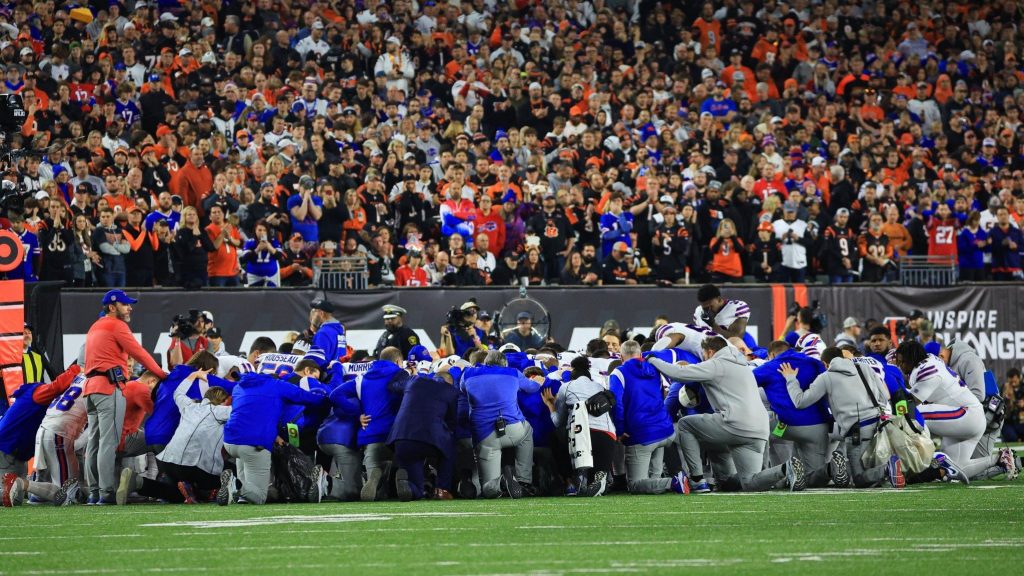
The images still haunt us. A healthy, young, 24-year-old athlete lay dead on the football field. Players who surrounded him were weeping. An ambulance drove across the grass as an athletic trainer performed CPR for nearly 10 minutes. An AED was used to shock the young man’s heart back into life. Oxygen was administered. When he was finally stabilized enough for transport, he was taken to the ICU of the nearest hospital, which happened to be only two miles away. Today, Damar Hamlin is recovering and making tremendous strides. He is breathing on his own and talking. Thanks be to God!

This morning I read a thread on Twitter from a hospital chaplain asking that people not label this as a “miracle.” His reasoning is that by labeling everyday medical procedures as miracles “we end up with people who deny its legitimacy.” A doctor retweeted it and gave a lengthy explanation of all the step-by-step medical science that was the reason for Hamlin’s recovery, calling each step a miracle. I have to say I’m with the doc on this one. The doctor saw what the chaplain couldn’t. God was with Hamlin every step of the way. Life after death is a miracle. I don’t care what avenues of medical science God uses … he is still the author of all life who performs miracles every day. Who’s with me on this?

Today’s lectionary passage is all about people seeing for themselves. Jesus invites us all to “come and see.”

John 1 (The Message)

29-31 The very next day John saw Jesus coming toward him and yelled out, “Here he is, God’s Passover Lamb! He forgives the sins of the world! This is the man I’ve been talking about, ‘the One who comes after me but is really ahead of me.’ I knew nothing about who he was—only this: that my task has been to get Israel ready to recognize him as the God-Revealer. That is why I came here baptizing with water, giving you a good bath and scrubbing sins from your life so you can get a fresh start with God.”

32-34 John clinched his witness with this: “I watched the Spirit, like a dove flying down out of the sky, making himself at home in him. I repeat, I know nothing about him except this: The One who authorized me to baptize with water told me, ‘The One on whom you see the Spirit come down and stay, this One will baptize with the Holy Spirit.’ That’s exactly what I saw happen, and I’m telling you, there’s no question about it: This is the Son of God.”

Come, See for Yourself

35-36 The next day John was back at his post with two disciples, who were watching. He looked up, saw Jesus walking nearby, and said, “Here he is, God’s Passover Lamb.”

37-38 The two disciples heard him and went after Jesus. Jesus looked over his shoulder and said to them, “What are you after?”

They said, “Rabbi” (which means “Teacher”), “where are you staying?”

39 He replied, “Come along and see for yourself.”

I believe miracles are happening all around us every day. From the profound to the ordinary, God is present. Here is an example from the mundane: my husband and I drove 12 hours on I-95 through four states a few days ago and never once slowed down. If you’ve ever driven that route, you know that was a miracle!

They came, saw where he was living, and ended up staying with him for the day. It was late afternoon when this happened.

40-42 Andrew, Simon Peter’s brother, was one of the two who heard John’s witness and followed Jesus. The first thing he did after finding where Jesus lived was find his own brother, Simon, telling him, “We’ve found the Messiah” (that is, “Christ”). He immediately led him to Jesus.

Jesus took one look up and said, “You’re John’s son, Simon? From now on your name is Cephas” (or Peter, which means “Rock”).

Finding the Messiah in the ordinary is miraculous. Receiving grace and compassion from a stranger is a miracle. God sending his son to forgive the sins of the world was the best miracle of all. You have the opportunity to come and see this Passover Lamb for yourself and then invite others.

Come and see!

The Power of Prayer photo by the New York Times via Facebook

Supernova

“Whatever it was, it is significant that God met them in their own medium.”

This powerful quote from David Guzik’s “Enduring Word” commentary on Matthew 2 caught my breath away. I do a fair amount of commentary reading on each scripture that I am studying and sometimes a single beautiful sentence will take my thinking into a different place.

So, let’s back up and unpack this.

We are in that familiar place in the post-nativity drama where King Herod had just discovered that Jesus was born. In his anxious paranoia, he immediately set out to destroy anyone who might challenge his fragile grip on his throne. The scriptures record that he was frightened, and his fear of this usurper baby spread throughout his minions and his city.

Enter the magi, which is translated to astronomer or philosopher. These men studied the skies, the stars, the planets, and the ancient astrological predictions. They realized that a king had been born to the Jews. Not kings themselves, these curious scientists traveled many miles following Christ’s star to Bethlehem:

Matthew 2 (Common English Bible)

2 In the time of King Herod, after Jesus was born in Bethlehem of Judea, magi from the east came to Jerusalem, asking, “Where is the child who has been born king of the Jews? For we observed his star in the east and have come to pay him homage.” When King Herod heard this, he was frightened, and all Jerusalem with him, and calling together all the chief priests and scribes of the people, he inquired of them where the Messiah was to be born. They told him, “In Bethlehem of Judea, for so it has been written by the prophet:

‘And you, Bethlehem, in the land of Judah,
    are by no means least among the rulers of Judah,
for from you shall come a ruler
    who is to shepherd my people Israel.’ ”

The Jewish scholars confirmed what the Eastern astronomers knew: something astronomical had happened and it needed to be seen. When the magi reached the place where the Epiphany star rested over Bethlehem they were overwhelmed with joy.

Then Herod secretly called for the magi and learned from them the exact time when the star had appeared. Then he sent them to Bethlehem, saying, “Go and search diligently for the child, and when you have found him, bring me word so that I may also go and pay him homage.” When they had heard the king, they set out, and there, ahead of them, went the star that they had seen in the east, until it stopped over the place where the child was. 10 When they saw that the star had stopped,  they were overwhelmed with joy. 

Let us stop here for a moment as well.

The magi were gentiles. They were not Jews who had anticipated the Messiah’s arrival for generations. They were stargazers, and planet-watchers … in other words, men of learning and science. Religion paid no part in their quest; they were drawn by the appearance of a spectacular vision in the heavens and their curiosity drove them to find answers. Or, as Guzik states, “Whatever it was, it is significant that God met them in their own medium.” Planets, stars, imploding new universes, supernovas … whatever that “star”was, God chose their medium to communicate the birth of his son to them. He spoke to them from the star, knowing that they were looking at the skies.

God always speaks to us in our own medium. He uses people, situations, events, callings, tragedies, blessings, joy, etc. to speak his language of love and hope into our lives.

Are you listening?

11 On entering the house, they saw the child with Mary his mother, and they knelt down and paid him homage. Then, opening their treasure chests, they offered him gifts of gold, frankincense, and myrrh. 12 And having been warned in a dream not to return to Herod, they left for their own country by another road.

God also speaks words of warning into our lives when we are headed in the wrong direction. How hard he works to keep us going in the right direction! How disappointed he must be when we continue to go our own way, despite his warnings.

God invites us to look around today and discover where he is speaking to us. And then we are invited to follow.

That’s what wise people do.

This image is dominated by NGC 7469, a luminous, face-on spiral galaxy approximately 90 000 light-years in diameter that lies roughly 220 million light-years from Earth in the constellation Pegasus. Its companion galaxy IC 5283 is partly visible in the lower left portion of this image. This spiral galaxy has recently been studied as part of the Great Observatories All-sky LIRGs Survey (GOALS) Early Release Science program with the NASA/ESA/CSA James Webb Space Telescope, which aims to study the physics of space. Photo credit to the James Webb Space Facebook page.

Navel-Gazing

Navel-gazing is the habit of excessive contemplation on a single issue at the expense of being able to see the wider view of the bigger picture. The image that comes to mind with this phrase is a person with their head bent low, not looking up and not engaging in the world around them. Focusing on their own navel, they never see what God is doing in the midst of their crisis.

Today’s beautiful psalm begins with an antidote to navel-gazing. The psalmist reminds us to look up. It is an instruction to lift up our eyes and look heavenward. This is what he did, and he saw God’s presence.

Psalm 121 (New International Version)

I lift up my eyes to the mountains—
    where does my help come from?
My help comes from the Lord,
    the Maker of heaven and earth.

Whatever you are dealing with right now, ask yourself this: where does your help come from? Too often we look the wrong direction for direction. We look to social media to confirm our bias. We look to alcohol and drugs to numb our distress. We look to gossip and over-sharing to assuage our anxiety. We look to movies and television to help us ignore reality. We look in all the wrong places because they are easy to obtain. But our only real help comes from the Lord. Lift up your eyes!

He will not let your foot slip—
    he who watches over you will not slumber;
indeed, he who watches over Israel
    will neither slumber nor sleep.

This is a powerful reminder of what happens when we look to God to help us and completely yield our situation to him. He won’t let your foot slip. In all of those moments when you awaken at 4:00 in the morning and can’t get back to sleep because your problems keep running through your mind, God is already on watch.

The Lord watches over you—
    the Lord is your shade at your right hand;
the sun will not harm you by day,
    nor the moon by night.

Psalm 121 is a pilgrimage song that was sung as the people journeyed to Jerusalem. They had to walk over hills and through valleys that were surrounded by mountains. There was danger on the road. Robbers would hide in the hills and attack them. The sun beat down on them by day and the moon exposed their position by night. But God provided a protection of shade for them, as he will for you.

The Lord will keep you from all harm—
    he will watch over your life;
the Lord will watch over your coming and going
    both now and forevermore.

Knowing that God watches over us is a blessing of comfort and assurance. The promise that God will keep you from harm is something you can count on now, and forevermore. When we entirely yield our lives to his safe keeping, we walk in his peace. When that happens, the only kind of navel-gazing you will need is to bow your head in a prayer of submission and thanksgiving and let it all go to him.

The Lord is your keeper! Thanks be to God.

I Lift Up My Eyes by David Bevel Jones

The Time is Coming

Our lectionary passage today comes from a time in Old Testament history when God was about to restore Israel and Judah and bring the people home. He had allowed the infiltration of foreign armies to come in and decimate them, but the time was coming soon for the people to be returned from the diaspora and reclaim their land. A lot had happened since they left, and their understanding of the Law, the covenant, and their relationship with God had been diluted during their time in Babylon and beyond. But God remembered his covenant and told the prophet Jeremiah that the return to their promised land was upon them:

Jeremiah 31 (Common English Bible)

27 The time is coming, declares the Lord, when I will plant seeds in Israel and Judah, and both people and animals will spring up. 28 Just as I watched over them to dig up and pull down, to overthrow, destroy, and bring harm, so I will watch over them to build and plant, declares the Lord. 29 In those days, people will no longer say:

Sour grapes eaten by parents
    leave a bitter taste in the mouths of their children.
30 Because everyone will die for their own sins:
    whoever eats sour grapes
    will have a bitter taste in their own mouths.

Several generations had been born and had died during the time that they were away from Israel and Judah. The sins of the fathers had taken a toll on the children. But God’s new covenant with his people would be different.

31 The time is coming, declares the Lord, when I will make a new covenant with the people of Israel and Judah. 32 It won’t be like the covenant I made with their ancestors when I took them by the hand to lead them out of the land of Egypt. They broke that covenant with me even though I was their husband, declares the Lord. 

33 No, this is the covenant that I will make with the people of Israel after that time, declares the Lord. I will put my Instructions within them and engrave them on their hearts. I will be their God, and they will be my people. 34 They will no longer need to teach each other to say, “Know the Lord!” because they will all know me, from the least of them to the greatest, declares the Lord; for I will forgive their wrongdoing and never again remember their sins.

God desired now to put his instructions within each person, engraving the Law and his promises on their hearts. No longer would they have to depend on the priest to mete out scriptural teaching … God desired that everyone know him. And knowing him came with forgiveness of their past sins, which God promised to forget.

This scripture is a great reminder to us today of the importance of personal bible study, daily devotions, prayer, and meditation. We cannot rely on the pastor or priest for scriptural instruction, but rather are invited to know God in our hearts and minds for ourselves. Considering that multiple Bible translations are right in your phone, that task has never been easier.

God desires to KNOW you and be known by you. Isn’t it amazing to think that the Creator of the universe wants a relationship with you? Thanks be to God.

Looking for a new devotional book? Psalms by the Sea is now available at Amazon.

Moonrise by Victor Miles

East, West, North, and South

Have you ever lost something or someone very significant to you? Loss is a crushing thing, whether it’s the loss of a job, a marriage, a loved one, a home, a rebellious child … and many times when we endure a loss, we feel that God is lost from us as well. It is a normal reaction to the shock of being separated from that thing or person that you so desperately loved.

Job struggled with this when God allowed Satan to test Job’s righteousness. In a matter of days, he lost everything, including his wife and children, who perished together when a mighty wind from the desert caused their house to collapse on them. He was left with the company of useless friends for comfort. In the midst of his tremendous loss, he cried out that he could not find God anywhere in the void of all that has been taken from him: 

Job 23 (New International Version)

Then Job replied: 

“Even today my complaint is bitter; his hand is heavy in spite of my groaning. If only I knew where to find Him; if only I could go to His dwelling! I would state my case before him and fill my mouth with arguments. I would find out what he would answer me, and consider what he would say to me. Would he vigorously oppose me? No, he would not press charges against me. There the upright can establish their innocence before him, and there I would be delivered forever from my judge.

But if I go to the east, he is not there; if I go to the west, I do not find him. When he is at work in the north, I do not see him; when he turns to the south, I catch no glimpse of him.”

Part of Job’s perspective about the loss of his property and the death of his sons and daughters was that God was nowhere to be found. Indeed, many people feel the exact same thing. Their perspective of death includes the notion that they have experienced the complete abandonment of God.

Even Jesus, in His moment of agony on the cross, cried out: 

“My God, my God! Why have you forsaken me?” (Matthew 27:46, NIV) 

But God’s response to Job illuminates exactly where God is and has been in the midst of all of our temporal struggles:

Job 38 (New International Version

4“Where were you when I laid the earth’s foundation? Tell me, if you understand.
Who marked off its dimensions? Surely you know! Who stretched a measuring line across it? 

On what were its footings set,
or who laid its cornerstone
while the morning stars sang together
and all the angels shouted for joy?”

God reminds Job that as Author of creation of the earth, he was there when the morning stars sang their first song together; he was the One who marked off the depth and breadth of the earth. He was and always will be THERE…. and where was Job? In this seemingly harsh response, God is reminding Job about the temporary nature of Job’s fleeting life in comparison to the magnitude of creation, which has been brought forth over the span of eternity. In God’s perspective, Job’s complaint is but a fleeting second in the context of Time.

God is in every moment of our being. 

From God’s point of view, death is not the worst thing. In fact, death isn’t even the last thing; death never gets the last word. Hear these words from the book of Romans: 

Romans 8 (NIV)

“Who shall separate us from the love of Christ? Shall trouble or hardship or persecution or famine or nakedness or danger or sword? No, in all these things we are more than conquerors through him who loved us. For I am convinced that neither death nor life, neither angels nor demons, neither the present nor the future, nor any powers, neither height nor depth, nor anything else in all creation, will be able to separate us from the love of God that is in Christ Jesus our Lord.

So, we see here that nothing, even death, can separate us from God. 

Are you struggling with a loss today? Take heart. God is wholly centered in your situation with you. You are not alone. Thanks be to God!

Today’s devotional is an excerpt from Mourning Break, available at Amazon.

Morning Break by Michelle Robertson

Grateful

We recently studied the passage from Luke 17 where Jesus healed ten lepers and only one came back to thank him. In that devotional, we were reminded to give thanks to God in all seasons and for all things, and never take what we have, who we are, and what our future holds for granted. Some of you commented that it was a much-needed reminder. One commenter said she got “pinged”. When that happens, I hope you know that it isn’t me doing the pinging!

Today, we will practice offering God the thanksgiving he deserves. This eloquent psalm focuses on all the reasons to thank God. We thank him for his works. We thank him for his righteousness. We thank him for the company of our congregation. We thank him for food, wonderful deeds, grace, mercy, power, our heritage … everything. Are you having a bad day/week/year? Read this one aloud. Twice.

Psalm 111 is an acrostic psalm, which means that each line of the psalm starts with a letter in the order of the Hebrew alphabet. Acrostic psalms were written to help people memorize them, much as elementary school kids do when they learn the song about the state capitals in alphabetic order. I know adults who can still sing the State Capitals song. Can you?

I can’t imagine the skill it would take to write a piece of poetry like this and ensure that every verse started with a specific letter in the alphabet. We should endeavor to memorize it for that very reason.

Psalm 111 (New Revised Standard Version Updated Edition)

Praise the Lord!
I will give thanks to the Lord with my whole heart,
    in the company of the upright, in the congregation.

Giving thanks with our whole heart is something God deserves from us. Charles Spurgeon put it this way: “God cannot be acceptably praised with a divided heart, neither should we attempt so to dishonor him; for our whole heart is little enough for his glory, and there can be no reason why it should not all be lifted up in his praise.” Wise words.

Great are the works of the Lord,
    studied by all who delight in them.
Full of honor and majesty is his work,
    and his righteousness endures forever.
He has gained renown by his wonderful deeds;
    the Lord is gracious and merciful.
He provides food for those who fear him;
    he is ever mindful of his covenant.

God’s covenant with his people is a pledge to give protection, provision, and blessing. When the psalmist says that God is mindful of his covenant and that he has commanded his covenant to last forever, he reassures the reader that God’s promises last forever. As modern Christian readers, we know that God’s covenant was fulfilled on the cross when he sent his only son for the salvation of the world. Through Jesus, we received a new covenant. Thank God!

He has shown his people the power of his works,
    in giving them the heritage of the nations.
The works of his hands are faithful and just;
    all his precepts are trustworthy.
They are established forever and ever,
    to be performed with faithfulness and uprightness.
He sent redemption to his people;
    he has commanded his covenant forever.

Holy and awesome is his name.

10 The fear of the Lord is the beginning of wisdom;
    all those who practice it have a good understanding.
    His praise endures forever.

I always prefer to understand the word “fear” in these passages as “reverential trust.” This word is not meant to imply quaking and trembling in terror before a powerful entity, but rather it portrays a picture of a respectful reverence that acknowledges God’s power and might and our insignificance. Only by grace may we approach the throne. But approach it, we may.

Holy and AWESOME is his name!

Grateful for Sunsets

Ungrateful

I am working on a book on Psalms (hopefully available on Amazon soon!) and I have organized it into a five-week study for small groups. Each week will focus on a type of psalm: praise, lament, trust, wisdom, and thanksgiving. As I was writing the leader’s guide chapter on Psalms of Thanksgiving, I wrote a discussion question that made me wonder what my own response would be: “Do you remember to thank God for everything he has given you?” I pondered that for a moment. Do I? Do you? Or do we take this life, this world, these homes, our families, good health, our food, and our jobs all for granted? Do we just go along living our lives and act like we’re entitled to everything? Or worse, do we think we have earned it all by the work of our hands alone?

I have a family member who would argue that she has worked for everything she has. Her lifestyle is a result of her hard work, her persistence, and her skills. I have no argument with that. Surely these things have served her well. But I believe that her work ethic was passed down from generations of people who worked God’s harvest before her and taught her that value. I believe her persistence is a personality trait that was knit into her by God when he formed her in the womb. And I believe that God gives us skills and spiritual gifts with which we can serve him and sustain our families. I don’t think there is anything we have for which we can take sole credit. God is the creator of everything, even our ability to earn a living. For that I thank God!

Our lectionary passage today tells a wonderful story of healing. Jesus was doing his thing, traveling between Samaria (where his type was not received) and Galilee (where his type belonged). Upon entering a village, he met ten men who desperately needed healing:

Luke 17 (Common English Bible)

11 On the way to Jerusalem, Jesus traveled along the border between Samaria and Galilee. 12 As he entered a village, ten men with skin diseases approached him. Keeping their distance from him, 13 they raised their voices and said, “Jesus, Master, show us mercy!”

14 When Jesus saw them, he said, “Go, show yourselves to the priests.” As they left, they were cleansed. 

It is interesting to note that a measure of obedience was required from the men. They were being asked to step out on faith and participate in their healing. They had to go to the priests. Their healing was not just doled out to them. It is also noteworthy that their common disease had broken down the societal barriers that normally stood between Samaritans and Jews. They were a mixed group, bound together in misery … and hope.

15 One of them, when he saw that he had been healed, returned and praised God with a loud voice. 16 He fell on his face at Jesus’ feet and thanked him. He was a Samaritan. 17 Jesus replied, “Weren’t ten cleansed? Where are the other nine? 18 No one returned to praise God except this foreigner?” 19 Then Jesus said to him, “Get up and go. Your faith has healed you.”

The Samaritan was doubly blessed. While all ten received physical healing, only he returned to Jesus for a healing of heart and received an additional blessing of faith. The foreigner became the faithful.

I think that if we look hard enough, we can always find something to be grateful for. Bible commentator Matthew Henry was once robbed of his wallet. That night he wrote in his diary all the things he was grateful for. He was grateful that he had never been robbed before. He was thankful that they took his wallet but not his life. He wrote that even though they took all his money, it wasn’t very much. Finally, he gave thanks that he was the one who was robbed and not the one who did the robbing.

Do you owe God a debt of thanksgiving? Has he done anything for you lately? Don’t be ungrateful. It is never too late to return to the Lord with an attitude of gratitude.

He deserves no less from us.

Pink Sky Blessings

Undeserved

Last week I was in the Norfolk airport and stumbled upon someone’s driver’s license lying on the floor. It had been lying face down and many people had just walked by it, assuming it was trash. The small holographic image of the woman’s face caught my eye and when I turned it over, lo and behold it was a New York State driver’s license. I quickly looked around to see if anyone who matched the picture was frantically looking for it, but nobody was.

So, I took the license to the Southwest gate and waited patiently while a ramp worker was processing a gate check for a stroller. He was the only one working the gate. He took a phone call while I waited, did some computer work, then asked if he could help me.

I showed him the license and he immediately checked his manifest, and sure enough, the woman was listed on a flight leaving from that gate an hour after my flight. I was relieved to know that he would eventually be able to find her when she attempted to board. He asked me to wait while he made a few PA announcements asking for her to come to the gate. She did not respond. I was ready to leave at that point, knowing the license was in good hands, but then he asked me my name and requested that I wait while he assisted another customer. He said he had something for me.

When he finally was able to turn his attention back to me, he reached under the desk and said, “I have something for you.” Southwest is known for their great sense of humor and attention to customer care, and I thought perhaps he was going to give me a key chain or even a free drink coupon.

He handed me a Southwest voucher for $100.

I gasped a little as he explained how to use it, and I said, “Sir, I can’t accept this! I don’t deserve something for simply being a Good Samaritan and picking up a driver’s license off the floor.” At that point another gate agent had joined him, and she was grinning. He looked me in the eye and said, “Is this the first time we have met?” I replied, “Yes, it is.” And he said, “Well now you know me, and this is what I do.” The other gate agent nodded and said, “Yep. It’s no use arguing. This is just how he is!” I smiled at him and said, “Well in that case, I’ll let you be you! Thank you so much.”

Do you think Jesus has returned and is working gate A5 at the Norfolk airport?

Giving us things that we don’t deserve is Jesus’ way. It’s called grace.

Titus 3 (Common English Bible)

 But when the kindness and love of God our Savior appeared, he saved us, not because of righteous things we had done, but because of his mercy. He saved us through the washing of rebirth and renewal by the Holy Spirit, whom he poured out on us generously through Jesus Christ our Savior, so that, having been justified by his grace, we might become heirs having the hope of eternal life.

Jesus saved us, not because of anything we have done or could do, but because of his grace. God’s kindness and love appeared on earth in the form of Jesus, who brought us unconditional love and unmerited favor. His grace is poured out generously on us, making us the recipients of eternal life. Jesus went to the cross on our behalf and extends a free voucher of forgiveness and acceptance.

If you haven’t accepted Christ as your personal Lord and loving Savior, now is the time. Your flight has been called and it’s almost time to board. Won’t you accept this amazing, underserved gift? It will change your life forever.

Grace by Kathy Schumacher