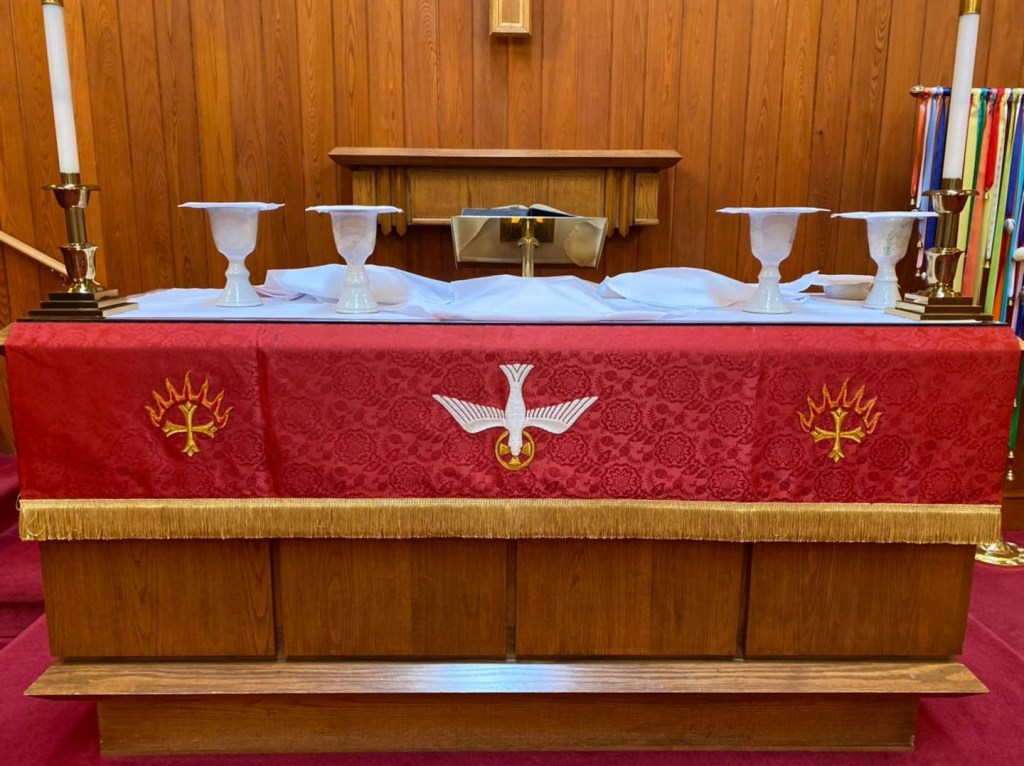
First Fruit

This last Fourth of July was an extremely hot day, so my husband and I opted to spend part of it watching the movie “Independence Day.” It is a blockbuster adventure about a massive alien attack on earth, and how a handful of pilots and a nerdy scientist saved the day. My pilot husband especially enjoyed that part of the plot. I thought about this movie today as I read the account from Acts about the events that happened 10 days after Jesus ascended into heaven. He had instructed his disciples to wait in Jerusalem for a gift that would come from heaven.

The scene must have looked like a modern day science fiction movie. People were milling about, having come to Jerusalem for a celebration of the Feast of the First Fruits, also known as the Pentecost. This Jewish celebration was held exactly 50 days after Passover and was well attended by pious Jews from all around. The pleasant weather and the joyful nature of the event made it very popular. First fruits represented the best of the new harvest. The finest wheat, the perfect grapes, the unblemished sheep … only the best would do. The festival was prescribed in Numbers 28:26: “‘On the day of first fruits, when you present to the Lord an offering of new grain during the Festival of Weeks, hold a sacred assembly and do no regular work” (Numbers 28:26, New International Version).

Who doesn’t like a day off of work?

Acts 2 (Common English Bible)

When Pentecost Day arrived, they were all together in one place. Suddenly a sound from heaven like the howling of a fierce wind filled the entire house where they were sitting. They saw what seemed to be individual flames of fire alighting on each one of them. They were all filled with the Holy Spirit and began to speak in other languages as the Spirit enabled them to speak.

The sudden appearance of flame and wind must have been disturbing and surreal. They were anticipating the usual Temple service, replete with altar sacrifices and the presentation of crops, and now this. Can you imagine?

There were pious Jews from every nation under heaven living in Jerusalem. When they heard this sound, a crowd gathered. They were mystified because everyone heard them speaking in their native languages. They were surprised and amazed, saying, “Look, aren’t all the people who are speaking Galileans, every one of them? How then can each of us hear them speaking in our native language? Parthians, Medes, and Elamites; as well as residents of Mesopotamia, Judea, and Cappadocia, Pontus and Asia, 10 Phrygia and Pamphylia, Egypt and the regions of Libya bordering Cyrene; and visitors from Rome (both Jews and converts to Judaism), 11 Cretans and Arabs—we hear them declaring the mighty works of God in our own languages!” 

We understand this to be a reversal of the Tower of Babel debacle from Genesis 11. In that situation, God deliberately confused all of humanity’s languages so that the people couldn’t plot and scheme by communicating with one another. Any idea of human superiority was humbled in that moment. So when the powerful word of the disciples proclaiming the good news of Jesus Christ was suddenly heard and understood in every dialect, they were surprised and bewildered. The power of the Holy Spirit came down upon them with such force that even in the midst of revelation, amazement still reigned.

12 They were all surprised and bewildered. Some asked each other, “What does this mean?” 13 Others jeered at them, saying, “They’re full of new wine!”

Some scholars see this as the fulfillment of the Levitical instructions on what to bring to the altar in order to consecrate the first fruits at Pentecost. In Leviticus 23:15-22, we see the instructions to the priest to hold up two loaves of leavened bread at the altar as a “wave offering”. Why two?

17 From wherever you live, bring two loaves made of two-tenths of an ephah of the finest flour, baked with yeast, as a wave offering of firstfruits to the Lord (Leviticus 23: 17, New International Version).

Theologian Charles Spurgeon suggested that one loaf represented the saving of Israel, and the other loaf, the saving of the Gentiles. Jesus Christ, the only son of God, was the First Fruit of heaven. And indeed, on the day of Pentecost in Acts, the church began with a mission to offer salvation to both Jew and Gentile alike.

What do you think represents your first fruit? What resource, gift, ability, or strength are you willing to commit to the Lord? Is it your very best? May we joyfully offer our very best at the altar.

The First Fruit of God by Kathy Schumacher

Make the Connection

Have you ever been in a situation where you encounter a new thing, person, or place and your mind is realizing that there is some connection to be made? My husband had a conversation like that with our neighbor. We knew that both of them were raised in Navy families, and also knew at different times of their lives they lived in the Virginia Beach area. But one evening a conversation led them to realize that the houses they lived in were in the same neighborhood, which meant … you guessed it … they went to the same Elementary school. Instant connection! Suddenly the conversation switched to remembering favorite teachers, playground memories, what it was like to walk to that school, etc. The familiar became really familiar in that moment.

I felt that way when I read Isaiah 66. This well-loved Old Testament prophet wrote about a “new heaven and a new earth” and I realized a connection with his vision and the words written in Revelation. Another random connection is the number 66. This is from the 66th chapter of Isaiah, and Revelation is the 66th book of the Bible.

Today’s Scripture is a journey into what happens at the end. The Old Testament prophet talks about how God will gather all the nations and cultures together to see his glory, and points to the new heavens and new earth that God will create.

Isaiah 66 (Common English Bible)

18 Because of their actions and thoughts, I’m coming to gather all nations and cultures. They will come to see my glory. 19 I will put a sign on them, by sending out some of the survivors to the nations, to Tarshish, Libya, and Lydia, and to the archers of Cilicia and Greece—distant coastlands that haven’t heard of my fame or seen my glory. They will declare my glory among the nations. 20 They will bring your family members from all nations as an offering to the Lord—on horses, in chariots, in wagons, on mules, and on camels—to my holy mountain Jerusalem, says the Lord, like Israelites bringing an offering in purified containers to the Lord’s house. 21 I will select some of them as priests and Levites, says the Lord.

22 As the new heavens and the new earth that I’m making will endure before me, says the Lord,
    so your descendants and your name will endure.
23 From month to month and from Sabbath to Sabbath,
    all humanity will come to worship me, says the Lord.

People love to speculate about the end times. Scholars, Bible study teachers, preachers, and the average Joe in the pew have differing ideas about what will happen when Jesus returns to claim his kingdom. Scriptures from Matthew, Second Corinthians, Ephesians, Daniel, Acts, Revelation, etc. sketch out what will occur. The study of end times theology is called eschatology. Notice the connection between Isaiah 66 and these passages from Revelation:

Revelation 7 (Common English Bible)

After this I looked, and there was a great crowd that no one could number. They were from every nation, tribe, people, and language.

Revelation 21 (Common English Bible)

Then I saw a new heaven and a new earth, for the former heaven and the former earth had passed away, and the sea was no more. I saw the holy city, New Jerusalem, coming down out of heaven from God, made ready as a bride beautifully dressed for her husband. 

One connection I hope we make today is that heaven will be filled with people from all nations, races, cultures, and languages. Why do we struggle so much to get along on earth? Why do we war with one another when in eternity, all those “differences” will be set aside?

Perhaps this is a good reminder to do everything we can to live each day as though it we are living in heaven on earth. People, get ready! Heaven awaits.

Heaven on Earth by Michelle Robertson

Power Lifting

Want to learn more about theology? Talk to a three-year-old. The study of theology should include a mandatory class on how three-year-olds experience God. All of the books, commentaries, studies, and wise masters of thought can’t hold a candle to the simple observation of these tiny theologians.

Many years ago I had a chance to be schooled by my then three-year-old grandson Connor. He put my seminary years to shame. And to the test. One morning we came upon a dead bird on the street on our walk. I remember my alarm bells instantly going off. Danger, danger, warning, Will Robinson!! You’re going to have to explain death in a minute! Sure enough:

Connor: What’s that?

Me: Oh, that’s a dead bird, Sweetie.

Connor: How did it die?

Me: It looks like maybe it fell out of its nest. (Or was attacked and dropped by a larger predator bird … quick .edit. … yeah, it fell out of its nest.)

Connor: Will it wake up?

This is when my sweating turned to praying. The concept of death is a terrible struggle for an adult, much less a concrete, literal thinker who has only been on the planet for 36 months.

Me: No, it won’t.

Connor: Then where will it go?

AHA! Something I know about! Here is a chance to talk to this boy about heaven! Eternal Life! The power of God! The hope! Something I can explain!

Me: It will go to heaven and live with Jesus.

Connor: How will it get there?

Me: God will take it there.

Connor: But how can God lift it up?

Enough with the concrete thinking, young man. We live by faith, not by sight! Boy was he putting my education to the test … and then I remembered a song he had just sung at his pre-school end-of-year program. Thanking God for all things Presbyterian, I said:

Me: Remember the song you just sang at pre-school?

Connor: Yes!

He started to sing “What a Mighty God We Serve.” I started to breathe again.

Me: So God is mighty enough to take the bird up to heaven.

Connor: Can God lift up a bird?

Me: Yes.

Connor: Can God lift up a bush?

Me: Yes.

Connor: Can God lift up a boat?

Me: Yes.

Connor: But God can’t lift up a cactus.

Me: Why not?

Connor: Because he will get a pokey poke.

Me: Its OK, God is stronger than a pokey poke.

We then worked through how God can lift up houses, helicopters, and sharks, even though they bite.

So, I have a simple question for you today. What are you carrying that is impossibly heavy? What burden, sin, problem, or regret are you lugging around that is absolutely crushing you?

And the second question is: Why?

Isaiah 40 ( Common English Bible)
Look up at the sky and consider:
    Who created these?
    The one who brings out their attendants one by one,
    summoning each of them by name.
Because of God’s great strength
    and mighty power, not one is missing.
27 Why do you say, Jacob,
    and declare, Israel,
    “My way is hidden from the Lord,
    my God ignores my predicament”?
28 Don’t you know? Haven’t you heard?
    The Lord is the everlasting God,
    the creator of the ends of the earth.
    He doesn’t grow tired or weary.
His understanding is beyond human reach,
29     giving power to the tired
    and reviving the exhausted.
30 Youths will become tired and weary,
    young men will certainly stumble;
31     but those who hope in the Lord
    will renew their strength;
    they will fly up on wings like eagles;
    they will run and not be tired;
    they will walk and not be weary.

God can lift up any impossible thing that is weighing you down. He can lift you up on eagle’s wings, but only if you let him. Why carry it any longer? Give it over to God and let him do the heavy lifting from now on.

Fly Away by Michelle Robertson

The Permanent Rule

Do you ever wonder why priests and pastors lift certain things up during worship? You’ve probably watched as the chalice, the paten, the bread, the offering plates, etc. are lifted up as words of blessing are spoken. Many of these traditions are hand-me-downs from ancient rituals observed by our desert fore-parents, who were sometimes following Levitical laws. We remember that the tribe of Levi were the ones who were the designated priests for the nation of Israel, so the book of Leviticus is chock-full of priestly knowledge and instruction.

In today’s passage, instructions are given for the observance of the Feast of Weeks, also known as the Pentecost. You will remember that it was this same festival that was being observed in Acts when the Holy Spirit came upon the disciples gathered there and empowered them to speak and understand each other’s languages. It is understood that the church began that day. The festival of Pentecost was so named as it fell 50 days after the Feast of the First Fruits. The other two festivals that were prescribed in this chapter are the Passover and the Feast of the Unleavened Bread.

Leviticus 23:15-21

15 You must count off seven weeks starting with the day after the Sabbath, the day you bring the bundle for the uplifted offering; these must be complete. 16 You will count off fifty days until the day after the seventh Sabbath. Then you must present a new grain offering to the Lord. 17 From wherever you live, you will bring two loaves of bread as an uplifted offering. These must be made of two-tenths of an ephah of choice flour, baked with leaven, as early produce  to the Lord. 

The precision with which these instructions were given seems almost daunting.

18 Along with the bread you must present seven flawless one-year-old lambs, one bull from the herd, and two rams. These will be an entirely burned offering to the Lord, along with their grain offerings and drink offerings, as a food gift of soothing smell to the Lord. 19 You must also offer one male goat as a purification offering and two one-year-old lambs as a communal sacrifice of well-being. 20 The priest will lift up the two sheep, along with the bread of the early produce, as an uplifted offering before the Lord. These will be holy to the Lord and will belong to the priest. 

The image of the priest lifting up two sheep is an impressive one. I have trouble lifting up two metal offering plates on Sundays … and that’s not because they are full! But imagine the power of this image to the worshippers. As we lift things up in worship, we are reminding ourselves of the One who provided those gifts in the first place. By lifting them up to heaven, we consecrate our gifts back to God, our Provider. So while we aren’t required to bring our goats, lambs, and sheep to the altar any longer (thank heavens) we are invited to lift up our hearts to the Lord at every holy occasion and give generously of our means..

21 On that very same day you must make a proclamation; it will be a holy occasion for you. You must not do any job-related work. This is a permanent rule wherever you live throughout your future generations.

Do you observe the Sabbath? Do you avoid work on that day? Is Sunday a holy occasion?

God deserves an offering of our hearts and minds at least one day a week. May we make that our permanent rule.

We Lift Up Our Hearts by Kitty Hawk United Methodist Church

The One Who Knows

Think for a moment about every relationship you have. Your parents, siblings, extended family, spouse, children, friends … who in this group would you say knows you the best? If you have a good relationship with your parents, you may have said one of them. If you are blessed by a good marriage, perhaps you named your spouse. For some of us, it’s a sibling who has known us all our lives. I took a walk with an old friend last week and told her I was relieved to have just submitted a completed assignment to the Cokesbury Publishing House, where I am an Adult Bible Study writer. She looked at me and said, “Yes, and when is it due? How many months early did you finish it?” I was tickled that she knows me so well. I like to get writing assignments wrapped up and off my desk early so that I can move on to the next thing. It blessed me to have a friend who has listened to me so carefully. I felt known.

And she was right. It’s not due until October.

No matter how strong your earthly relationships are, there is One who knows you better than anyone else. Psalm 33: 15 makes this clear: “God is the one who made all their hearts, the one who knows everything they do.” This unattributed psalm makes the case that God is both interested and observant in every aspect of our lives. God made all the hearts of humanity and watches over all who honor the Lord. Kings and warrior horses cannot save us: only God can deliver us from death.

God knows everything we do. How does that make you feel today, to be so fully known by the Creator of the Universe? Does it fill you with awe or shame?

Psalm 33 (Common English Bible)

The Lord looks down from heaven;
    he sees every human being.
14 From his dwelling place God observes
    all who live on earth.
15 God is the one who made all their hearts,
    the one who knows everything they do.

16 Kings aren’t saved by the strength of their armies;
    warriors aren’t rescued by how much power they have.
17 A warhorse is a bad bet for victory;
    it can’t save despite its great strength.
18 But look here: the Lord’s eyes watch all who honor him,
    all who wait for his faithful love,
19     to deliver their lives from death
    and keep them alive during a famine.

20 We put our hope in the Lord.
    He is our help and our shield.
21 Our heart rejoices in God
    because we trust his holy name.
22 Lord, let your faithful love surround us
    because we wait for you.

The sheer beauty of this last portion needs to be read again. We do, indeed, put our hope in the Lord who is our help and our shield! No matter what you are going through today, God’s faithful love goes through it with you. Do you trust that? Do you feel that faithful love surrounding you today?

We wait for God … and God never disappoints.

Getting To Know You by Michelle Robertson

Where is Wisdom

What do you do when you feel very frustrated with the plethora of misinformation that has flooded our world? I have tried to turn a blind eye to the ridiculous, harmful, and devastating stream of lies, innuendo, and manipulation that is coming from institutions and media outlets that were designed to protect and serve the people. Truth is hard to find. “Both sides” are guilty of pushing agendas that serve only themselves. I don’t know about you, but I have had enough. Staying off social media and not turning on the news helps a little, but it is not enough.

My greatest fear in all of this hate-talk is that we have become so used to it, we don’t question things anymore. We accept lies as truth in our numbness and have reached a level of tolerance when we see our nation’s leaders attack and demean one another without any sanctions or reprisals. The 24-hour news cycle must be fed, and so we quickly shift our focus onto the next scandal. I read yesterday that our ability to focus has gone from two-and-a-half minutes to 52 seconds. Try having a real conversation with anyone holding a phone and you will experience this. We’ve become addicted to click-bait, where very little real information is presented.

Where is the truth? Where is humility? Where is respect?

Where is wisdom?

Our lectionary this week addresses the subject of wisdom. As we pursue this topic, we are treated to a short passage from Proverbs on the subject. It is a somewhat fanciful account of “Lady Wisdom” inviting those who are struggling with “impoverished confusion” to come into her home for a special banquet meal:

Proverbs 9 (The Message)

1-6 Lady Wisdom has built and furnished her home;
    it’s supported by seven hewn timbers.
The banquet meal is ready to be served: lamb roasted,
    wine poured out, table set with silver and flowers.
Having dismissed her serving maids,
    Lady Wisdom goes to town, stands in a prominent place,
    and invites everyone within sound of her voice:
“Are you confused about life, don’t know what’s going on?
    Come with me, oh come, have dinner with me!
I’ve prepared a wonderful spread—fresh-baked bread,
    roast lamb, carefully selected wines.
Leave your impoverished confusion and live!
    Walk up the street to a life with meaning.”

I have to say that this brought me up short today. I want nothing to do with the “impoverished confused” at this point. But that is wrong, and not the way God calls us to deal with people. When people are impoverished, they need to be fed the Bread of Life. When people are confused, they need to be taught the Word. This is our job as followers of Jesus.

Scripture always points to the loving inclusion of the Kingdom of God. Lady Wisdom was wise enough to realize that the way to combat those who lack knowledge is to welcome them in, serve them the finest things, and invite them to walk out to a life with meaning….in other words, be patient. Be kind. Be less judgmental and more open to conversation.

This is a hard lesson today. May God grant us grace in our frustrations, wisdom in how to deal with things, and may he bring the Truth to bear down on all of us equally.

Help us, Lord.

Clarity by Michelle Robertson

Fall to the Ground

Our last devotional dealt with the call of Samuel and how he mistook God’s voice for his mentor Eli. As you recall, he eventually recognized that it was God speaking, and responded in obedience and faith by saying, “Speak, Lord. I am listening.” We are challenged to do the same thing in our lives … to finely tune our ears for the voice and command of the Lord.

What Samuel heard probably came a bit of a shock to the young boy. Even God acknowledged that it would make people’s ears “tingle.” The proclamation was devastating.

1 Samuel 3 (New Revised Standard Version)

11 Then the Lord said to Samuel, “See, I am about to do something in Israel that will make both ears of anyone who hears of it tingle. 12 On that day I will fulfill against Eli all that I have spoken concerning his house, from beginning to end. 13 For I have told him that I am about to punish his house forever for the iniquity that he knew, because his sons were blaspheming God, and he did not restrain them. 14 Therefore I swear to the house of Eli that the iniquity of Eli’s house shall not be expiated by sacrifice or offering forever.”

Hophni and Phinehas were terrible sons, and Eli was a terrible father/high priest in that he neither restrained nor corrected them. They were guilty of stealing, embezzling, taking meat intended for sacrifices, and committing immoral acts with the women of the Temple. Eli had been warned about their apostasy and rebellion and did nothing. God had had enough. (See 1 Samuel 2:12-36 for the entire salacious story.)

Because they were given an opportunity to repent and save the house of Eli and rejected it, God shut off any chance of expiation by sacrifice or offering. This may raise a question for you about whether or not God would do the same to Christ-followers. I direct you to Hebrews 10:26, where the offense of rejecting the work of Christ Jesus for us would also result in no longer being able to access his sacrifice of our sins. Salvation and forgiveness are gifts of the cross, but you have to accept them.

Hebrews 10 (The Message)

26-31 If we give up and turn our backs on all we’ve learned, all we’ve been given, all the truth we now know, we repudiate Christ’s sacrifice and are left on our own to face the Judgment—and a mighty fierce judgment it will be! If the penalty for breaking the law of Moses is physical death, what do you think will happen if you turn on God’s Son, spit on the sacrifice that made you whole, and insult this most gracious Spirit? This is no light matter. God has warned us that he’ll hold us to account and make us pay. He was quite explicit: “Vengeance is mine, and I won’t overlook a thing” and “God will judge his people.” Nobody’s getting by with anything, believe me.

So Eli demanded that Samuel tell him the truth about what God had said:

1 Samuel 3 (New Revised Standard Version)

15 Samuel lay there until morning; then he opened the doors of the house of the Lord. Samuel was afraid to tell the vision to Eli. 16 But Eli called Samuel and said, “Samuel, my son.” He said, “Here I am.” 17 Eli said, “What was it that he told you? Do not hide it from me. May God do so to you and more also, if you hide anything from me of all that he told you.” 18 So Samuel told him everything and hid nothing from him. Then he said, “It is the Lord; let him do what seems good to him.”

Eli declares defeat. Samuel becomes the last judge and first prophet of Israel. The Lord was with him and let none of his words “fall to ground.”

19 As Samuel grew up, the Lord was with him and let none of his words fall to the ground. 20 And all Israel from Dan to Beer-sheba knew that Samuel was a trustworthy prophet of the Lord.

Friends, when we listen and obey God’s word, none of our words will fall to the ground, either. Is God calling you to share your faith with someone before they reject the work of Christ?

Don’t delay.

God Calls by Michelle Robertson

You Called?

Do you think it is harder to speak, or to listen? Unless you have a true fear of talking, most of us would say it is harder to listen. A lawyer friend of mine made this comment at dinner last week. Given the amount of listening he has had to do in his long career, I think he speaks with authority on the matter. And as someone who talks for a living in court, he knows both sides. Probably one of the hardest things we do as friends, neighbors, parents, and spouses is to keep quiet long enough for someone to be able to articulate their feelings and emotions. It is so easy to jump in and try to verbally solve everything!

My church is blessed to have a program called Stephen Ministry. It is a ministry of listening. Stephen Ministers accomplish 50 hours of training and are assigned to people in crisis who just need a listening ear, an open heart, and praying hands. These beautiful folks are an absolute God-send to the congregation.

In our Scripture today, we see an almost humorous exchange between the old man Eli and the young boy Samuel. Samuel kept hearing someone calling him, so he kept waking up (and probably annoying) Eli as Eli tried to rest:

1 Samuel 3 (Common English Bible)

3 Now the boy Samuel was serving the Lord under Eli. The Lord’s word was rare at that time, and visions weren’t widely known. One day Eli, whose eyes had grown so weak he was unable to see, was lying down in his room.God’s lamp hadn’t gone out yet, and Samuel was lying down in the Lord’s temple, where God’s chest  was.

A key point from this opening passage is that the Lord’s word was rare at that time, but God’s lamp hadn’t gone out yet. What hope that brings to the church today, as we deal with declining attendance, the predominance of secular and anti-religion attitudes, and an aging membership. We can also claim that God’s lamp has not gone out. Thanks be to God!

The Lord called to Samuel. “I’m here,” he said.

Samuel hurried to Eli and said, “I’m here. You called me?”

“I didn’t call you,” Eli replied. “Go lie down.” So he did.

Again the Lord called Samuel, so Samuel got up, went to Eli, and said, “I’m here. You called me?”

“I didn’t call, my son,” Eli replied. “Go and lie down.”

Samuel was not the first and certainly not the last person who mistook God’s voice for someone else. Most of us can’t imagine God speaking to us and so we instantly look for another answer. Ask any minister and they will tell you the same thing: At the beginning of our callings, we were shocked that God was actually calling and leading us into ministry. I’m still shocked.

(Now Samuel didn’t yet know the Lord, and the Lord’s word hadn’t yet been revealed to him.)

A third time the Lord called Samuel. He got up, went to Eli, and said, “I’m here. You called me?”

Then Eli realized that it was the Lord who was calling the boy. So Eli said to Samuel, “Go and lie down. If he calls you, say, ‘Speak, Lord. Your servant is listening.’” So Samuel went and lay down where he’d been.

I love how Eli the annoyed became Eli the anticipator. He finally recognized what was happening and prepared Samuel on how to be ready to respond the next time God speaks. That’s what good mentors do. They help us hear God.

10 Then the Lord came and stood there, calling just as before, “Samuel, Samuel!”

Samuel said, “Speak. Your servant is listening.”

Our next devotional will delve into what God asked of Samuel, but for now, let’s pause and consider the young boy’s answer.

Speak, he says.

I am your servant.

I am listening.

Are you willing to listen to God? Is God telling you to listen to someone in your life who needs to be heard? As God’s servant in the world, where are you being called to lead or mentor someone in their faith?

Today, may we be like Samuel and simply reply, “Speak, Lord.”

Kitty Hawk Moonlight by Lola Hilton (a Stephen Minister!)

Life Guarding

Memorial Day Weekend brings many things to the Outer Banks: tourists, traffic, revenue, beautiful beach days, and good times. On the Friday prior, it brings something else: the return of the Life Guard stands.

This acts as a catalyst for locals. When we see the stands coming out of storage from the beach houses and being erected, our pulse quickens. Summer is finally and officially here! Businesses prepare, restaurants shine up, rental agencies ready welcome packages, and I begin to pray.

The season we all depend on and wait all winter long to enjoy will bring another thing that we dread: ocean rescues. When we vacationed here before moving here, I used to get excited when I saw the Coast Guard helicopters flying overhead, until I realized they aren’t training…they are rescuing. I see the guard stands returning as a sure sign of summer, but now I see it with a sigh in my heart. Someone will lose his or her life here on our beach this summer.

The beach areas on the North Carolina coast are subject to undertows and rip tides that have a deadly force. Posted all along our beach accesses are signs with information on how to stay safe in the water. Unfortunately, many folks don’t read these as they trundle by with their arms laden with umbrellas, towels, shovels, and coolers. 80% of all ocean rescues involve getting swimmers out of rip tides.

HERE IS HOW TO SAVE YOURSELF FROM A RIP TIDE:

1. Don’t panic. Rip Tides are only about 20-100 feet wide. You can swim out of one.

2. Don’t swim directly to shore. When you feel the undertow pulling you out to sea, the urge will be to swim straight to shore. That will result in your being pulled out to sea.

3. Swim parallel to the beach. This will enable you to swim out of the current. Think of it like a treadmill that won’t turn off: you have to “step off the side” to get out of it.

4. If you are too exhausted, just relax and float. Tread water until the current dissipates, and then slowly make your way back, swimming parallel to the shore at an angle. Signal for help and wait for the Life Guard to come to you.

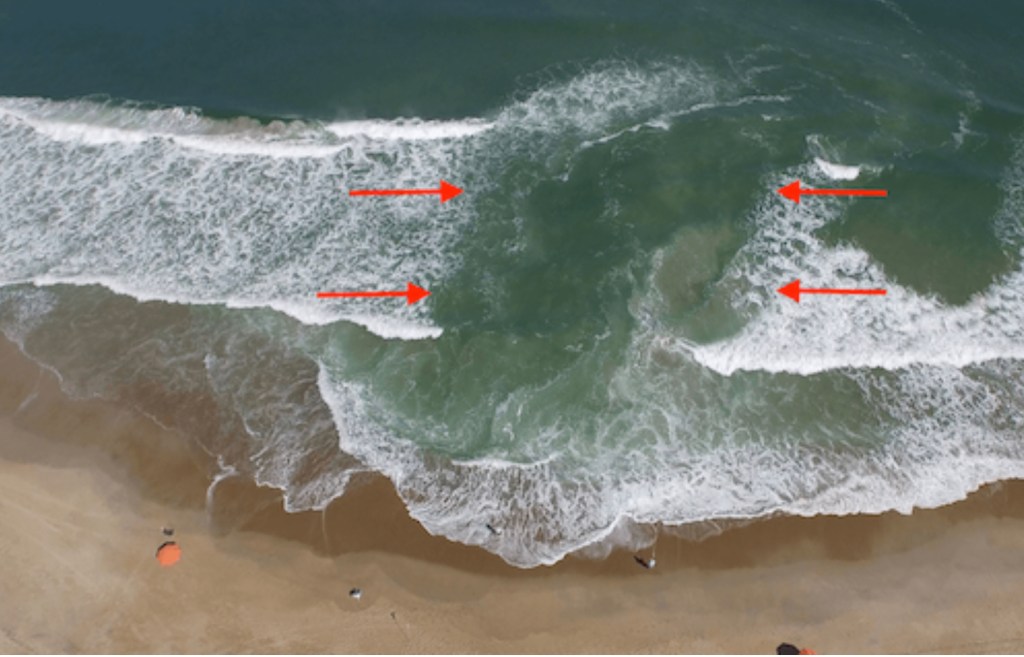
5. Learn how to spot rip tides. They look like disturbances in the wave line. They can be a flat and glossy break in the wave pattern, or a foamy one. While the waves come parallel to the shore line, rip currents run straight out to sea, cutting the wave in half.

We struggle with rip tides in life as well. There comes a time in everyone’s life when a rogue wave suddenly breaks on your shore, cuts you off at the knees, and threatens to sweep you out into the deep. Death, divorce, cancer, job loss, the discovery of a spouse’s betrayal … all the things that catch us off guard can feel like we are caught in an emotional current of foamy power, and we can’t even keep our heads up.

Psalm 46 (Common English Bible)

God is our refuge and strength,
    a help always near in times of great trouble.
That’s why we won’t be afraid when the world falls apart,
    when the mountains crumble into the center of the sea,
    when its waters roar and rage,
    when the mountains shake because of its surging waves. Selah

There is a river whose streams gladden God’s city,
    the holiest dwelling of the Most High.
God is in that city. It will never crumble.
    God will help it when morning dawns.
Nations roar; kingdoms crumble.
    God utters his voice; the earth melts.
The Lord of heavenly forces is with us!
    The God of Jacob is our place of safety. Selah

Come, see the Lord’s deeds,
    what devastation he has imposed on the earth—
    bringing wars to an end in every corner of the world,
    breaking the bow and shattering the spear,
        burning chariots with fire.

10 “That’s enough! Now know that I am God!
    I am exalted among all nations; I am exalted throughout the world!”

11 The Lord of heavenly forces is with us!
    The God of Jacob is our place of safety. 

But just like a real rip tide, with God’s help you can swim out of yours. Even if all you can do is tread water and float until rescue arrives, you can survive. The trick is to keep your head up. Stay focused on God’s activity in the midst of your panic. Keep praying toward heaven for help until it arrives. Lift your eyes upon Jesus and don’t look down.

No matter what it is you are floating in, God is with you. As big and frightening as your troubles are, they will not overwhelm you. You belong to God.

Rip Tide courtesy of NOAA

Being Adopted

Did you know that you are adopted?

True statement. Certainly, there is a percentage of readers who were adopted into their families, but in a spiritual sense, every one of us is adopted by God. This language of a familial relationship that carries a certain legal and permanent change of status speaks volumes about the love that God feels for each of us, his children.

In 1st Century Rome, adoption was a very serious matter. In adoption, a son (always a son) would be deliberately chosen to perpetuate the father’s name and his estate. Adoption provided that the son gained all new rights in the new family and all of his old life and debts were canceled. Prominent families who only had daughters could adopt a male so that their line and lineage would continue. This was necessitated by the (ridiculous) law that prevented female children from inheriting anything.

So when Paul uses adoption language in Romans, he is referencing the legal and binding relationship between Father/God and son/children:

Romans 8 (Common English Bible)

12 So then, brothers and sisters, we have an obligation, but it isn’t an obligation to ourselves to live our lives on the basis of selfishness. 13 If you live on the basis of selfishness, you are going to die. But if by the Spirit you put to death the actions of the body, you will live.

Paul was always quick to point out that living for the flesh (“selfishness” … understood to mean sinful rebellion to God) would result in death. He goes on to remind us that we aren’t just saved by the works of the spirit, but we must also walk by the Spirit.

14 All who are led by God’s Spirit are God’s sons and daughters. 15 You didn’t receive a spirit of slavery to lead you back again into fear, but you received a Spirit that shows you are adopted as his children. With this Spirit, we cry, “Abba, Father.” 16 The same Spirit agrees with our spirit, that we are God’s children.

With joyful confidence, we can proclaim God as Abba, Father, just like Jesus did. We understand Abba to be comparable to the word “Daddy.” What does it mean to you to think of God as Daddy?

17 But if we are children, we are also heirs. We are God’s heirs and fellow heirs with Christ, if we really suffer with him so that we can also be glorified with him.

Being an heir means all of your past has been wiped out. Being an heir means all of your debts are forgiven. Being an heir means that you have a Daddy who loves you and will never leave you. Your inheritance includes the key to the very gates of heaven itself. As God’s heir apparent, how will you live out your life? In faithfulness and duty, or in rejection and denial?

God invites us to live as the children of God. May our words and choices reflect our position.

Fountain of Blessings