Psalm 95 The Promise

Today’s lectionary passage is the beautiful Psalm 95. Hebrews 4:7 attributes this psalm to David. It is filled with both promise and warning. Today’s reading will focus on the hopeful aspects of David’s writing in verses 1-7a. Be sure to log on for the next devotional, which will delve into the warnings found at the end of Psalm 95 in verses 7b-11.

As I read this psalm today, my thoughts immediately went to the many and varied worship experiences I have participated in over the years. I was raised Methodist (we did not become “United Methodist” until I was about 9 years old) and so of course most of my experience has been formed by my denomination. But I have also worshipped in a “black box” non-denominational church where a fog machine and heavy metal guitars were dominant. As a kid I attended services in camp settings, where church was outside and we sat on logs and scratched bug bites on our ankles. And then there was that transcendent Christmas Eve service in Paris’ Notre Dame Cathedral where the service was in French. And Catholic. Of course we have all done church online thanks to the pandemic, and as I travel, I either visit nearby churches or log into my home church in Kitty Hawk to worship there.

Of all the ways I worship, I honestly have to confess that online is my least favorite. I am grateful for the fact that online is available to us when we can’t physically get to a church and for many folks, it is the only option. So while it enables me to stay in touch with my church family at home, something is always missing, and that “something” is the community of people around me, singing, laughing, shaking hands, smiling, making eye contact … things I can’t get at home on my couch.

David begins his psalm with a tender invitation to come and sing out loud to the Lord. See, that’s the problem with online worship. I have never sung with my computer during a church service. Even though the words are on my screen and I can hear the congregation singing, I can’t bring myself to sit on my couch in a quiet room and burst out in song. Maybe it’s just me, but singing has got to be communal. Raising a joyful shout to the rock of our salvation from my living room seems weird and unappealing, not to mention how much it might startle the neighbors.

Psalm 95 (Common English Bible)

Come, let’s sing out loud to the Lord!
    Let’s raise a joyful shout to the rock of our salvation!
Let’s come before him with thanks!
    Let’s shout songs of joy to him!

David recognized that singing allows us to express our thoughts emotionally, especially as we experience joy. And the songs of joy are sung to God, not for the pleasure of the gathered people. We are reminded that when we gather, God is present and it is his presence that deserves our thanksgiving. When worship becomes performative and when worships leaders focus attention on themselves, everyone loses the real purpose of worship: To come before God and God alone. This cannot be pleasing to the Lord.

Pure worship directs our attention to God’s attributes. God is great. God is greater than any other god. God’s mastery of creation is to be celebrated. God’s ownership of his creation, including us, is to be remembered. Nothing around us came from human ingenuity or hard work. Everything and everyone comes from his hands and belongs to him.

In the Hebrew language, verse 3 highlights three aspects of God’s nature. God is EL, great, mighty, and strong. God is JEHOVAH, the great I Am through whom all things are made. And God is ELOHIM, expressing the covenant relationship to humankind as something that belongs to him.

The Lord is a great God,
    the great king over all other gods.
The earth’s depths are in his hands;
    the mountain heights belong to him;
    the sea, which he made, is his
        along with the dry ground,
        which his own hands formed.

The invitation continues with a call to humility. Worship in essence is a bowing down to the Lord. By submitting to a prostrate position, whether physically or just in our hearts, we signal our acceptance of our place before the Lord. We kneel in acknowledgment that we are but frail sheep in his hands. We depend on his care. We exist because he keeps us safe, fed, and nurtured in the pasture. We are his, and he is ours.

Come, let’s worship and bow down!
    Let’s kneel before the Lord, our maker!
He is our God,
    and we are the people of his pasture,
    the sheep in his hands.

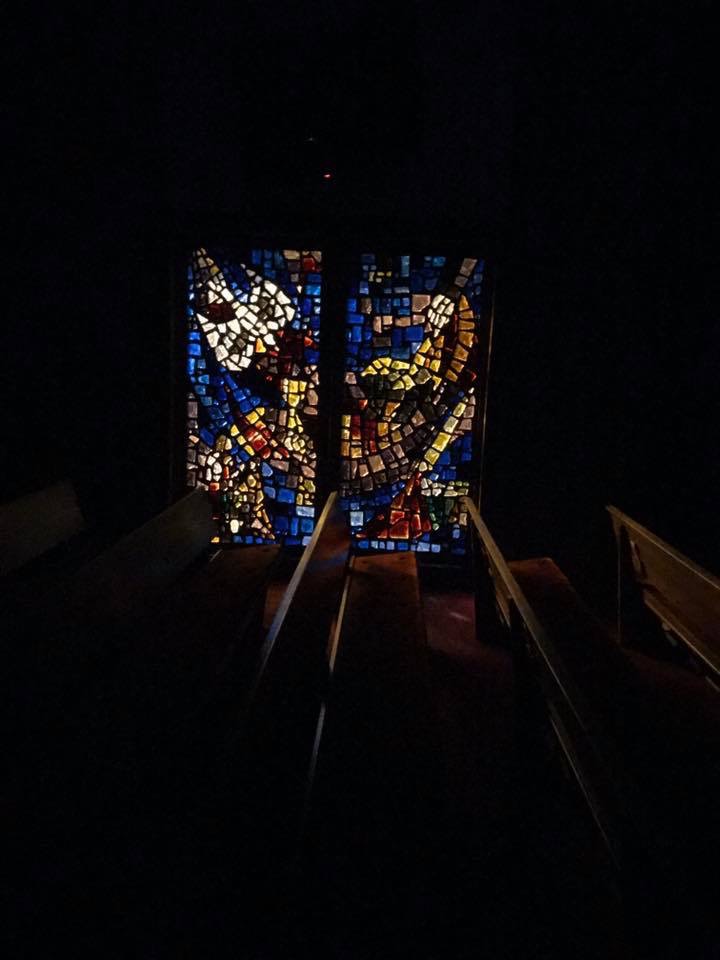
We will tackle the warnings that follow in verse 7b next time, but for now, take a moment to worship God wherever you are. Sing, pray, kneel, and bow down. The Lord is here, even online.

The Lord is Here by Becca Ziegler
Church Clothes

Consider the history of the necktie. Legionnaires in the 2nd century B.C. wore the first neckwear, according to some historians. Their cloth bands were worn as protection from the weather. Other people cite the 3rd century B.C. terra-cotta statues of Chinese warriors as the first evidence of neckties. They wore neck scarves to protect the source of their strength, i.e. their Adam’s apples.

Most experts, however, date the initial appearance of what led to the modern tie back to 1636. Croatian mercenaries hired by King Louis XIV wore cloth bands around their necks to ward off natural elements and sword slashes.

Today, however, men don’t need to protect themselves from weather, assaults to their Adam’s apples, and hopefully not sword slashes. So why the tie? Many men find them uncomfortable and bothersome. Loosening the tie is often the first thing a fellow does the minute he leaves the office. I mean, even the word neck-tie sounds restrictive.

Neckties are a means of uniformity. Imagine the workplace of the 1960’s without men in neckties. Imagine the church of the 1990’s without men in neckties. Uniformity was the goal, and neckties were the instrument that tied it all together. Blessed be the tie that binds? Not when it is tied around the neck!

Thank God we are over that.

Ties, hats, gloves, and heels have faded away as mandatory “Sunday morning best.” Society has accepted the fact that it is so much more important to show up than to show off.

So with neckties out, what should we wear around our necks?

Proverbs 3 New Living Translation (NLT)

3  My child, never forget the things I have taught you.

    Store my commands in your heart.

2  If you do this, you will live many years,

    and your life will be satisfying.

3  Never let loyalty and kindness leave you!

    Tie them around your neck as a reminder.

    Write them deep within your heart.

4  Then you will find favor with both God and people,

    and you will earn a good reputation.

Loyalty and kindness. The perfect neckwear for any occasion! This type of necktie will help you find favor with God and people alike. When we tie the things God has taught us around our necks, we will have a satisfying life and a good reputation. Now that’s a necktie everyone should have in their closet.

I once had a conversation with a teenager about church clothes. Michael was the son of the school bus driver and never attended church. I knew him from the High School marching band, where I volunteered as a chaperone and band announcer. All the kids knew me, but most didn’t know I am a pastor. Michael had spent the weekend at Taylor’s house, and when they awoke on Sunday morning, Taylor’s mom called them to breakfast and told them what time to be ready for church.

When Michael arrived, he looked around at all the people dressed up for church, and all the men wearing ties. He found me and immediately came up to me. “Miss Betsy, I am so sorry to be wearing my band t-shirt and jeans in your church,” he said. “I spent the night at Taylor’s house and my Mom didn’t know we would be coming to church so I didn’t pack any church clothes.”

I looked him in the eye and asked, “Michael, are you in a church?” He replied, “Yes, Ma’am.” I said, “And are you wearing clothes?” He laughed and said, “Yes, Ma’am.” I smiled and said, “Then you’re obviously wearing church clothes, so have a seat.”

The Gospel is a message of freedom, not restriction. Church is a place of harmony, not uniformity. Come on in and find a seat! We’re just glad you’re here. There is no dress code in God’s house. In my church at the beach, the acolytes wear flip flops, and the pastor never wears a tie. Got clothes? Come on in.

No Dress Code by Kitty Hawk United Methodist Church

Through Fire and Water

There is a great debate among the faithful about the pandemic and God’s activity in it. Some people believe that God has brought this upon the earth as a corrective measure. The effect of the stay-at-home orders on the environment is cited to support this notion. As the air and the waters clear up, people in that camp point to the lessening of pollution (due to the fact that we aren’t driving and flying as much) as part of God’s purpose in “causing” the pandemic. They point to the plagues of the Old Testament to solidify their argument.

Others are in the camp of “God allows.” This perspective suggests that there are things that simply happen that God allows. In other words, God didn’t cause it, but has allowed a virus like this to sweep the globe, which has brought needed changes and is teaching us many important things. God has allowed this situation, which has brought us a cleansing of the environment. This notion encourages us to know that what he “allows” is within his control, and in his time, it will end.

Wherever you stand on this, or if you don’t care either way, it is good to know certain things about God’s activity in a disaster.

We can know that he is with us.

We can know that he has brought us through fire and water, and he will bring us through this.

We can know that even when he corrects us, he does so with mercy and love.

We can know that he brings us through the refining fires of testing to a rich fulfillment that only he can provide.

Listen to how the Psalmist puts it:

Psalm 66 (New King James)

Oh, bless our God, you peoples!
And make the voice of His praise to be heard,
Who keeps our soul among the living,
And does not allow our feet to be moved.


10 For You, O God, have tested us;
You have refined us as silver is refined.
11 You brought us into the net;
You laid affliction on our backs.
12 You have caused men to ride over our heads;
We went through fire and through water;
But You brought us out to rich fulfillment.

Our response, regardless of how we got here, should always be worship. Worship reminds us of who we are, and whose we are.

13 I will go into Your house with burnt offerings;
I will pay You my vows,
14 Which my lips have uttered
And my mouth has spoken when I was in trouble.
15 I will offer You burnt sacrifices of fat animals,
With the sweet aroma of rams;
I will offer bulls with goats. Selah

So if you are having a bad day/week/month, if you are worn out and ready for this pandemic to be OVER, remind yourself of all of the times that God has already rescued you. Can you name them?

Certainly God has heard us. And he always attends to the voice of our prayers.

16 Come and hear, all you who fear God,
And I will declare what He has done for my soul.
17 I cried to Him with my mouth,
And He was extolled with my tongue.
18 If I regard iniquity in my heart,
The Lord will not hear.
19 But certainly God has heard me;
He has attended to the voice of my prayer.

20 Blessed be God,
Who has not turned away my prayer,
Nor His mercy from me!

God has not turned away. So let us learn everything from him that he is trying to teach us right now. His mercy is always ready to be given! Blessed be the Lord.

Blessed be God! By Margaret Brushwood

Come

Isn’t it exciting to be invited to come to a party or event? Back when all invitations were delivered by mail, it was a thrill to open that small colored envelope that indicated an invitation to a baby shower, birthday party, graduation ceremony, or some other special event. Receiving an invitation was the height of inclusion. Somebody wanted YOU. Your presence was requested. The party would not be the same without you, so COME.

God is the ultimate invitation-giver. The entire bible might be summed up in the word “come.” Come to me, all you weary people. Come to me and rest. Come and be healed. Come and find peace. Just come.

In the 55th chapter of Isaiah, we receive a beautiful invitation. This one is offered to the thirsty, the poor, the hungry, and the people of every nation:

Isaiah 55 (New International Version)

“Come, all you who are thirsty,
    come to the waters;
and you who have no money,
    come, buy and eat!
Come, buy wine and milk
    without money and without cost.
Why spend money on what is not bread,
    and your labor on what does not satisfy?
Listen, listen to me, and eat what is good,
    and you will delight in the richest of fare.
Give ear and come to me;
    listen, that you may live.
I will make an everlasting covenant with you,
    my faithful love promised to David.
See, I have made him a witness to the peoples,
    a ruler and commander of the peoples.
Surely you will summon nations you know not,
    and nations you do not know will come running to you,
because of the Lord your God,
    the Holy One of Israel,
    for he has endowed you with splendor.”

Even the wicked are invited to come, and we are all invited to seek the Lord. Mercy is found when people seek God.

Seek the Lord while he may be found;
    call on him while he is near.
Let the wicked forsake their ways
    and the unrighteous their thoughts.
Let them turn to the Lord, and he will have mercy on them,
    and to our God, for he will freely pardon.

In the mystery of this universal invitation, all are invited to come for pardon. This may confuse us. We may question the offer of pardoning to the evil ones who have brought so much destruction to others. Yet God reserves the right to invite whomever he pleases…and it is not for us to question. His thoughts and ways are far higher than ours.

“For my thoughts are not your thoughts,
    neither are your ways my ways,”
declares the Lord.
“As the heavens are higher than the earth,
    so are my ways higher than your ways
    and my thoughts than your thoughts.
10 As the rain and the snow
    come down from heaven,
and do not return to it
    without watering the earth
and making it bud and flourish,
    so that it yields seed for the sower and bread for the eater,
11 so is my word that goes out from my mouth:
    It will not return to me empty,
but will accomplish what I desire
    and achieve the purpose for which I sent it
.

So we have two jobs today. One is to accept the invitation to come before the Lord and receive all of his mercy, pardon, and blessing. The other is to extend that invitation to the most vulnerable and hurting among us. Go, and do likewise. Or better still, come.

Come and See the Beauty of Creation by Wende Pritchard