The Power of Love

The power of guilt is something that can overtake an entire life and crush it with the strength of an oncoming avalanche. I saw this firsthand at a women’s retreat I attended many years ago. A participant sought me out after a very emotional worship experience where people were invited to give over their guilt, sins, burdens, and shame in an act of “dying moments.” The invitation was to process those life-long secrets and figuratively place them at the foot of the cross and “die to them” by letting them go.

This particular woman had about twenty years worth of crushing heaviness to lift up. She told me her story in gasps and sobs as we sat under a piano until 3 a.m. It included drug and alcohol abuse, criminal activity, adultery, an abortion she had never told anyone about, and the eventual loss of her marriage and children. It all came spilling out that night. She was dead inside.

Ephesians 2 (Common English Bible)

2 At one time you were like a dead person because of the things you did wrong and your offenses against God. 2 You used to live like people of this world. You followed the rule of a destructive spiritual power. This is the spirit of disobedience to God’s will that is now at work in persons whose lives are characterized by disobedience. 3 At one time you were like those persons. All of you used to do whatever felt good and whatever you thought you wanted so that you were children headed for punishment just like everyone else.

This is exactly where this woman was in her journey. She had lived a life of disobedience to God’s will. She spent her life doing things that “felt good” and subsequently lost her life to those things.

4-5 However, God is rich in mercy. He brought us to life with Christ while we were dead as a result of those things that we did wrong. He did this because of the great love that he has for us. You are saved by God’s grace! 6 And God raised us up and seated us in the heavens with Christ Jesus. 7 God did this to show future generations the greatness of his grace by the goodness that God has shown us in Christ Jesus.

And so here she was sitting with a strange pastor in the middle of the night and it all came out. Her greatest struggle was believing that with all that she had done, God would still be able to forgive her. She kept saying that her behavior was unforgivable. She was unredeemable. She was “unworthy.”

8 You are saved by God’s grace because of your faith. This salvation is God’s gift. It’s not something you possessed. 9 It’s not something you did that you can be proud of. 10 Instead, we are God’s accomplishment, created in Christ Jesus to do good things. God planned for these good things to be the way that we live our lives.

When she had finally exhausted herself, I calmly asked her if she thought that she was stronger or greater than Jesus. The question took her aback and she said no, of course not. I went on to explain that there is no sin greater than his activity on the cross and so it takes a certain kind of arrogance to think that OUR sin is the one so great and unforgivable that his death couldn’t obliterate it forever. To Jesus, she IS that worthy.

Otherwise the cross is a joke.

The next day, this woman woke up and knew for the first time in her life that she was forgiven, redeemed, and freed of her sins. She was a brand new creation in Christ. Hallelujah!

We are God’s accomplishment. Salvation is not something we possess on our own. It’s not something we did and now we can be proud of ourselves. And the opposite is true: there is nothing we’ve done that is so bad it can’t be forgiven. That’s the power of love.

You were created in Christ Jesus to do good things. Receive his forgiveness and go forth in your new life.

Cleansed by the Water by Jess Spiegelblatt

Sacred

What is sacred to you? Are there actions, behaviors, or things that you categorize as sacred and untouchable?

Things that people find sacred include marriage vows, children, sabbath practices, the language we use when we speak of God…we can attach holiness to any number of things. When we hold something as “sacred” we indicate its value and the prominence it takes in our lives.

The temple in Jerusalem was sacred to Jesus. It was his father’s house. It was a house of worship. It was a place where God resided. It was not to be violated or used for any other purpose than the worship of God.

John 2 (Contemporary English Version)

13 Not long before the Jewish festival of Passover, Jesus went to Jerusalem. 14 There he found people selling cattle, sheep, and doves in the temple. He also saw moneychangers sitting at their tables. 15 So he took some rope and made a whip. Then he chased everyone out of the temple, together with their sheep and cattle. He turned over the tables of the moneychangers and scattered their coins.

16 Jesus said to the people who had been selling doves, “Get those doves out of here! Don’t make my Father’s house a marketplace.”

I remember a story that a former colleague once told of watching someone violate the sanctity of his church. It was at the end of a wedding, when people were still milling around the sanctuary waiting for pictures to be taken. (As a side note, I must confess that pastors often struggle with weddings and how they can become mere commercial venues for folks who have no notion of the sacredness of the space.) Such was the case that day, and my friend watched in horror as the father of the bride strode up the steps to the altar and lit a cigarette from the Christ candle. I haven’t seen this friend for over a decade, but I bet he still tells that story with the same sense of revulsion he felt when he observed it the first time.

Jesus felt the same revulsion at the loan sharks and money changers who charged exorbitant rates to lend money to people so they could buy overpriced animals for slaughter in the house that he loved. His actions that day remind us that we don’t have to put up with such violations in our sacred spots, whether they are physical locations or places in our hearts and minds. If someone is violating your spirit with their inappropriate words or behavior, throw them out of your life.

17 The disciples then remembered that the Scriptures say, “My love for your house burns in me like a fire.”

18 The Jewish leaders asked Jesus, “What miracle will you work to show us why you have done this?”

19 “Destroy this temple,” Jesus answered, “and in three days I will build it again!”

20 The leaders replied, “It took forty-six years to build this temple. What makes you think you can rebuild it in three days?”

21 But Jesus was talking about his body as a temple. 22 And when he was raised from death, his disciples remembered what he had told them. Then they believed the Scriptures and the words of Jesus.

This last part reminds us that even in his zeal to rid the temple of the merchants, Jesus ultimately acknowledges that he is the true temple. He is our church. He is our sacristy. He is our altar. Even after a temporary tear-down, he was rebuilt and raised from the dead. His words and his sacredness can never be defiled!

No matter what we build with our hands, the House of Jesus lasts forever.

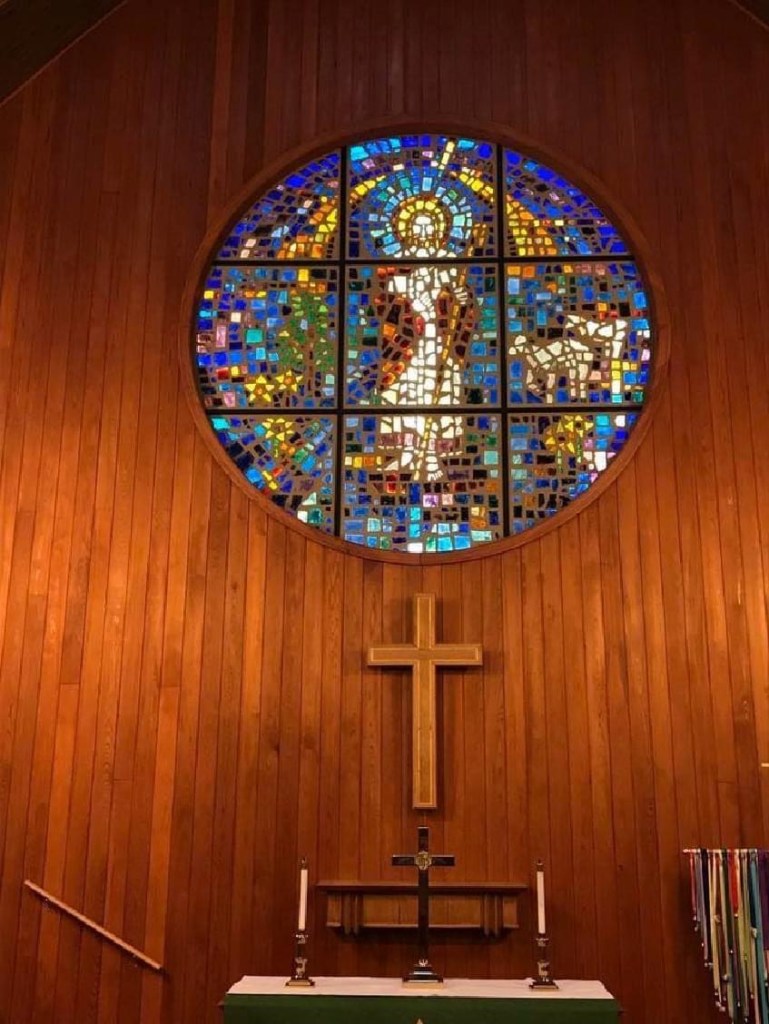
Sacred Space by Kitty Hawk United Methodist Church

Conventional Wisdom

The disunity we are experiencing in our country, our towns, our churches, and our families is rooted in our discourse, and the subsequent positioning we take from intractable sides. One says blue and the other says red, and both point to endless articles to bolster their point. One says conservative and the other says progressive, and both point to scripture to prove their position. This type of debate-posturing results in both sides being disenfranchised from the koinonia, or the fellowship/kinship of the combined whole.

Paul writes this in Philippians 2:

1-4 If you’ve gotten anything at all out of following Christ, if his love has made any difference in your life, if being in a community of the Spirit means anything to you, if you have a heart, if you care—then do me a favor: Agree with each other, love each other, be deep-spirited friends. Don’t push your way to the front; don’t sweet-talk your way to the top. Put yourself aside, and help others get ahead. Don’t be obsessed with getting your own advantage.

The root of our disconnect with one another is found in our reliance on our own wisdom. We apply our personal conventional wisdom to matters that wisdom defies. Our wisdom is colored and flavored with the prejudices of our environment, our status in society, and our upbringing. And when we think that OUR wisdom is better than THEIR wisdom, the community is destroyed. Truly wise, truly educated, truly intelligent people can effectively argue an issue from many sides. So where is the truth?

1 Corinthians 1 (The Message)

18-21 The Message that points to Christ on the Cross seems like sheer silliness to those hellbent on destruction, but for those on the way of salvation it makes perfect sense. This is the way God works, and most powerfully as it turns out. It’s written,

I’ll turn conventional wisdom on its head,
I’ll expose so-called experts as shams.

So where can you find someone truly wise, truly educated, truly intelligent in this day and age? Hasn’t God exposed it all as pretentious nonsense? Since the world in all its fancy wisdom never had a clue when it came to knowing God, God in his wisdom took delight in using what the world considered stupid—preaching, of all things!—to bring those who trust him into the way of salvation.

22-25 While Jews clamor for miraculous demonstrations and Greeks go in for philosophical wisdom, we go right on proclaiming Christ, the Crucified. Jews treat this like an anti-miracle—and Greeks pass it off as absurd. But to us who are personally called by God himself—both Jews and Greeks—Christ is God’s ultimate miracle and wisdom all wrapped up in one. Human wisdom is so cheap, so impotent, next to the seeming absurdity of God. Human strength can’t begin to compete with God’s “weakness.”

The only truth that matters in the end is Christ crucified. All other debates, posturing, and positioning can only lead to further disruption of the singular message of “Christ crucified.” There is no human wisdom that can adequately explain this. There is no intelligent education that can sufficiently prove anything. Christ is God’s ultimate miracle and wisdom all wrapped up in one. Go and preach THAT, and that alone.

Unconventional Beauty by Michelle Robertson

Lose your Life

In an earlier devotional, I referenced the story from Greek mythology of King Midas, who was granted a wish that everything he touched would turn to gold. Then he discovered that the food he needed to live could not be consumed, as it became gold the minute he touched it. I think this is a perfect allegory for what Jesus was talking about when he said, “Why would people gain the whole world but lose their lives?” We are reminded that when we pursue worldly goods, ideas, agendas, and behaviors, we risk losing the eternal life to which all are called through Christ Jesus.

Take a look at this exchange between Jesus and his disciples:

Mark 8 (Common English Bible)

31 Then Jesus began to teach his disciples: “The Human One must suffer many things and be rejected by the elders, chief priests, and the legal experts, and be killed, and then, after three days, rise from the dead.” 32 He said this plainly. But Peter took hold of Jesus and, scolding him, began to correct him. 33 Jesus turned and looked at his disciples, then sternly corrected Peter: “Get behind me, Satan. You are not thinking God’s thoughts but human thoughts.”

Peter is admonished for thinking “human thoughts.” What human thoughts do you engage in that are ungodly? What behaviors would condemn you as someone speaking for Satan? Is Jesus trying to correct something in your life today? Say NO to yourself.

34 After calling the crowd together with his disciples, Jesus said to them, “All who want to come after me must say no to themselves, take up their cross, and follow me. 35 All who want to save their lives will lose them. But all who lose their lives because of me and because of the good news will save them. 36 Why would people gain the whole world but lose their lives?37 What will people give in exchange for their lives? 38 Whoever is ashamed of me and my words in this unfaithful and sinful generation, the Human One will be ashamed of that person when he comes in the Father’s glory with the holy angels.”

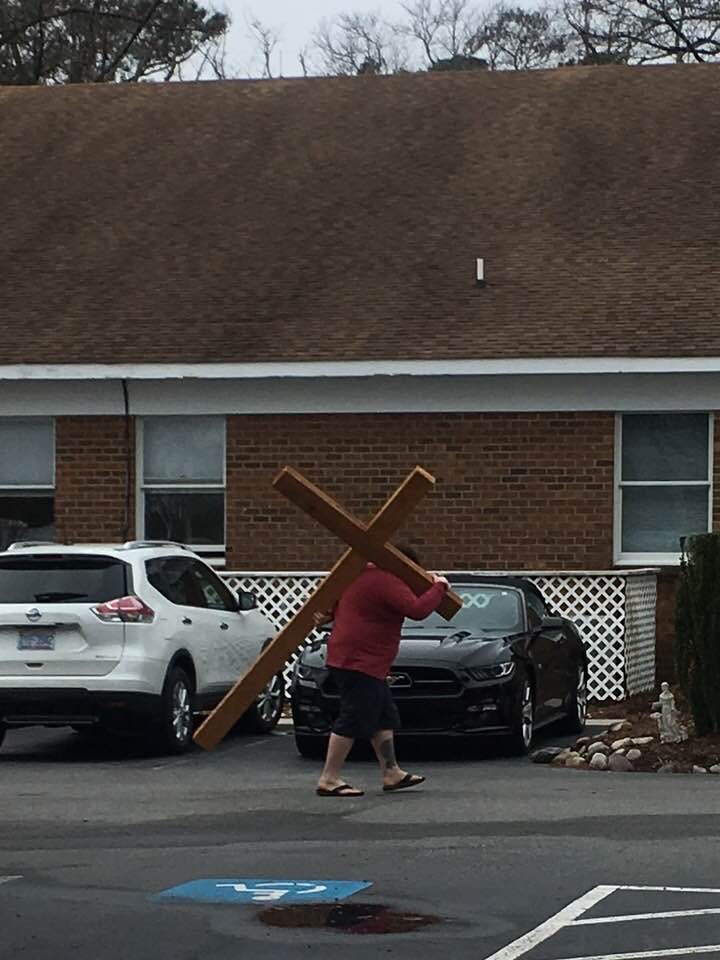
The invitation is to follow Jesus. That means saying NO to all of the unholy things we say, do, think, and participate in. Those things are not worthy of a holy life, and those things are not worthy of you. Jesus invites us to take up our cross and follow him, and in that way we will save our lives as we lose them…in other words, lose the secular lives we are living and gain eternal lives in Christ.

The call is real. The circumstance is dire. The time is upon us. Lose your life because of Jesus, and you will gain heaven itself. And that, my friends, is good news.

Take Up Your Cross

The Art of Listening

In a sermon I recently preached on the subject of prayer, I reminded the congregation that God gave us two ears and one mouth, which perhaps might be a hint that we should listen twice as much as we speak. I was applying this to prayer, but I think it could apply to everything else…our conversations, our arguments, our discussions with our family, our debates…there is nothing we do that wouldn’t be improved by more listening and less talking.

Listening is a way of God. Did you ever think about that? No matter what you take to him, he is guaranteed to listen to you. There is NOTHING you can say, no evil or destructive behavior you need to confess, no grudge so petty, no angry word expressed, that he won’t hear with loving concern. As the psalmist says, “He didn’t hide his face from me. No, he LISTENED when I cried out to him for help.”

Psalm 22 (Common English Bible)

All of you who revere the Lord—praise him!
    All of you who are Jacob’s descendants—honor him!
    All of you who are all Israel’s offspring—
        stand in awe of him!
24 Because he didn’t despise or detest
    the suffering of the one who suffered—
    he didn’t hide his face from me.
    No, he listened when I cried out to him for help.

For this alone, God is worthy of our praise. He inclines his ear to our suffering. He is found by those who seek him. He is worthy of the worship of all nations.

25 I offer praise in the great congregation
    because of you;
    I will fulfill my promises
    in the presence of those who honor God.
26 Let all those who are suffering eat and be full!
    Let all who seek the Lord praise him!
        I pray your hearts live forever!
27 Every part of the earth
    will remember and come back to the Lord;
    every family among all the nations will worship you.
28 Because the right to rule belongs to the Lord,
    he rules all nations.
29 Indeed, all the earth’s powerful
    will worship him;
    all who are descending to the dust
    will kneel before him;
    my being also lives for him.
30 Future descendants will serve him;
    generations to come will be told about my Lord.
31 They will proclaim God’s righteousness
        to those not yet born,
        telling them what God has done.

What can we do in response? We can listen in his name. We can incline our ear to suffering. We can come back to him with repentant hearts. We can refuse to hide our faces from people who need help.

We can hear the way he hears.

Find someone today who simply needs to be heard, and offer them the gift of your time and your presence. And remember to listen twice as much as you speak.

Listen Well by Michelle Robertson

In the Desert

Name something that tempts you….as in, REALLY tempts you. Something that causes you to go weak in the knees trying to resist. Money? Power? Fame? Immortality? Gossip? Drama? Chocolate-covered caramel bars? CHEEZE??

The Greek myth of King Midas comes to mind when I think of temptation. He loved and worshipped gold. Gold was his kryptonite. He was granted a wish that everything he touched might be turned into gold. What joy! What bliss! Until the very food that he needed to survive was turned into gold and he couldn’t consume it. He cursed his power then, and sought relief from that which had once tempted him so strongly.

Today we read about Christ’s forty days in the desert where he was tempted by Satan. This reading falls in the first week of Lent for a reason. We are challenged to face the things that tempt us and have the power to pull us away from observing a Holy Lent.

Mark 1 (Common English Bible)

9 About that time, Jesus came from Nazareth of Galilee, and John baptized him in the Jordan River. 10 While he was coming up out of the water, Jesus saw heaven splitting open and the Spirit, like a dove, coming down on him. 11 And there was a voice from heaven: “You are my Son, whom I dearly love; in you I find happiness.”

12 At once the Spirit forced Jesus out into the wilderness. 13 He was in the wilderness for forty days, tempted by Satan. He was among the wild animals, and the angels took care of him.

An oversimplification of this passage would point out that God finds happiness in all of his children at the moment of baptism. He experiences joy when we commit to a life of resisting evil in all of its forms and promise to walk a righteous path. Temptations don’t come from God. He is not trying to ensnare us, but rather will send angels to take care of us in those moments of weakness….if we allow it. Sometimes our addictions block us from receiving help.

These 40 days of Lent are an exercise against temptation…the temptation to give up on our Lenten disciplines. The temptation to step off the path of righteousness. The temptation to succumb to evil in the form of gossip, sin, anger, betrayal, and shutting out God. The temptation to withhold forgiveness.

14 After John was arrested, Jesus came into Galilee announcing God’s good news, 15 saying, “Now is the time! Here comes God’s kingdom! Change your hearts and lives, and trust this good news!”

Jesus calls us to something better. He invites us to change our hearts and lives. We are encouraged to trust the good news of his life, death, and resurrection. Don’t be tempted to do anything less….that’s how Satan wins.

Wilderness Wonderland by Mary Anne Mong Cramer

Teach Me

We are officially in the season of Lent. This 40-day time of solemn preparation for the celebration of Easter Sunday is often marked by “giving something up.” This is always a good practice for those of us who have slipped into a spiritual lethargy since last Lent, methinks! I encourage the plus/minus form of Lent-making. In other words, don’t just give something up, but add something new in its place.

This year I decided to teach a Lent Bible Study in my congregation. It is my own personal “adding to.” I know that the discipline of preparing for class each week will add to my own discipleship and shake me out of my complacency. Our first lesson is on prayer, and already God is working in my spirit to teach me things I need to learn about prayer.

So imagine my joy when Psalm 25 came along in today‘s lectionary. Not only is David’s psalm a prayer, but it also teaches us about prayer! Let’s find those teaching points together today.

Psalm 25 (New Revised Standard Version)

To you, O Lord, I lift up my soul.
2 O my God, in you I trust;
    do not let me be put to shame;
    do not let my enemies exult over me.
3 Do not let those who wait for you be put to shame;
    let them be ashamed who are wantonly treacherous.

We can’t enter a conversation with the Lord without lifting up our soul. This first sentence reminds us that we need to be deliberate in seeking and entering God’s presence. To lift up one’s soul is to expose everything we are dealing with in our hearts and minds to him. We enter a sacred chamber and wait, trusting God’s immediate presence. Through prevenient grace, we know that he is already in the chamber. We wait for OUR spirit to catch up with his presence.

4 Make me to know your ways, O Lord;
    teach me your paths.
5 Lead me in your truth, and teach me,
    for you are the God of my salvation;
    for you I wait all day long.

So often our prayers are mere lists of needs and wants. Indeed, God inclines his ear to hear our wailing, but David reminds us that if we pause our litany of woes long enough, we can also be taught and led into God’s ways and his truth. The difference is LISTENING. God gave us two ears and one mouth. They should be used proportionally in prayer. Speak once. Listen twice.

6 Be mindful of your mercy, O Lord, and of your steadfast love,
    for they have been from of old.
7 Do not remember the sins of my youth or my transgressions;
    according to your steadfast love remember me,
    for your goodness’ sake, O Lord!

Reminding God of his goodness is a psalmist’s trick to remind the reader of God’s mercy and steadfast love. When we remember those truths, our prayers are more honest and forthcoming. And remembering that God forgets our sins gives us permission to also forget them.

8 Good and upright is the Lord;
    therefore he instructs sinners in the way.
9 He leads the humble in what is right,
    and teaches the humble his way.
10 All the paths of the Lord are steadfast love and faithfulness,
    for those who keep his covenant and his decrees.

The Psalmist ends with more references to instructing, teaching, and leading.

What are you learning about prayer today? How will your prayers during Lent be different than before? Being humble in your approach to God is the first step. Humility calls us to be listening learners rather than loud demanders.

May we all rejoice in practicing listening, and may we celebrate a Holy Lent this year.

Our Prayers Take Flight by Michelle Robertson

Re-Lent

It happens every year. We just get past the overindulgence of Thanksgiving gravy, Christmas pie, New Years’ toasts, Super Bowl snacks, Valentine’s chocolates, and BAM. Lent happens. This 40-day period of self examination is not designed to punish us for our self-indulgences, but rather it provides an opportunity to grow closer to God by focusing on the things that realign our priorities and our time. It is a chance to re-center our thinking. It is a chance to re-do our to-do lists and put God at the top. We worship a God of second chances, and Lent is our chance once again to shift our lives back toward God.

But more than that, Lent is about our mortality. The ashes we place on our foreheads on Ash Wednesday remind us that from the earth we have come and to the earth we return….ashes to ashes, dust to dust. This sobering season begins when the alarm has sounded, the assembly has gathered, and the day of darkness is upon us:

Joel 2 (New Revised Standard Version)

Blow the trumpet in Zion;
    sound the alarm on my holy mountain!
Let all the inhabitants of the land tremble,
    for the day of the Lord is coming, it is near—
2 a day of darkness and gloom,
    a day of clouds and thick darkness!
Like blackness spread upon the mountains
    a great and powerful army comes;
their like has never been from of old,
    nor will be again after them
    in ages to come.

We are invited to return…..and repent:

Yet even now, says the Lord,
    return to me with all your heart,
with fasting, with weeping, and with mourning;
13     rend your hearts and not your clothing.

The promise is offered: if we return to the Lord, he will relent from punishing. As we re-Lent, he will relent.

Return to the Lord, your God,
    for he is gracious and merciful,
slow to anger, and abounding in steadfast love,
    and relents from punishing.
14 Who knows whether he will not turn and relent,
    and leave a blessing behind him,
a grain offering and a drink offering
    for the Lord, your God?

The call is urgent to come to the altar quickly. The time is upon us to begin this process. Even the bride and bridegroom are summoned from their bedchamber to be about the Lord’s business.

15 Blow the trumpet in Zion;
    sanctify a fast;
call a solemn assembly;
16     gather the people.
Sanctify the congregation;
    assemble the aged;
gather the children,
    even infants at the breast.
Let the bridegroom leave his room,
    and the bride her canopy.

17 Between the vestibule and the altar
    let the priests, the ministers of the Lord, weep.
Let them say, “Spare your people, O Lord,
    and do not make your heritage a mockery,
    a byword among the nations.
Why should it be said among the peoples,
    ‘Where is their God?’”

Many of us will not be able to gather in an assembly tonight due to the pandemic. Some of you may have obtained ashes from your church and will participate in an Ash Wednesday service online. In any case, you are invited to contemplate taking on the spiritual disciplines of prayer, fasting, scripture reading, self-examination, repentance, meditation, and penitence. You may choose to give something up for the next six weeks so that you can focus on God in its absence. You may choose to add a new practice that would take you deeper in your discipleship. I hope reading this daily devotional will be part of your commitment! If you don’t have access to ashes, you can use water and make the sign of the cross on your forehead as a mark of your sincerity.

I pray that you will join me as we observe a Holy Lent.

Gracious and Loving God, be with us today as we contemplate those things that have pulled us away from you. Help us to return. We hear your call and we desire nothing but a right relationship with your Son. Grant us a meaningful Lent season, so that when Easter morning dawns, you will find us to be new people, made more like him and less like ourselves. AMEN

Dust to Dust by Becca Ziegler

Saved by Water

The rain on the OBX has given us a one-day reprieve as we read again about the saving of Noah’s family from the flood. I haven’t seen the surface of my street for days and I am beginning to envy the passengers on the Ark. They didn’t get their feet wet everyday. But did you ever stop to think about the many times we are not only saved FROM water, but saved BY water?

Our United Methodist baptism liturgy has this beautiful section:

Eternal Father:
When nothing existed but chaos,
you swept across the dark waters
and brought forth light.
In the days of Noah
you saved those on the ark through water.
After the flood you set in the clouds a rainbow.
When you saw your people as slaves in Egypt,
you led them to freedom through the sea.
Their children you brought through the Jordan
to the land which you promised

In the fullness of time you sent Jesus,
nurtured in the water of a womb.
He was baptized by John and anointed by your Spirit.
He called his disciples
to share in the baptism of his death and resurrection
and to make disciples of all nations.

In our lectionary passage today, we see echos of “saved by water” in 1 Peter 3:

1 Peter 3 (Contemporary English Version)

Christ died once for our sins.
An innocent person died
    for those who are guilty.
Christ did this
    to bring you to God,
when his body
    was put to death
and his spirit
    was made alive.

19 Christ then preached to the spirits that were being kept in prison. 20 They had disobeyed God while Noah was building the boat, but God had been patient with them. Eight people went into that boat and were brought safely through the flood.

It is understood that the imprisoned spirits referred to are demons. Note that God’s patience extends even to them.

21 Those flood waters were like baptism that now saves you. But baptism is more than just washing your body. It means turning to God with a clear conscience, because Jesus Christ was raised from death. 22 Christ is now in heaven, where he sits at the right side of God. All angels, authorities, and powers are under his control.

Baptism is indeed more than just washing your body. It means your conscience is washed clean through the shed blood of the atonement. It means that your heart is made ready through the confession of sins and the clean slate offered to you by the Redeemer. It means you are welcomed home by the God of second chances.

Christ did all this to bring you to God. Today you are invited to wash again, turn to God, and bask in the waters of salvation and hope.

Come to the Water by Kathy Schumacher

Rainbow Covenant

I love everything about living in the Outer Banks except January and February. Don’t get me wrong, if you love the color GREY, this is the place to be. But the days upon days upon days of rain do me in after a while. Walking the dog becomes a challenge of finding how far up our neighbor’s front lawns we have to go to avoid puddles that take days to clear. Winds make umbrellas impossible, if not somewhat dangerous!

I know, first world problems. But I really miss the sun and the blue skies.

One of the rewards of the rain, however, is an abundance of rainbows. Probably because we enjoy “big sky” in every direction, rainbow spotting is a common occurrence. As the rain begins to taper off and the sun (finally) emerges, the perfect conditions are created for these beautiful reminders of God’s promises.

Today’s lectionary takes us to that very moment when God established the bow as a sign of his protection:

Genesis 9 (Common English Bible)

8 God said to Noah and to his sons with him, 9 “I am now setting up my covenant with you, with your descendants, 10 and with every living being with you—with the birds, with the large animals, and with all the animals of the earth, leaving the ark with you. 11 I will set up my covenant with you so that never again will all life be cut off by floodwaters. There will never again be a flood to destroy the earth.”

We understand the word covenant to be more than just a promise. It is an ironclad agreement brought about through the relationship of God and his people. It has the force of law, and is unbreakable. It is a contract that is signed by the very word of God.

12 God said, “This is the symbol of the covenant that I am drawing up between me and you and every living thing with you, on behalf of every future generation. 13 I have placed my bow in the clouds; it will be the symbol of the covenant between me and the earth. 14 When I bring clouds over the earth and the bow appears in the clouds, 15 I will remember the covenant between me and you and every living being among all the creatures. Floodwaters will never again destroy all creatures. 16 The bow will be in the clouds, and upon seeing it I will remember the enduring covenant between God and every living being of all the earth’s creatures.” 17 God said to Noah, “This is the symbol of the covenant that I have set up between me and all creatures on earth.”

Later would come a contract that was signed by the very Word of God. Jesus is our final Covenant, and when we receive him into our lives, we have an ironclad guarantee that we will find refuge, shelter, forgiveness, and protection under his wings.

Where have you broken your side of the covenant with God? Have you willfully walked away and set aside all of his promises for the fake promises of the world? Are you guilty of turning away from what God has called you to do, say, think, or repair? Perhaps this is the moment to return. The best thing about God’s promises is that they are always available to the repentant seeker.

God is our great Covenant-Maker. He sent Jesus as the final signature on the contract. You can bet your life on it.

Colington Rainbow