Navel-Gazing

Navel-gazing is the habit of excessive contemplation on a single issue at the expense of being able to see the wider view of the bigger picture. The image that comes to mind with this phrase is a person with their head bent low, not looking up and not engaging in the world around them. Focusing on their own navel, they never see what God is doing in the midst of their crisis.

Today’s beautiful psalm begins with an antidote to navel-gazing. The psalmist reminds us to look up. It is an instruction to lift up our eyes and look heavenward. This is what he did, and he saw God’s presence.

Psalm 121 (New International Version)

I lift up my eyes to the mountains—
    where does my help come from?
My help comes from the Lord,
    the Maker of heaven and earth.

Whatever you are dealing with right now, ask yourself this: where does your help come from? Too often we look the wrong direction for direction. We look to social media to confirm our bias. We look to alcohol and drugs to numb our distress. We look to gossip and over-sharing to assuage our anxiety. We look to movies and television to help us ignore reality. We look in all the wrong places because they are easy to obtain. But our only real help comes from the Lord. Lift up your eyes!

He will not let your foot slip—
    he who watches over you will not slumber;
indeed, he who watches over Israel
    will neither slumber nor sleep.

This is a powerful reminder of what happens when we look to God to help us and completely yield our situation to him. He won’t let your foot slip. In all of those moments when you awaken at 4:00 in the morning and can’t get back to sleep because your problems keep running through your mind, God is already on watch.

The Lord watches over you—
    the Lord is your shade at your right hand;
the sun will not harm you by day,
    nor the moon by night.

Psalm 121 is a pilgrimage song that was sung as the people journeyed to Jerusalem. They had to walk over hills and through valleys that were surrounded by mountains. There was danger on the road. Robbers would hide in the hills and attack them. The sun beat down on them by day and the moon exposed their position by night. But God provided a protection of shade for them, as he will for you.

The Lord will keep you from all harm—
    he will watch over your life;
the Lord will watch over your coming and going
    both now and forevermore.

Knowing that God watches over us is a blessing of comfort and assurance. The promise that God will keep you from harm is something you can count on now, and forevermore. When we entirely yield our lives to his safe keeping, we walk in his peace. When that happens, the only kind of navel-gazing you will need is to bow your head in a prayer of submission and thanksgiving and let it all go to him.

The Lord is your keeper! Thanks be to God.

I Lift Up My Eyes by David Bevel Jones

The Time is Coming

Our lectionary passage today comes from a time in Old Testament history when God was about to restore Israel and Judah and bring the people home. He had allowed the infiltration of foreign armies to come in and decimate them, but the time was coming soon for the people to be returned from the diaspora and reclaim their land. A lot had happened since they left, and their understanding of the Law, the covenant, and their relationship with God had been diluted during their time in Babylon and beyond. But God remembered his covenant and told the prophet Jeremiah that the return to their promised land was upon them:

Jeremiah 31 (Common English Bible)

27 The time is coming, declares the Lord, when I will plant seeds in Israel and Judah, and both people and animals will spring up. 28 Just as I watched over them to dig up and pull down, to overthrow, destroy, and bring harm, so I will watch over them to build and plant, declares the Lord. 29 In those days, people will no longer say:

Sour grapes eaten by parents
    leave a bitter taste in the mouths of their children.
30 Because everyone will die for their own sins:
    whoever eats sour grapes
    will have a bitter taste in their own mouths.

Several generations had been born and had died during the time that they were away from Israel and Judah. The sins of the fathers had taken a toll on the children. But God’s new covenant with his people would be different.

31 The time is coming, declares the Lord, when I will make a new covenant with the people of Israel and Judah. 32 It won’t be like the covenant I made with their ancestors when I took them by the hand to lead them out of the land of Egypt. They broke that covenant with me even though I was their husband, declares the Lord. 

33 No, this is the covenant that I will make with the people of Israel after that time, declares the Lord. I will put my Instructions within them and engrave them on their hearts. I will be their God, and they will be my people. 34 They will no longer need to teach each other to say, “Know the Lord!” because they will all know me, from the least of them to the greatest, declares the Lord; for I will forgive their wrongdoing and never again remember their sins.

God desired now to put his instructions within each person, engraving the Law and his promises on their hearts. No longer would they have to depend on the priest to mete out scriptural teaching … God desired that everyone know him. And knowing him came with forgiveness of their past sins, which God promised to forget.

This scripture is a great reminder to us today of the importance of personal bible study, daily devotions, prayer, and meditation. We cannot rely on the pastor or priest for scriptural instruction, but rather are invited to know God in our hearts and minds for ourselves. Considering that multiple Bible translations are right in your phone, that task has never been easier.

God desires to KNOW you and be known by you. Isn’t it amazing to think that the Creator of the universe wants a relationship with you? Thanks be to God.

Looking for a new devotional book? Psalms by the Sea is now available at Amazon.

Moonrise by Victor Miles

East, West, North, and South

Have you ever lost something or someone very significant to you? Loss is a crushing thing, whether it’s the loss of a job, a marriage, a loved one, a home, a rebellious child … and many times when we endure a loss, we feel that God is lost from us as well. It is a normal reaction to the shock of being separated from that thing or person that you so desperately loved.

Job struggled with this when God allowed Satan to test Job’s righteousness. In a matter of days, he lost everything, including his wife and children, who perished together when a mighty wind from the desert caused their house to collapse on them. He was left with the company of useless friends for comfort. In the midst of his tremendous loss, he cried out that he could not find God anywhere in the void of all that has been taken from him: 

Job 23 (New International Version)

Then Job replied: 

“Even today my complaint is bitter; his hand is heavy in spite of my groaning. If only I knew where to find Him; if only I could go to His dwelling! I would state my case before him and fill my mouth with arguments. I would find out what he would answer me, and consider what he would say to me. Would he vigorously oppose me? No, he would not press charges against me. There the upright can establish their innocence before him, and there I would be delivered forever from my judge.

But if I go to the east, he is not there; if I go to the west, I do not find him. When he is at work in the north, I do not see him; when he turns to the south, I catch no glimpse of him.”

Part of Job’s perspective about the loss of his property and the death of his sons and daughters was that God was nowhere to be found. Indeed, many people feel the exact same thing. Their perspective of death includes the notion that they have experienced the complete abandonment of God.

Even Jesus, in His moment of agony on the cross, cried out: 

“My God, my God! Why have you forsaken me?” (Matthew 27:46, NIV) 

But God’s response to Job illuminates exactly where God is and has been in the midst of all of our temporal struggles:

Job 38 (New International Version

4“Where were you when I laid the earth’s foundation? Tell me, if you understand.
Who marked off its dimensions? Surely you know! Who stretched a measuring line across it? 

On what were its footings set,
or who laid its cornerstone
while the morning stars sang together
and all the angels shouted for joy?”

God reminds Job that as Author of creation of the earth, he was there when the morning stars sang their first song together; he was the One who marked off the depth and breadth of the earth. He was and always will be THERE…. and where was Job? In this seemingly harsh response, God is reminding Job about the temporary nature of Job’s fleeting life in comparison to the magnitude of creation, which has been brought forth over the span of eternity. In God’s perspective, Job’s complaint is but a fleeting second in the context of Time.

God is in every moment of our being. 

From God’s point of view, death is not the worst thing. In fact, death isn’t even the last thing; death never gets the last word. Hear these words from the book of Romans: 

Romans 8 (NIV)

“Who shall separate us from the love of Christ? Shall trouble or hardship or persecution or famine or nakedness or danger or sword? No, in all these things we are more than conquerors through him who loved us. For I am convinced that neither death nor life, neither angels nor demons, neither the present nor the future, nor any powers, neither height nor depth, nor anything else in all creation, will be able to separate us from the love of God that is in Christ Jesus our Lord.

So, we see here that nothing, even death, can separate us from God. 

Are you struggling with a loss today? Take heart. God is wholly centered in your situation with you. You are not alone. Thanks be to God!

Today’s devotional is an excerpt from Mourning Break, available at Amazon.

Morning Break by Michelle Robertson

Grateful

We recently studied the passage from Luke 17 where Jesus healed ten lepers and only one came back to thank him. In that devotional, we were reminded to give thanks to God in all seasons and for all things, and never take what we have, who we are, and what our future holds for granted. Some of you commented that it was a much-needed reminder. One commenter said she got “pinged”. When that happens, I hope you know that it isn’t me doing the pinging!

Today, we will practice offering God the thanksgiving he deserves. This eloquent psalm focuses on all the reasons to thank God. We thank him for his works. We thank him for his righteousness. We thank him for the company of our congregation. We thank him for food, wonderful deeds, grace, mercy, power, our heritage … everything. Are you having a bad day/week/year? Read this one aloud. Twice.

Psalm 111 is an acrostic psalm, which means that each line of the psalm starts with a letter in the order of the Hebrew alphabet. Acrostic psalms were written to help people memorize them, much as elementary school kids do when they learn the song about the state capitals in alphabetic order. I know adults who can still sing the State Capitals song. Can you?

I can’t imagine the skill it would take to write a piece of poetry like this and ensure that every verse started with a specific letter in the alphabet. We should endeavor to memorize it for that very reason.

Psalm 111 (New Revised Standard Version Updated Edition)

Praise the Lord!
I will give thanks to the Lord with my whole heart,
    in the company of the upright, in the congregation.

Giving thanks with our whole heart is something God deserves from us. Charles Spurgeon put it this way: “God cannot be acceptably praised with a divided heart, neither should we attempt so to dishonor him; for our whole heart is little enough for his glory, and there can be no reason why it should not all be lifted up in his praise.” Wise words.

Great are the works of the Lord,
    studied by all who delight in them.
Full of honor and majesty is his work,
    and his righteousness endures forever.
He has gained renown by his wonderful deeds;
    the Lord is gracious and merciful.
He provides food for those who fear him;
    he is ever mindful of his covenant.

God’s covenant with his people is a pledge to give protection, provision, and blessing. When the psalmist says that God is mindful of his covenant and that he has commanded his covenant to last forever, he reassures the reader that God’s promises last forever. As modern Christian readers, we know that God’s covenant was fulfilled on the cross when he sent his only son for the salvation of the world. Through Jesus, we received a new covenant. Thank God!

He has shown his people the power of his works,
    in giving them the heritage of the nations.
The works of his hands are faithful and just;
    all his precepts are trustworthy.
They are established forever and ever,
    to be performed with faithfulness and uprightness.
He sent redemption to his people;
    he has commanded his covenant forever.

Holy and awesome is his name.

10 The fear of the Lord is the beginning of wisdom;
    all those who practice it have a good understanding.
    His praise endures forever.

I always prefer to understand the word “fear” in these passages as “reverential trust.” This word is not meant to imply quaking and trembling in terror before a powerful entity, but rather it portrays a picture of a respectful reverence that acknowledges God’s power and might and our insignificance. Only by grace may we approach the throne. But approach it, we may.

Holy and AWESOME is his name!

Grateful for Sunsets

Ungrateful

I am working on a book on Psalms (hopefully available on Amazon soon!) and I have organized it into a five-week study for small groups. Each week will focus on a type of psalm: praise, lament, trust, wisdom, and thanksgiving. As I was writing the leader’s guide chapter on Psalms of Thanksgiving, I wrote a discussion question that made me wonder what my own response would be: “Do you remember to thank God for everything he has given you?” I pondered that for a moment. Do I? Do you? Or do we take this life, this world, these homes, our families, good health, our food, and our jobs all for granted? Do we just go along living our lives and act like we’re entitled to everything? Or worse, do we think we have earned it all by the work of our hands alone?

I have a family member who would argue that she has worked for everything she has. Her lifestyle is a result of her hard work, her persistence, and her skills. I have no argument with that. Surely these things have served her well. But I believe that her work ethic was passed down from generations of people who worked God’s harvest before her and taught her that value. I believe her persistence is a personality trait that was knit into her by God when he formed her in the womb. And I believe that God gives us skills and spiritual gifts with which we can serve him and sustain our families. I don’t think there is anything we have for which we can take sole credit. God is the creator of everything, even our ability to earn a living. For that I thank God!

Our lectionary passage today tells a wonderful story of healing. Jesus was doing his thing, traveling between Samaria (where his type was not received) and Galilee (where his type belonged). Upon entering a village, he met ten men who desperately needed healing:

Luke 17 (Common English Bible)

11 On the way to Jerusalem, Jesus traveled along the border between Samaria and Galilee. 12 As he entered a village, ten men with skin diseases approached him. Keeping their distance from him, 13 they raised their voices and said, “Jesus, Master, show us mercy!”

14 When Jesus saw them, he said, “Go, show yourselves to the priests.” As they left, they were cleansed. 

It is interesting to note that a measure of obedience was required from the men. They were being asked to step out on faith and participate in their healing. They had to go to the priests. Their healing was not just doled out to them. It is also noteworthy that their common disease had broken down the societal barriers that normally stood between Samaritans and Jews. They were a mixed group, bound together in misery … and hope.

15 One of them, when he saw that he had been healed, returned and praised God with a loud voice. 16 He fell on his face at Jesus’ feet and thanked him. He was a Samaritan. 17 Jesus replied, “Weren’t ten cleansed? Where are the other nine? 18 No one returned to praise God except this foreigner?” 19 Then Jesus said to him, “Get up and go. Your faith has healed you.”

The Samaritan was doubly blessed. While all ten received physical healing, only he returned to Jesus for a healing of heart and received an additional blessing of faith. The foreigner became the faithful.

I think that if we look hard enough, we can always find something to be grateful for. Bible commentator Matthew Henry was once robbed of his wallet. That night he wrote in his diary all the things he was grateful for. He was grateful that he had never been robbed before. He was thankful that they took his wallet but not his life. He wrote that even though they took all his money, it wasn’t very much. Finally, he gave thanks that he was the one who was robbed and not the one who did the robbing.

Do you owe God a debt of thanksgiving? Has he done anything for you lately? Don’t be ungrateful. It is never too late to return to the Lord with an attitude of gratitude.

He deserves no less from us.

Pink Sky Blessings

Undeserved

Last week I was in the Norfolk airport and stumbled upon someone’s driver’s license lying on the floor. It had been lying face down and many people had just walked by it, assuming it was trash. The small holographic image of the woman’s face caught my eye and when I turned it over, lo and behold it was a New York State driver’s license. I quickly looked around to see if anyone who matched the picture was frantically looking for it, but nobody was.

So, I took the license to the Southwest gate and waited patiently while a ramp worker was processing a gate check for a stroller. He was the only one working the gate. He took a phone call while I waited, did some computer work, then asked if he could help me.

I showed him the license and he immediately checked his manifest, and sure enough, the woman was listed on a flight leaving from that gate an hour after my flight. I was relieved to know that he would eventually be able to find her when she attempted to board. He asked me to wait while he made a few PA announcements asking for her to come to the gate. She did not respond. I was ready to leave at that point, knowing the license was in good hands, but then he asked me my name and requested that I wait while he assisted another customer. He said he had something for me.

When he finally was able to turn his attention back to me, he reached under the desk and said, “I have something for you.” Southwest is known for their great sense of humor and attention to customer care, and I thought perhaps he was going to give me a key chain or even a free drink coupon.

He handed me a Southwest voucher for $100.

I gasped a little as he explained how to use it, and I said, “Sir, I can’t accept this! I don’t deserve something for simply being a Good Samaritan and picking up a driver’s license off the floor.” At that point another gate agent had joined him, and she was grinning. He looked me in the eye and said, “Is this the first time we have met?” I replied, “Yes, it is.” And he said, “Well now you know me, and this is what I do.” The other gate agent nodded and said, “Yep. It’s no use arguing. This is just how he is!” I smiled at him and said, “Well in that case, I’ll let you be you! Thank you so much.”

Do you think Jesus has returned and is working gate A5 at the Norfolk airport?

Giving us things that we don’t deserve is Jesus’ way. It’s called grace.

Titus 3 (Common English Bible)

 But when the kindness and love of God our Savior appeared, he saved us, not because of righteous things we had done, but because of his mercy. He saved us through the washing of rebirth and renewal by the Holy Spirit, whom he poured out on us generously through Jesus Christ our Savior, so that, having been justified by his grace, we might become heirs having the hope of eternal life.

Jesus saved us, not because of anything we have done or could do, but because of his grace. God’s kindness and love appeared on earth in the form of Jesus, who brought us unconditional love and unmerited favor. His grace is poured out generously on us, making us the recipients of eternal life. Jesus went to the cross on our behalf and extends a free voucher of forgiveness and acceptance.

If you haven’t accepted Christ as your personal Lord and loving Savior, now is the time. Your flight has been called and it’s almost time to board. Won’t you accept this amazing, underserved gift? It will change your life forever.

Grace by Kathy Schumacher

Nothing is Too Hard

I love the headings that bible editors put in the beginning of each passage. They give us a clue about what is coming and provide a lovely one-sentence synopsis of the verses. I was delighted to open up the Common English Bible version of today’s passage and read the heading, “Nothing is too hard for the Lord.” Now I can’t wait to dive in!

Let’s go back to a time in Old Testament history when Babylon had invaded Jerusalem and the prophet Jeremiah was in jail. Israel had fallen into enemy hands and Judah was on the verge of being taken over as well. The people had been captured and taken to Babylon and the outlook was very bleak.

Hopeless, even.

Jeremiah 32 (Common English Bible)

32 Jeremiah received the Lord’s word in the tenth year of Judah’s King Zedekiah, which was the eighteenth year of Nebuchadnezzar’s rule. At that time, the army of the Babylonian king had surrounded Jerusalem, and the prophet Jeremiah was confined to the prison quarters in the palace of Judah’s king. Judah’s King Zedekiah had Jeremiah sent there after questioning him: “Why do you prophesy, ‘This is what the Lord says: I’m handing this city over to the king of Babylon, and he will occupy it.

In this midst of this mess, God spoke.

Jeremiah said, The Lord’s word came to me: Your cousin Hanamel, Shallum’s son, is on his way to see you; and when he arrives, he will tell you: “Buy my field in Anathoth, for by law you are next in line to purchase it.”And just as the Lord had said, my cousin Hanamel showed up at the prison quarters and told me, “Buy my field in Anathoth in the land of Benjamin, for you are next in line and have a family obligation to purchase it.” Then I was sure this was the Lord’s doing.

This is one of those “Wait … what??” moments. God told Jeremiah that Judah was falling into enemy hands and they are about to be deported, so he should go buy a field of land in Jerusalem. Jeremiah’s strong faith was evident in his response to this startling instruction … he knows that something this nonsensical has got to be the Lord’s doing.

Have you ever been in a situation that seemed hopeless … impossible even … and then all of a sudden something changed or moved or appeared that made it all work out? Has God ever given you an instruction that seemed crazy, but it turned out to be exactly the right way to go?

Jeremiah did as he was told.

So I bought the field in Anathoth from my cousin Hanamel, and weighed out for him seventeen shekels of silver. 10 I signed the deed, sealed it, had it witnessed, and weighed out the silver on the scales. 11 Then I took the deed of purchase—the sealed copy, with its terms and conditions, and the unsealed copy— 12 and gave it to Baruch, Neriah’s son and Mahseiah’s grandson, before my cousin Hanamel and the witnesses named in the deed, as well as before all the Judeans who were present in the prison quarters.13 I charged Baruch before all of them: 14 “The Lord of heavenly forces, the God of Israel, proclaims: Take these documents—this sealed deed of purchase along with the unsealed one—and put them into a clay container so they will last a long time. 

15 The Lord of heavenly forces, the God of Israel, proclaims: Houses, fields, and vineyards will again be bought in this land.”

And indeed, the diaspora eventually ended, and the Israelites returned home.

I think this is a good reminder to us that when the Lord speaks, we should listen and obey. And it also assures us that nothing is too hard for the Lord. So whatever heavy load you are carrying today, give it to him.

God is able.

God is Able by Michelle Robertson

Wait For It

If you have spent even a minute on social media, you have probably seen the caption “Wait for it” on videos. This is an indication that the funny moment or big reveal happens at the very end of the clip. Do you suppose this is an indication of how short our attention spans have become? Do we really need an instruction on a 30 second video to wait for the ending? That’s a scary thought.

Our lectionary this week has a lot of “wait for it” instructions. We find it again in this passage from Habakkuk. Habakkuk stood before Jerusalem as yet another foreign enemy army was on a rampage to destroy Judah. God’s people remained there after the fall of the Northern Kingdom in 722 B.C., but it became evident that Judah will fall as well.

This remarkable dialogue between the prophet and God has a lot to teach us about waiting, disappointment, and why it sometimes seems that God is inactive in our strife. Or is he?

Habakkuk 1 (Common English Bible)

1 The oracle that Habakkuk the prophet saw.

Lord, how long will I call for help and you not listen?
        I cry out to you, “Violence!”
            but you don’t deliver us.
Why do you show me injustice and look at anguish
        so that devastation and violence are before me?
There is strife, and conflict abounds.
        The Instruction is ineffective.
            Justice does not endure
            because the wicked surround the righteous.
        Justice becomes warped.

These words express the tears of frustration and betrayal that the people of Judah felt. They saw the walls closing in and were acutely aware of their impending destruction. Why was God not coming to their defense? Where was the justice? Why were the wicked people prospering?

But Habakkuk remembers his place, and returns to his post in humble obedience.

2:1  I will take my post;
        I will position myself on the fortress.
        I will keep watch to see what the Lord says to me
        and how he will respond to my complaint.

Then God answered the prophet’s complaint.

Then the Lord answered me and said,

Write a vision, and make it plain upon a tablet
    so that a runner can read it.
        There is still a vision for the appointed time;
            it testifies to the end;
                it does not deceive.

If you are in a place of great hurt right now and you need God to come, read this. He will come in his time.

If it delays, wait for it;
        for it is surely coming; it will not be late.

Some people’s desires are truly audacious;
            they don’t do the right thing.
        But the righteous person will live honestly

So, if you are waiting for justice, vengeance, deliverance, the truth to come out, or any audacious thing to be overturned, just wait for it. Return to your post in humble obedience. Surely it is coming, saith the Lord.

Waiting for Dawn by Michelle Robertson

New Mercies

What is your favorite hymn? I have several, but “Great is thy Faithfulness” is way on the top of the list.

Great is Thy faithfulness, O God my Father
There is no shadow of turning with Thee
Thou changest not, Thy compassions, they fail not
As Thou hast been, Thou forever will be

Chorus: Great is Thy faithfulness
Great is Thy faithfulness
Morning by morning new mercies I see
All I have needed Thy hand hath provided
Great is Thy faithfulness, Lord, unto me

(Chorus)

Summer and winter and springtime and harvest
Sun, moon and stars in their courses above
Join with all nature in manifold witness
To Thy great faithfulness, mercy and love

(Chorus)

Pardon for sin and a peace that endureth
Thine own dear presence to cheer and to guide
Strength for today and bright hope for tomorrow
Blessings all mine with 10, 000 beside.

Would it surprise you to know that this positive and upbeat hymn is based on the Old Testament book of Lamentations? Here is the story:

Thomas O. Chisholm was born in a Kentucky log cabin in 1866. He succeeded academically even though he did not receive a formal education. Thomas became a schoolteacher at the age of 16 in the same schoolhouse where he was educated. He later became associate editor of the local newspaper and moved on to be an editor of the Pentecostal Herald in Louisville, Kentucky.

At the age of 26, Thomas made one of the most important decisions that he would make in his life when he accepted Christ as his Lord and Savior in 1893. In 1903, he was officially ordained a minister, but was forced to limit his years of service due to his poor health.

Thomas wrote hundreds of poems throughout his life. One was based in Lamentations 3:22-23:

22 Certainly the faithful love of the Lord hasn’t ended; certainly God’s compassion isn’t through! 23 They are renewed every morning. Great is your faithfulness.

Thomas sent this poem to a fellow minister and friend, William Runyan who configured a musical setting for the poem and called it, “Great is Thy Faithfulness.”

Let’s now read the full passage from Lamentations, written by the prophet Jeremiah as he reflected on the desolation of the once-proud city of Jerusalem.

Lamentations 3 (Common English Bible)

19 The memory of my suffering and homelessness is bitterness and poison. 20 I can’t help but remember and am depressed. 21 I call all this to mind—therefore, I will wait.
22 Certainly the faithful love of the Lord hasn’t ended; certainly God’s compassion isn’t through!
23 They are renewed every morning. Great is your faithfulness.

Powerful words. What does it say to you? Are you watching destruction and desolation, and longing for God to intervene in your situation? What can you do? According to Jeremiah, you can wait.

24 I think: The Lord is my portion! Therefore, I’ll wait for him. 25 The Lord is good to those who hope in him, to the person who seeks him.26 It’s good to wait in silence for the Lord’s deliverance.

May we wait in silence today for the Lord’s deliverance from everything that has come to steal our hope.

Reflections of Waiting by Kathy Schumacher

Rich Simplicity

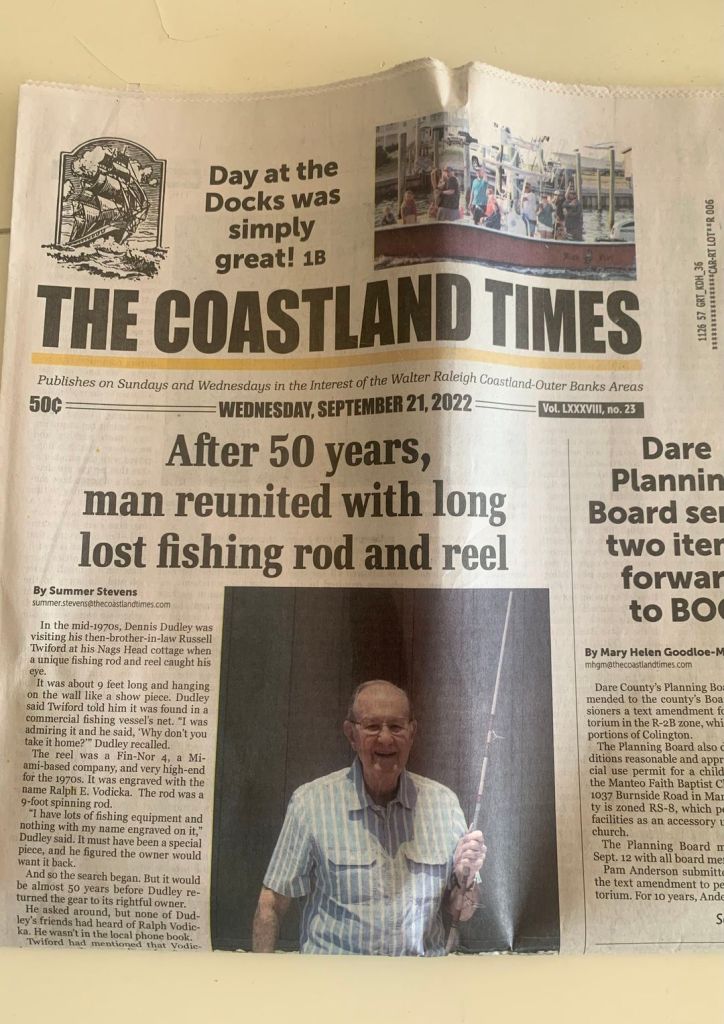
Take a look at this picture. This was front-page news, above-the-fold breaking information that came out this week in my local paper.

Yes, it is an article about a man being reunited with his favorite fishing pole after a 50-year separation. You can just see the look of joy on his face! You can hear the rush of excitement in the voices of the man who found the rod and the man who lost the rod. Can I just say that I love where I live?

Our front-page news is often like this. Usually, it is a beautiful picture of waterfowl, a big fish, or a Boy Scout taking an oath. These things constitute ‘big doin’s’ in this part. My husband and I always chuckle when the paper comes. We are blessed and delighted to live in this simple place.

Many of us have a yearning for this kind of simplicity in a community. Headlines and news programs literally scream at us with words that are harsh, complex, divisive, and distressing. We live in a broken world and our media reflects that on a daily/hourly basis. Oh, to go to a place and time that is easier!

Our lectionary passage speaks about “rich simplicity.” Paul connects simplicity with “being yourself before God” in this pastoral epistle to Timothy, probably written in A.D. 62-66.

1 Timothy 6 (The Message)

6-8 A devout life does bring wealth, but it’s the rich simplicity of being yourself before God. Since we entered the world penniless and will leave it penniless, if we have bread on the table and shoes on our feet, that’s enough.

What a picture Paul paints here. If we can keep our needs and wants in line with what we actually need to live, that’s enough. This surely begs the question about “stuff.” How much stuff do you have? How much stuff do you need? I have a friend who deeply dislikes all the storage units that have popped up on our island. Sometimes they are needed when you are between house moves, but a lot of it is just stuff we have acquired and can’t fit into our houses.

My closet reflects this. It is always a good exercise to look through your things and consider that if you haven’t worn something in months (years?) it probably isn’t that necessary to you.

Paul then moves on to the love of money:

9-10 But if it’s only money these leaders are after, they’ll self-destruct in no time. Lust for money brings trouble and nothing but trouble. Going down that path, some lose their footing in the faith completely and live to regret it bitterly ever after.

Can it get any plainer? Lust for money brings trouble and nothing but trouble. Have you ever compromised your principles because the lure of money got the better of you? If people didn’t do that, there wouldn’t be a lottery program in every state. What can we do?

Paul says to run.

11-12 But you, Timothy, man of God: Run for your life from all this. Pursue a righteous life—a life of wonder, faith, love, steadiness, courtesy. Run hard and fast in the faith. Seize the eternal life, the life you were called to, the life you so fervently embraced in the presence of so many witnesses.

Run for your life from all of this. Run toward the goal that is Christ Jesus. Run to the beauty that is righteousness. Run toward wonder, faith, love, steadiness and courtesy. You remember courtesy, don’t you? Just run.

In essence, Paul says just to keep it simple, and run toward the life to which God called you. Be yourself before God.

But clean out your closets first!

Photo via The Coastland Times