Blame Game

For the brave among us, turning on any of the “news” programs is like watching an extended version of the blame game. It is never anybody’s fault anymore. Actions and words that are on film and on the record are denied the minute the tide changes and what was said or done no longer fits the current agenda. It boggles the mind how callous and deceitful people can be. Rather than stand up for what they said or did, the finger immediately comes out and they point to their enemy with emphatic “It wasn’t me. I didn’t do it. They are the ones that did wrong.” Like two young brothers trying to avoid punishment for hitting each other, they deflect responsibility and falsely accuse the other of the crime. And it’s just as childish.

In our Scripture today, we witness the miracle of Jesus’ healing a blind man with the simple elements of dirt and spit. One would think that this incredible, mind blowing thing would have people on their knees in awe and wonder. But other things take precedence, like trying to figure out who to blame for his blindness.

John 9: 1-41 (The Message)

 1-2 Walking down the street, Jesus saw a man blind from birth. His disciples asked, “Rabbi, who sinned: this man or his parents, causing him to be born blind?”

3-5 Jesus said, “You’re asking the wrong question. You’re looking for someone to blame. There is no such cause-effect here. Look instead for what God can do. We need to be energetically at work for the One who sent me here, working while the sun shines. When night falls, the workday is over. For as long as I am in the world, there is plenty of light. I am the world’s Light.”

We need to remember that in those times, disabilities like blindness were thought to be the result of sin. The Jewish understanding of the Levitical blessings and curses detailed in Leviticus 26 led them to believe that disobedience to God’s Word resulted in physical impairments. But even with that background, it is very disappointing to read that the disciples’ first reaction was to try to assess blame rather than to see how they might be able to help the man. They imply that the sin that led to the man’s blindness might even be the result of his parent’s sin, since he was blind from birth. 

I love Jesus’ immediate reaction. His sharp response left no room for interpretation. “You’re asking the wrong question.” They tried to impose their faulty theology on the situation when what the situation actually called for compassion and action.

I’m sure all of us are guilty of asking the wrong question from time to time. I remembered a scene from the old Pink Panther movie that illustrates this and still makes me laugh. Inspector Jacques Clouseau is checking into a hotel and there is a dog at the registration desk. 

Clouseau asks, “Does your dog bite?” The Hotel Clerk responds “No.” Clouseau bows down to pet the dog. “Nice doggie.” And immediately the dog barks and bites Clouseau’s hand.

Clouseau says,  “I thought you said your dog did not bite!” The Hotel Clerk responds, “That is not my dog.” Poor Clouseau! He asked the wrong question.

When we come upon someone who needs our help, maybe it is better and more Christ-like to ask, “How can I help” rather than, “How did you end up in this situation?” What we see can be severely clouded by our assumptions. We hear that someone has lung cancer, and we assume they are a heavy smoker. We see a teenager get arrested and we assume it is a result of bad parenting. We hear that someone got fired, and we speculate about what they did something to deserve it. We read a bad review of a doctor on Facebook, and we assume they are at fault.

Blame-casting and making assumptions have very little value when they replace just looking at situations with unbiased eyes and trying to see what God sees.

The challenge for us today is to be better than the disciples in this story and start asking the right questions. Next time you see someone in need, ask God to show you what he sees, and ask him to show you how you can help. Lent asks us this question: Can you see what God sees? Or do you need God to heal you of your blindness?

I See the Moon and the Moon Sees Me by Michelle Robertson
Why I Don’t Like Snakes

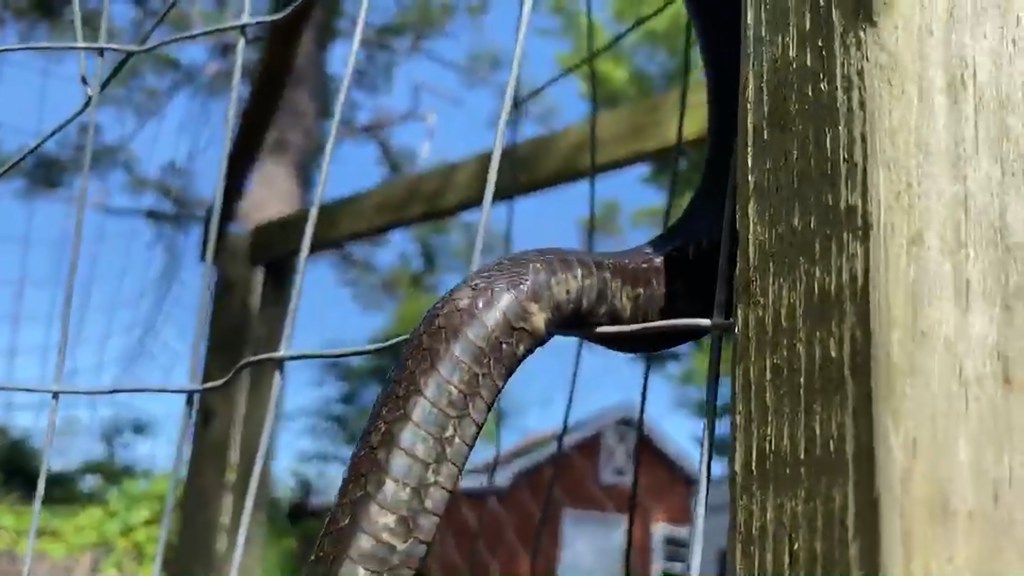
I have a vegan friend who is a true animal lover. She has rescued many of God’s creatures. This woman dares to go where no sane person (speaking completely for myself) has gone before. She has rescued dogs, cats, a serval, owls, turtles, a pelican, and….wait for it…snakes.

Why did it have to be snakes?

She keeps a chicken enclosure in her large back yard, and she loves and protects her chickens from all manners of evil. One morning at feeding time she realized that a snake, attracted by their eggs, had entrapped itself in the protective fence. Now any sane person would have called the local “Critter Gitter” (we have one on the Outer Banks) to remove said snake, or would have killed it and disentangled its lifeless body. Not this girl. She worked for an hour to slowly untangle it, and then she set it free.

My dislike of snakes is Biblical. I contend that after what happened in the Garden of Eden, we are all predisposed to not like snakes. Prove me wrong!

Genesis 3 (The Common English Bible)

During that day’s cool evening breeze, they heard the sound of the Lord God walking in the garden; and the man and his wife hid themselves from the Lord God in the middle of the garden’s trees. The Lord God called to the man and said to him, “Where are you?”

We have to stop there to observe a few things. First, how lovely that must have been! The evening offered a cool breeze, God was present, the man and the woman stood among the garden’s beautiful trees….and then came the question. “Where are you?” God inquires.

How many times has God asked you that? In the middle of some place where you should not have been, engaging in some activity you should not have participated in, have you not also heard God asking, “Where are you?” Of course it probably didn’t sound as much like God’s voice as it did your own, coming from somewhere in the back of your mind…which is much easier to ignore. God speaks to us through our conscience. When we rationalize and justify our sinful behavior, we are ignoring the voice of God.

Having been caught with their pants down (as it were), the man and the woman started the blame-casting:

10 The man replied, “I heard your sound in the garden; I was afraid because I was naked, and I hid myself.”

11 He said, “Who told you that you were naked? Did you eat from the tree, which I commanded you not to eat?”

12 The man said, “The woman you gave me, she gave me some fruit from the tree, and I ate.”

13 The Lord God said to the woman, “What have you done?!”

And the woman said, “The snake tricked me, and I ate.”

It’s God’s fault for giving the woman to the man. It’s the woman’s fault for giving the fruit to man. It’s the snake’s fault for tricking the woman….oy vey. Notice that neither the man nor the woman takes responsibility for having eaten the fruit.

One thing is certain: we haven’t evolved much since the Garden, have we? All you have to do is turn on the news and you’ll see a lot of finger-pointing that dominates the air time. Rarely do we see people taking responsibility for their own behavior.

14 The Lord God said to the snake,

“Because you did this,
    you are the one cursed
        out of all the farm animals,
        out of all the wild animals.
    On your belly you will crawl,
        and dust you will eat
        every day of your life.

15 I will put contempt between you and the woman,
    between your offspring and hers.
They will strike your head,
        but you will strike at their heels.”

So the snake takes the first fall, and humanity falls next. The concept of “original sin” points to the innate tendency we all have to sin, and traces back to Adam and Eve’s first sin and subsequent dismissal from the garden.

We also are asked, “Where are YOU?” God calls us to take responsibility for our actions and sinful behavior, and to stop trying to blame people or circumstances for our decisions. And when we do, the offer of absolution of our guilt is always there in the presence of Jesus. When you own up to your sins and ask for forgiveness, you are GUARANTEED to receive it.

Don’t let sin entrap you for one more day. Untangle yourself from its grip and let God set you free.

Snake Handlin’ by Wende Pritchard