Unusable

I have a beef with the manufacturer of the moisturizer I use. When the container is still half full, the pump stops working. No matter how hard I pound, pump, tilt, and cajole, a good portion of the product remains in the heavy glass container, completely unusable. Eventually I am forced to break the neck of the pump and try to scrape the sides of the container until the lotion is gone. It is aggravating! I’m sure the reason the manufacturer doesn’t fix it is because folks give up and just buy more moisturizer. Not this girl! I’m too cheap.

We are surrounded every day by things that are unusable: electronic cords from long gone devices, expired food products we just can’t throw out, clothing that is too small, but we leave it in the closet anyway, last generation cell phones shoved in kitchen drawers … can you name some unusable things in your life right now?

Malachi gave a warning about people who were unusable. They were labeled “stubble,” referring to the wheat chaff that was the unusable part of grain that burned quickly in a fire. The arrogant and all the evil doers were stubble. The day was coming when they would be burned and leave nothing behind to take root again.

Malachi 4 (New Revised Standard Version)

See, the day is coming, burning like an oven, when all the arrogant and all evildoers will be stubble; the day that comes shall burn them up, says the Lord of hosts, so that it will leave them neither root nor branch.  But for you who revere my name the sun of righteousness shall rise, with healing in its wings. You shall go out leaping like calves from the stall.

In John 15, Jesus gives a similar warning about the dead wood that would burn in the fire after the healthy branches were pruned for growth. His standard was measured in what produced “good fruit.” Anything that was not productive, i.e. unusable, would be burned.

If you don’t remain in me, you will be like a branch that is thrown out and dries up. Those branches are gathered up, thrown into a fire, and burned.

Dead branches are of no use to God. Dead branches produce no fruit, can’t be used for anything useful, and actually hurt the living, producing branches. This Scripture makes it clear that the standard by which the vineyard keeper judges the viability of the branch is the branch’s ability to produce the fruit of love. When love is no longer the fruit you are producing, the keeper will throw you away and allow you to dry up. The same is true of the church. If we no longer produce the fruit of love, we will be thrown out.

My Father is glorified when you produce much fruit and in this way prove that you are my disciples.

And what fruit are we to be producing? Paul gives us a beautiful list in Galatians 5: 

22 But the fruit of the Spirit is love, joy, peace, patience, kindness, goodness, faithfulness, 23 gentleness, and self-control. There is no law against things like this.

Are you “usable” for the kingdom of God? Do you revere God’s name in everything you do? Actions speak louder than words. Is love the fruit you bear? May the sun of righteousness rise up in your life and shine so brightly that everyone can see Jesus in you.


Shine On by Kathy Schumacher

The Power of Darkness

This is the time of year when the sun is fickle about making an appearance. It acts like a self-conscious teenager deciding on whether or not to go to the school dance. She shows up too early in the morning and peeks through our bedroom blinds like she needs to see who else is there before she commits. Then she ducks behind clouds for the rest of day, avoiding the scrutiny of the rest of the kids. Finally, she calls her dad and goes home way too early, making us think that midnight has suddenly arrived in the middle of the afternoon as she takes her light with her. We miss the boldness of that summer sun who came out to play and stayed all day! Come back, summer sun!

In our Scripture today, Paul talks to the church at Colossae about the “power of darkness”. This same phrase is used in Luke 22:53 when Jesus describes the sinister forces of Satan as he was being arrested and taken away for his crucifixion. This is the darkness of Satan’s domain. It lulls us to sleep, distracts us, afflicts and depresses us, and is very skillful at hiding.

Colossians 1 (New Revised Standard Version)

For this reason, since the day we heard it, we have not ceased praying for you and asking that you may be filled with the knowledge of God’s will in all spiritual wisdom and understanding, 10 so that you may walk worthy of the Lord, fully pleasing to him, as you bear fruit in every good work and as you grow in the knowledge of God. 11 May you be made strong with all the strength that comes from his glorious power, so that you may have all endurance and patience, joyfully 12 giving thanks to the Father, who has enabled you to share in the inheritance of the saints in the light. 

Paul gives us the switch to flood our souls with the light that overpowers the darkness. When we know God’s will we have spiritual understanding. This wisdom enables us to live a life worthy of Christ and bear spiritual fruit in everything we do: The big tasks as well as the small moments of grace that we share with others. God strengthens us and blesses us with endurance and patience. And what is the result? We inherit the light.

13 He has rescued us from the power of darkness and transferred us into the kingdom of his beloved Son, 14 in whom we have redemption, the forgiveness of sins.

God rescues us from the power of darkness ,and we now belong to his kingdom, which is a kingdom of light.

How can you be the light to someone living in darkness today? The days are getting shorter and colder and people living on the edge are anxiously waiting for help and redemption. Who will you save today?

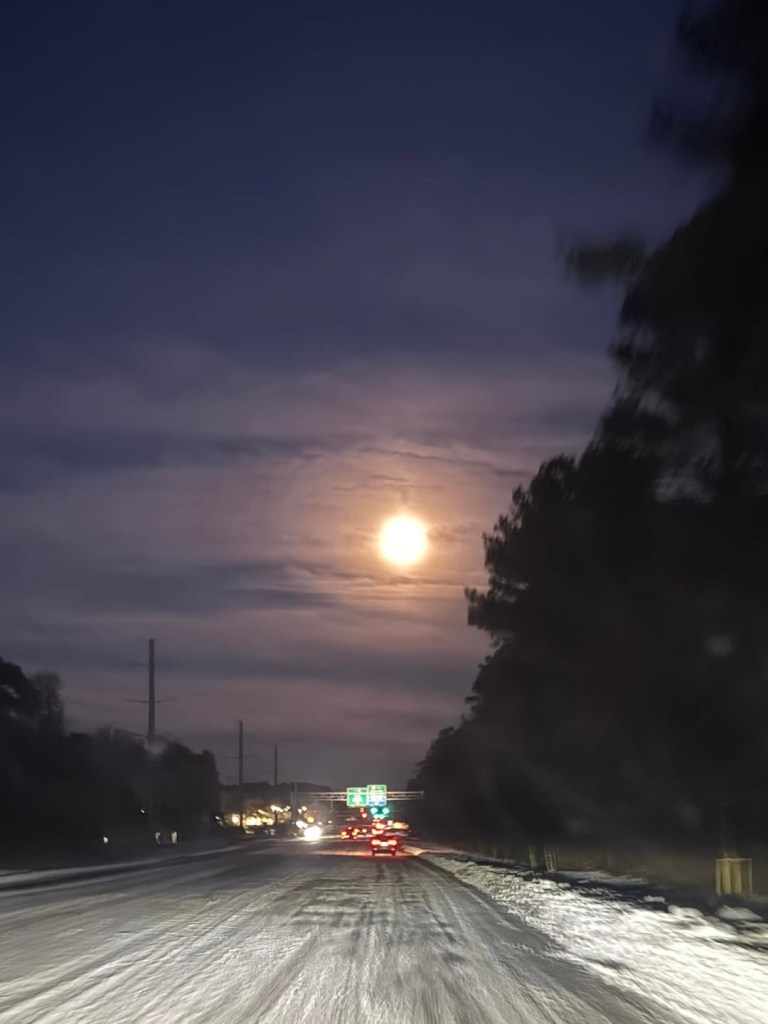
Moonlight Overcoming the Darkness

The Visible Invisible

Over the last two days, many people in the United States were treated to a stunning display of an aurora borealis. Known as the Northern Lights, this is a phenomenon caused by  “the interaction between the Earth’s magnetic field and charged particles from the sun’s atmosphere that enter the earth’s atmosphere. A solar flare (energetic particles from the sun) floats through space on the solar wind, eventually penetrating the Earth’s magnetic field. Electrons in the magnetic field sideswipe oxygen atoms or nitrogen molecules in the Earth’s atmosphere. The bursts of colorful light—the northern lights—are colliding particles (usually electrons) and atoms; at collision, electrons can return to their initial, lower energy state, and in the process, release photons or light particles we know as aurorae” according to MIT. You need a degree from MIT to follow all that. But in short, the aurora borealis is a spectacular nighttime light show.

We were treated to this beautiful marvel all the way down here in the Outer Banks. I had been reading and hearing about it, and as soon as pictures began to be posted from my local area, I ran out into the freezing wind to see it. It took a little more probing, however, to realize that in my area the lights could only be seen through my iPhone camera lens set to “night mode.” There is a completely scientific reason for that, but the short story is that the lights were invisible to the naked eye.

And yet, they were there.

We continue our lectionary reading of Colossians today. As you read this, take note of the invisible/visible references.

Colossians 1 (Common English Bible)

The Son is the image of the invisible God,
        the one who is first over all creation,

16 Because all things were created by him:
        both in the heavens and on the earth,
        the things that are visible and the things that are invisible.
            Whether they are thrones or powers,
            or rulers or authorities,
        all things were created through him and for him.

17 He existed before all things,
        and all things are held together in him.

Paul helps us understand that Jesus is the visible eikon of God: He is the “stamp” or manifestation of God on earth. Through Christ, the invisible becomes visible. Christ was present at creation, and all things were created by and through him. Every power, throne, principality, and ruler are subject to him. This gives me great comfort in these days of chaos.

18 He is the head of the body, the church,
who is the beginning,
        the one who is firstborn from among the dead
        so that he might occupy the first place in everything.

By saying that Jesus is the head of the church, we are reminded of the importance of not falling prey to “personality cultism,” where parishioners become too enamored of their preachers. When those mortal people fail or leave, the church suffers for having taken their eyes off of Christ, the true head. Does your church worship the pastor? Be careful. I’ve been in those churches, and they always end poorly.

19 Because all the fullness of God was pleased to live in him,
20         and he reconciled all things to himself through him—
        whether things on earth or in the heavens.
            He brought peace through the blood of his cross.

Christ is both the unifying principle and the personal sustainer of all creation, both in heaven and on earth. As we look to the stars each night, may it be a reminder to never take our eyes off of him.

Break Forth, O Beauteous Heavenly Light

A Second Taste

Last week our lectionary passage offered a taste of heaven, specifically in regard to marriage. (You can read it here if you missed that one.) Today we delve further into what a new heaven and a new earth will be like according to Isaiah. In Isaiah’s words, a new earth is promised that will be a state of being where the children of God can look forward to living together in complete peace and harmony. That’s something we need right now!

Isaiah described a time of social transformation with equitable justice, spiritual transformation that will usher in an unprecedented closeness and intimacy with the very-present God, and ecological transformation that will result in predators eating and living together in comfortable companionship.

Isaiah 65 (Common English Bible)

Look! I’m creating a new heaven and a new earth:
    past events won’t be remembered;
    they won’t come to mind.
18 Be glad and rejoice forever
    in what I’m creating,
    because I’m creating Jerusalem as a joy
    and her people as a source of gladness.
19 I will rejoice in Jerusalem and be glad about my people.
    No one will ever hear the sound of weeping or crying in it again.

Joy will abound and long life is promised. Crying and weeping will be a thing of the past.

20 No more will babies live only a few days,
    or the old fail to live out their days.
The one who dies at a hundred will be like a young person,
    and the one falling short of a hundred will seem cursed.

This new earth will see the eradication of theft and oppression. No longer will people work for the benefit of the powers that would take the products of their efforts away. Does this mean no more taxes?? Bring it on!

21 They will build houses and live in them;
    they will plant vineyards and eat their fruit.
22 They won’t build for others to live in,
    nor plant for others to eat.
Like the days of a tree will be the days of my people;
    my chosen will make full use of their handiwork.
23 They won’t labor in vain,
    nor bear children to a world of horrors,
    because they will be people blessed by the Lord,
    they along with their descendants.
24 Before they call, I will answer;
    while they are still speaking, I will hear.

Just stop for a moment and think about what it will be like for God to be so close to you that all you have to do is start a sentence and he will finish it. All you have to do is reach out to him and find that he is already there. This kind of access will be startling and beautiful.

25 Wolf and lamb will graze together,
    and the lion will eat straw like the ox,
    but the snake—its food will be dust.
They won’t hurt or destroy at any place on my holy mountain,
    says the Lord.

Well, you have to feel a little sorry for the snake, but the violence of animal-on-animal feeding frenzies will cease to exist, and species will live together as one. As will people. So these artificial constructs of “us-versus-them” and the prejudice against races that aren’t like you will finally go away.

The holy mountain of God will be a new Eden. Are you ready?

Normandy

I Know

Few things in life sting more than the betrayal of a friend. When someone you have depended on for companionship, comfort, and understanding turns away from you, you can easily find yourself in a pit of despair. If that happens when your life is in crisis, the burning of their condemnation can scorch your very soul. Has this ever happened to you? It has happened to me.

It happened to Job, too. You remember Job. He found himself to be the unwitting pawn in a chess match between God and Satan. God praised Job’s blameless and upright manner, to which Satan replied that Job is only righteous because God had blessed him so favorably. The double-dog dare followed: Satan dared God to allow Job to suffer great losses, contending that Job will change and curse God. God had faith in Job and allowed the suffering to begin.

Along the way, after losing his sheep, servants, ten children, and then suffering with a terrible skin disease, Job sought the consolation of his friends Eliphaz, Bildad, and Zophar. These fair weather friends quickly condemned Job and argued that he must have done something evil to provoke God’s actions. With friends like that, who needs enemies?

Can you relate?

After one particularly mean attack by Bildad, Job had a bit of an epiphany. This new revelation turned things around for him through the rest of his suffering until God returned to restore all that Job had lost.

Job 19 (New International Version)

“Oh, that my words were recorded,
    that they were written on a scroll,
24 that they were inscribed with an iron tool on lead,
    or engraved in rock forever!

In his misery, Job had no idea that indeed, his words would be written down and studied even to this very day! This is a great reminder of the promise of Romans 8:28, where we are assured that God can use ALL things for our good. Even our misery.

25 I know that my redeemer lives,
    and that in the end he will stand on the earth.
26 And after my skin has been destroyed,
    yet in my flesh I will see God;
27 I myself will see him
    with my own eyes—I, and not another.
    How my heart yearns within me!

“I know that my redeemer lives.” There is so much power in these words! The Hebrew word for redeemer used in this passage is goel. A goel is someone who stood for another to defend his case, avenge the harm done to him, and acquit him of any charges laid against him. This kind of redeemer brought vindication for all unjust wrongs. This pure statement of faith gave Job enough strength to withstand his friends’ lack of compassion for his plight and emboldened him to proclaim that he will indeed see his redeemer with his own eyes. And so he did.

If you’re in a situation today that is causing you great pain, take heart. If your “friends” have abandoned you, find better ones. May we stand with Job and join our hearts in yearning for that day when we see our redeemer Jesus with our own eyes.

Take that, Satan!

He Will Stand on the Earth by Kathy Schumacher

A Very New Song (with choreography)

We are blessed at our church to have an accompanist who is talented, faithful, kind, and sassy. Yes, sassy. She is humorous in ways that connect people and make you chortle. She recently challenged our youth director in a Facebook post to teach the kids a new song and dance that has gone viral on TikTok, Instagram, and Facebook. Have you seen it? The artist is Forrest Frank, and the song is called, “Celebration.” This lively song is a mix of Christian pop and hip hop and is full of hope, joy, and challenging dance steps. I know because I tried to do it. I ended up with a bruise. (check it out here.)

This week’s lectionary is a celebration song of its own kind, just without the dance steps. But it speaks right into Frank’s vision for singing to the Lord a NEW song. Think about that for a minute. Why do we need new songs when the old ones have worked so well for generations? Don’t new songs threaten the status quo and upset the delicate balance of theology, expectations, and musical limits? Why would we want new songs?

I think the reason is because God deserves new expressions of praise with each generation. God, whose mercies are made new every morning, is truly worthy of something fresh and dynamic from his people. God, who has created and is creating, invites us to experience his steadfast love and faithfulness every single day. God has earned a response of joyful noise breaking forth in joyous songs that demonstrate our love and thanksgiving for everything he has provided for us.

Psalm 98

O sing to the Lord a new song,
    for he has done marvelous things.
His right hand and his holy arm
    have gotten him victory.
The Lord has made known his victory;
    he has revealed his vindication in the sight of the nations.
He has remembered his steadfast love and faithfulness
    to the house of Israel.
All the ends of the earth have seen
    the victory of our God.

Make a joyful noise to the Lord, all the earth;
    break forth into joyous song and sing praises.
Sing praises to the Lord with the lyre,
    with the lyre and the sound of melody.
With trumpets and the sound of the horn
    make a joyful noise before the King, the Lord.

And not only should the people of God respond with a new song, but all of creation joins in harmony as the seas and the hills take their places on the drum set and guitar in a praise band like no other.

Let the sea roar and all that fills it,
    the world and those who live in it.
Let the floods clap their hands;
    let the hills sing together for joy
at the presence of the Lord, for he is coming
    to judge the earth.

And the best news of all? This psalm proclaims that God is the judge of the world, and his judgment is done with equity. His judgement will never be tainted by ideology or prejudice, and he can’t be bribed. Justice will rain down evenly upon us, and the oppressed and those who were denied justice in this life will receive fairness and righteousness.

He will judge the world with righteousness
    and the peoples with equity.

I can’t think of a better reason for a new song. Can you?

Let’s Have a Celebration

A Taste of Heaven

I once performed a wedding for a bride who was on her seventh marriage. I know this to be true, as the wedding license that pastors sign indicate the number (if any) of previous marriages. Now lest we be too judgmental, her first marriage was when she was in her late teens, when few of us understand the consequences of choices made in the heat of the moment at such a young age. Two of her marriages ended when those husbands passed away, so there’s that. Still, it was a bit like officiating an Erica Kane wedding, but I am happy to say that they are still together, and she has found her happily ever after.

Jesus once encountered a question about multiple marriages and the resurrection. It came from a group known as the Sadducees, who were a conservative elite group of Jews who only accepted the first five books of the Torah as the authentic word of God. If you remember your Bible history, that meant that they pretty much were limited to the creation stories, Abraham and his many sons, Moses and the exodus, and a whole lot of Law. They did not believe in the resurrection. This made the Sadducees sad, you see. (Sorry for that. I just wanna be a sheep.)

Luke 20 (New Revised Standard Version)

27 Some Sadducees, those who say there is no resurrection, came to him 28 and asked him a question: “Teacher, Moses wrote for us that if a man’s brother dies leaving a wife but no children, the man shall marry the widow and raise up children for his brother.29 Now there were seven brothers; the first married a woman and died childless; 30 then the second 31 and the third married her, and so in the same way all seven died childless. 32 Finally the woman also died. 33 In the resurrection, therefore, whose wife will the woman be? For the seven had married her.”

You can see that for folks to ask such a question when they didn’t believe in the resurrection meant they were hoping to trap or embarrass Jesus. The fact that the question was framed in the extreme of seven marriages was meant almost as a taunt. Of course that can happen (as I discovered), but it truly is a rare thing.

34 Jesus said to them, “Those who belong to this age marry and are given in marriage, 35 but those who are considered worthy of a place in that age and in the resurrection from the dead neither marry nor are given in marriage. 36 Indeed, they cannot die anymore, because they are like angels and are children of God, being children of the resurrection. 37 And the fact that the dead are raised Moses himself showed, in the story about the bush, where he speaks of the Lord as the God of Abraham, the God of Isaac, and the God of Jacob. 38 Now he is God not of the dead but of the living, for to him all of them are alive.”

There is much to unpack here. Resurrection does not include marriage for the obvious reason that there will be no reason to procreate, as eternal life is just that: eternal. We will become “like angels” but we know from other Scriptures that we will be higher than the angels. (1 Corinthians 6:3.) It will be a true community of love, and Jesus pointed out that Moses’ own testimony was that the Lord IS the God of Abraham, Isaac, and Jacob, ascribing them to be part of the living and not the dead. Such a clever piece of oratory, as the Sadducees were very attached to these Old Testament figures. Jesus spoke right into their belief system and spoke truth.

If you are happily married on earth, this may sadden you. On the other hand, if your marriage is filled with strife, a community of love will be just what you need. In any case, life in heaven will truly be nothing like life on earth.

And that is very good news indeed.

A Taste of Heaven

The Gentle Whisper

The Outer Banks has been battered by winds and storms in the last few months. You may have seen news reports that fifteen houses (as of this writing) have fallen into the sea in Buxton and Rodanthe. Here in Colington, we were battered and blown about by strong gale force winds. I was certain that the house was going to blow down. Winds that were the force of hurricane gusts brought an impressive cold front to the Outer Banks, and the windows rattled, the screens tore, and my house swayed. This three-story house was swaying in the wind so hard that it woke me up from a dead sleep. Winds are not uncommon on our little island on the edge of the continent, but this was a doozy. There is something both unsettling and reassuring when we are confronted with the power and force of a true “act of God” of Old Testament proportions. We can do nothing but listen to its howl and wait for it to subside on its own accord.

In the book of 1 Kings, Elijah fled for his life with Jezebel on his heels. He ran to the safety of a cave and had a one-on-one with God, complaining that he is the only righteous man left in Israel, and now they were about to kill him. He was instructed by an angel of the Lord to climb the same mountain where Moses received the commandments and wait.

God sent a great and strong wind to assault the mountain, but he himself was not in the wind. Then an earthquake followed, but he was not in the earthquake. Finally, a fire raged through, but still no God. When the ruckus was over, God chose then to speak to Elijah in a still, small, thin, and quiet voice:

1 Kings 19 (NIV)

11 The Lord said, “Go out and stand on the mountain in the presence of the Lord, for the Lord is about to pass by.”

Then a great and powerful wind tore the mountains apart and shattered the rocks before the Lord, but the Lord was not in the wind. After the wind there was an earthquake, but the Lord was not in the earthquake. 12 After the earthquake came a fire, but the Lord was not in the fire.

And after the fire came a gentle whisper. 13 When Elijah heard it, he pulled his cloak over his face and went out and stood at the mouth of the cave.

After the power display, God told Elijah that it was time to get back to work. Elijah received his marching orders, was given a helper, and sent back into the trenches. His mission was to bring Israel back to the Lord.

I often wonder if I am missing God in the loudness that surrounds me.

I wonder if we miss our own marching orders because we are so focused on the wind, the earthquake, and the fire that we don’t stand still long enough to tune our ear to the whisper. So much to do! We are so overwhelmed with busyness! I’m WAAY too busy to sit quietly and listen! The winds of our jobs, the earthquakes of family responsibilities, and the fire of maintaining our day-to-day lives keep us from hearing the still, small voice that offers the solution.

Woe unto us if we continue living in the cacophony. God is patiently waiting us out. He will not shout over the noise we have surrounded ourselves with, but rather will wait until we are ready to tune our busy noise out so we can tune his quiet love in.

Take heed. As Thanksgiving and Advent approach, it is going to get louder. Busy upon busy, we will frantically run around preparing to celebrate the … what? Oh, yes, the birth of the Savior, who was quietly laid in a humble manger with only the sounds of the soft-spoken cow and the peacefully snoring donkey providing background noise. Christ is the focus, so don’t get caught up in lights and tinsel and all the rest of the noise so much that you miss the moment.

God with us, Emmanuel. Be quiet! And listen.

Just Listen

All Hallows

The history of Halloween is interesting. It began as a Celtic practice called Samhain, which was held at the end of the harvest season, when late fall turns into frozen winter and the death of all the earth’s growing things was imminent. The Celts believed that on the day of Samhain, the veil between the living and the dead was lifted, and the dead came back and walked the earth. So the people dressed in costumes and lit bonfires to confuse the ghosts and ward off the evil spirits and the walking dead among them. Samhain was held on October 31st.

All Saints’ Day, a festival for remembering the saints, was set by Pope Gregory III on November 1st in order to co-opt this pagan tradition and connect it to a Christian practice. Samhain thus became known as All Hallows’ Eve, which we now call Halloween. In many ways, the two traditions are related. All Saints’ Day recognizes the work of the faithful who have died in the previous year and have gone on to experience God’s glorious eternity. Samhain was a day when people actively defied death, laughing at the very notion of it.

As it should be.

Nobody wants to die. We are designed by God to seek life, preserve life, protect life, and frankly, we spend most of our days trying to make the best of this life that we’ve been given. So while we don’t look forward to dying, we also can live our lives as those who are prepared to die, because living or dying, our life is with the Lord. God designed us for life, but death is a part of God’s design as well. Because of the resurrection of Jesus and his promise to take us to the place where he went upon his death, we can live in such a way that, while we don’t seek death, we don’t dread it either. We can laugh at death on All Hallow’s Eve, because in the end, death has no lasting power over us:

1 Corinthians 15 (The Message)

51-57 But let me tell you something wonderful, a mystery I’ll probably never fully understand. We’re not all going to die—but we are all going to be changed. You hear a blast to end all blasts from a trumpet, and in the time that you look up and blink your eyes—it’s over. On signal from that trumpet from heaven, the dead will be up and out of their graves, beyond the reach of death, never to die again.

At the same moment and in the same way, we’ll all be changed. In the resurrection scheme of things, this has to happen: everything perishable taken off the shelves and replaced by the imperishable, this mortal replaced by the immortal. Then the saying will come true:

Death swallowed by triumphant Life!

Who got the last word, oh, Death?

Oh, Death, who’s afraid of you now?

I know a man who was not afraid of death, despite his ongoing battle with brain cancer. He sought treatments, had surgery, and received miracles of love, healing, and friendships from the Lord. A new tumor had stabilized, and the original tumor bed has another tumor growing in it. This would be dealt with through prayer, positivity, medical treatments, and the power of God. In the meantime, guess what this man did when he received that diagnosis? He offered to lead a men’s Bible study and support group. That, my friends, is laughing at death. Who gets the last word? Jesus. Always Jesus.

We ain’t afraid of no ghosts.

58 With all this going for us, my dear, dear friends, stand your ground. And don’t hold back. Throw yourselves into the work of the Master, confident that nothing you do for him is a waste of time or effort.

Don’t hold back! Death has no sting.

.We Ain’t Skeered

Stuff Happens

Stuff happens. Then more stuff happens. And before you know it, stuff has taken over, and you find yourself spending much more time than is reasonable just managing your stuff.

Our family has just enjoyed a week camping together. We started with two of us, added three more, then added two, then added five more. By the time the last ones had arrived, it became a challenge to find places to put everyone’s stuff. We managed it well, but it was tight at times!

Stuff is the biggest challenge for folks who make the crazy decision to move into a tiny house. Made popular by HGTV, tiny houses are a fascinating (if wholly unrealistic!) trend for folks desiring a more simple and uncomplicated life.

Tiny houses range from 300-500 square feet. Think of that: you need to cram a kitchen, bathroom, bedrooms, living room, storage space, and an eating table in less than 500 square feet. And then….where do you put your STUFF?

What do you really need? If you could pare your life down to the essentials, what would remain? Imagine you had to move into a 300 square foot tiny house: what would you keep, and what would you throw away?

The early church found out. They actually sold all their things so that they could support one another and live together in community, where everyone had what they needed and nobody had too much:

Acts 2:45-47 Common English Bible (CEB)

45 They would sell pieces of property and possessions and distribute the proceeds to everyone who needed them. 46 Every day, they met together in the temple and ate in their homes. They shared food with gladness and simplicity.

47 They praised God and demonstrated God’s goodness to everyone. The Lord added daily to the community those who were being saved.

They shared, with gladness and SIMPLICITY.

Do you ever wish for a more simple life? Is life too complicated? Have you lost sight of the simple delights God has provided? What does the Lord desire for you…more stuff, or more simplicity?

I believe we are all called to simplicity. Removing anything that distracts us from our calling as disciples enables us to experience a certain level of godliness that comes with simple contentment. Paring down to the essentials of what is necessary is a pathway to holiness.

And you might even fit it all in a tiny house, with room left over.

1 Timothy 6 (NIV)

6 But godliness with contentment is great gain. 7 For we brought nothing into the world, and we can take nothing out of it. 8 But if we have food and clothing, we will be content with that.

Tiny on!