Have you ever locked yourself out of your house or is it just me? We were returning from a family outing and found that sure enough, all the doors to the house were locked and we couldn’t get in. All of a sudden our five-year-old grandson yelled, “Hey! I think I can go through the dog door!” At first all the adults tried to go through but each one of us got stuck. Finally we instructed him on how to open the front door and not stop to play on the way. Sure enough, his tiny little frame crawled perfectly though the flaps and we were in like flint. Sometimes little is better.
This is the underlying message for today’s passage. In ways, it reads like a recruitment poster for righteousness. Writing from the long-life experience of a man who was after God’s own heart, David assures readers that even though the righteous have little compared to the “overabundant wealth”(verse 16) of the evil, things will right themselves in the end.
Psalm 37 (Common English Bible)
Better is the little that the righteous have than the overabundant wealth of the wicked. 17 The arms of the wicked will be broken, but the Lord supports the righteous. 18 The Lord is intimately acquainted with the lives of the blameless; their heritage will last forever.
David sets up his argument in a series of opposites. The blameless receive an inheritance that lasts forever: The wicked die. The righteous are generous: The wicked borrow and don’t pay back. The blessed will possess the land: The cursed will be cut off.
19 They won’t be ashamed in troubling times, and in a period of famine they will eat their fill. 20 But the wicked will die, the Lord’s enemies will disappear— disappear like the beauty of a meadow—in smoke. 21 The wicked borrow and don’t pay it back, but the righteous are generous and giving. 22 Those blessed by God will possess the land, but those cursed by God will be cut off.
If that wasn’t enough to make you want to join the righteous, David offers a beautiful word picture in verse 24: “Though they trip up, they won’t be thrown down, because the Lord holds their hand”. Who among us doesn’t resonate with an image of a loving father holding the hand of a small child?
23 A person’s steps are made secure by the Lord when they delight in his way. 24 Though they trip up, they won’t be thrown down, because the Lord holds their hand.
You see, the overabundance of the wicked in this world is a fleeting, temporary illusion. Whatever they have now will not last. The “little” that comes from doing good is eternal and enough to sustain us though times of famine and strife. In the end, the righteous will live in the land forever.
25 I was young and now I’m old, but I have never seen the righteous left all alone, have never seen their children begging for bread. 26 They are always gracious and generous. Their children are a blessing.
David ends his recruitment speech with a clear directive: “Turn away from evil! Do good!”.
27 Turn away from evil! Do good! Then you will live in the land forever. 28 The Lord loves justice. He will never leave his faithful all alone. They are guarded forever, but the children of the wicked are eliminated. 29 The righteous will possess the land; they will live on it forever.
Friends, we are living in times when it seems like the wicked among us are living in luxury and power. It is easy to get discouraged to see them prosper while the poor and disenfranchised suffer. David speaks directly to us today. The Lord loves justice! Vengeance will be God’s. God will never leave the faithful alone. Of that we can be sure.
Would you rather have it all in this life or the next? How can we encourage one another to do good in the world? These are good things to ponder as we enter Holy Week.
Did you read Hamlet in high school? Many of us were exposed to this monumental Shakespearian “revenge tragedy” in our youth. Hamlet is a story of revenge gone wrong. Instructed by his father’s ghost to avenge his death, young Hamlet devises a way to kill his uncle for the murder. So Hamlet fakes madness, rejects his intended love interest Ophelia (who later drowns), stabs loyal attendant Polonius by accident behind a tapestry, and watches his mother die from poisoned wine intended for him. It ends with duel that kills both Laertes and Hamlet. The lesson of Hamlet is that revenge is a dish best not served.
David’s Psalm 37 teaches the same thing. This wisdom psalm is reminiscent of Proverbs and follows a rough acrostic pattern where the first words of each line flow alphabetically from Alpha to Zed.
Psalm 37 (Common English Bible)
Don’t get upset over evildoers; don’t be jealous of those who do wrong, 2 because they will fade fast, like grass; they will wither like green vegetables.
David tells us not to fret. We all recognize that fretting is harmful and unproductive, and yet when evildoers prevail, it is hard not to fume. David teaches us instead to “farm faithfulness” by waiting on God to avenge us. God will eliminate the evil doers who fade fast like grass on a hot summer day. We don’t need to take action, for God will avenge us.
3 Trust the Lord and do good; live in the land, and farm faithfulness. 4 Enjoy the Lord, and he will give what your heart asks. 5 Commit your way to the Lord! Trust him! He will act 6 and will make your righteousness shine like the dawn, your justice like high noon. 7 Be still before the Lord, and wait[b] for him. Don’t get upset when someone gets ahead— someone who invents evil schemes.
Verses 3 through 7 are a list of directives that will help us from being distracted by our desire for revenge and enable us to farm that faithfulness that David encouraged. Look at the first words in each verse. We are instructed to enjoy the Lord, commit our way to God, trust God, be still, and don’t get upset. The invitation to delight in God reminds us that even in prison, Paul and Sirus sang as they awaited justice. God intends to give us the desires of our heart if we commit our ways to him.
8 Let go of anger and leave rage behind! Don’t get upset—it will only lead to evil. 9 Because evildoers will be eliminated, but those who hope in the Lord— they will possess the land. 10 In just a little while the wicked won’t exist! If you go looking around their place, they won’t be there. 11 But the weak will inherit the land; they will enjoy a surplus of peace. 12 The wicked plot against the righteous, grinding their teeth at them. 13 But my Lord just laughs at them because he knows that their day is coming. 14 The wicked draw their swords and bend their bows to bring down the weak and the needy, to slaughter those whose way is right. 15 But the sword of the wicked will enter their own hearts! Their bows will be broken!
Psalm 37 offers pointers on how to live in and live as the Kingdom of God. We can see correlations between David’s writing and Jesus’ Beatitudes found in Matthew 5, particularly in the revelation that the meek shall inherit the land/earth in Psalm 37:11 and Matthew 5:5. All of the spiritual reversals in the Beatitudes are reflected in this psalm’s contrasts between the wicked and the righteous. Our Lord knew his Scriptures and certainly Psalm 37 served as a foundation to the words he spoke in the Sermon on the Mount. Blessed are we when we trust God’s justice and wait patiently for God to act.
Do you trust God enough to be patient or do you need to get revenge? What would it take for you emulate meekness? Be still. God is on your side.
American shows today seem to center on our fascination of what it means to be truly rich. We just can’t get enough! From heavy duty productions like Game of Thrones to silly indulgences like Succession and Palm Royale, the story of the ruthless wealthy class exalting in their ultra-privileged lives while the poor characters scrabble and fight and long to break in to that class is told over and over again. It’s almost biblical! Actually, it is biblical.
Our passage in James today plays with similar themes of rich and poor and asks us to consider what it means to be truly rich. The book of James is considered to be the first letter written in the New Testament and he wrote in an age of great prejudice and hatred based on class, nationality, and religious distinctions. The people lived with permanent categories that divided and separated them into Gentiles or Jews, free or slave, rich or poor, and Greek or barbarian.
James 2 (Common English Bible)
My brothers and sisters, when you show favoritism you deny the faithfulness of our Lord Jesus Christ, who has been resurrected in glory. 2 Imagine two people coming into your meeting. One has a gold ring and fine clothes, while the other is poor, dressed in filthy rags. 3 Then suppose that you were to take special notice of the one wearing fine clothes, saying, “Here’s an excellent place. Sit here.” But to the poor person you say, “Stand over there”; or, “Here, sit at my feet.” 4 Wouldn’t you have shown favoritism among yourselves and become evil-minded judges?
5 My dear brothers and sisters, listen! Hasn’t God chosen those who are poor by worldly standards to be rich in terms of faith? Hasn’t God chosen the poor as heirs of the kingdom he has promised to those who love him? 6 But you have dishonored the poor. Don’t the wealthy make life difficult for you? Aren’t they the ones who drag you into court? 7 Aren’t they the ones who insult the good name spoken over you at your baptism?
James’ letter attempts to break down these walls for the newly formed Christian community. His goal was to encourage them to see themselves as one race of believers under God. Paul echoed this sentiment in Ephesians 2:14-15 where he wrote that Jesus “made both Jews and Gentiles into one group”.
But unity was a radical and shocking idea, much like the Civil Rights Movement of the 1960’s was in our time. James had to break down the notion that partiality should be shown to the rich and introduce the idea that richness in faith is the greater ideal. The poor were more likely to have this richness of faith because they had more opportunities to trust God and less obstacles to overcome than the rich. Indeed, the rich young ruler who questioned Jesus about how to get into heaven learned this the hard way (Matthew 19:16-22).
Jesus came to be poor and lived his entire life in poverty. Putting too much stock in material wealth and “gold rings” is antithetical to a faith system that values the heart over appearance (1 Samuel 16:7). God isn’t partial to the rich. Neither should we be.
As we continue along in our Lent contemplations this week, it is good to pause and ask ourselves questions.How do you define richness? Are you pursuing richness in faith?
Richness in faith comes through trust in God and adherence to God’s Word. May we linger on that today.
“A bird, a turtle, and an alligator walk onto a bar …”
This morning we return to the story of a blind man who was healed by Jesus by mixing dirt and spit together and putting it on the man’s eyes. Our focus today is on the blindness of the Pharisees. You will quickly see that they live up to their name and are not fair-you-see. (Google “I Just Wanna Be a Sheep” for further explanation.)
John 9 (The Message)
13-15 They marched the man to the Pharisees. This day when Jesus made the paste and healed his blindness was the Sabbath. The Pharisees grilled him again on how he had come to see. He said, “He put a clay paste on my eyes, and I washed, and now I see.”
16 Some of the Pharisees said, “Obviously, this man can’t be from God. He doesn’t keep the Sabbath.”Others countered, “How can a bad man do miraculous, God-revealing things like this?” There was a split in their ranks.
17 They came back at the blind man, “You’re the expert. He openedyoureyes. What do you say about him?”He said, “He is a prophet.”
24 They called the man back a second time—the man who had been blind—and told him, “Give credit to God. We know this man is an impostor.”
25 He replied, “I know nothing about that one way or the other. But I know one thing for sure: I was blind . . . I now see.”26 They said, “What did he do to you? How did he open your eyes?”
27 “I’ve told you over and over and you haven’t listened. Why do you want to hear it again? Are you so eager to become his disciples?”
28-29 With that they jumped all over him. “You might be a disciple of that man, but we’re disciples of Moses. We know for sure that God spoke to Moses, but we have no idea where this man even comes from.”
30-33 The man replied, “This is amazing! You claim to know nothing about him, but the fact is, he opened my eyes! It’s well known that God isn’t at the beck and call of sinners but listens carefully to anyone who lives in reverence and does his will. That someone opened the eyes of a man born blind has never been heard of—ever. If this man didn’t come from God, he wouldn’t be able to do anything.”
34 They said, “You’re nothing but dirt! How dare you take that tone with us!” Then they threw him out in the street.
So immediately the crowd started to buzz about the miracle and begin to deny what was evident right before their very eyes. “Wasn’t this the blind man?” “No, it couldn’t be the blind man. It just looks like him!” So even though he gave a clear account of what Jesus had done, they couldn’t see it for what it was and dragged the man before the Pharisees.
The Pharisees, you recall, suffered with their own kind of blindness. It was a spiritual blindness to the needs of the community due to their laser point focus on the Law. The word Pharisee comes from the Hebrew word “perushim” meaning separated. They separated themselves from everyone else by living in strict accord of the sacred writings and the oral traditions that laid down very exact rules for living. They hoped to keep their religion pure and wanted to ward off any influence of pagan and gentile thought and culture.
But it isn’t an overstatement to suggest that sometimes they carried this too far and their rigidity blinded them to the acts of God that were happening all around them. Because of this blindness, they were highly offended that Jesus healed on the Sabbath, which broke the Law, even going so far as to proclaim that this alone disqualified Jesus from being a “man of God,” for surely someone truly sent by God would have let the blind man remain blind in order to honor the Sabbath. In their self-righteousness, they were totally blind to compassion, humanity, and God’s priorities for his people.
The story ends with Jesus finding the man again after his argument with the Pharisees has landed him out on the street. Now we need to remember that the last time they were together, the man walked away to the pool with mud pies on his eyes, so he had not seen Jesus until that very moment. When he put the voice to the face, he recognized that he was seeing Jesus for the first time, he cried out “I believe!” Seeing is believing, but also believing is seeing.
Friends, Lent is all about seeing God more clearly. Lent is a good time to do an “I” exam. Lent teaches us to look for God in ordinary places and things like mud and spit and water. Lent adjusts and sharpens the lens of God’s healing power and what we must do to help ourselves get better, physically, spiritually, relationally, and nationally. Lent invites us into a pool of purification so that we might be cleansed and sent. Do you see what I’m talking about?
What are you being blind to? What situation in your family, your workplace, your neighborhood, or your nation are you deliberately not seeing that is crying out for your help? Where do you need corrective lenses so that you can see what God sees?
Today is a good to open your eyes. May God bring clarity and direction to our sight.
I need to confess to you that there have been times in my ministry when I let frustration get the better of me. One time in particular stands out in my memory. A week before Thanksgiving I received a phone call from the adult daughter of one of our elderly couples. She called to inquire about our Care Ministry and asked if someone could go to her parent’s house on Thanksgiving and take them a home cooked turkey dinner. Our Care Ministry is always responsive to any kind of need, but I was hesitant to ask someone to leave their family on Thanksgiving day to do this task. The parents were mobile enough to attend worship every Sunday, so I asked if one of them was sick or if something had happened. No, she responded, I just want them to have a nice Thanksgiving dinner on Thursday.
I knew that this daughter lived in Virginia, less than an hour’s drive, so I asked her if she had plans to see her parents over the long weekend. She responded that she was hosting Thanksgiving dinner for her golf buddies and their spouses and couldn’t possibly get down to her parent’s house. She got a little annoyed at my questions and said, “I thought that was what the church is for!! I just want them to have a nice home cooked turkey dinner on Thanksgiving day!!” I told her that we would deliver a meal on Wednesday, but if she wanted them to have a nice home cooked dinner on Thursday, perhaps she could drive down and get them so they could join her party. I’m pretty sure she hung up on me at that point.
She thought that is what the church is for. I thought that is what family is for. I found out the following Sunday when I saw the parents at church that they had enjoyed a Thanksgiving buffet at a local restaurant and their daughter had surprised them on Friday by bringing them her leftovers. As pleased as they were, I was sad that all the daughter could muster was dropping off day-old leftovers.
John 9 (The Message)
6-7 Jesus said this and then spit in the dust, made a clay paste with the saliva, rubbed the paste on the blind man’s eyes, and said, “Go, wash at the Pool of Siloam” (Siloam means “Sent”). The man went and washed—and saw.
8 Soon the town was buzzing. His relatives and those who year after year had seen him as a blind man begging were saying, “Why, isn’t this the man we knew, who sat here and begged?”
9 Others said, “It’s him all right!”But others objected, “It’s not the same man at all. It just looks like him.”He said, “It’s me, the very one.”
10 They said, “How did your eyes get opened?”
11 “A man named Jesus made a paste and rubbed it on my eyes and told me, ‘Go to Siloam and wash.’ I did what he said. When I washed, I saw.”
12 “So where is he?”“I don’t know.”
While the town was buzzing about who this man was and what was happening, Jesus had simply seen the man’s anguish and mixed some dust and clay and spit together and made a miracle happen. He sent the man off to the pool at Siloam to wash. This was the pool that was used to purify pilgrims before entering the Temple. The word Siloam means “sent”… here is Jesus, the one sent by God, sending the man off to the pool to then be sent back bright-eyed into the world to bring a word of testimony. And it is significant that the man has to actively participate in his healing. He has to accept the help offered and collaborate with Jesus in his miracle.
The disciples and the crowd made a lot assumptions about the man’s identity and were totally blind to the need that stood before them. But I found it very unsettling to read in verse 9 that there were relatives among the crowd. And then later in the chapter in verse 18 we discover that this blind beggar has parents in town. This makes me pause and wonder why nobody in the family could house and feed this man so that he didn’t have to beg for a living. Like the daughter at Thanksgiving, they acted like it was somebody else’s job.
And that then makes me wonder if there are times in our lives when we are deliberately blind to a need in our own families that we could potentially meet but decide instead to just look away. It is a good moment right here to ask yourself if you are choosing to be blind to a relative who needs your help, and what could you be doing do to alleviate their distress? Are you going to be like this crowd, or like Jesus?
Several years ago I was flying home from a trip and witnessed a funny exchange between a passenger and a Flight Attendant. Our plane had been reassigned from the one that had been scheduled, and the seats were not configured the same way. This meant that all of our boarding passes had to be reissued with the new seat numbers. For the most part, people were assigned the same seat they originally had, but one lady had lost her economy class window seat and was given an aisle seat. She was furious and argued with the Flight Attendant that she deserved the window seat and how dare they give her an aisle seat! She would not sit down until her needs were met, blocking the aisle and delaying the boarding process. The Flight Attendant apologized and tried to calm her down, but the plane was full and there were no empty seats available. Finally a second flight attendant came from the back and leaned over to speak to a gentlemen seated at the window seat that was a few rows behind the lady’s row. The man got a big smile on his face and agreed. They swapped seats and the crisis was over. I looked up at the row numbers and instantly saw why he was smiling: the woman’s new seat had been upgraded to Comfort Plus. She now sat in Economy while he enjoyed the free drinks, upgraded snacks, and free entertainment that was meant to be hers. Did I mention that this happened at night? What could she possibly see from her window?
Today’s passage comes from the book of Luke and has a mysterious story that Jesus told in an effort to school the Pharisees about their self-justification about their wealth, status, and privilege. While not a parable, this story is intended to be educational and confrontational. Some scholars suggest that Jesus is sharing a scene that he witnessed during a mystical and divine visit to the afterlife. They believe that it is a story he observed from his eternal perspective. In any case, the rich man he described is meant to represent not only the Pharisees, but all who feel entitled to their riches on earth. And so it offers us a chance to consider our own sense of superiority.
Luke 16 (Common English Bible)
14 The Pharisees, who were money-lovers, heard all this and sneered at Jesus. 15 He said to them, “You are the ones who justify yourselves before other people, but God knows your hearts. What is highly valued by people is deeply offensive to God. 16 Until John, there was only the Law and the Prophets. Since then, the good news of God’s kingdom is preached, and everyone is urged to enter it. 17 It’s easier for heaven and earth to pass away than for the smallest stroke of a pen in the Law to drop out. 18 Any man who divorces his wife and marries another commits adultery, and a man who marries a woman divorced from her husband commits adultery.
Luke sets the scene beautifully from the very beginning, calling the Pharisees money-lovers who sneered at a parable Jesus had just told about a shrewd manager (found in Luke 16:1-13). Jesus ended that lesson by reminding the hearers that no one can serve two masters, stating that you cannot serve both God and wealth. The presumably wealthy Pharisees derided his teaching and turned their noses up at its implications. Jesus responded by calling out the Pharisees’ practice of justifying why they deserved their riches and how pious they were in their strict adherence to the Law while ignoring the needs of the people around them.
We remember that Jesus came not to abolish the Law but to fulfill it. The common practice of divorcing a wife for reasons that included her burning a meal was detestable to Jesus and he reminded them of the law of the marriage vow. Laws could not be bent and twisted to suit their whims but must serve to bring righteousness and justice to God’s people. Notice how he sandwiches his comments about the law and the prophets around this story about a rich man and a poor man. This pericope intentionally demonstrates that he himself is now the Law and the Prophet to end all prophets. As heralded by John the Baptizer, Jesus is the new order and the new covenant.
19 “There was a certain rich man who clothed himself in purple and fine linen, and who feasted luxuriously every day. 20 At his gate lay a certain poor man named Lazarus who was covered with sores.21 Lazarus longed to eat the crumbs that fell from the rich man’s table. Instead, dogs would come and lick his sores.
22 “The poor man died and was carried by angels to Abraham’s side. The rich man also died and was buried. 23 While being tormented in the place of the dead, he looked up and saw Abraham at a distance with Lazarus at his side. 24 He shouted, ‘Father Abraham, have mercy on me. Send Lazarus to dip the tip of his finger in water and cool my tongue, because I’m suffering in this flame.’ 25 But Abraham said, ‘Child, remember that during your lifetime you received good things, whereas Lazarus received terrible things. Now Lazarus is being comforted and you are in great pain. 26 Moreover, a great crevasse has been fixed between us and you. Those who wish to cross over from here to you cannot. Neither can anyone cross from there to us.’
27 “The rich man said, ‘Then I beg you, Father, send Lazarus to my father’s house. 28 I have five brothers. He needs to warn them so that they don’t come to this place of agony.’ 29 Abraham replied, ‘They have Moses and the Prophets. They must listen to them.’30 The rich man said, ‘No, Father Abraham! But if someone from the dead goes to them, they will change their hearts and lives.’31 Abraham said, ‘If they don’t listen to Moses and the Prophets, then neither will they be persuaded if someone rises from the dead.’”
One of the reasons that we know that this story isn’t a parable is because the poor man is named. Parables did not include names. The name Lazarus is from the Hebrew word Eleazar which means “God is my help.” It is interesting then that Jesus did not name the rich man. Do you suppose the reason is because he wanted the hearers of the story to see themselves in this character?
There is a beautiful symbolism in the use of the distance between the rich man and his gate, where Lazarus begged, and the distance between them in the afterlife. Remember that Jesus had not been resurrected yet, so this place was not the heaven of eternity that we anticipate today. instead it was a kind of Hades or Sheol that had two sides: one for the righteous who experienced its comfort and one that was a place of torments. Notice that even while the rich man was being tormented in the place of the dead, he asked Abraham to send Lazarus to bring him cool water, treating Lazarus like a servant. Apparently, entitlement follows us to the afterlife.
Abraham was right that the brothers, who have access to the teachings of Moses and the Prophets, won’t listen to anyone about the fate that awaits them. So too are those who have access to the teachings of Christ and refuse to believe. This is why it is imperative that we who are the church not just preach the gospel but also be the gospel in our communities.
This passage challenges us to examine our own behavior, something that we are serious about during Lent. Do we act like entitled and spoiled children who deserve the blessings God bestows, or are we humble and grateful for God’s grace? Do we demonstrate that humility by taking care of those around us or are we stingy and oblivious? Are Christians today sometimes guilty of using Scripture to justify our selfish actions?
Tonight, as you sit at your table to feast luxuriously in your warm, comfortable home, take a moment to thank God and ask the Holy Spirit to show you the Lazarus’s in your community. Then go and do something about it.
The first 7 lines of Psalm 95 are a joyful rendering of what it is like to gather together in an assembly of worshippers and bow humbly before God in worship and adoration. Indeed, God created us for worship and this natural outpouring of admiration and appreciation for our maker is the very least we can do. David highlights the blessings that come when we sing and shout for joy to our incomparable God.
Then his tone shifts with the admonition to “listen to God’s voice right now.” He refers to Meribah and Massah, two places where the children of Israel displayed open rebellion and mistrust of God’s plan to deliver them to the Promised Land. After the miracles God had bestowed on them, after helping them escape Egypt, after bringing them through the Red Sea, destroying Pharaoh and his army as they tried to pursue them, after everything God did through Moses to save the people, their response was rebellious, unbelieving, and dismissive. They rejected God’s intervention, complaining that they should have been allowed to either die in Egypt where at least they had food, or die right there in the wilderness.
God offered them the choice to take the Promised Land by faith, and they responded with hearts that were hard with unbelief.
Psalm 95 (Common English Bible)
If only you would listen to his voice right now! 8 “Don’t harden your hearts like you did at Meribah, like you did when you were at Massah, in the wilderness, 9 when your ancestors tested me and scrutinized me, even though they had already seen my acts.
God won’t suffer our rejection for long. Refusing God’s ways is a sign of a twisted heart that has gone astray. As Spurgeon put it, “be not willful, wanton, or repeatedly and obstinately rebellious.” God honored their choice and left them to perish in the wilderness as Joshua and Caleb entered the Promised Land.
10 For forty years I despised that generation; I said, ‘These people have twisted hearts. They don’t know my ways.’ 11 So in anger I swore: ‘They will never enter my place of rest!’”
The question this poses for us today is, are you resisting God’s will for your life? Are you rebelling against his voice and refusing to hear him? Are you putting God to the test? Take a page from Israel’s book. Bow down in trusting acceptance and sing songs of joy, or rebel against God at your own risk. Listen to God’s voice right now.
Today’s lectionary passage is the beautiful Psalm 95. Hebrews 4:7 attributes this psalm to David. It is filled with both promise and warning. Today’s reading will focus on the hopeful aspects of David’s writing in verses 1-7a. Be sure to log on for the next devotional, which will delve into the warnings found at the end of Psalm 95 in verses 7b-11.
As I read this psalm today, my thoughts immediately went to the many and varied worship experiences I have participated in over the years. I was raised Methodist (we did not become “United Methodist” until I was about 9 years old) and so of course most of my experience has been formed by my denomination. But I have also worshipped in a “black box” non-denominational church where a fog machine and heavy metal guitars were dominant. As a kid I attended services in camp settings, where church was outside and we sat on logs and scratched bug bites on our ankles. And then there was that transcendent Christmas Eve service in Paris’ Notre Dame Cathedral where the service was in French. And Catholic. Of course we have all done church online thanks to the pandemic, and as I travel, I either visit nearby churches or log into my home church in Kitty Hawk to worship there.
Of all the ways I worship, I honestly have to confess that online is my least favorite. I am grateful for the fact that online is available to us when we can’t physically get to a church and for many folks, it is the only option. So while it enables me to stay in touch with my church family at home, something is always missing, and that “something” is the community of people around me, singing, laughing, shaking hands, smiling, making eye contact … things I can’t get at home on my couch.
David begins his psalm with a tender invitation to come and sing out loud to the Lord. See, that’s the problem with online worship. I have never sung with my computer during a church service. Even though the words are on my screen and I can hear the congregation singing, I can’t bring myself to sit on my couch in a quiet room and burst out in song. Maybe it’s just me, but singing has got to be communal. Raising a joyful shout to the rock of our salvation from my living room seems weird and unappealing, not to mention how much it might startle the neighbors.
Psalm 95 (Common English Bible)
Come, let’s sing out loud to the Lord! Let’s raise a joyful shout to the rock of our salvation! 2 Let’s come before him with thanks! Let’s shout songs of joy to him!
David recognized that singing allows us to express our thoughts emotionally, especially as we experience joy. And the songs of joy are sung to God, not for the pleasure of the gathered people. We are reminded that when we gather, God is present and it is his presence that deserves our thanksgiving. When worship becomes performative and when worships leaders focus attention on themselves, everyone loses the real purpose of worship: To come before God and God alone. This cannot be pleasing to the Lord.
Pure worship directs our attention to God’s attributes. God is great. God is greater than any other god. God’s mastery of creation is to be celebrated. God’s ownership of his creation, including us, is to be remembered. Nothing around us came from human ingenuity or hard work. Everything and everyone comes from his hands and belongs to him.
In the Hebrew language, verse 3 highlights three aspects of God’s nature. God is EL, great, mighty, and strong. God is JEHOVAH, the great I Am through whom all things are made. And God is ELOHIM, expressing the covenant relationship to humankind as something that belongs to him.
3 The Lord is a great God, the great king over all other gods. 4 The earth’s depths are in his hands; the mountain heights belong to him; 5 the sea, which he made, is his along with the dry ground, which his own hands formed.
The invitation continues with a call to humility. Worship in essence is a bowing down to the Lord. By submitting to a prostrate position, whether physically or just in our hearts, we signal our acceptance of our place before the Lord. We kneel in acknowledgment that we are but frail sheep in his hands. We depend on his care. We exist because he keeps us safe, fed, and nurtured in the pasture. We are his, and he is ours.
6 Come, let’s worship and bow down! Let’s kneel before the Lord, our maker! 7 He is our God, and we are the people of his pasture, the sheep in his hands.
We will tackle the warnings that follow in verse 7b next time, but for now, take a moment to worship God wherever you are. Sing, pray, kneel, and bow down. The Lord is here, even online.
Over the last few Sundays I have worshipped at St. Luke United Methodist Church in Orlando, Florida. This magnificent church boasts a large and well-rehearsed choir and a full orchestra every Sunday at their traditional service. I find myself being drawn to tears by the music at least once every service. I hope and pray that if you are ever in that area, you will make a plan to go there. I am a music geek/nerd and music speaks to my soul in ways that words can’t. But be assured that every spoken word of prayer, liturgy, and sermon in that church Is spellbinding and as moving as the music.
I am such a nerd that if a hymnal is available, I reach for it. Yes, the words are displayed on two huge screens at the front of the chancel area, but this girl likes to do it old school. I can read music, so part of the attraction is to watch the notes and see where they go. Sometimes I sight-read the alto just to hone my rusty skills (apologies to those who sit near me!). Another advantage of using the hymnal is that you can see the theology build through the entire hymn. You can’t do that with screens. Songs like “Lord of the Dance,” which so beautifully tell the story of Jesus verse by verse, aren’t nearly as effective on the screens. Next time you’re in church, pick up a hymnal and see what I mean.
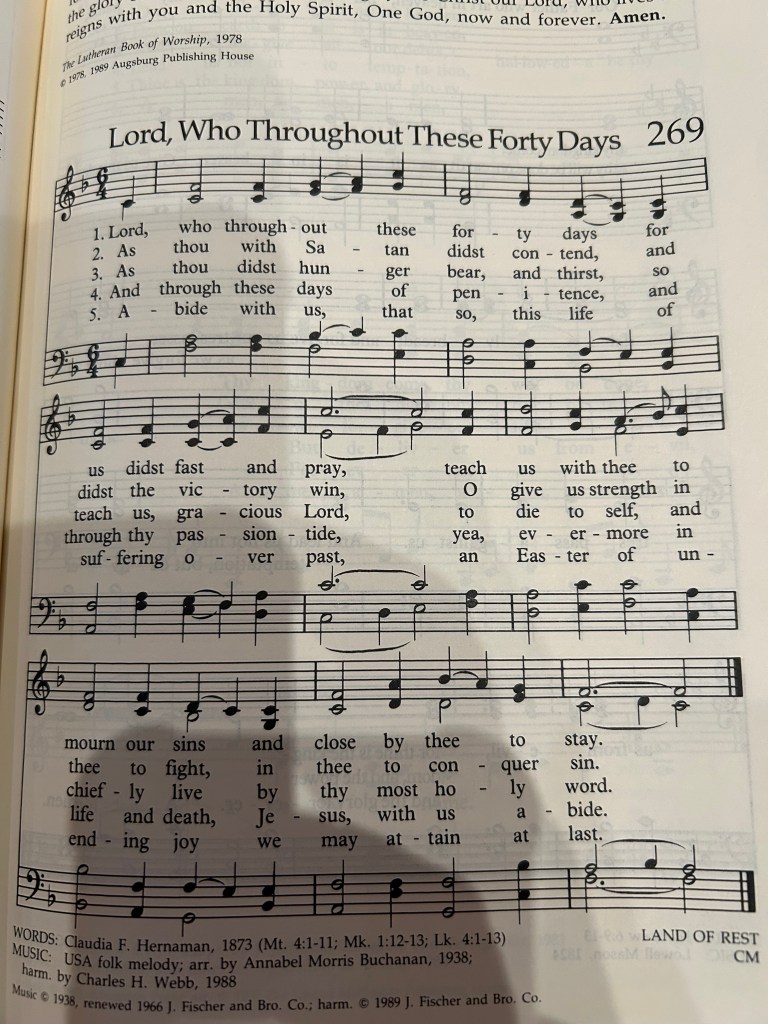
The selection for the first Sunday of Lent was “Lord, Who Throughout These Forty Days” found on page 269 of the United Methodist Hymnal. This hymn is five verses of perfect teaching about the meaning and purpose of Lent. While we all know that Lent is the 40 day season of preparation (or, as the preacher put it, “rehearsal”) for Easter, we tend to forget the nuances of what Jesus did in his forty days in the wilderness. We focus on our own disciplines, and hopefully grow closer to God through our fasting, praying, repentance, and study, but it is easy for us to be me-centered instead of Jesus-centered in this season. While focusing on our spiritual growth is truly part of Lent’s goal, we miss out on the deeper and richer story that surrounds us.
“Lord, Who Throughout These Forty Days” reminds us of the truth at the heart of Lent. Jesus fasted and prayed for us in his forty days. He calls us to mourn our sins and remain close to him. He contended with Satan in the wilderness and won that battle, enabling us to also withstand the temptation to sin. He was hungry and thirsty, setting an example for us to die to self as he did for our sake. He lived by the Word of God so that we might live by the Word. He abides with us through our penitence, our life, and our death. And thus when Lent has fulfilled its purpose, an Easter of unending joy will be ours.
Look, Easter is coming regardless of your participation. Easter is a force beyond anything our obedience or disobedience can control. Ignore it and it will still come. But will you experience unending joy? Or will that day just be filled with bunnies, eggs, and candy and then it’s all back to life as normal?
Lent is an invitation to rehearse and prepare for unending joy. But you have to be all in for it to work. I pray that today you resolve to finish these forty days as you started, with serious contemplation and dedicated time spent in repentance, fasting, praying, and immersion into God’s Word. And if you haven’t started any Lent practices, start now. When we do this, Easter will usher in the unending joy that Jesus died for.
Have you ever resisted someone’s help? Thinking that you had everything under control, did you ever reject the kind ministrations of friends and just plugged along in your misery? False pride, embarrassment, stubbornness, and a sense of not wanting to appear weak can turn our heads away from the compassionate offering that a friend is trying to make. When we do that, we miss out on so much.
Many years ago, my daughter had to come home from college when she was diagnosed with cancer. She lived with us for nine months while she underwent daily chemotherapy, surgeries, and procedures. We were overwhelmed with her care, and our loving and supportive church tried to help. I was serving as a pastor on that staff and really resisted any assistance. Cards and gifts for my daughter were welcome and appreciated, but any offering of help for her father and me as caregivers was rejected. “We’re okay, we’ve got this, we’re good” became my mantra when any kind soul offered support for us. How foolish I was! Talk about stupid and unnecessary pride. Finally I realized that my pride was preventing the church from being the church to us, so I began to accept meals. We’re Methodist, and casseroles are our love language! I was inadvertently stopping people from loving on us and doing the acts of ministry that God was calling them to do for our family.
The first delivery was something called “Hot Chicken Salad.” This casserole dish of pure heaven was not a salad as such, but a culinary adventure in beautiful white chicken chunks, crunchy slivered almonds, and a saucy sauce that made my eyes roll back in my head. And for that moment, I was uplifted by the gift of a friend and church member who was also uplifted to be able to do something tangible in our fight against cancer. I still make that recipe today.
In our passage today, we see Jesus offer an act of ministry to a man who was born blind.
John 9 (The Message)
1-2 Walking down the street, Jesus saw a man blind from birth. His disciples asked, “Rabbi, who sinned: this man or his parents, causing him to be born blind?”
Right from the bat we see that the disciples asked the wrong question. They were focused on trying to figure out the theology behind the blindness, proving that they were blind to his need. Jesus focused on a compassionate response.
3-5 Jesus said, “You’re asking the wrong question. You’re looking for someone to blame. There is no such cause-effect here. Look instead for what God can do. We need to be energetically at work for the One who sent me here, working while the sun shines. When night falls, the workday is over. For as long as I am in the world, there is plenty of light. I am the world’s Light.”
We often hesitate to step into places of helping a stranger. We ask how the unhoused person ended up that way. We question if giving the person on the street some money might enable them to go off and get high. We question how the mother with a lot of kids in tow ended up on food stamps. We hesitate to support the veteran found sleeping in the freezing rain because we don’t trust the GoFundMe that a community member set up.
We ask the wrong question.
6-7 He said this and then spit in the dust, made a clay paste with the saliva, rubbed the paste on the blind man’s eyes, and said, “Go, wash at the Pool of Siloam” (Siloam means “Sent”). The man went and washed—and saw.
Dust and clay played an important role in Genesis 2:7: 7 then the Lord God formed man from the dust of the ground and breathed into his nostrils the breath of life, and the man became a living being.(Common English Bible) Jesus’ use of dust in this healing miracle harkens back to the power of creation. Indeed, Jesus created sight in the blind man. What is he trying to create in you today? What are you blind to? Where is God hoping to open your eyes so that you might offer a compassionate response?
The last sentence reminds us that when we are offered healing, we need to participate. The man went and washed and he saw. I accepted a gift of a meal and ate of the bread of empathy that night, and it made me stronger. Is God calling you to participate in your own miracle?
Say yes to the Hot Chicken Salad. It will change your life.









 At Water’s Edge