Calling All Saints
Saints. They can be canonized heroes of our faith, plaster statues in a cathedral, a football team in New Orleans, or the person sitting next to you.
We usually balk at the notion that every day folks are saints, and the thought that we ourselves fall into that category is especially squirm-worthy. Comparing ourselves with the likes of the Apostle Paul, Mother Teresa, and Gabriel the Archangel is uncomfortable at best, unless you have a really, really big ego. Most Protestant denominations don’t have saints like our Catholic brothers and sisters do. Our traditions don’t include canonization, but we do have saints of the ordinary variety.
You and me.
All Saints’ Day is a way of marking the ordinariness of extraordinary people of faith. Many churches observe this on the first Sunday of November. Names of those who have died in the last year are read, and a candle is lit for each. Sometimes a bell is tolled as well. It is a sacred and solemn day of remembrance and thanksgiving for the faithfulness of these folks.
The phrase saints appears in the Bible over 60 times. In Colossians 10, Paul assures us that all of us are saints:
Colossians 1:10-14 New Revised Standard Version (NRSV)
10 So that you may lead lives worthy of the Lord, fully pleasing to him, as you bear fruit in every good work and as you grow in the knowledge of God. 11 May you be made strong with all the strength that comes from his glorious power, and may you be prepared to endure everything with patience, while joyfully 12 giving thanks to the Father, who has enabled you to share in the inheritance of the saints in the light. 13 He has rescued us from the power of darkness and transferred us into the kingdom of his beloved Son, 14 in whom we have redemption, the forgiveness of sins
The root of the word saint comes from the word sanctified. To be sanctified is to be “set apart for holy use.” We have been called out of the world to be the reflection of Christ to a world that doesn’t know him but needs him desperately.
Many years ago, I traveled to Israel. Most of the holy sites are maintained by different churches: Roman Catholic, Coptic, Greek Orthodox, Franciscans, etc. As an American Methodist, I was struck by all of the plaster statues and busts of saints I knew nothing about. It was an interesting distraction from the holy site itself.
When I got home, I reflected on our Protestant understanding of saints as ordinary people, and I sadly realized that in many instances, I have been and continue to be a plaster saint. How about you? Do you ever feel that way … That if people knew what was really going on inside of you, they surely would feel differently about you?
The scriptures may affirm us as saints with the rest of the members of the household of God, but in so many ways, our usefulness as those set apart for holy use only runs skin deep. I may appear somewhat saintly on the outside, but the plaster is covering who I really am and hiding my less-than-sanctified-self from the world.
In our ordinariness, we all sin and fall short of the glory of God. Then we put on a plaster cast and show a holiness to the world that doesn’t really speak to who we are inside. As they say, actions speak louder than words, and people can easily see past the mask. And so can God.
On this All Saints’ Day, let us spend a moment meditating on that. Do you mirror the image of God in everything you say, do, think, and post? Or is your sainthood just a plaster façade, hiding an inner self you don’t want others to see? Let us mark this day with self-examination, confession, repentance, and change.
As saints, we are called to work hard in every way to do the right thing and endure in good works no matter the cost. We are instructed to grow in our knowledge of God, so keep doing your daily devotionals, people! Thank you for reading! Saints endeavor to live a life worthy of God, not just show up to church occasionally so we can check that box.
You see, the whole point of sainthood is not to be perfect, but to be redeemed, forgiven, and strengthened by the Holy Spirit to live a life that reflects our faith. And someday, when the saints go marching in, oh Lord, let us be in that number!
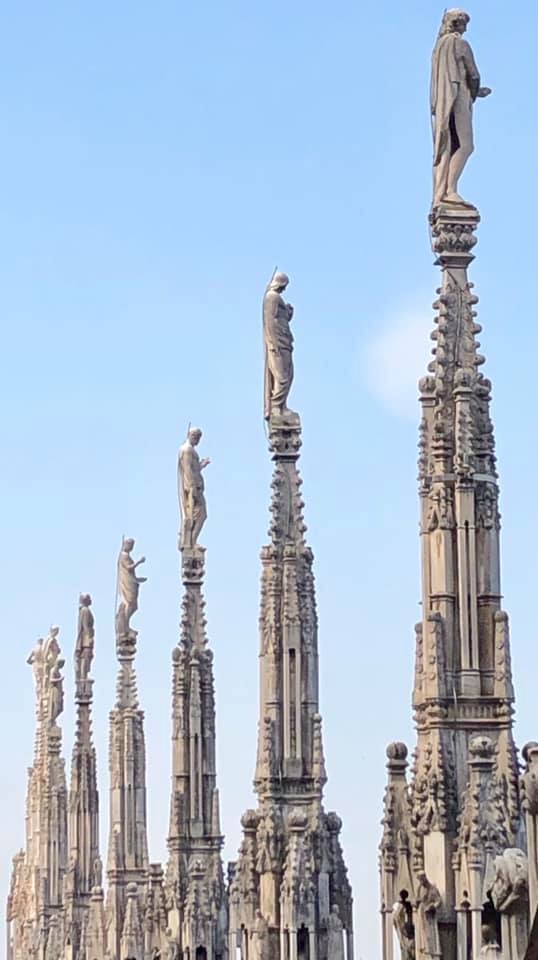
Stone Saints by Alan Janesch

 At Water’s Edge