Last evening our dear friends returned to their home next door, and we spent several minutes hugging and talking in our adjoining backyards. We caught up on happy and sad news and made plans to do things together while they are here. In the midst of that joy, my husband suddenly looked past me with a startled look on his face. I followed his gaze and was shocked to see that an entire section of railing and glass slats had fallen from our bedroom balcony onto the middle deck. It was laying across chairs. My heart skipped a beat, remembering that I had let our dog out on that balcony only hours earlier. I had watched her from the bedroom as I put laundry away but could not see the missing panel from that vantage point. I am so glad she plopped down for a rest in her normal sunny spot in the middle and did not try to explore the new opening! We have no idea when it fell and never heard anything. Luckily nobody was sitting in the chairs when it did. Even more surprising is that none of the glass slats broke on impact. Praise the Lord for that!
It is good to praise God in good times and bad. In times of sudden disaster, praising God might not be the first thing that comes to mind, but it is a healthy habit to get into. Praising God in the storms reminds us that God is in the storm with us, and that is something for which to be thankful.
Psalm 113 (Common English Bible) Praise the Lord! You who serve the Lord—praise! Praise the Lord’s name! 2 Let the Lord’s name be blessed from now until forever from now! 3 From sunrise to sunset, let the Lord’s name be praised! 4 The Lord is high over all the nations; God’s glory is higher than the skies!
5 Who could possibly compare to the Lord our God? God rules from on high; 6 he has to come down to even see heaven and earth! 7 God lifts up the poor from the dirt and raises up the needy from the garbage pile 8 to seat them with leaders— with the leaders of his own people! 9 God nests the once barren woman at home— now a joyful mother with children!
Praise the Lord!
Psalm 113 is the first of the “Egyptian Hallel” psalms. These were so named for their references to God’s deliverance of Israel from Egypt during the exodus, and the people’s response of praise (as in “Hallel-uyah”, meaning praise the Lord). Indeed, the word “praise” occurs three times in the first verse. This collection of psalms includes Psalm 113 through 118 and is used by Jews at all major festivals, but especially at the beginning and the conclusion of the Passover. For Christians, Psalm 113 is used for the celebration of Easter.Mark 14:26 tells us that Jesus and his disciples went to the Mount of Olives after “singing songs of praise” at the Last Supper, since it was a traditional Passover meal. It is very likely that Psalm 113 was one of those songs.
Our despair over the inequities of earthly life are answered beautifully with the promise of salvation in the verses 7 and 8: “God lifts up the poor from the dirt and raises up the needy from the garbage pile to seat them with the leaders”. We can almost feel the anticipation of Christ’s Second Coming, when he will return and level out every top-heavy system humanity has created. On days when we despair over what is happening (and not happening) in our own government, we can remember to praise God, even when it seems that all “Hallel” is breaking out. God is still in control, praise be! The promise of redemption is offered to all of God’s people … and that is reason to praise, indeed!
So, take heart. God is with us in every moment. Thanks be to God.
Nothing hurts like rejection. Whether it happens on the playground, the boardroom, the marriage bed, or the church, rejection is a bitter pill to swallow. Even those who understand that God is always working for the good of those who love him suffer when a relationship is severed and someone they love turns their face and walks away. Part of the deepest pain I have felt over my church’s schism is the feeling of rejection by those who left my church. Family estrangements are always filled with hurt, confusion, and a feeling of “just not being good enough” for the one who departed.
When we are in those phases of waning relationships, we can find comfort in remembering that even our Lord felt the pangs of rejection, albeit on a much larger scale. He spent his entire life loving and caring for people and suffered a horrible rejection for it. Peter describes him as a cornerstone, and it is an apt description. A cornerstone is a large stone placed at the intersection of two masonry walls that form the foundation of a building. As such, it has come to mean something vitally important to a group or an idea, without which the system would fail.
Peter’s cornerstone reference comes from Psalm 118:22, a passage that these Jewish religious leaders would certainly have recognized:
The stone the builders rejected has become the cornerstone; 23 the Lord has done this, and it is marvelous in our eyes. 24 The Lord has done it this very day; let us rejoice today and be glad.
Does your church building have a cornerstone? It probably has a date engraved on it that indicates the year of construction. That engraving celebrates not only the year, but the people in the congregation at that time who were vitally essential in the church’s construction. We talk about things being the “cornerstone” of democracy, the “cornerstone” of our budget, and the “cornerstone” of our faith. Are you a cornerstone? It can be challenging to hold up heavy walls. Jesus knew this.
Acts 4 (Common English Bible)
5 The next day the leaders, elders, and legal experts gathered in Jerusalem,6 along with Annas the high priest, Caiaphas, John, Alexander, and others from the high priest’s family. 7 They had Peter and John brought before them and asked, “By what power or in what name did you do this?”
8 Then Peter, inspired by the Holy Spirit, answered, “Leaders of the people and elders, 9 are we being examined today because something good was done for a sick person, a good deed that healed him? 10 If so, then you and all the people of Israel need to know that this man stands healthy before you because of the name of Jesus Christ the Nazarene—whom you crucified but whom God raised from the dead. 11 This Jesus is the stone you builders rejected; he has become the cornerstone! 12 Salvation can be found in no one else. Throughout the whole world, no other name has been given among humans through which we must be saved.”
I have to wonder what was going on in the minds of Annas the high priest and Caiaphas. These men, who were so instrumental in Jesus’ crucifixion, are now first-hand witnesses to the power of the risen Lord. We have all been in situations where new information comes to light and we have to second guess our original assessment of an event, but can you imagine how they felt when they saw with their own eyes that you just can’t kill the Son of God?? You just can’t kill the power of the Holy Spirit! You just can’t kill a movement of disciples and followers who are about to take on the ministry that Jesus started and go to the ends of the known world proclaiming his good news.
Perhaps it is good for us today to acknowledge that Jesus’ rejection was necessary for the healing of the world. As I look back on times when I have suffered a rejection, I can find some good there. Rejections forced me to move on, to be more realistic in my expectations, and to seek out more stable and healthy relationships. If you are struggling today with feelings of being rejected, take heart. Jesus will indeed work it out someday for your own good, too.
I have a question for the parents today. Do you ever reach a point with your kids where you stop worrying about them? Watching the young parents in my church as they watch over their children reminds me of all the sleepless nights during my own childrearing days when the pressure and anxiety I felt over their safety and well-being was overwhelming at times. Being married to a pilot who flew international trips meant that I was sole-parenting for about half the month, and the responsibility for their care fell squarely on me. Thank God for our church, which walked beside me in my soul-parenting efforts in those days and carried the burden of care with me through pre-school, children, and youth programs. There were other adults who loved and nurtured my kids at church, and I felt the momentary relief that came from trusting them over to the watchful hearts of church members. My youngest daughter is now a member of that same church, and last Sunday morning we gave over the care of my three grandchildren to Tim, Beth, and Gigi, three of the extraordinary human beings who loved on my two kids when they were growing up and continue to love on the next generation in the name and for the sake of Jesus. What a tremendous blessing children’s ministry volunteers are!
When my daughters got married, I was grateful that there would now be someone in their lives taking care of them. I felt relief that there were two lovely husbands who would now shoulder the responsibility for their well-being. I especially felt relieved that they would be right there for my daughters when I couldn’t be. But I still worry. All the time. Do you ever let go of that?
Today I want to dive into Paul’s letter to his church in Thessalonica, where we can feel his parental anxiety coming through the pages. The new church was dealing with problems and persecutions for their faith, and Paul just wanted to run to their side. But like that Mom who can’t turn the car around and sit in her son’s dorm room for a semester, Paul can’t discontinue his own work to come back to check on them. So he sends his trusted friend Timothy to render assistance and encouragement.
1 Thessalonians 3 (Common English Bible) 1So when we couldn’t stand it any longer, we thought it was a good idea to stay on in Athens by ourselves, 2 and we sent you Timothy, who is our brother and God’s coworker in the good news about Christ. We sent him to strengthen and encourage you in your faithfulness. 3 We didn’t want any of you to be shaken by these problems. You know very well that we were meant to go through this. 4 In fact, when we were with you, we kept on predicting that we were going to face problems exactly like what happened, as you know. 5 That’s why I sent Timothy to find out about your faithfulness when I couldn’t stand it anymore.
I love how Paul repeated himself when he said, “I couldn’t stand it (i.e. being away from them) anymore.” Have you ever felt that way when you were worried over a child? Have you ever wanted to get in the car and go and peek in their window just to assure yourself that they are alright? Have you ever called or texted too much, just to put your anxiety at ease? I have.
You know, there is an antidote to this kind of worry: it’s called prayer.
When the weight of parenting gets too heavy, it is good to let it press you straight down to your knees. By turning our loved ones over to God’s care, we know we have reached out to One who loves them even more that we do and has the power to protect, guide, and save them in ways that we never could. Paul tells his church that he had been praying “night and day” (verse 10), a good reminder to take our anxiety to God daily in prayer and leave it there.
And maybe you could be a Beth, Tim, or Gigi to a child in your church or neighborhood. If you ask any of them why they have volunteered in children’s ministry for so long, they will recount countless blessings they have received from their work. Are you being called to be blessed to be a blessing so that young parents in your church can have a moment of respite? There is no more vital work to be done than that, I promise you.
Today’s Scripture is an opportunity to take a moment to practice waiting on God. Can you replace your anxiety as you wait for God to resolve something this week by simply praying about it, night and day? Give it a try. God is able!
The recent solar eclipse raised a lot of interest in the apocalypse. Some folks thought that it might usher in the Second Coming, as Scripture talks about the world going dark just before Christ returns. As you can see by the fact that we’re all still here, that didn’t happen. My running partner and I were speculating about what might happen if it had. We decided that being ushered into the heavenly realm would certainly mean that we would be eternally located in our happy place, which for us involved being the caretakers of all the dogs who have gone to heaven before us. The idea of running a Celestial Doggy Day care was very appealing to us. People could drop their dogs off with us on their way to their choir practice and harp lessons. Doesn’t that sound heavenly??
In the fourth chapter of 1 Thessalonians, Paul addresses the Second Coming head on:
13 Brothers and sisters, we want you to know about people who have died so that you won’t mourn like others who don’t have any hope. 14 Since we believe that Jesus died and rose, so we also believe that God will bring with him those who have died in Jesus. 15 What we are saying is a message from the Lord: we who are alive and still around at the Lord’s coming definitely won’t go ahead of those who have died.
16 This is because the Lord himself will come down from heaven with the signal of a shout by the head angel and a blast on God’s trumpet. First, those who are dead in Christ will rise.17 Then, we who are living and still around will be taken up together with them in the clouds to meet with the Lord in the air. That way we will always be with the Lord. 18 So encourage each other with these words.
Paul paints images of signals, shouts, head angels making proclamations, and trumpet blasts, which raise goosebumps on our arms and causes feathered hope to rise in our hearts. Not to be confused with Scriptures on the “rapture,” this passage falls in line with our expectations from the book of Matthew which describes it this way:
“Then the sign of the Human One will appear in the sky. At that time all the tribes of the earth will be full of sadness, and they will see the Human One coming in the heavenly cloudswith power and great splendor. 31 He will send his angels with the sound of a great trumpet, and they will gather his chosen ones from the four corners of the earth, from one end of the sky to the other” (Matthew 24:30-31).
Paul clarifies that the Lord will come down at the sound of the trumpet and those who are dead will rise, joining those who are still living. This last bit of encouragement about the Second Coming was precious to the church, and it is precious to us as well.
Christ’s triumphal return is reminiscent of the royal processionals of earth’s great kings. Even in our lifetime, we experienced the pageantry and pomp of King Charles III of Britain when he took the throne in 2023. You may remember the tens of thousands of people who lined the street to welcome their new king that day as he was driven by eight white horses in a centuries old Gold State Coach surrounded by over 4,000 members of the Royal Navy, Royal Army, Royal Marines, the Tri Service Guard of Honor, and the Royal British Legion. It was spectacular and as some would say, “fit for a king.” How will we welcome our King when his time comes to return? Will it be a big and noisy spectacle of crowds cheering and trumpets blasting, or will we groan in sorrow because we aren’t ready?
Paul envisions Jesus coming from heaven to earth on a kind of celestial highway that will lead him straight to the graveyards in order to resurrect the dead. This offers a word of hope that when we die in Jesus we will arise in Jesus and never be separated from him. Matthew 25 explains what will happen next:
Matthew 25:31-33 (Common English Bible)
Now when the Human Onecomes in his majesty and all his angels are with him, he will sit on his majestic throne. 32 All the nations will be gathered in front of him. He will separate them from each other, just as a shepherd separates the sheep from the goats. 33 He will put the sheep on his right side. But the goats he will put on his left” (Matthew 25:31-33).
Understanding that the judging of the nations is coming should serve as a wake-up call to us today. Where will you stand at the end? If Jesus were to return tomorrow, would the church be ready? Are you living your life everyday with the expectation that Jesus’ return could happen at any moment?
A friend of mine broke her wrist after falling in a parking lot after church. I immediately flashed back to times when I broke a bone and I truly commiserated with her. The process of healing is long and complicated. In my case, learning to walk with a boot and crutches was tricky and exhausting. Many people assured me, though, that a broken bone heals stronger. Have you ever heard that? Apparently it is true, but only applies to the time in the healing process when your body forms a callus around the break, indeed making it stronger for a time.
This made me think about things that actually do get stronger after they break.
I believe that people can get stronger after they suffer a break of sorts. Case in point is a dear friend who came out of a prolonged and contentions divorce much, much stronger due to the break in her marriage. She found her voice in the process, is able to stand up for herself in ways she never could before, found the courage to leave her abusive husband, and discovered God’s redemptive and saving power in ways she would never have experienced had she not been broken so badly. So, there is that. Have you ever been broken and then healed stronger?
In our lectionary passage today, Peter addressed the crowd after healing a lame man. Watch what happened and how the crowd reacts:
Acts 3: 7-10 Common English Bible
7 Then he grasped the man’s right hand and raised him up. At once his feet and ankles became strong. 8 Jumping up, he began to walk around. He entered the temple with them, walking, leaping, and praising God. 9 All the people saw him walking and praising God. 10 They recognized him as the same one who used to sit at the temple’s Beautiful Gate asking for money. They were filled with amazement and surprise at what had happened to him.
The once broken and damaged feet and ankles became strong, and the man began his witness walk. He was a living, breathing example of the power of God to change and make new. Are you that person? Has God taken your brokenness and made you new? How are you proclaiming his power with your own witness walk?
12 Seeing this, Peter addressed the people: “You Israelites, why are you amazed at this? Why are you staring at us as if we made him walk by our own power or piety? 13 The God of Abraham, Isaac, and Jacob—the God of our ancestors—has glorified his servant Jesus. This is the one you handed over and denied in Pilate’s presence, even though he had already decided to release him. 14 You rejected the holy and righteous one, and asked that a murderer be released to you instead. 15 You killed the author of life, the very one whom God raised from the dead. We are witnesses of this.
Peter takes this opportunity to preach about Jesus’ crucifixion and resurrection. It is important to note that he did not allow any of the attention to remain on himself, but immediately deflected their wonder to the power of Christ.
16 His name itself has made this man strong. That is, because of faith in Jesus’ name, God has strengthened this man whom you see and know. The faith that comes through Jesus gave him complete health right before your eyes.
We know that we are healed in the strong and powerful name of Jesus. We know that when we have faith in Jesus’ name, strength comes to us by his grace.
17 “Brothers and sisters, I know you acted in ignorance. So did your rulers.18 But this is how God fulfilled what he foretold through all the prophets: that his Christ would suffer. 19 Change your hearts and lives! Turn back to God so that your sins may be wiped away.
Peter’s final words are good for us today. How do you respond to Easter? How do you understand healing? How do you account for the strength that you have obtained from God? Changing our hearts is the only way to respond. May our minds be set on turning back to God today as we continue our witness walk in everything we say and do.
I gave my four-year-old grandson a bath last week and watched as he happily played with his Little People bath toys. I noticed that he was stuffing them all in the rinsing cup until it was full. “Why are all the Little People in the cup?” I asked. “Oh,” he replied. “They’re in cup jail.” “Good heavens!” I said. “What did they do to be put in cup jail?” I asked. He looked me straight in the eye. “They made baaaad choices,” he responded solemnly.
Well, you just can’t argue with that.
My daughters are constantly advising their children to make good choices. When a bad choice seems to be asserting itself, they caution them to “make a better choice.” Even the four-year-old understands the consequences of bad choices.
In Paul’s letter to the church in Galatia, he gave the same parenting advice. Remember how much Paul loved his churches, and truly felt a parental responsibility for each one of them. Listen to what he says in this well-known warning about reaping and sowing.
Galatians 6:7-8(Common English Bible)
7 Make no mistake, God is not mocked. A person will harvest what they plant. 8 Those who plant only for their own benefit will harvest devastation from their selfishness, but those who plant for the benefit of the Spirit will harvest eternal life from the Spirit.
God pays attention to everything we say and do, and when those choices don’t fall in line with his word and his will for our lives, you can be sure there will be ramifications. I have a friend who spent a year denouncing an organization that she belonged to and basically burned every bridge on her way out. She returned to that organization recently and was hurt when someone asked her in surprise why she had come to the meeting. Reaping and sowing are basic to life. When you sow discord and rejection, you risk reaping discord and rejection.
Think for a moment about how you treat others. When you sow anger, discrimination, harsh words, and carelessness, these things will come back to you tenfold. Overindulgence in consuming things that are ultimately harmful to your body will result in actual harm to your body. Lying, cheating, and gossip often backfire and expose you to ridicule and alienation. Are these things worth the temporary pleasure?
A better choice is to sow the seeds of love and acceptance. A better choice is to choose healthy things for your body ,mind, and soul. A better choice is to plant seeds for the benefit of God’s kingdom. That will result in a harvest of eternal life and help you to avoid cup jail.
And trust me, you don’t want to end up in cup jail.
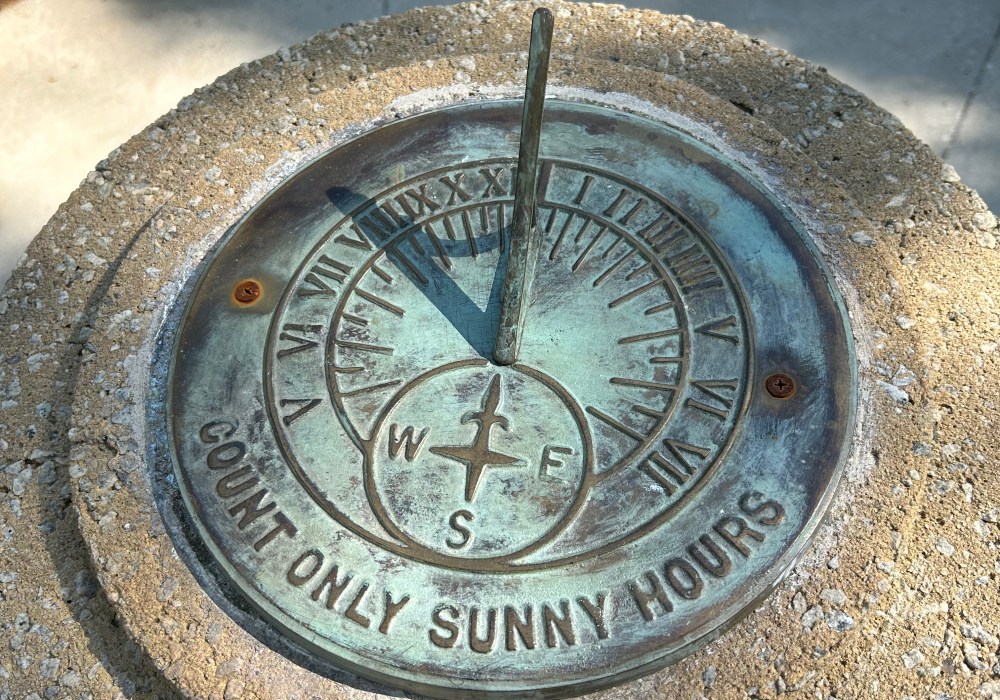
A few weeks ago, my husband and I were walking our dog in Celebration FL and passed by an old sun dial in a park. I stopped to look at it and was surprised to see that it was inscribed with the words, “Count only sunny hours.” Surely this is a good instruction for how to tell time on a sun dial, but isn’t that a perfect instruction for life? We should only count the sunny hours. This is not to discount the dark hours of grief and loss that we experience in life. To pretend that we are never hurt or disappointed would be disingenuous and serve no purpose. But it is in those darkest moments that we need to shine light, if for no other reason than to see our way out.
Isaiah 43 (New Revised Standard Version) Do not remember the former things or consider the things of old. 19 I am about to do a new thing; now it springs forth; do you not perceive it? I will make a way in the wilderness and rivers in the desert. 20 The wild animals will honor me, the jackals and the ostriches, for I give water in the wilderness, rivers in the desert, to give drink to my chosen people, 21 the people whom I formed for myself so that they might declare my praise.
We look to God, the creator and giver of all light, to help lead us out of dark days. When he sent his son to be the Light of the world, he gave us the ultimate and permanent way out. God provides the sunny hours to encourage, uplift, and recenter us after the hard ones.
Psalm 18 (New Revised Standard Version) It is you who light my lamp; the Lord, my God, lights up my darkness. 29 By you I can outrun a troop, and by my God I can leap over a wall. 30 This God—his way is perfect; the promise of the Lord proves true; he is a shield for all who take refuge in him.
We had a death in our extended family that caught us completely off guard. The last ten days have been a topsy-turvy whirlwind of grief, memories, a celebration of life, plans made, changed, re-made … death left a small tsunami in its wake, but we will be okay.
I was drawn to these words from Isaiah in the lectionary this week. They were spoken in a time of great trial for Israel, yet they lead the hearer to look forward and not dwell in the immediate or the past. As you know, the best way to drive a car is to focus looking out the windshield, not the rear view mirror.
Isaiah 25 (New International Version) On this mountain the Lord Almighty will prepare a feast of rich food for all peoples, a banquet of aged wine— the best of meats and the finest of wines. 7 On this mountain he will destroy the shroud that enfolds all peoples, the sheet that covers all nations; 8 he will swallow up death forever. The Sovereign Lord will wipe away the tears from all faces; he will remove his people’s disgrace from all the earth. The Lord has spoken.
Something called the Marriage Supper of the Lamb occurs a few times in the Bible (see Revelation 19:9) which is a great feast that takes place at the end of days. This passage suggests that it will take place on earth, not in heaven. It will be resplendent with fine wines and fat meats, but the best part is that it will be a feast for all peoples.
Just last week we studied the Last Supper in Matthew 26. If you attended a Maundy Thursday service, you probably heard this Scripture read aloud. Do you remember when Jesus said, “I will not drink of this fruit of the vine from now until that day when I drink it new with you in my Father’s kingdom”? I wonder if it is this Marriage Supper of the Lamb, held on a beautiful high mountain with all people, where we will take our first communion with the Risen Lord when he returns to redeem his people. I don’t know about you, but I’m looking forward to that.
9 In that day they will say,
“Surely this is our God; we trusted in him, and he saved us. This is the Lord, we trusted in him; let us rejoice and be glad in his salvation.”
I don’t know what you’re going through right now but take heart. There will come a day when every tear is dried, every groan is silenced, every bad thing gone from your life, and we will sup and commune with our Sacrificial Lamb, who indeed came to save us. You can trust this, because God is trustworthy.
20 1-2 Early in the morning on the first day of the week, while it was still dark, Mary Magdalene came to the tomb and saw that the stone was moved away from the entrance. She ran at once to Simon Peter and the other disciple, the one Jesus loved, gasping for breath. “They took the Master from the tomb. We don’t know where they’ve put him.”
3-10 Peter and the other disciple left immediately for the tomb. They ran, neck and neck. The other disciple got to the tomb first, outrunning Peter. Stooping to look in, he saw the pieces of linen cloth lying there, but he didn’t go in. Simon Peter arrived after him, entered the tomb, observed the linen cloths lying there, and the kerchief used to cover his head not lying with the linen cloths but separate, neatly folded by itself. Then the other disciple, the one who had gotten there first, went into the tomb, took one look at the evidence, and believed. No one yet knew from the Scripture that he had to rise from the dead. The disciples then went back home.
11-13 But Mary stood outside the tomb weeping. As she wept, she knelt to look into the tomb and saw two angels sitting there, dressed in white, one at the head, the other at the foot of where Jesus’ body had been laid. They said to her, “Woman, why do you weep?”
13-14 “They took my Master,” she said, “and I don’t know where they put him.” After she said this, she turned away and saw Jesus standing there. But she didn’t recognize him.
15 Jesus spoke to her, “Woman, why do you weep? Who are you looking for?”
She, thinking that he was the gardener, said, “Sir, if you took him, tell me where you put him so I can care for him.”
16 Jesus said, “Mary.”
Turning to face him, she said in Hebrew, “Rabboni!” meaning “Teacher!”
17 Jesus said, “Don’t cling to me, for I have not yet ascended to the Father. Go to my brothers and tell them, ‘I ascend to my Father and your Father, my God and your God.’”
18 Mary Magdalene went, telling the news to the disciples: “I saw the Master!” And she told them everything he said to her.
18 Jesus, having prayed this prayer, left with his disciples and crossed over the brook Kidron at a place where there was a garden. He and his disciples entered it.
2-4 Judas, his betrayer, knew the place because Jesus and his disciples went there often. So Judas led the way to the garden, and the Roman soldiers and police sent by the high priests and Pharisees followed. They arrived there with lanterns and torches and swords. Jesus, knowing by now everything that was imploding on him, went out and met them. He said, “Who are you after?”
They answered, “Jesus the Nazarene.”
5-6 He said, “That’s me.” The soldiers recoiled, totally taken aback. Judas, his betrayer, stood out like a sore thumb.
7 Jesus asked again, “Who are you after?”
They answered, “Jesus the Nazarene.”
8-9 “I told you,” said Jesus, “that’s me. I’m the one. So if it’s me you’re after, let these others go.” (This validated the words in his prayer, “I didn’t lose one of those you gave.”)
10 Just then Simon Peter, who was carrying a sword, pulled it from its sheath and struck the Chief Priest’s servant, cutting off his right ear. Malchus was the servant’s name.
11 Jesus ordered Peter, “Put back your sword. Do you think for a minute I’m not going to drink this cup the Father gave me?”
12-14 Then the Roman soldiers under their commander, joined by the Jewish police, seized Jesus and tied him up. They took him first to Annas, father-in-law of Caiaphas. Caiaphas was the Chief Priest that year. It was Caiaphas who had advised the Jews that it was to their advantage that one man die for the people.
15-16 Simon Peter and another disciple followed Jesus. That other disciple was known to the Chief Priest, and so he went in with Jesus to the Chief Priest’s courtyard. Peter had to stay outside. Then the other disciple went out, spoke to the doorkeeper, and got Peter in.
17 The young woman who was the doorkeeper said to Peter, “Aren’t you one of this man’s disciples?”
He said, “No, I’m not.”
18 The servants and police had made a fire because of the cold and were huddled there warming themselves. Peter stood with them, trying to get warm.
The Interrogation
19-21 Annas interrogated Jesus regarding his disciples and his teaching. Jesus answered, “I’ve spoken openly in public. I’ve taught regularly in meeting places and the Temple, where the Jews all come together. Everything has been out in the open. I’ve said nothing in secret. So why are you treating me like a traitor? Question those who have been listening to me. They know well what I have said. My teachings have all been aboveboard.”
22 When he said this, one of the policemen standing there slapped Jesus across the face, saying, “How dare you speak to the Chief Priest like that!”
23 Jesus replied, “If I’ve said something wrong, prove it. But if I’ve spoken the plain truth, why this slapping around?”
24 Then Annas sent him, still tied up, to the Chief Priest Caiaphas.
25 Meanwhile, Simon Peter was back at the fire, still trying to get warm. The others there said to him, “Aren’t you one of his disciples?”
He denied it, “Not me.”
26 One of the Chief Priest’s servants, a relative of the man whose ear Peter had cut off, said, “Didn’t I see you in the garden with him?”
27 Again, Peter denied it. Just then a rooster crowed.
The King of the Jews
28-29 They led Jesus then from Caiaphas to the Roman governor’s palace. It was early morning. They themselves didn’t enter the palace because they didn’t want to be disqualified from eating the Passover. So Pilate came out to them and spoke. “What charge do you bring against this man?”
30 They said, “If he hadn’t been doing something evil, do you think we’d be here bothering you?”
31-32 Pilate said, “You take him. Judge him by your law.”
The Jews said, “We’re not allowed to kill anyone.” (This would confirm Jesus’ word indicating the way he would die.)
33 Pilate went back into the palace and called for Jesus. He said, “Are you the ‘King of the Jews’?”
34 Jesus answered, “Are you saying this on your own, or did others tell you this about me?”
35 Pilate said, “Do I look like a Jew? Your people and your high priests turned you over to me. What did you do?”
36 “My kingdom,” said Jesus, “doesn’t consist of what you see around you. If it did, my followers would fight so that I wouldn’t be handed over to the Jews. But I’m not that kind of king, not the world’s kind of king.”
37 Then Pilate said, “So, are you a king or not?”
Jesus answered, “You tell me. Because I am King, I was born and entered the world so that I could witness to the truth. Everyone who cares for truth, who has any feeling for the truth, recognizes my voice.”
38-39 Pilate said, “What is truth?”
Then he went back out to the Jews and told them, “I find nothing wrong in this man. It’s your custom that I pardon one prisoner at Passover. Do you want me to pardon the ‘King of the Jews’?”
40 They shouted back, “Not this one, but Barabbas!” Barabbas was a Jewish freedom fighter.
The Thorn Crown of the King
19 1-3 So Pilate took Jesus and had him whipped. The soldiers, having braided a crown from thorns, set it on his head, threw a purple robe over him, and approached him with, “Hail, King of the Jews!” Then they greeted him with slaps in the face.
4-5 Pilate went back out again and said to them, “I present him to you, but I want you to know that I do not find him guilty of any crime.” Just then Jesus came out wearing the thorn crown and purple robe.
Pilate announced, “Here he is: the Man.”
6 When the high priests and police saw him, they shouted in a frenzy, “Crucify! Crucify!”
Pilate told them, “You take him. You crucify him. I find nothing wrong with him.”
7 The Jews answered, “We have a law, and by that law he must die because he claimed to be the Son of God.”
8-9 When Pilate heard this, he became even more scared. He went back into the palace and said to Jesus, “Where did you come from?”
Jesus gave no answer.
10 Pilate said, “You won’t talk? Don’t you know that I have the authority to pardon you, and the authority to—crucify you?”
11 Jesus said, “You haven’t a shred of authority over me except what has been given you from heaven. That’s why the one who betrayed me to you has committed a far greater fault.”
12 At this, Pilate tried his best to pardon him, but the Jews shouted him down: “If you pardon this man, you’re no friend of Caesar’s. Anyone setting himself up as ‘king’ defies Caesar.”
13-14 When Pilate heard those words, he led Jesus outside. He sat down at the judgment seat in the area designated Stone Court (in Hebrew, Gabbatha). It was the preparation day for Passover. The hour was noon. Pilate said to the Jews, “Here is your king.”
15 They shouted back, “Kill him! Kill him! Crucify him!”
Pilate said, “I am to crucify your king?”
The high priests answered, “We have no king except Caesar.”
16-19 Pilate caved in to their demand. He turned him over to be crucified.
The Crucifixion
They took Jesus away. Carrying his cross, Jesus went out to the place called Skull Hill (the name in Hebrew is Golgotha), where they crucified him, and with him two others, one on each side, Jesus in the middle. Pilate wrote a sign and had it placed on the cross. It read:
jesus the nazarene the king of the jews.
20-21 Many of the Jews read the sign because the place where Jesus was crucified was right next to the city. It was written in Hebrew, Latin, and Greek. The Jewish high priests objected. “Don’t write,” they said to Pilate, “‘The King of the Jews.’ Make it, ‘This man said, “I am the King of the Jews.”’”
23-24 When they crucified him, the Roman soldiers took his clothes and divided them up four ways, to each soldier a fourth. But his robe was seamless, a single piece of weaving, so they said to each other, “Let’s not tear it up. Let’s throw dice to see who gets it.” This confirmed the Scripture that said, “They divided up my clothes among them and threw dice for my coat.” (The soldiers validated the Scriptures!)
24-27 While the soldiers were looking after themselves, Jesus’ mother, his aunt, Mary the wife of Clopas, and Mary Magdalene stood at the foot of the cross. Jesus saw his mother and the disciple he loved standing near her. He said to his mother, “Woman, here is your son.” Then to the disciple, “Here is your mother.” From that moment the disciple accepted her as his own mother.
28 Jesus, seeing that everything had been completed so that the Scripture record might also be complete, then said, “I’m thirsty.”
29-30 A jug of sour wine was standing by. Someone put a sponge soaked with the wine on a javelin and lifted it to his mouth. After he took the wine, Jesus said, “It’s done . . . complete.” Bowing his head, he offered up his spirit.
31-34 Then the Jews, since it was the day of Sabbath preparation, and so the bodies wouldn’t stay on the crosses over the Sabbath (it was a high holy day that year), petitioned Pilate that their legs be broken to speed death, and the bodies taken down. So the soldiers came and broke the legs of the first man crucified with Jesus, and then the other. When they got to Jesus, they saw that he was already dead, so they didn’t break his legs. One of the soldiers stabbed him in the side with his spear. Blood and water gushed out.
35 The eyewitness to these things has presented an accurate report. He saw it himself and is telling the truth so that you, also, will believe.
36-37 These things that happened confirmed the Scripture, “Not a bone in his body was broken,” and the other Scripture that reads, “They will stare at the one they pierced.”
* * *
38 After all this, Joseph of Arimathea (he was a disciple of Jesus, but secretly, because he was intimidated by the Jews) petitioned Pilate to take the body of Jesus. Pilate gave permission. So Joseph came and took the body.
39-42 Nicodemus, who had first come to Jesus at night, came now in broad daylight carrying a mixture of myrrh and aloes, about seventy-five pounds. They took Jesus’ body and, following the Jewish burial custom, wrapped it in linen with the spices. There was a garden near the place he was crucified, and in the garden a new tomb in which no one had yet been placed. So, because it was Sabbath preparation for the Jews and the tomb was convenient, they placed Jesus in it.












 At Water’s Edge