When You are Being Trampled

An old song from the musical “The King and I” kept floating through my mind during the recent hurricanes. As we were bombarded with images of charts and graphs showing the hurricanes increasing in intensity and coming closer and closer, this little song would replay itself. Sung by Anna as she is entering life as a teacher in the great palace of the fierce and intimidating King of Siam, the lyrics are a lighthearted reminder to try to project a brave countenance, even when you don’t feel it:

Whenever I feel afraid
I hold my head erect
And whistle a happy tune
So no one will suspect I’m afraid

I whistle a happy tune
And every single time
The happiness in the tune
Convinces me that I’m not afraid

Make believe you’re brave
And the trick will take you far
You may be as brave
As you make believe you are

The last verse is the best. You may be as brave as you make believe you are. Possibly the success in this lies in the fact that working to project a fearlessness that you don’t feel will distract you from the spinning cycle of despair that would like to swirl you downward deeper into your situation.

Today’s reading is from a time when David definitely felt afraid. The Philistines had seized him in Gath. He was alone, desperate, and very, very frightened. David was in great and constant danger from many enemies, both the Philistines and Saul’s servants. He cried out to God, knowing that divine help could rescue him from any man-made threat. He appealed to the mercy of God, not relying on what he may or may not deserve.

This is such a good place to start, whenever we feel afraid. Appealing to God’s mercy is exactly the right thing to do. David dove right into his petition, and addressed the attacks of his enemies who were “trampling” him.

You may or may not have “enemies” per se, but can you list people who oppose or oppress you? Are there people in your life who attack you on social media, family members who ignore or dismiss you, or rebellious teenagers who are working your last nerve? Who or what tramples you?

Psalm 56 (New International Version)

56 God, have mercy on me because I’m being trampled.
    All day long the enemy oppresses me.
My attackers trample me all day long
    because I have so many enemies.

Having made his petition David turned to his God on High, calling him “Exalted one.” This is David’s way of reminding both God and David that he understood the high and powerful nature of the God to whom he cried out. If you were writing this psalm, what name would you use for God? Who is God to you?
Exalted one, whenever I’m afraid,
    I put my trust in you—
        in God, whose word I praise.
        I trust in God; I won’t be afraid.
    What can mere flesh do to me?

David put his whole trust in God, and it made him feel less afraid. What would it mean to put your trust in God and leave all your fears there?

David now expressed his paranoia over his enemies ganging up against him. Have you ever felt that way? Can you recall a time when you felt ambushed or trapped by people or circumstances that you couldn’t overcome?

All day long they frustrate my pursuits;
    all their thoughts are evil against me.
They get together and set an ambush—
    they are watching my steps,
    hoping for my death.
Don’t rescue them for any reason!
    In wrath bring down the people, God!

But watch what comes next. David remembers and acknowledges where God has been all along. God has kept track of his misery. There is a tenderness in his statement “you put my tears into your bottle.” The tear bottle tradition dates back nearly 3,000 years, when mourners were said to collect their tears in a tear bottle, also called a lachrymatory. Tear bottles were buried with loved ones to express honor and devotion.

You yourself have kept track of my misery.
    Put my tears into your bottle—
    aren’t they on your scroll already?

What does it mean to you to know that God has numbered and kept every tear you have shed? For David, it gave him courage. It took his anxiety away and helped him see God’s activity in his situation. Then came this beautiful statement: “I know this because God is mine.” God is yours as well.

Then my enemies will retreat when I cry out.
    I know this because God is mine.
10     God: whose word I praise.
        The Lord: whose word I praise.
11 I trust in God; I won’t be afraid.
    What can anyone do to me?

When God is yours and you are God’s, what can anyone or any circumstance do to you, indeed?

12 I will fulfill my promises to you, God.
    I will present thanksgiving offerings to you
13     because you have saved my life from death,
    saved my feet from stumbling
        so that I can walk before God in the light of life.

God saves us from death and saves our feet from stumbling. We don’t have to be afraid! God enables us to walk in the light of life. Whenever you are afraid, God creates space for you. He counts, stores, and records everything about your fears and your tears.

And to know that the God of the universe cares about you makes everything all right. 

Moonrise over Colington

Too Big for Their Britches

Do you have phrases stuck in your head that your grandparents used when you were a kid? These down-to-earth tidbits of elder wisdom are priceless core memories that can instantly take you right back to Grandma’s dining room table laden with Thanksgiving dinner delights whenever you hear them. I recently had a conversation with a friend who was bemoaning the fight in her neighborhood between the HOA and a separate governing board. We talked through the issues and finally she threw up her hands and said, “They’ve all just become too big for their britches!” Grandma would have loved that. It was one of her favorite sayings! Indeed, the ego driven arrogance of some of these “leaders” in that neighborhood fits that description. Paul would say, “They think more highly of themselves than they ought.” And you know the problem of becoming too big for your britches: You risk splitting the back seam of your pants and showing your … um … core memory.

Today’s passage is a classic tale of two brothers who had gotten way too big for their britches, or robes in this case:

Mark 4 (Common English Bible)

35 James and John, Zebedee’s sons, came to Jesus and said, “Teacher, we want you to do for us whatever we ask.”

36 “What do you want me to do for you?” he asked.

37 They said, “Allow one of us to sit on your right and the other on your left when you enter your glory.”

38 Jesus replied, “You don’t know what you’re asking! Can you drink the cup I drink or receive the baptism I receive?”

39 “We can,” they answered.

How conceited was that response? They had no idea what drinking the cup and receiving the baptism meant, but they were absolutely positive that they were big enough to handle it. In their limited thinking, sitting at places of honor in Jesus’ kingdom would be amazing. In truth, it would involve drinking from the cup of sorrow and receiving a baptism of suffering, death, and resurrection.

Jesus said, “You will drink the cup I drink and receive the baptism I receive, 40 but to sit at my right or left hand isn’t mine to give. It belongs to those for whom it has been prepared.”

I wonder if when Jesus told them they will drink the cup and receive the baptism they smiled and high-fived each other, thinking they had won something. But I am sure that Jesus did not participate in their celebration, as he knew exactly what would happen. James was the first disciple to be martyred according to Acts 12, and tradition suggests that John survived an attempted murder when he was submerged in a vat of boiling oil. In truth, the baptism they received was a baptism of fire.

41 Now when the other ten disciples heard about this, they became angry with James and John. 42 Jesus called them over and said, “You know that the ones who are considered the rulers by the Gentiles show off their authority over them and their high-ranking officials order them around. 43 But that’s not the way it will be with you. Whoever wants to be great among you will be your servant.44 Whoever wants to be first among you will be the slave of all,45 for the Human One didn’t come to be served but rather to serve and to give his life to liberate many people.”

Jesus dressed them all down and then redressed them in pants that fit their mission. They were called to be humble servants of each other and greatness would be defined by how well and faithfully they served. In this way, they took on the servanthood appearance of our Lord, who humbled himself even unto death.

Is God trying to humble you? Do you need to take a step back and see where you might serve someone in quiet kindness and gentle generosity?

The only way to be first in Jesus’ kingdom is to choose to be last.

Serving the Hungry at Fayetteville United Methodist Church by Kathy Schumacher

For All the Cracked Pots

There is an old legend from India about a water bearer who had two large water pots in which he carried water daily from the river to his master. One of the pots was perfect. The other one had a crack in it. The perfect pot always arrived at the master’s quarters perfectly full. The cracked pot was always half empty. Embarrassed and ashamed, the cracked pot said to his carrier one day, ‘Why don’t you get rid of me? I never arrive at the master’s quarters more than half full.’ ‘Ah’, replied the water bearer, ‘you don’t know the full story. Look beside the road where I carry you each day. There are flowers growing that I pick for the master’s table. The flowers only bloom on your side of the road. It is your cracked pot that waters them.”

Isn’t that an inspiring story for all of the cracked pots reading this today???

The marvelous writer Henri Nouwen helped us understand that God can use us in our brokenness to help others who are also broken. He calls us to become “wounded healers,” and encourages us to gather up our pain and come alongside someone who is hurting and offer support and understanding. It is a way of blessing others with the blessing we received when we saw firsthand how God came close to us when we were brokenhearted . God saves us from being crushed by our sorrow, our sin, our confusion, our grief, and our trials.

Psalm 34 (Common English Bible)
15 The Lord’s eyes watch the righteous,
    his ears listen to their cries for help.
16 But the Lord’s face is set against those who do evil,
    to eliminate even the memory of them from the earth.
17 When the righteous cry out, the Lord listens;
    he delivers them from all their troubles.
18 The Lord is close to the brokenhearted;
    he saves those whose spirits are crushed.

Have you been broken by something? Do you have a story to tell about God’s goodness in your bad situation? Someone needs to hear your testimony. By being willing to water the flowers God plants along the road, your words could bring healing and blessing to someone who is hurting. Maybe today is the day to allow God to use your brokenness for someone’s good. Don’t delay!

Marsh Flowers by Michelle Robertson

Whenever I Feel Afraid

An old, old song from the musical “The King and I” kept floating through my mind during the recent hurricanes. As we were bombarded with images of charts and graphs showing the hurricanes increasing in intensity and coming closer and closer, this little song would replay itself. Sung by Anna as she is entering life as a teacher in the great palace of the fierce and intimidating King of Siam, the lyrics are a lighthearted reminder to try to project a brave countenance, even when you don’t feel it:

Whenever I feel afraid
I hold my head erect
And whistle a happy tune
So no one will suspect I’m afraid

I whistle a happy tune
And every single time
The happiness in the tune
Convinces me that I’m not afraid

Make believe you’re brave
And the trick will take you far
You may be as brave
As you make believe you are

The last verse is the best. You may be as brave as you make believe you are. Possibly the success in this lies in the fact that working to project a fearlessness that you don’t feel will distract you from the spinning cycle of despair that would like to swirl you downward deeper into your situation.

Today’s reading is from a time when David definitely felt afraid. The Philistines had seized him in Gath. He was alone, desperate, and very, very frightened. David was in great and constant danger from many enemies, both the Philistines and Saul’s servants. He cried out to God, knowing that divine help could rescue him from any man-made threat. He appealed to the mercy of God, not relying on what he may or may not deserve.

This is such a good place to start, whenever we feel afraid. Appealing to God’s mercy is exactly the right thing to do. David dove right into his petition, and addressed the attacks of his enemies who were “trampling” him.

You may or may not have “enemies” per se, but can you list people who oppose or oppress you? Are there people in your life who attack you on social media, family members who ignore or dismiss you, or rebellious teenagers who are working your last nerve? Who or what tramples you?

Psalm 56 (New International Version)

56 God, have mercy on me because I’m being trampled.
    All day long the enemy oppresses me.
My attackers trample me all day long
    because I have so many enemies.

Having made his petition David turned to his God on High, calling him “Exalted one.” This is David’s way of reminding both God and David that he understood the high and powerful nature of the God to whom he cried out. If you were writing this psalm, what name would you use for God? Who is God to you?
Exalted one, whenever I’m afraid,
    I put my trust in you—
        in God, whose word I praise.
        I trust in God; I won’t be afraid.
    What can mere flesh do to me?

David put his whole trust in God, and it made him feel less afraid. What would it mean to put your trust in God and leave all your fears there?

David now expressed his paranoia over his enemies ganging up against him. Have you ever felt that way? Can you recall a time when you felt ambushed or trapped by people or circumstances that you couldn’t overcome?

All day long they frustrate my pursuits;
    all their thoughts are evil against me.
They get together and set an ambush—
    they are watching my steps,
    hoping for my death.
Don’t rescue them for any reason!
    In wrath bring down the people, God!

But watch what comes next. David remembers and acknowledges where God has been all along. God has kept track of his misery. There is a tenderness in his statement “you put my tears into your bottle.” The tear bottle tradition dates back nearly 3,000 years, when mourners were said to collect their tears in a tear bottle, also called a lachrymatory. Tear bottles were buried with loved ones to express honor and devotion.

You yourself have kept track of my misery.
    Put my tears into your bottle—
    aren’t they on your scroll already?

What does it mean to you to know that God has numbered and kept every tear you have shed? For David, it gave him courage. It took his anxiety away and helped him see God’s activity in his situation. Then came this beautiful statement: “I know this because God is mine.” God is yours as well.

Then my enemies will retreat when I cry out.
    I know this because God is mine.
10     God: whose word I praise.
        The Lord: whose word I praise.
11 I trust in God; I won’t be afraid.
    What can anyone do to me?

When God is yours and you are God’s, what can anyone or any circumstance do to you, indeed?

12 I will fulfill my promises to you, God.
    I will present thanksgiving offerings to you
13     because you have saved my life from death,
    saved my feet from stumbling
        so that I can walk before God in the light of life.

God saves us from death and saves our feet from stumbling. We don’t have to be afraid! God enables us to walk in the light of life. Whenever you are afraid, God creates space for you. He counts, stores, and records everything about your fears and your tears.

And to know that the God of the universe cares about you makes everything all right. 

What, Me Worry?

Go!

Last week I had a frustrating day. I have once again registered to run a Half Marathon in January, and I hadn’t been able to run for a week due to travel and commitments. That day was the day to get out and attempt 10 miles, which would put me back on track in my training. So I hydrated, slept well, woke up early, had my clothes already laid out and guess what? Rain. Not a nice drizzle to keep me cool, but pre-hurricane drenching rain.

In my feeling-sorry-for-myself -funk, I remembered this beautiful passage from Hebrews. It must have been a sunny day when the guy wrote this. Jelly!

Hebrews 12:1-2

12 So then let’s also run the race that is laid out in front of us, since we have such a great cloud of witnesses surrounding us. Let’s throw off any extra baggage, get rid of the sin that trips us up, 2 and fix our eyes on Jesus, faith’s pioneer and perfecter. He endured the cross, ignoring the shame, for the sake of the joy that was laid out in front of him, and sat down at the right side of God’s throne.

I have always loved this passage, as it has so much to teach us.

The first thing that jumps out at us is the phrase “the race that is laid out in front of us.” Just stop for a moment and consider that. This is a reassurance that God has a path, a way, and a journey already laid out for us. Not in a predestination sense of the word: As United Methodists, we don’t believe in predestination. But rather in a prevenient grace kind of way. Consider the grace that is spelled out in Jeremiah 29:11 which assures us that God has a plan for our lives. It is a plan to prosper us and not harm us, and it is a plan to give us a future with HOPE. As Methodists, we understand that we indeed get to exercise our free will. We can choose to stay in the race that is laid out in front of us and choose God’s plan which offers hope, or we can choose our own way, often to our detriment, distraction, and even destruction.  

So where is our hope? Our hope comes from keeping our eyes on Jesus, whom the writer of Hebrews calls the “pioneer and perfecter of our faith.” The perfecter part we expect, but did you hear that other word? Pioneer. Jesus is our pioneer, because he came before us to conquer death and blaze a trail of righteousness for us to follow. He is our example, our model, and our inspiration. He’s the guy in the marathon who puts his race bib and a message on the back of his shirt instead of the front because everyone else is following him. He has already run this race and if you keep your eyes on him, you own the race.

And one last word: He ran the race for your joy. He ran it for “the sake of the joy that was laid out for him:” The joy of knowing that his race brought you freedom and eternal life. So run your race with the joy that Jesus purchased for you on the cross, always keeping your eyes on him, and run every day with perseverance. Someday when you cross that finish line he will hand you the best race bling of all … not a finisher’s medal to hang around your neck, but a crown of glory to wear upon your head. 

Ready, Set …

Dark Times

Sometimes, in moments of frustration and despair, I think that we are living in dark times. The continuing war in the Middle East, the continuing war in Ukraine, the recent devastation of Hurricane Helene and the one on the way this week, the continuing war in our nation over human rights, border issues, the economy, the rule of law, the impending elections … dark times indeed.

Have you ever noticed that it has to be very, very dark in order to see the stars?

I remember a trip we took to the Big Island in Hawaii many years ago. At night, this island’s streetlights shine through very muted yellow lightbulbs so that the space observatory at the top of Mauna Kea can see the stars, planets, and celestial bodies clearly. There is a strict lighting ordinance in effect for all of the homes and businesses on the island that ensures the darkest of skies possible. Mauna Kea has 12 separate nonprofit observatories, which makes this area the most scientifically productive site of astronomy in the world.

When it is dark enough, you can see the stars.

Today’s passage from Luke describes the upheaval that we will experience when Jesus returns. The end times will be marked with changes and disruption in the sun, moon, stars, planets, and other heavenly bodies. It sounds horrific.

Luke 21:25-28, 34-36 (Common English Bible)

25 “There will be signs in the sun, moon, and stars. On the earth, there will be dismay among nations in their confusion over the roaring of the sea and surging waves. 26 The planets and other heavenly bodies will be shaken, causing people to faint from fear and foreboding of what is coming upon the world. 27 Then they will see the Human One coming on a cloud with power and great splendor. 

28 Now when these things begin to happen, stand up straight and raise your heads, because your redemption is near.”

“RAISE UP YOUR HEADS, because your redemption is drawing near.” Jesus says. Salvation is on the way, not because you can figure a way out, not because you have kept your chin up and your upper lip stiff, not because the fictitious “Universe” will use its non-existent power to reverse your course, but because God is going to act. Our Christian hope does not rest in what we might do, but in what God will do. It is God who acts when we cannot. It is God who saves when we are hopelessly mired in sin and shame. It is God who gives us the victory when we are utterly defeated.

The point of this text, in fact the point of the entire gospel is this: When there is nothing you can do—nothing—God will act on your behalf. When you are out of resources, out of time, out of patience, out of help, out of hope, when the sea is foaming and the tide is about to take you under, when you have nothing left, no defense, nothing to fight back with so shred of hope to grasp onto—that is the time to lift up your head, for when things are darkest, then you can see the stars. 

So what should we do in the meantime, in these dark times? Jesus continues:

34 “Take care that your hearts aren’t dulled by drinking parties, drunkenness, and the anxieties of day-to-day life. Don’t let that day fall upon you unexpectedly, 35 like a trap. It will come upon everyone who lives on the face of the whole earth. 36  Stay alert at all times, praying that you are strong enough to escape everything that is about to happen and to stand before the Human One.” 

Take care of your hearts. Stay alert. Pray for strength. Find a way to be a light in someone’s darkness.

And look up.

Moonrise by Michelle Robertson

The Light Reflecting

 Today, I want to tell you about a magnificent basilica called Sagrada Familia in Barcelona, Spain. I was blessed to see this glorious structure last month. The picture you see below shows the remarkable colors that come through stained glass windows that are set at just the right angles to focus the light. When I first saw it I thought the walls were painted in those beautiful colors. It is absolutely breathtaking.

Sagrada Familia (“Holy Family”) was designed by the famous architect Antoni Gaudi and begun in 1882. Gaudi worked on it from 1883 until his death in 1926, at which point it was less than 25% complete. The building is still not finished. Currently, it is expected that construction will be complete in 2026, nearly a hundred and fifty years after it was begun.

Even though Gaudi only got to see a fraction of the church completed, the work is still guided by his vision. Gaudi planned for the church to have three great façades: one dedicated to the Nativity, which we entered, one dedicated to the Passion, which we exited, and one dedicated to Christ’s Glory. Gaudi only worked directly on the Nativity façade; work on the Passion and Glory façades have followed his plans. To say that this place is magnificent is inadequate.

Gaudi was a master architect. Nearly a century after his death, his plans and vision continue to guide the construction. The foundation he laid, literally and artistically, shapes the whole church.

You, too, are an unfinished dwelling of the Lord. You were laid on the foundation of God with Jesus Christ as your cornerstone. You, too, are the light reflecting Christ through your own life. You are God’s temple and God’s spirit dwells in you. Do people see his light in your actions, your words, and your deeds?  

And if not, what needs to change?

Matthew 5:16 (New International Version)

16 In the same way, let your light shine before others, that they may see your good deeds and glorify your Father in heaven.

Shine On Sagrada Familia, Barcelona, Spain

Running Toward the Sound

If there is one thing we know about here on the Outer Banks, it is WIND. We are famous for it. Remember the Wright Brothers? They came here to try out their new-fangled flying machine because our winds are strong and consistent. That’s great for kite flying on Jockey’s Ridge, but not so great for spray painting a baker’s rack, which I once did in my side yard. I ended up with more paint on the grass than the metal.

When the winds hit gale force, we hunker down or leave. That is why I was so amazed this morning to read that in the face of gale force winds on the day of Pentecost, the devout pilgrims in Jerusalem ran toward the sound:

Acts 2 (The Message)

1-4 When the Feast of Pentecost came, they were all together in one place. Without warning there was a sound like a strong wind, gale force—no one could tell where it came from. It filled the whole building. Then, like a wildfire, the Holy Spirit spread through their ranks, and they started speaking in a number of different languages as the Spirit prompted them.

5-11 There were many Jews staying in Jerusalem just then, devout pilgrims from all over the world. When they heard the sound, they came on the run. Then when they heard, one after another, their own mother tongues being spoken, they were blown away. They couldn’t for the life of them figure out what was going on, and kept saying, “Aren’t these all Galileans? How come we’re hearing them talk in our various mother tongues?

Parthians, Medes, and Elamites;
Visitors from Mesopotamia, Judea, and Cappadocia,
    Pontus and Asia, Phrygia and Pamphylia,
    Egypt and the parts of Libya belonging to Cyrene;
Immigrants from Rome, both Jews and proselytes;
Even Cretans and Arabs!

“They’re speaking our languages, describing God’s mighty works!”

In John 15 we read that Jesus prays that his followers might be one. Here again we see that the power of the Holy Spirit at Pentecost united the followers in such a way that their languages could be understood by each other. Unity is a theme in the early church. It is God’s desire for his followers. How are we doing?

12 Their heads were spinning; they couldn’t make head or tail of any of it. They talked back and forth, confused: “What’s going on here?”

13 Others joked, “They’re drunk on cheap wine.”

The cacophony of confusion was so strong, it appeared as though the people were drunk. But Peter explains that it is only nine o’clock in the morning and they haven’t had time to get drunk. Peter has obviously never been to a morning college football game.

But notice that he stands to speak to the confused crowd with bold urgency. When was the last time you spoke for God with bold urgency?

Peter Speaks Up

14-21 That’s when Peter stood up and, backed by the other eleven, spoke out with bold urgency: “Fellow Jews, all of you who are visiting Jerusalem, listen carefully and get this story straight. These people aren’t drunk as some of you suspect. They haven’t had time to get drunk—it’s only nine o’clock in the morning. This is what the prophet Joel announced would happen:

“In the Last Days,” God says,
“I will pour out my Spirit
    on every kind of people:
Your sons will prophesy,
    also your daughters;
Your young men will see visions,
    your old men dream dreams.
When the time comes,
    I’ll pour out my Spirit
On those who serve me, men and women both,
    and they’ll prophesy.
I’ll set wonders in the sky above
    and signs on the earth below,
Blood and fire and billowing smoke,
    the sun turning black and the moon blood-red,
Before the Day of the Lord arrives,
    the Day tremendous and marvelous;
And whoever calls out for help
    to me, God, will be saved.”

This foretelling of what will happen in the end times is chilling. God’s Spirit will be poured out on all kinds of people. Visions, dreams, and prophesies will abound. Wonders in the sky and signs on the earth will be hard to miss, as will the blood, fire, and billowing smoke.

All these things will announce that the Day of the Lord is at hand. It sounds terrifying. Are you ready?

Whoever calls out for help will be saved.

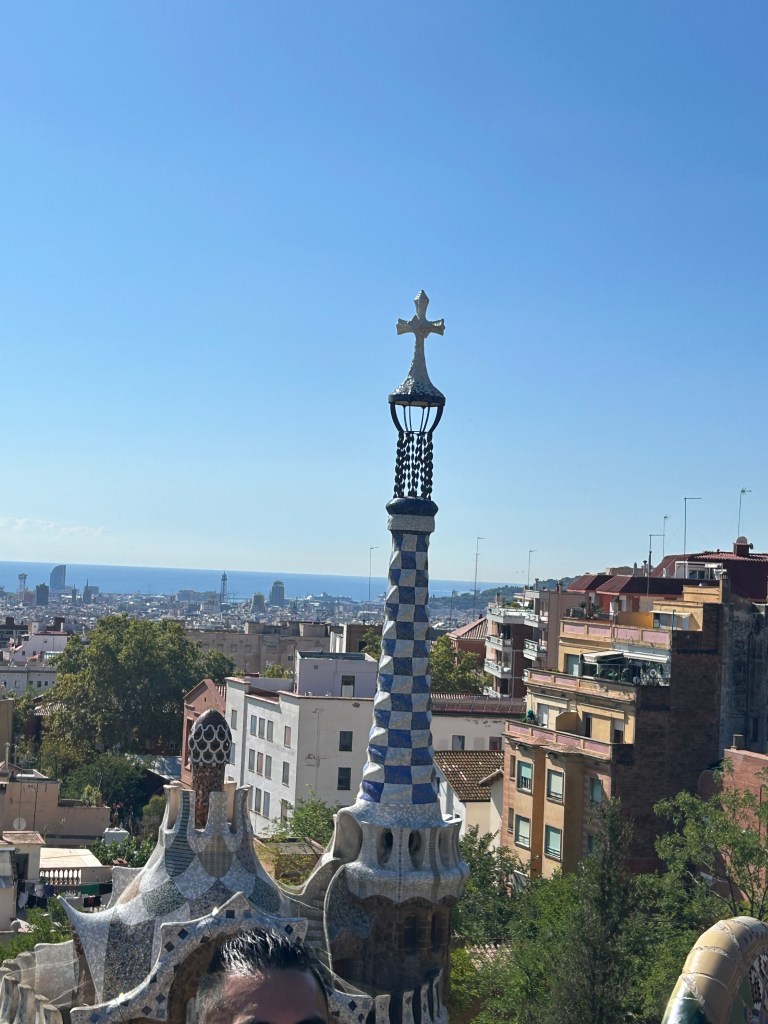
Gaudi Park, Barcelona, Spain

Taming the Tongue

Yesterday a good friend posted a simple request on Facebook. She asked her friends to stop discussing politics on their feeds. The comments ranged from “You are so right! I hate all the arguing!” to “Freedom of speech.” Wherever you stand on that issue, surely the constant arguing that is happening in our country is wearing us all down.

James had a lot to say about “taming the tongue.”

James 3:13 – 4:3, 7-8a  The Message

13-16 Do you want to be counted wise, to build a reputation for wisdom? Here’s what you do: Live well, live wisely, live humbly. It’s the way you live, not the way you talk, that counts. Mean-spirited ambition isn’t wisdom. Boasting that you are wise isn’t wisdom. Twisting the truth to make yourselves sound wise isn’t wisdom. It’s the furthest thing from wisdom—it’s animal cunning, devilish plotting. Whenever you’re trying to look better than others or get the better of others, things fall apart and everyone ends up at the others’ throats.

17-18 Real wisdom, God’s wisdom, begins with a holy life and is characterized by getting along with others. It is gentle and reasonable, overflowing with mercy and blessings, not hot one day and cold the next, not two-faced. You can develop a healthy, robust community that lives right with God and enjoy its results only if you do the hard work of getting along with each other, treating each other with dignity and honor.

1-2 Where do you think all these appalling wars and quarrels come from? Do you think they just happen? Think again. They come about because you want your own way, and fight for it deep inside yourselves. You lust for what you don’t have and are willing to kill to get it. You want what isn’t yours and will risk violence to get your hands on it.

2-3 You wouldn’t think of just asking God for it, would you? And why not? Because you know you’d be asking for what you have no right to. You’re spoiled children, each wanting your own way. This is scary: You can tame a tiger, but you can’t tame a tongue—it’s never been done. 

“You can tame a tiger, but you can’t tame a tongue—it’s never been done.” OUCH!

Think about the last argument you had with your spouse, or consider the enormous political division that exists in our country, and look again: 1-2 Where do you think all these appalling wars and quarrels come from? Do you think they just happen? Think again. They come about because you want your own way, and fight for it deep inside yourselves. You’re spoiled children, each wanting your own way.

James really tells it like it is, doesn’t he? He insists that it is our own selfish personal desires – what he calls our war within – that create the conflicts in our families and communities and inner selves. Because we want more – more attention, more respect, more power, more authority – our wanting puts us in direct conflicts with our own families, church, community, and country. 

We want to be right. We want to be in control. We want to have our own way.

This is not the way of the followers of Christ, friends. Verse 17 reminds us of the way we are to follow: It begins with a holy life and is characterized by getting along with others. It is gentle and reasonable, overflowing with mercy and blessings, not hot one day and cold the next, not two-faced. You can develop a healthy, robust community that lives right with God and enjoy its results only if you do the hard work of getting along with each other, treating each other with dignity and honor.

So what can you do to get along with others? Are you gentle and reasonable or are you exercising your right to free speech at the expense of others? Are you contributing to a healthy, robust community that lives right with God, or are you your own island?

God calls us to treat each other with dignity and honor. May we do all in our power to live up to this.

Getting Along by Michelle Robertson

Stuff Stuff

Yesterday I preached a sermon based on James 3-4. The primary focus was James ‘blunt and almost abrasive call to practice a humble life and stop living in “animal cunning and devilish schemes”. James contends that we are spoiled children, wanting things was can’t have and operating out of our selfish desires to have more and more in our lives that we don’t need. In thinking about that, I did a lot of research about accumulating “stuff.” I learned that in 1960, the first ever self-storage facility was built in Texas. Today there are over 53,000 self-storage facilities, making it a $44.3 billion dollar industry. You read that right, friends. We spend $44.3 billion dollars per year to store all of our extra stuff. As I wade through my own closets full of stuff I don’t need or use, that really hit me hard.

Rev. John Strother, my former DS, posted this caution about gathering up too much stuff on his Facebook page last month. First, we will read Jesus’ parable in Luke 12 in the New International Version

And he told them this parable: “The ground of a certain rich man yielded an abundant harvest. 17 He thought to himself, ‘What shall I do? I have no place to store my crops.’

18 “Then he said, ‘This is what I’ll do. I will tear down my barns and build bigger ones, and there I will store my surplus grain. 19 And I’ll say to myself, “You have plenty of grain laid up for many years. Take life easy; eat, drink and be merry.”’

20 “But God said to him, ‘You fool! This very night your life will be demanded from you. Then who will get what you have prepared for yourself?’

21 “This is how it will be with whoever stores up things for themselves but is not rich toward God.”

Now let’s read it again from the Cotton Patch Bible. The Cotton Patch Bible is a modern translation written in a southern U.S. dialect:

Luke 12 The Cotton Patch Bible 

Then God said to him, “You NITWIT! On this very night all these things are possessing your soul. You don’t own them. They own YOU! And all this stuff you have piled up, whose is it really?…..So the poor rich farmer was struck with the realization that he would continue for the rest of his life in bondage to the things that had enslaved him all along….. “And that’s the way it is”, said Jesus, “with a man who sets his heart on money….and not on God.”

How much stuff do you really need? Like it said in the Cotton Patch Gospel, don’t be a nitwit! Maybe it’s time to let go of the stuff that has a hold over you.

Maybe we can start by clearing out our self-storage units and closets and giving all that stuff away. I bet there is a thrift store in your area that would be able to turn your unused stuff into money they can use for their ministry. In the Outer Banks, we have a young men’s addiction recovery program called Dare Challenge. They operate a thrift store that supports their important work, and they just opened a new women’s center. Think of what a difference your unused stuff could make to places like this!

Then we could take the money we spent on self-storage rental and donate it to good causes in our community like your local food pantries or homeless shelters. Luke’s parable reminds us that it is okay to settle for less.

May we covenant to seek God’s wisdom so that we might live well, live wisely, and live a humble life together. 

Humble Life by Kathy Schumacher