Let the Seas Roar

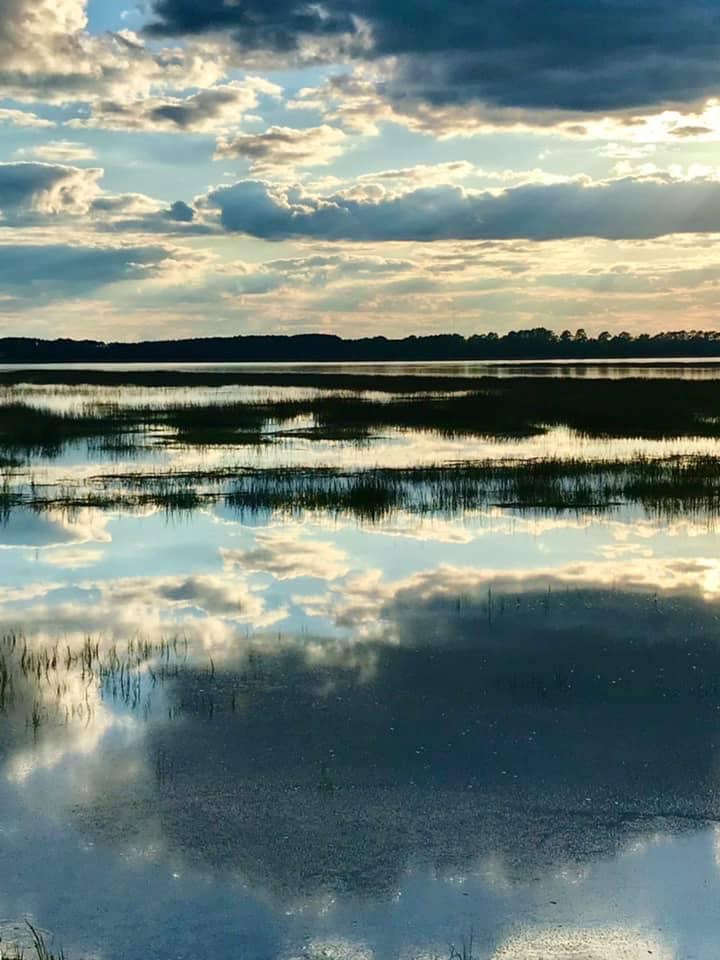
One of the absolute joys of living on the Outer Banks is the constant presence of water. Canals, inlets, sounds, bays, creeks, and of course the magnificent ocean surround us with beauty and song. As I was driving to my office last week, I glanced in my rear view mirror and there it was…I could see the dunes, the sea oats, and the ocean itself as I headed west to my church. Sheer glory! Water, water, everywhere.

I remember standing out in the church parking lot after an evening worship service when I first moved here and hearing an unusual sound. It was a kind of dull roar or constant wooooshing sound that I couldn’t quite place. It was the ocean. A storm was coming in and we could hear it from a mile away. I had never heard the ocean at the church before and I was struck by the beauty of the sound that evening. The noisy bypass that lies between the church and the beach usually obliterates the sound of the crashing waves, but not that night.

When all of creation sings of the majesty and the power of God, we need to listen.

Psalm 98 (New King James Version)

Oh, sing to the Lord a new song!
For He has done marvelous things;
His right hand and His holy arm have gained Him the victory.
The Lord has made known His salvation;
His righteousness He has revealed in the sight of the nations.
He has remembered His mercy and His faithfulness to the house of Israel;
All the ends of the earth have seen the salvation of our God.

God is worthy of our songs and shouts of joy! He is the giver of every marvelous thing and has brought salvation by his holy arm. His faithfulness to his people is an opera of his great works on our behalf. We owe him our rejoicing and our praise songs.

Shout joyfully to the Lord, all the earth;
Break forth in song, rejoice, and sing praises.
Sing to the Lord with the harp,
With the harp and the sound of a psalm,
With trumpets and the sound of a horn;
Shout joyfully before the Lord, the King.

So bring out the trumpets, the harps, and the horns! The Lord reigns, and his kingdom lasts forever. Even the sea roars in anticipation of his coming. The rivers clap their hands and the hills dance in his presence. Praise the Lord!

Let the sea roar, and all its fullness,
The world and those who dwell in it;
Let the rivers clap their hands;
Let the hills be joyful together
    before the Lord,
For He is coming to judge the earth.
With righteousness He shall judge the world,
And the peoples with equity.

Sing joyfully to the Lord, all the earth! Let us praise the Lord.

The Seas Roar by Michelle Robertson

Wells of Salvation

I finally hugged my first non-family person this week. It came at the end of a surprise breakfast with my District Superintendent and his lovely wife. She is an incredible woman of faith and we sometimes tease him that he “married up.” He doesn’t mind this because he agrees.

We were discussing how life would feel now that we are all fully-vaccinated, and I mentioned that I think I have become “touch averse.” For over a year I restrained myself from hugging, shaking hands, touching a shoulder in a gesture of comfort, visiting the sick in a hospital and holding a hand, comforting the grieving with a gentle pat on the arm…the virus stole all of this from us and as a pastor who easily uses touch to convey concern and love, IT HAS BEEN HARD. All of you “huggers” feel this pain with me, I am sure!

This sweet woman listened with great empathy to my confession and then said, “You know, when you are with someone in a pastoral setting, you are clearly being the love to Jesus to them in that moment. And with that comes the power and protection of the Holy Spirit in everything you say to them and everything you do.” When breakfast was over, I hugged her. Happily.

This is exactly what I needed to hear as I make my way up from the dark hole of touch aversion back to the sunlight of normal behavior. She offered me a sip from the well of Christ’s salvation and I didn’t even know how parched I was. I will trust and not be afraid.

Isaiah 12 (New International Version)

Surely God is my salvation;
    I will trust and not be afraid.
The Lord, the Lord himself, is my strength and my defense;
    he has become my salvation.”
With joy you will draw water
    from the wells of salvation.

My concern has not just myself, but also for those around me. My congregation is a delicate population for the most part, and as an international airline pilot’s wife, I have not wanted to give or receive any illnesses during this time. But the Lord has done a glorious thing, and the county where I live has received state-wide commendation for our vaccine implementation. And in all things, the Lord himself is my strength and my defense.

In that day you will say:

“Give praise to the Lord, proclaim his name;
    make known among the nations what he has done,
    and proclaim that his name is exalted.
Sing to the Lord, for he has done glorious things;
    let this be known to all the world.
Shout aloud and sing for joy, people of Zion,
    for great is the Holy One of Israel among you.”

The time is almost upon us to return to those wells of salvation where we will hug each other and draw water together with joy. Soon it really will be over and we will sing once again to the Lord and let the world know what he has done. So as we approach the end of this terrible marathon we’ve all been running, let us safely press on toward the goal of living as those who are saved by the Lord.

We really are one day closer to the end of this thing! Thanks be to God.

Reflections of Joy by Debby Fox

Bee Still

When it comes to gardening, I have a real “black thumb.” I don’t come by it honestly. My Dad was a terrific “green-thumb” gardener and I grew up eating fresh vegetables from his back garden. Plants die easily in my care, including silk ones. You think I’m kidding. I received a gift of a beautiful plant in a ceramic holder a few months ago. I put it on my coffee table and was so grateful that the giver had chosen an artificial plant for me. A few weeks later I returned from a long trip to discover that the leaves had turned black. I can’t even tell real plants from fake ones.

I have a raised planter at the side of my house that I was determined would hold some vegetable plants this year. I make this determination every year. Friends have built a new house on that side, and so my garden of weeds is making me a little self-conscious, as my new neighbors will be able to look down into it from their upper deck. I read that we shouldn’t tend our gardens until the temperature is above 50 degrees, so as to not disturb winter pollinators who take refuge in dormant gardens. The world’s bee population is being decimated by insecticides and climate change, and we all need to do our part.

When the temps rose, I went out to really study it and see about taking down all the weeds so I could plant some tomato plants in their place. Lo and behold, my “garden” of weedy wild flowers is full of bees. I have decided to just neaten it up by trimming the edges, and I may put a sign in the middle that says “Bee Garden.” Perhaps the kindest thing I can do is just let the bees have it…I don’t think I can kill them if I just leave them alone. If I can’t grow plants, maybe I can grow bees!

In our passage from the fifteenth chapter of John, we see the image of God as a Master Vineyard Keeper. He lovingly removes unproductive branches and trims the remaining ones to produce more fruit.

John 15 (Common English Bible)

15 “I am the true vine, and my Father is the vineyard keeper. He removes any of my branches that don’t produce fruit, and he trims any branch that produces fruit so that it will produce even more fruit. You are already trimmed because of the word I have spoken to you. 

People-branches are trimmed by the word of God. When we read scripture and allow it to take root in our lives, our behavior changes accordingly. We stop doing unproductive things and engage in activities that grow our faith and pollinate the world with God’s message.

Remain in me, and I will remain in you. A branch can’t produce fruit by itself, but must remain in the vine. Likewise, you can’t produce fruit unless you remain in me. I am the vine; you are the branches. If you remain in me and I in you, then you will produce much fruit. Without me, you can’t do anything. 

John reminds us that apart from God, we can’t do anything. Did you get that? Apart from God, you can’t do anything. I know people who are very proud of their self-reliance, as though everything they have achieved and everything they possess is by their own hand. Yes, hard work and perseverance are part of success, but apart from God, we have nothing. God calls us to remain in him and he will cause us to produce much fruit.

If you don’t remain in me, you will be like a branch that is thrown out and dries up. Those branches are gathered up, thrown into a fire, and burned. If you remain in me and my words remain in you, ask for whatever you want and it will be done for you. My Father is glorified when you produce much fruit and in this way prove that you are my disciples.

Today is a good day to be humble and thank our Master Gardener for everything that he provides. Our true vine is our source of all things! Let us take root in his word. Thanks be to God.

Sound Roots and Branches by Lainie Reed

Feed My Sheep

Feeding America projects that 42 million (1 in 8) Americans will experience food insecurity in 2021. That number includes 13 million children. If you have never personally experienced this, it may come as a shock to think that such a high percentage of Americans are unsure about where their next meal will come from.

In response to the pandemic when schools had to close, my local school system quickly organized a way to distribute free lunches to any family who needed them. A school bus was conveniently parked in several locations in our community for parents to come and receive lunch for their children. Our local food pantry does a mobile version that takes boxes of food stuffs into the community for easier distribution. During my Lent study, a couple shared with the class that they were adding a canned good to their “Lent Box” everyday and praying for each family that their donation would serve before adding it to the box. A few years ago, I had an opportunity to volunteer at a student food bank at my Alma mater, and was shocked to learn about how many students struggle to feed themselves after paying rent and tuition. My own church’s Trustee Committee is building a Little Free Food Pantry on our front lawn.

Those who have are called to share with those who have not.

This idea is as old as civilization itself. We see numerous examples of “inviting the stranger in” as a standard of hospitality in the Old Testament. Take a look at today’s Psalm and see what God has to say about suffering and eating:

Psalm 22 (Common English Bible)

I offer praise in the great congregation
    because of you;
    I will fulfill my promises
    in the presence of those who honor God.
26 Let all those who are suffering eat and be full!
    Let all who seek the Lord praise him!
        I pray your hearts live forever!

The psalmist reminds us that part of fulfilling our promises to God includes making sure that those who suffer hunger have a chance to eat and be full. The next section reminds us that when we do these things in response to God’s call it, makes a positive witness to those around us. People remember God in our actions.

27 Every part of the earth
    will remember and come back to the Lord;
    every family among all the nations will worship you.
28 Because the right to rule belongs to the Lord,
    he rules all nations.
29 Indeed, all the earth’s powerful
    will worship him;
    all who are descending to the dust
    will kneel before him;
    my being also lives for him.

The psalmist declares, “my being also lives for him.” Do you feel that way about the Lord? Do you live for him?

30 Future descendants will serve him;
    generations to come will be told about my Lord.
31 They will proclaim God’s righteousness
        to those not yet born,
        telling them what God has done.

Working at a food bank or dropping off donations is just one way that we can partner with God and tell the world about what God has done for us. I pray you will make an effort to support the food pantry in your community this week. Let those who are suffering eat and be full!

Do You Love Me? Feed My Sheep. By Colington United Methodist Church

Perfect Love

Think for a moment about someone that you can’t stand. Dare I say, someone you actually hate. It might be a family member, politician, celebrity, boss, neighbor…people do things that make you want as much distance from them as possible. Being in their presence makes your stomach churn. Hearing their voice makes you cringe. You get the idea. When your enemies and adversaries are loud and present, your feelings of revulsion and fear are often well-earned.

Now consider this. God is love, and those who abide in love abide in God, and God abides in them.

So what do we do with our hate?

1 John 4 (New Revised Standard Version)

Beloved, let us love one another, because love is from God; everyone who loves is born of God and knows God. Whoever does not love does not know God, for God is love. God’s love was revealed among us in this way: God sent his only Son into the world so that we might live through him. 10 In this is love, not that we loved God but that he loved us and sent his Son to be the atoning sacrifice for our sins. 11 Beloved, since God loved us so much, we also ought to love one another. 12 No one has ever seen God; if we love one another, God lives in us, and his love is perfected in us.

Can hate live in the same space as love? Does our enemy deserve our love, or is hate just a way of protecting ourselves against further harm?

13 By this we know that we abide in him and he in us, because he has given us of his Spirit. 14 And we have seen and do testify that the Father has sent his Son as the Savior of the world. 15 God abides in those who confess that Jesus is the Son of God, and they abide in God. 16 So we have known and believe the love that God has for us.

God is love, and those who abide in love abide in God, and God abides in them. 17 Love has been perfected among us in this: that we may have boldness on the day of judgment, because as he is, so are we in this world. 18 There is no fear in love, but perfect love casts out fear; for fear has to do with punishment, and whoever fears has not reached perfection in love. 

Here we have a clue about what to do when we truly hate someone. John makes the case that God is love, and love has been perfected among us so that we may have boldness on the day of judgement. And who is the judge? God. That assures us that our adversaries and enemies will answer for their actions against us before God’s judgement seat. Our boldness in love is a reprieve for us…we don’t have to judge, just love. And then let it go.

When we unpack our feelings about our enemies, we may discover that fear informs our reaction to them. We fear the power they have over our peace and our happiness. But perfect love casts out fear, which frees us up to allow God to be God. HE will hold your adversary accountable.

19 We love because he first loved us. 20 Those who say, “I love God,” and hate their brothers or sisters, are liars; for those who do not love a brother or sister whom they have seen, cannot love God whom they have not seen. 21 The commandment we have from him is this: those who love God must love their brothers and sisters also.

This is a hard teaching, friends. But scripture is clear. Those who love God must love their brothers and sisters also. So let God do the work of redemption, and in all things, just love…even your enemies.

Just Love by Abby Johnson

Be Teachable

Are you teachable? Do you have a spirit of openness to new ideas, concepts, or opinions? People tend to close that part of their personality off as they advance in years. Long-held notions cement themselves with an iron grip and it is hard to loosen an idea or ideology in some folks.

Years ago I taught a year-long bible study called Disciple. It is a comprehensive Methodist study of the Bible from Genesis to Revelation that is well known and respected. Imagine my surprise when a retired Methodist pastor in my congregation deep into his 90’s signed up to be a student. I was just a little intimidated! He set my mind at ease on the first day when I heard him tell the rest of the class that he loved learning new things. Besides, he explained, he was “now studying for his finals.” He was an absolute delight in class and we all learned so much from him…and he would say he learned a lot from us as well.

This fellow was teachable. He understood the power of the Holy Spirt that comes into a particular moment with a particular scripture and breathes new life into it for the usefulness of the reader. But the reader has to remain teachable for this to work.

John Wesley, as explained by Albert C. Outler, seemed to follow a four-part strategy for understanding God: scripture, tradition, reason, and experience. It is the “experience” part where teachability is key. This is where the current context of your situation interacts with the instruction of the Holy Spirit to bring meaning and understanding to scripture in a new way. For example, until you have lost a loved one, Psalm 23 will not mean the same thing to you as it will the first time you hear it read after their death. The experience of the Holy Spirit illuminating that scripture in your grief brings you into a new and deeper place in your relationship with God.

In our passage in Acts today, we see a lovely encounter between Philip and a very unusual man. This man is a Hebrew, a eunuch, the treasurer for a Queen, and an Ethiopian. Luke spares no detail! We can see him riding in a regal chariot as he is returning from his pilgrimage to Jerusalem. He is a dedicated believer, following the dictates of his religious practice. And he is teachable:

Acts 8 (The Message)

26-28 Later God’s angel spoke to Philip: “At noon today I want you to walk over to that desolate road that goes from Jerusalem down to Gaza.” He got up and went. He met an Ethiopian eunuch coming down the road. The eunuch had been on a pilgrimage to Jerusalem and was returning to Ethiopia, where he was minister in charge of all the finances of Candace, queen of the Ethiopians. He was riding in a chariot and reading the prophet Isaiah.

29-30 The Spirit told Philip, “Climb into the chariot.” Running up alongside, Philip heard the eunuch reading Isaiah and asked, “Do you understand what you’re reading?”

31-33 He answered, “How can I without some help?” and invited Philip into the chariot with him. The passage he was reading was this:

As a sheep led to slaughter,
    and quiet as a lamb being sheared,
He was silent, saying nothing.
    He was mocked and put down, never got a fair trial.
But who now can count his kin
    since he’s been taken from the earth?

When the eunuch asks Philip how he could understand Isaiah without some help, he is throwing the door wide open to a new interpretation, a revelation, and an unknown insight into God’s word. Philip immediately grabs the opportunity to teach Jesus to him, and by the end of the encounter, the eunuch is baptized. His entire life changes in that teachable moment.

34-35 The eunuch said, “Tell me, who is the prophet talking about: himself or some other?” Philip grabbed his chance. Using this passage as his text, he preached Jesus to him.

36-39 As they continued down the road, they came to a stream of water. The eunuch said, “Here’s water. Why can’t I be baptized?” He ordered the chariot to stop. They both went down to the water, and Philip baptized him on the spot. When they came up out of the water, the Spirit of God suddenly took Philip off, and that was the last the eunuch saw of him. But he didn’t mind. He had what he’d come for and went on down the road as happy as he could be.

Because he was teachable, his life would never be the same. Imagine the impact this had on the court. Imagine what happened in Ethiopia when he returned and told people what happened. Imagine the pure joy of that moment!

Where is God trying to teach you something? Are you resisting? Where is he giving instruction in the context of THIS moment and inviting you to change, grow, be better, and understand him more fully?

We won’t know until we open ourselves up to being taught. Open the eyes of our hearts, Lord! We want to see you.

New Day by Michelle Robertson

Calmed With Love

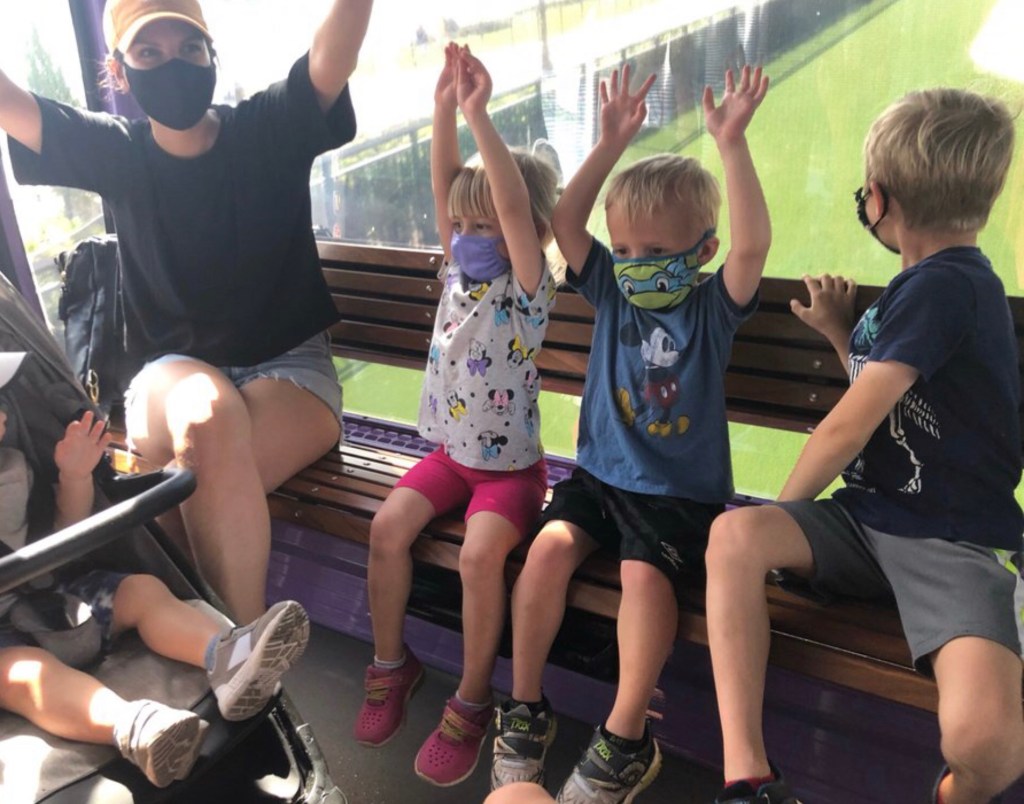
I know a little boy who is apprehensive about riding the Skyliner at Disney World. His younger siblings and cousin mindlessly throw their hands in the air as it swoops up from the station into the sky. But this little boy is old enough to have heard about the time when two or three of the cars collided in the first week of operation, and he is not quite ready to completely enjoy the experience yet.

We all know his apprehension and we say soothing things to him as we take off from the station. He holds on while we throw our arms in the air, and when we are in the sky, we say things that help him loosen his grip and look around. It won’t be long before he forgets his apprehension and will fully participate in the joy of flying skyward. In the meantime, we create calm in him with our love.

Our scripture this morning offers us a lovely image of God as he calms his people with love. The exile is over and the people will return to Jerusalem. God has defeated their enemies and has brought victory to them.

Zephaniah 3 (Common English Bible)

Rejoice, Daughter Zion! Shout, Israel!
        Rejoice and exult with all your heart, Daughter Jerusalem.
15 The Lord has removed your judgment;
        he has turned away your enemy.
The Lord, the king of Israel, is in your midst;
        you will no longer fear evil.
16 On that day, it will be said to Jerusalem:
        Don’t fear, Zion.
        Don’t let your hands fall.
17 The Lord your God is in your midst—a warrior bringing victory.
        He will create calm with his love;
        he will rejoice over you with singing.

God’s calming love will bring back the lame and the outcast, and will restore all the people to their beloved homeland. All of the surrounding nations will watch as their fame and possessions are restored. They put their hope in God and he delivered them.

18         I will remove from you those worried about the appointed feasts.
        They have been a burden for her, a reproach.
19 Watch what I am about to do to all your oppressors at that time.
        I will deliver the lame;
        I will gather the outcast.
        I will change their shame into praise and fame throughout the earth.
20 At that time, I will bring all of you back,
        at the time when I gather you.
        I will give you fame and praise among all the neighboring peoples
            when I restore your possessions and you can see them—says the Lord
.

In a time of fear and exile, God calmed his people with his love. Where is God calling you to calm someone with your love today? Do you know a child who needs to be soothed? Is there a teenager in your midst who is stressing out over something and needs to be heard? Is your spouse worried about something? Can you say a kind word to a stranger today?

God’s calming love is both ours to keep and ours to give away. Go and create calm with his love for someone today.

Here We Gooooo!

Shadows

Epiphanies come at the oddest of times. Sometimes you are deliberately seeking meaning and understanding and the “AHA!” moment happens. Other times your attention is diverted and an epiphany breaks through unexpectedly. These moments of clarity are always welcome, as they deepen our understanding of God and our relationship with him.

A very long time ago I had an epiphany in the middle of a funeral. I was standing in the pulpit reading the 23rd Psalm when a word jumped out at me and the heavens broke open, with the angel choir singing a loud chord of resonant “AHHHHHH!”

The word was shadow. See if you can spot it.

The Lord is my shepherd;
I shall not want.
He makes me to lie down in green pastures;
He leads me beside the still waters.
He restores my soul;
He leads me in the paths of righteousness
For His name’s sake.

Yea, though I walk through the valley of the shadow of death,
I will fear no evil;
For You are with me;
Your rod and Your staff, they comfort me.

And there it is. “Yea, though I walk through the valley of the SHADOW of death…” What a lovely epiphany! If you are grieving the loss of a loved one or fearful for your own death, what is this saying?

When David wrote this timeless classic (which is read at almost every funeral I have officiated) he was expressing the hope and the reality of our relationship with God. He praises God for providing for all of his needs. He paints images of green pastures and still waters as a way of suggesting that being in God’s presence is where we find peace. He reminds us that when we are weary and strung out, God restores us. If we are smart enough to follow God, our path will be one of righteousness.

With God, the valley we travel is only a mere shadow of death, for death has no sting.

This powerful image proclaims that death is not a real or a final destination…it is as fleeting as a cloud passing in front of the sun for a moment. Shadows come and go. Death comes and goes. Eternal life is forever, and it is in the house of eternal life that we will dwell with the Lord all the days of our lives. We walk through the valley of the shadow of death to arrive on the other side, where heaven is found.

You prepare a table before me in the presence of my enemies;
You anoint my head with oil;
My cup runs over.
Surely goodness and mercy shall follow me
All the days of my life;
And I will dwell in the house of the Lord
Forever.

I pray that these words today bring you comfort. When I read them, my cup very much runs over with goodness and mercy.

Christ invites us to come to the table that is prepared before us and feast on peace, hope, comfort, and joy.

Cloud Shadow by Michelle Robertson

Cornerstone

The definition of the word “cornerstone” offers two meanings. A cornerstone is a stone uniting two masonry walls in the construction of a building. It also describes something that is essential, indispensable, or basic. So you can attend a ceremony where the cornerstone of a new federal building is being laid while recognizing that democracy is the cornerstone of a free society.

I like the fact that cornerstones unite walls. Think about that in a figurative way…people often put up walls around them as they draw lines around their political, religious, racial, and societal preferences. Living in community with people of opposite preferences requires that common cornerstones be used to hold things together.

Jesus is such a cornerstone. Salvation can be found in no other place, regardless of one’s thoughts or leanings. He is the uniting factor that brings disparate entities together.

Our passage in Acts today follows a healing miracle that Peter and John performed in Jesus’ name. They are immediately questioned by the leaders, elders, and legal experts:

Acts 4 (Common English Bible)

The next day the leaders, elders, and legal experts gathered in Jerusalem, along with Annas the high priest, Caiaphas, John, Alexander, and others from the high priest’s family. They had Peter and John brought before them and asked, “By what power or in what name did you do this?”

One would think that the healing of a fellow citizen would bring unity to the commUNITY and be met with joy and appreciation. One would be wrong. It only brought division.

Then Peter, inspired by the Holy Spirit, answered, “Leaders of the people and elders, are we being examined today because something good was done for a sick person, a good deed that healed him? 10 If so, then you and all the people of Israel need to know that this man stands healthy before you because of the name of Jesus Christ the Nazarene—whom you crucified but whom God raised from the dead. 

Peter is clear that it is only through the power of Jesus’ name that the man was healed. He was also clear that God had raised Jesus from the dead.

11 This Jesus is the stone you builders rejected; he has become the cornerstone! 12 Salvation can be found in no one else. Throughout the whole world, no other name has been given among humans through which we must be saved.”

The message of salvation is a cornerstone of our hope, our belief, and our faith. It is an essential and indispensable teaching of our faith, one that we can build upon.

Whether we allow it to unite our walls or divide us is up to us. Jesus came to save the whole world and salvation can be found in no one else. Let this be the cornerstone of your witness as you proclaim the good news of the one raised from the dead.

A Cornerstone of Faith

Good Shepherds

I got pulled over by a Sheriff’s deputy last week. Yep, it happens. It was an unexpected encounter in many ways. First, when he put his flashy blue lights in my rear view mirror, I seriously thought he was trying to get around me to go bust a heroin ring or chase down a gunman. We were on a narrow, twisty, curvy two-lane road on the island where I live where passing is nigh impossible. So when this good citizen saw the lights go on, I assumed I was being asked to do my duty in cooperating with whatever chase he was about to start and get out of his way.

Turns out he was chasing me.

I pulled into a convenient side road and was startled when he pulled in behind me. I had checked my speedometer when the lights went on by reflex, and I had been driving 34 in a 35 MPH zone. What the heck!?!

We exchanged pleasantries through the open window and I still wasn’t sure why we were having such a lovely chat. Turns out that I had been doing 34 in a 25 MPH speed zone. This is what happens when you aren’t paying attention to which part of the curves you are traveling on. Most of the road is 35, except that small portion of extreme curviness where he caught me.

I deserved a ticket.

Our passage is a very familiar one from John which talks about the Jesus being the Good Shepherd. I want you to read this differently today and focus on the function of the sheep pen:

John 10 ( The Message)

11-13 “I am the Good Shepherd. The Good Shepherd puts the sheep before himself, sacrifices himself if necessary. A hired man is not a real shepherd. The sheep mean nothing to him. He sees a wolf come and runs for it, leaving the sheep to be ravaged and scattered by the wolf. He’s only in it for the money. The sheep don’t matter to him.

14-18 “I am the Good Shepherd. I know my own sheep and my own sheep know me. In the same way, the Father knows me and I know the Father. I put the sheep before myself, sacrificing myself if necessary. You need to know that I have other sheep in addition to those in this pen. I need to gather and bring them, too.

The sheep pen is a place of safety, just like speed limits. When we stay inside them, we are kept from harm. Just like playgrounds have fences, things that are designed to “contain” us are meant to be places where ravaging wolves and traffic accidents can’t threaten us. Jesus not only wants to keep us safe in his “pen” of commandments, he wants those who live outside the pen to come in.

They’ll also recognize my voice. Then it will be one flock, one Shepherd. This is why the Father loves me: because I freely lay down my life. And so I am free to take it up again. No one takes it from me. I lay it down of my own free will. I have the right to lay it down; I also have the right to take it up again. I received this authority personally from my Father.”

Our Good Shepherd acts completely for the good of the one flock. He is willing to freely lay down his life for the sheep…which in fact he did.

My encounter with the deputy reminded me that this man is also willing to lay down his life for my safety. All first responders do. They race into places where harm is happening, without any thought to their own safety. I am grateful for that.

I am also grateful that Officer Long did not give me a ticket or even a written warning that day. I deserved it, but he showed me some grace. He was my Good Shepherd on the road, and I am humbled to know that he is out there keeping my community safe.

Remember to pray for the first responders in your community. They need the protection of their Good Shepherd, too.

Slow Curves