Have you ever been put in your place? Has a moment of brash talk ever resulted in someone “setting you straight”? It hurts, doesn’t it? I’ve been there and felt that. In hindsight, it was not so much a punishing experience as it was a learning experience. These moments of correction are painful, and often necessary. But we have to be open to their instruction … that’s the trick.
In today’s passage we find God giving Job the ultimate moment of instruction. Wowzers, this is a doozy. God begins by calling Job a “darkening counsel” and says that Job’s words lack knowledge:
Job 38 (Common English Bible)
Then the Lord answered Job from the whirlwind:
2 Who is this darkening counsel with words lacking knowledge? 3 Prepare yourself like a man; I will interrogate you, and you will respond to me.
Yikes. But as you read this next part, see how God describes all of his omnipotent power in a way that is reassuring, even as Job is being rebuked:
The establishing of order
4 Where were you when I laid the earth’s foundations? Tell me if you know. 5 Who set its measurements? Surely you know. Who stretched a measuring tape on it? 6 On what were its footings sunk; who laid its cornerstone, 7 while the morning stars sang in unison and all the divine beings shouted?
Can you issue an order to the clouds so their abundant waters cover you? 35 Can you send lightning so that it goes and then says to you, “I’m here”? 36 Who put wisdom in remote places, or who gave understanding to a rooster? 37 Who is wise enough to count the clouds, and who can tilt heaven’s water containers 38 so that dust becomes mud and clods of dirt adhere?
If you needed to be reminded of who is in control, this is it. God sends lightning and wisdom alike. He counts the clouds, tilts heaven’s water containers, and gives understanding to the rooster. Can you do that?
Lion and raven
39 Can you hunt prey for the lion or fill the cravings of lion cubs? 40 They lie in their den, lie in ambush in their lair. 41 Who provides food for the raven when its young cry to God, move about without food?
Job is a righteous man who experiences a humbling lesson. So should we. But rather than receive these words as a chastisement, as Job had to, may we embrace them as a beautiful reminder that God is God … and we are not.
Online shopping has taught us to be very careful about reading descriptions. Size, color, texture, weight, and even other people’s reviews are all helpful as we are trying to discern what a product is actually like. If you have ever ordered something without paying attention to the description, this may have been part of the learning curve for you. It was for me!
In the beginning of the pandemic, I panic-ordered hand sanitizer from an unfamiliar source and failed to look at the description closely. Where the picture (and the price!!) was indicative of a large bottle that would sit by your kitchen sink for family use, the actual product was a very expensive pocket-sized container. Thank goodness I ordered two!
The scriptures are full of descriptions of Jesus. John 3:16 gives the most concise description: ”For God so loved the world that he sent his only Son, that whosoever believeth in him shall not perish, but have everlasting life.” (I did that from memory … the King James Version was all the rage when this kid was in Sunday School.)
God our Savior showed us how good and kind he is. 5 He saved us because of his mercy, and not because of any good things that we have done.
God washed us by the power of the Holy Spirit. He gave us new birth and a fresh beginning. 6 God sent Jesus Christ our Savior to give us his Spirit.
7 Jesus treated us much better than we deserve. He made us acceptable to God and gave us the hope of eternal life.
Reading the description makes us much more aware of the qualities and special aspects of the subject. Titus beautifully describes the grace that was involved in Jesus’ coming.
I don’t think anyone would argue that some of the best descriptions of Jesus come from the book of Isaiah. This Old Testament prophet had a working knowledge of the suffering servant that was yet to come. His description came with no reviews, as he was describing something that hadn’t even happened yet. Unlike the eyewitness accounts of the Gospel writers, Isaiah only had prophetic visions to rely on … and yet he provided some of the most accurate and beautiful language about our Savior:
Isaiah 53 (Common English Bible)
It was certainly our sickness that he carried, and our sufferings that he bore, but we thought him afflicted, struck down by God and tormented. 5 He was pierced because of our rebellions and crushed because of our crimes. He bore the punishment that made us whole; by his wounds we are healed. 6 Like sheep we had all wandered away, each going its own way, but the Lord let fall on him all our crimes.
7 He was oppressed and tormented, but didn’t open his mouth. Like a lamb being brought to slaughter, like a ewe silent before her shearers, he didn’t open his mouth.
11 After his deep anguish he will see light, and he will be satisfied. Through his knowledge, the righteous one, my servant, will make many righteous, and will bear their guilt.
He was pierced for our transgressions.
He was crushed because of our sins.
He bore the punishment THAT MADE US WHOLE.
By his wounds we are healed.
Ponder that today. Who is Jesus to you? If you were to write a description of him, what would you say? How would you describe our Wonderful Counselor?
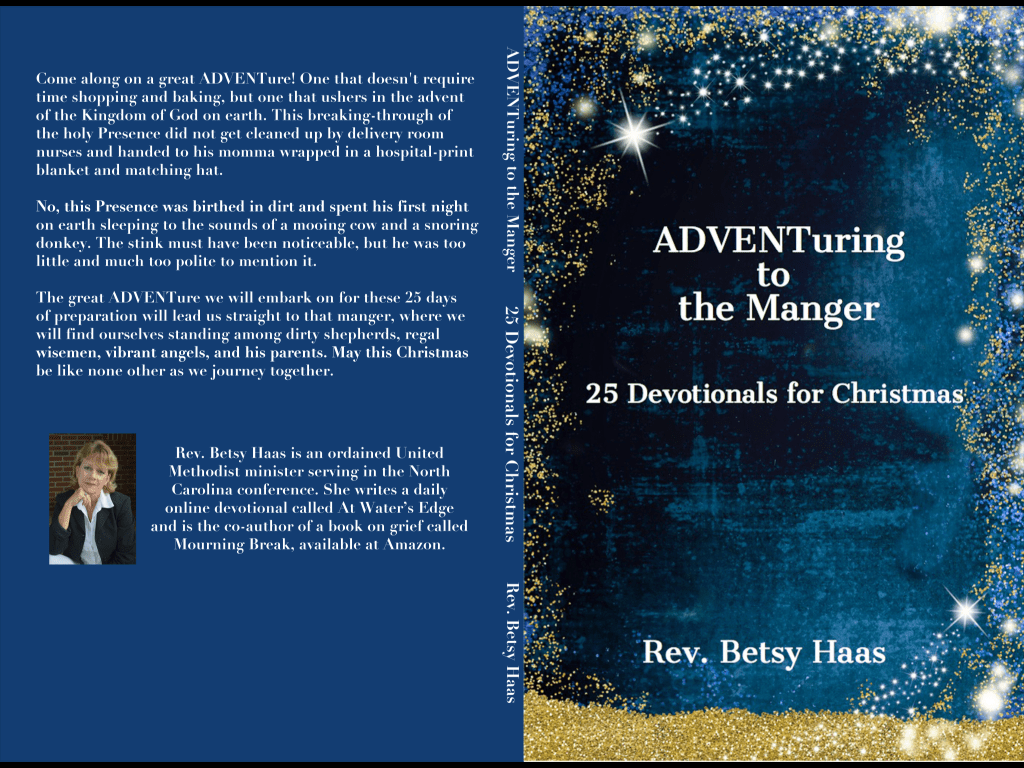
This leader’s guide is intended for teachers and leaders who wish to use ADVENTuring to the Manger in a group setting. While the book was primarily written for personal devotional use, it can easily be turned into either a four-week or six-week study during the season of Advent.
Advent is a liturgical season where we are invited to prepare our hearts and minds to receive the Christ child once again. Unfortunately, many of us have lost the ”hearts and minds” aspect and have become focused on the ”bake the cookies and deck the halls” part of getting ready for Christmas.
ADVENTuring to the Manger was written for real people dealing with the real pressures and scheduling stresses that the pre-Christmas season can bring. Each devotional takes the student into an illuminating scripture without adding a lot of time to their daily to-do list. The readings are easy to read and very approachable, without being too ”light.” Each day will only take between 5 to 10 minutes to read. Everyone can manage that, even at Christmas!
Individuals are invited to read one devotional per day beginning with December 1 and running right up to Christmas Day. Groups can create whatever schedule works best for them.
For group use, we recommend that you decide on either a four-week or six-week class, and then decide when you want the study to end. For example, if you choose a four-week format and want to be finished with this study by the middle of December (which is recommended,) consider starting around mid-November. If you choose a six-week format and want to be finished a few weeks before Christmas, begin the first week of November.
To allow for that kind of flexibility, I have included group discussion questions for each day. If you choose to do this in FOUR WEEKS, your assignments would look like this:
WEEK ONE: Day 1-Day 6
WEEK 2: Day 7-Day 12
WEEK THREE: Day 13-Day 18
WEEK 4: Day 19-24
Everyone reads Day 25 on Christmas Day.
If you choose to do this in SIX WEEKS, your assignments would look like this:
WEEK ONE: Day 1-Day 4
WEEK TWO: Day 5-Day 8
WEEK THREE: Day 9-Day 12
WEEK FOUR: Day 13-Day 16
WEEK FIVE: Day 17-Day 20
WEEK SIX: Day 21-Day 24
Everyone reads Day 25 at home on Christmas Day.
Every devotional contains a few reflection questions within the body of the reading. These are designed for personal use, but can make great discussion starter questions. We suggest that as you read through each day, highlight those questions in your book and consider using them as ”ice-breaker” openers for each class. Some of the questions in the book may feel too personal for group use, and that’s okay. You will soon discover how much self-disclosure your group can handle as you go through each week. Be prepared to share your own responses to those questions as you feel led.
Listed below are the group discussion questions for each day. Some are fun and non-threatening, and others are deep. As you spend time with your group, you will know what they will respond to. If you only ask one question and it takes off for the rest of the hour, that is great! Don’t feel pressure as the leader to ask all the personal reflection questions AND the group discussion questions for the week. Your class is the curriculum! You are the curriculum! The Holy Spirit is definitely the curriculum! The book in your hands is just a book. You and your students will be both teachers and learners in this adventure.
DAY ONE
Today’s lesson invites us to perform a ”spiritual check-up” as we begin this study. Why don’t people put Christ in the center of Christmas nowadays? What can we do to eliminate things that distract us from the real meaning of Christmas? Have you ever felt like you missed the whole thing? How can you change that this year?
DAY TWO
Today’s reading draws a contrast between expecting the Messiah to be a military commander who will conquer our troubles, versus a Messiah who is the gentle savior who finds us when we’re lost. Which one do people need more right now? What is your family hoping for and dreaming of this Christmas? What are your expectations this year?
DAY THREE
What are some of the strategies you use when you have to wait? Can you remember a time when you were grateful that you waited something out rather than received an immediate answer? Share your story. When is waiting a good thing?
DAY FOUR
Have you begun yet to prepare for Christmas? What does your usual preparation look like? What things are on your list? Is God calling you to simplify things this year?
DAY FIVE
Can people sometimes make Christmas about everything other than Christ’s birth? What are those things? Does family guilt ever play a role in it? How can we redirect our efforts toward loving the people that Jesus loves?
DAY SIX
Share a time when you had something good to tell. How did you feel? How did people respond to your good news? Who in your life needs some good news today?
DAY SEVEN
Have you ever encountered Jesus in an unexpected way? Have you met him in an unexpected person? Name ways we can all be an unexpected Light in someone’s darkness this season.
DAY EIGHT
This lesson invites us to hit the ”pause” button on the holly-jollies and acknowledge the pain and loneliness that Christmas can bring. Have you ever had a ”blue Christmas”? Can you share your story? What can we do to help others through this season when they are grieving?
DAY NINE
The full story of Christmas begins in a wooden manger and ends on a wooden cross. How does the resurrection inform our Advent experience? What does the resurrection mean to God’s people? What does it mean to you?
DAY TEN
Is it ever okay to doubt God? Have you ever experienced doubt in your relationship with God? What helped you through it? What can we do when others question God’s activity in the world?
DAY ELEVEN
Jesus brings a gift of JOY to the world in a box that is often left unopened. Where do we need joy? Is joy lacking in your life? How can you be a bringer of joy to someone who needs it? How can the church respond?
DAY TWELVE
What causes people to lose hope? Have you ever lost it? Describe what happened. How can we help people who feel hopeless?
DAY THIRTEEN
Do people ever treat God like an ATM in the sky? Is that ever okay? What are some good gifts that you have received at Christmas? Name some good gifts you have received from God. What are you asking God for right now?
DAY FOURTEEN
Jesus called God ”Abba,” which translates to Daddy, or Papa. It denotes an intimate relationship. What does it mean to be children of God and heirs of his kingdom? How can we change our prayer lives to reflect the intimate conversations God wants to have with us? The ”Big Reveal” of Christmas is a proclamation of freedom from bondage. What do we need to be freed from today?
DAY FIFTEEN
God’s marvelous deeds are all around us! Make a list of them. Where in your life have you experienced an act of God? Share your story. Mary was a faithful servant … what should we do to be more like her?
DAY SIXTEEN
The spirit of Santa is among us. How can we be givers in our community? Where is God calling us to be generous? Are you willing to give of yourself to others this season? Make a list … then make a plan.
DAY SEVENTEEN
Singing is such an important part of this season. What is your favorite Christmas carol? Do you agree or disagree with the statement that we should complain to school boards that have removed sacred songs in our public schools? What does ”Wonderful Counselor” mean to you?
DAY EIGHTEEN
Describe a time when you were deeply, utterly afraid. What happened? What are things that people fear in our world today? What message did the angels bring that can help us today?
DAY NINETEEN
Have you ever kept a big secret? Were you finally able to share it? How did that feel? Have people lost their child-like wonder and awe of Christmas? How can we get it back?
DAY TWENTY
Go around the room and have everyone name their favorite Christmas movie. Has anyone ever experienced a sleepless night? List the things that keep you awake. What can we do to find rest?
DAY TWENTY-ONE
This lesson talks about feasts. If you were invited to a great feast, what foods and drinks would you like to have? What are your plans for Christmas dinner? Does family tradition play a role in your choices?
DAY TWENTY-TWO
WHY do we need Christmas? Why do you think Jesus was born? Define these words: grace; unmerited favor; unconditional love; and mercy. What do those words mean to you?
DAY TWENTY-THREE
What does it mean to ”speak in your own voice”? Are you able to tell your story? Describe the words or actions people can use to tell the story of Jesus to others.
DAY TWENTY-FOUR
Do you have a plan for worshipping on Christmas Eve? Are you ready to receive the indwelling of Christ’s spirit? If not, what do you need to do today to be ready?
Questions for DAY TWENTY-FIVE are not needed, as students will read that day on their own.
FINAL THOUGHTS
We have provided you with a LOT of questions to choose from! There are three or four questions per day, and if you are teaching this in four weeks, that means we have provided you with approximately twenty questions per class session. That is obviously way too many, so focus on whatever days you feel your group has responded to the most and let that dictate the flow of your time together. You can even begin each class by asking them which day really stood out that week, and start there. Remember that if a devotional speaks to you, it will probably also speak to them, so trust your instincts.
Please feel free to contact me with any questions you have by leaving a comment on my website @atwatersedge.org, or emailing me at betsyhaas@atwatersedge.org. I will be happy to help you in any way I can. Thank you so much for using this group resource! YOU are a blessing.
A rabbi named Joseph Telushkin is a well known speaker on the subject of taming your tongue. The scriptures call us to consider the power of our words and their ability to hurt people. At the conclusion of his speech, Telushkin asks his audience an interesting question. He invites them to raise their hand if they think that if they tried really, really hard, they could go twenty-four hours without saying an unkind thing to or about someone else. Typically only a small minority of the audience raises their hands, while the rest of them chuckle and shake their heads no.
Let’s think about that…do you think you could make it twenty-four hours without saying something negative or derogatory to or about someone else?
Then the rabbi makes this salient point: If you couldn’t go twenty-four hours without alcohol, you would recognize that you have a drinking problem. If you couldn’t go twenty-four hours without a cigarette, you would know that you are probably addicted to nicotine. So if you can’t go twenty-four hours without making a negative comment, you have lost control of your tongue.
I told this story in a recent sermon on James 5, and church member texted me that afternoon and said that she didn’t even make it a full hour! What we think often comes out in what we say, and it is definitely the case that our thoughts and attitudes are revealed in our behavior and our conversations.
Our passage in Hebrews today reminds us that nothing we say, think, or do is hidden from God’s sight. He has provided his word as a daily guide for our interactions with one another. The things we do and say are under his watchful eye, and everything is uncovered and laid bare before him:
Hebrews 4 (New International Version)
12 For the word of God is alive and active. Sharper than any double-edged sword, it penetrates even to dividing soul and spirit, joints and marrow; it judges the thoughts and attitudes of the heart. 13 Nothing in all creation is hidden from God’s sight. Everything is uncovered and laid bare before the eyes of him to whom we must give account.
This is why it is imperative to live under the authority of God’s word. It is active and alive. It is sharper than a double-edged sword and it cuts to the heart of the matter. It is the standard by which we must give an account for our actions. Reading, understanding, and doing the word of God will keep us in line with God’s expectations of us.
Luckily, we have a great high priest to help us.
Jesus the Great High Priest
14 Therefore, since we have a great high priest who has ascended into heaven, Jesus the Son of God, let us hold firmly to the faith we profess. 15 For we do not have a high priest who is unable to empathize with our weaknesses, but we have one who has been tempted in every way, just as we are—yet he did not sin. 16 Let us then approach God’s throne of grace with confidence, so that we may receive mercy and find grace to help us in our time of need.
The old WWJD movement, where we were invited to consider What Would Jesus Do in any situation, was really a smart thing. If we are being held accountable to the word of God, wouldn’t it be smart to do things and say things that mirror the Word of God?
God sent Jesus to be an intermediator for us, allowing us access to the throne of grace. He is the Word that is sharp enough to judge our thoughts and attitudes. He is the Word that is a double-edged sword. He is the Word who offers us mercy and grace when our words betray us.
So consider what you say today. Consider what God’s word says. Consider what Jesus would do and say. And remember that when you need help, you will find mercy and grace every time you approach God’s throne.
Have you ever known someone who just had to get the last word in every argument? Infuriating, isn’t it?? You know that they aren’t doing it because they necessarily think they are right all the time … no indeed, they do it out of a stubbornness to simply be the final and unimpeachable word on a subject.
But not all last words are annoying. Some last words are life-giving. Take, for example, God’s last word to humanity: Jesus. Yes, Jesus is the final Word from God about how humanity will be saved. This Word is life-giving and unimpeachable, and fulfills all the words that came before him:
Hebrews 2 (Common English Bible)
1 In the past, God spoke through the prophets to our ancestors in many times and many ways. 2 In these final days, though, he spoke to us through a Son. God made his Son the heir of everything and created the world through him. 3 The Son is the light of God’s glory and the imprint of God’s being. He maintains everything with his powerful message. After he carried out the cleansing of people from their sins, he sat down at the right side of the highest majesty. 4 And the Son became so much greater than the other messengers, such as angels, that he received a more important title than theirs.
I always chuckle when I read this passage from Hebrews. It takes me back to a class I took in seminary called ”Survey of the Bible.” It was a Bible introduction class, and the curriculum was focused on getting us to learn the entire scope of the scriptures. We were tested on the meaning, theme, content, and writers of all 66 books. I was glad for the years I had spent in Disciple Bible Study, which did the same thing at a much slower pace. One of my memory tricks for remembering the theme of Hebrews was ”HE is Better than the REst, Without Substitute.” That helped me put Hebrews into context with the other New Testament writings, and it really does explain the writer’s perspective:
5 God didn’t put the world that is coming (the world we are talking about) under the angels’ control. 6 Instead, someone declared somewhere,
What is humanity that you think about them? Or what are the human beings that you care about them? 7 For a while you made them lower than angels. You crowned the human beings with glory and honor. 8 You put everything under their control.
When he puts everything under their control, he doesn’t leave anything out of control. But right now, we don’t see everything under their control yet. 9 However, we do see the one who was made lower in order than the angels for a little while—it’s Jesus! He’s the one who is now crowned with glory and honor because of the suffering of his death. He suffered death so that he could taste death for everyone through God’s grace.
The good news for Christ followers in this passage is that we worship the One who is able to make us holy and redeemed. Burnt offerings, sacrifices made at the altar, ”The Universe” … nothing else can accomplish what Jesus did when he died and rose again. He is the power of salvation, delivered as the final Word of God.
Qualified to be a high priest
10 It was appropriate for God, for whom and through whom everything exists, to use experiences of suffering to make perfect the pioneer of salvation. This salvation belongs to many sons and daughters whom he’s leading to glory. 11 This is because the one who makes people holy and the people who are being made holy all come from one source. That is why Jesus isn’t ashamed to call them brothers and sisters when he says,
12 I will publicly announce your name to my brothers and sisters. I will praise you in the middle of the assembly.
Jesus invites us to become part of his kingdom and follow him. We are heirs of God and brothers and sisters of the last Word. Will you listen?
He really is better than the rest, without substitute.
I cannot imagine going through life without helpers. I am blessed to be married to a man who knows how to fix things, how to cook amazing dinners, and he always remembers where I left my shoes. Not everyone is so lucky … after all, he’s married to me.
There is an interconnectedness of life that was intentional in God’s design. We were made to live in community. God’s plan was for harmony in his creation, so when discord breaks out, it truly grieves him. We are given to one another in order to help, support, build up, and encourage. Families, groups, churches, sports teams, institutions…every basic unit of life functions better when acceptance is given, help is available, individuals are lifted up by the group, and the strong look out for the weak. None of us is meant to go it alone. This is why twelve step groups like AA, NA, and Al Anon are so successful.
Everyone needs a helper.
Our need for others was built into us from the very beginning:
Genesis 2 (New International Version)
18 The Lord God said, “It is not good for the man to be alone. I will make a helper suitable for him.”
19 Now the Lord God had formed out of the ground all the wild animals and all the birds in the sky. He brought them to the man to see what he would name them; and whatever the man called each living creature, that was its name. 20 So the man gave names to all the livestock, the birds in the sky and all the wild animals.
But for Adam no suitable helper was found. 21 So the Lord God caused the man to fall into a deep sleep; and while he was sleeping, he took one of the man’s ribs and then closed up the place with flesh. 22 Then the Lord God made a woman from the rib he had taken out of the man, and he brought her to the man.
Is God telling you to offer help to someone today? Or has he shown you that you need to reach out to a friend and ask for help? This is a game where we all take turns. Sometimes you give help, and sometimes you need help. When we participate in a community of helpers, we experience the genius and the blessing of God’s creation.
A friend has recently been going through a very hard time and she has been emailing me through the process. I can see in her emails that the act of talking through things and then listening to my supportive responses is helping her. What she may not know is that it is helping me, too. To come alongside someone in a challenging life-moment is a blessing that is shared. As I see her making good decisions and moving on with her life, I am relieved to know that my friend is going to be okay. When we both look back at this time, we will be able to celebrate how much stronger our friendship became through this adversity. A burden shared is a burden halved.
And it’s really not that hard to be someone’s helper. I sent my friend a meme that said “Trust your hard work. It’s unlocking doors you can’t see yet.” A few weeks later she sent me a picture of her work computer. She had printed out the meme and taped it to her monitor as a daily reminder. It took me less than a minute to send it to her, and it is giving her encouragement every day. God works through the helpers!
Sometimes all a person needs is a kind text, a quick phone call, a casserole to be delivered, or a lovely card to be sent. You know how it feels to be on the receiving end of such kindness … so let us be about helping someone today.
God said it is not good for us to be alone. Be somebody’s somebody today.
Many years ago, I sat by my daughter’s hospital bed waiting for her to wake up from surgery. It was my job to tell her that the ”fibroid” that had just been removed turned out to be a malignant tumor. When I delivered this news, she shed a single tear, and then asked one question: was her roommate Maritsa still in the waiting room, and could she come see her now? I still marvel at that moment. She didn’t ask a thousand questions. She didn’t yell ”Why me?” She didn’t cry hysterically….she was ready to get on with it and tell her friend she was okay.
Throughout her cancer treatments, Sarah never once asked the why me? question. I finally asked her about that, and she shrugged. ”Why not me?” was her response. Her faith as a 20-year-old was strong enough to believe that since God had brought her to this moment, he would bring her through it. And he did.
Anyone who has undergone cancer surgeries and chemo treatments can probably relate to Job a little. In fact, anyone who has battled severe illness can find themselves somewhere in his story. Certainly those who have battled COVID and come out the other side must feel as though they had been sitting on an ash-heap covered in pain, with friends and family unable to relate to what they are going through.
There are many things in life that put us on an ash heap. Job loss, unfaithful spouses, belligerent kids, family members succumbing to addiction…we all have suffered in some way. The challenge is this: will your suffering cause you to cry out against God? Do you love him in the good times and curse him in the disasters?
Let’s look at Job today.
Job 2 (Contemporary English Version)
2 When the angels gathered around the Lord again, Satan was there with them, 2 and the Lord asked, “Satan, where have you been?”
Satan replied, “I have been going all over the earth.”
3 Then the Lord asked, “What do you think of my servant Job? No one on earth is like him—he is a truly good person, who respects me and refuses to do evil. And he hasn’t changed, even though you persuaded me to destroy him for no reason.”
4 Satan answered, “There’s no pain like your own. People will do anything to stay alive. 5 Try striking Job’s own body with pain, and he will curse you to your face.”
6 “All right!” the Lord replied. “Make Job suffer as much as you want, but just don’t kill him.” 7 Satan left and caused painful sores to break out all over Job’s body—from head to toe.
8 Then Job sat on the ash-heap to show his sorrow. And while he was scraping his sores with a broken piece of pottery, 9 his wife asked, “Why do you still trust God? Why don’t you curse him and die?”
10 Job replied, “Don’t talk like a fool! If we accept blessings from God, we must accept trouble as well.” In all that happened, Job never once said anything against God.
As you may remember, things get much, much worse for Job from this point on. But even after losing everything, he still refused to curse God. This is a lesson for us today. It is a reminder that even when things go very, very wrong, God is still in control. Things always happen for a reason, just like our mamas told us … even when we can’t fathom what that reason might be.
Are you sitting on an ash heap today? Take heart. God is with you in your suffering. If he brought you to this moment, he is guaranteed to bring you through it. So what are you meant to learn from it? Ponder that, and ask God to help you understand.
In all things, God is able. He is present in your suffering, and you do not walk alone. Remember that with him, all things are possible. Let that be your hope today.
That dichotomy is usually set up as Good News/Bad News, but today, there is no bad news … just other news.
The good news is that I am in final edits on a book called ”ADVENTuring to the Manger,” which is a collection of 25 devotionals for Christmas. It will be available on Amazon, hopefully as early as next week. While it was written for personal devotional use, it could also be a resource for small groups or bible study classes. In order for that to be easy on the leaders, I have decided to write a free, downloadable Leader’s Guide.
My other good news is that I have been hired by Cokesbury (the United Methodist Publishing House) to write an Adult Bible Study book that will be published in the summer of 2023. I have until next April to finish that manuscript, but even with the long deadline, attending to my church work and family has made all of this wonderfulness become somewhat of a juggling act. As someone who regularly drops things while unloading the dishwasher, I am not at all skilled at juggling. But thanks be to God for all these amazing opportunities to continue a ministry of writing!
So here is the other news. I need to take a step back from writing devotionals every day for At Water’s Edge. It will be a small step for now, as I intend to continue to publish two or three days per week.
I have cherished knowing that many of you are reading this EVERY DAY. As of this morning, I have published 618 devotionals in a row. Some of you have actually read all 618 of them. Bless you! My singular desire for this adventure was to get people immersed in scripture every day, and together, we have done that! Thank you, thank you! So while it is my intention to return to that at some point in the future, for now, please watch for devotionals two or three times a week.
Paul beautifully expresses how I feel about each one of you:
Philippians 1 (Common English Version)
3 I thank my God every time I mention you in my prayers. 4 I’m thankful for all of you every time I pray, and it’s always a prayer full of joy. 5 I’m glad because of the way you have been my partners in the ministry of the gospel from the time you first believed it until now. 6 I’m sure about this: the one who started a good work in you will stay with you to complete the job by the day of Christ Jesus. 7 I have good reason to think this way about all of you because I keep you in my heart. You are all my partners in God’s grace, both during my time in prison and in the defense and support of the gospel. 8 God is my witness that I feel affection for all of you with the compassion of Christ Jesus.
9 This is my prayer: that your love might become even more and more rich with knowledge and all kinds of insight. 10 I pray this so that you will be able to decide what really matters and so you will be sincere and blameless on the day of Christ. 11 I pray that you will then be filled with the fruit of righteousness, which comes from Jesus Christ, in order to give glory and praise to God.
Last week I received prayer concerns for several babies who had been born too early. A clergy friend asked for prayer for her granddaughter, who was born by emergency C-section at 33 weeks. A church member asked for prayer for a cousin’s baby, who was born weighing just over five pounds and requires surgery. Seeing pictures of newborns fully hooked up in the neonatal intensive care unit brought back memories of my twin grandchildren, who spent the first two weeks of their lives in a NICU. Today, they are thriving, healthy, ORNERY four-year-olds and I pray that every baby on our prayer list ends up just like them. Please Lord, make it so!
I had just finished praying for these babies when I read today’s lectionary passage from the book of Psalms. Look for David’s reference to babies:
Psalm 8 (New King James Version)
O Lord, our Lord, How excellent is Your name in all the earth, Who have set Your glory above the heavens!
2 Out of the mouth of babes and nursing infants You have ordained strength, Because of Your enemies, That You may silence the enemy and the avenger.
Out of the mouth of babes and nursing infants, God has ordained strength. What a wonderful concept! Can you imagine these tiny babies singing praises to God as they receive the tender care and ministrations of well-trained intensive care nurses and doctors? The beauty of this passage takes my breath away. As they lie there with their eyes taped shut, ventilators helping them breath, feeding tubes down their noses providing sustenance, and multiple monitors strapped to their little chests, they are busy singing praises to their God as they wait. Oh, my, yes!
David continues his own words of praise as he contemplates God’s creation:
3 When I consider Your heavens, the work of Your fingers, The moon and the stars, which You have ordained, 4 What is man that You are mindful of him, And the son of man that You visit him? 5 For You have made him a little lower than the angels, And You have crowned him with glory and honor.
As we wait through life’s trials and tribulations, we can sing praises to God regardless of the situation, hardship, challenge, or threat that we face. We are ordained with strength! God has made us just a little lower than the angels. All life is precious in God’s sight, and we are crowned with glory and honor.
This undeserved status is a gift from the One who told the stars and the moon where to sit. We are so loved by God.
6 You have made him to have dominion over the works of Your hands; You have put all things under his feet, 7 All sheep and oxen— Even the beasts of the field, 8 The birds of the air, And the fish of the sea That pass through the paths of the seas.
And with this crowning of glory comes responsibility for the works of God’s hand. We must care for God’s creatures. We must care for God’s earth. We must do everything we can to ensure that the tiny babies have clean air, unpolluted seas, and a healthy planet to raise their own babies. It is our job to take care of the beasts of the field and the birds of the air. How are we doing?
How will you respond to this today? Will you pray for the tiny babies? Will you change your habits to ensure a healthy world? Will you support your local SPCA?
God’s name is over all of the earth, from the smallest baby to the biggest whale in the sea. May all life rise up and sing praises to his name!
9 O Lord, our Lord, How excellent is Your name in all the earth!
Deception. Revenge. A double-cross. A beautiful queen. A wrathful king. Political intrigue. A nation hanging in the balance.
Believe it or not, this is not a description of the latest Netflix series or an update on the Harry and Meghan story. No, this twisting plot is from the Old Testament, and is found in a book that never mentions God once.
Intrigued?
Esther was a beautiful jewess who was given to the Persian King Xerxes after she won a beauty pageant that was held to find a new queen. Her benefactor and older cousin Mordecai received a position in the palace as well, infuriating a jealous and insecure man named Haman. Haman then plotted to annihilate the jews in order to rid himself of this competition. But the plot backfired when Esther, now the queen, leveraged the king’s favor and asked him to save her people:
Esther 7 (Contemporary English Version)
7 The king and Haman were dining with Esther 2 and drinking wine during the second dinner, when the king again said, “Esther, what can I do for you? Just ask, and I will give you as much as half of my kingdom!”
3 Esther answered, “Your Majesty, if you really care for me and are willing to help, you can save me and my people. That’s what I really want, 4 because a reward has been promised to anyone who kills my people. Your Majesty, if we were merely going to be sold as slaves, I would not have bothered you.”
5 “Who would dare to do such a thing?” the king asked.
6 Esther replied, “That evil Haman is the one out to get us!”
Haman was terrified, as he looked at the king and the queen.
In a beautiful twist of events, Haman’s scheme to hang Mordecai is used against him:
9 Then Harbona, one of the king’s personal servants, said, “Your Majesty, Haman built a tower seventy-five feet high beside his house, so he could hang Mordecai on it. And Mordecai is the very one who spoke up and saved your life.”
Earlier, Mordecai had uncovered a plot to assassinate the king, and acted quickly enough to save the king’s life. Xerxes is infuriated to learn that Haman is now plotting to execute Mordecai.
“Hang Haman from his own tower!” the king commanded. 10 Right away, Haman was hanged on the tower he had built to hang Mordecai, and the king calmed down.
20 Mordecai wrote down everything that had happened. Then he sent letters to the Jews everywhere in the provinces 21 and told them:
Each year you must celebrate on both the fourteenth and the fifteenth of Adar, 22 the days when we Jews defeated our enemies. Remember this month as a time when our sorrow was turned to joy, and celebration took the place of crying. Celebrate by having parties and by giving to the poor and by sharing gifts of food with each other.
And thus began the celebration known as Purim, which commemorates this turn of events that saved a nation, and celebrates the woman who used her influence to bring it all about. Esther understood that she had been brought into the kingdom ”for such a time as this,” and trusted that the time would come when she could save her people. And so she did.
This story is a great reminder to us today to celebrate the victories that come in the midst of hardship. It is important to acknowledge even small steps forward when you are in the midst of a trying time. Every kindness shown to you, every good health report, a child getting all A’s on their report card, the completion of one more chemo … celebrating these moments center your faith on the One who provides them. Purim is a Jewish feast designed to remember when a time of sorrow had turned to joy, and celebrants are encouraged to share that joy by giving to the poor and sharing gifts of food. Perhaps we also could give a gift of generosity when we receive a small triumph.
Do you have something to celebrate today? Can you recall a time when God put you in a place of influence to do something good for someone? God’s invitation is to pause and remember … and mark your joy with a gift of generosity. We give thanks to God in ALL things! He is our provider, our sustainer, and our rescuer.