Psalms by the Sea

Greetings, friends! I am happy to let you know that my book, Psalms by the Sea, has just been published and is available at Amazon. This is a 30 day devotional that takes you through a journey of the psalms. I hope you will come along!

Below is a free leader’s guide for small group use that accompanies the book. You can use Psalms by the Sea as a 5-week study. I hope you enjoy it!

Psalms by the Sea Small Group Leader’s Guide

This guide is provided for groups who wish to study Psalms by the Sea together. Originally intended as a personal devotional resource, Psalms by the Sea can easily be turned into a 5-week group study by using this leader’s guide.

This book, available at Amazon, is a compilation of 30 devotionals intended to take the reader on a journey through the ancient songs of praise, lament, wisdom, trust, and thanksgiving. These five categories are not obvious in the book, but I specifically organized my writing so that it could translate into a study on these individual psalm-types. By immersing ourselves in God’s word on a daily basis, we hope to learn how to sing new songs of faith to our Creator, Redeemer, and Sustainer. By coming together in a group every week, we can learn from one another and understand the different functions of psalm categories and what it means to worship God in every season of life. I pray that you and your group grow closer to God and one another as you take this pilgrimage together.

Every devotional contains a few reflection questions within the body of the reading. These are designed for personal use but can make great discussion starter questions. I suggest that as you read through each day, highlight those questions in your book and consider using them as “ice-breaker” openers for each class. Some of the questions in the book may feel too personal for group use, and that’s okay. You will soon discover how much self-disclosure your group can handle as you go through each week. Be prepared to share your own responses to those questions as you feel led.

Listed below are the group discussion questions for each day. Some are fun and non-threatening, and others are deep. As you spend time with your group, you will know what they will respond to. If you only ask one question and it takes off for the rest of the hour, that is great! Don’t feel pressure as the leader to ask all the personal reflection questions AND the group discussion questions for the week. I have deliberately provided more questions than you could possibly use so that you can tailor each lesson to your group. Your class is the curriculum! You are the curriculum! The Holy Spirit is definitely the curriculum! The book in your hands is just a book. You and your students will be both teachers and learners in this adventure. May God add many blessings to your journey!

Week One: Praise Hymns

Songs of praise are the most common type of psalm, as psalms were written to be part of a worship experience. When we praise God, we remind ourselves of all of God’s immeasurable blessings and provision. We offer him the adoration that he deserves and express our individual and corporate appreciation for who he is and whose we are. Praise psalms can be especially helpful in times of distress and anxiety because they remind us to look outside of our circumstance and lift up our hearts to a worthy and mighty Lord. The first six psalms (Days One through Six) are praise psalms.

Day 1 Call to Worship

Today’s devotional talks about remembering a terrible situation first thing in the morning that you forgot about your slumber. Have you ever experienced an awful moment of awakening to a tragedy? Describe what it felt like. What is your worst memory of the pandemic? Did you ever wonder if we would get though it? How did you cope?

Day 2 Secret Decoders

Our study of Psalm 145 invites us to praise God on the bad days. Do you do this? Why is it important? How can psalms and songs of praise help us when we feel broken?

Day 3 Slaying the Leviathan

Today we are reminded that God is bigger than your biggest failure, fear, or regret. Can you name a “leviathan” that made you feel trapped? What does this psalm say about God’s power? What can people do when they feel hopeless in the face of monsters that threaten to annihilate them?

Day 4 Pouring Out Speech

Psalm 19 is a beautiful song of praise to the creation and the Creator. What was your favorite image? We are challenged to be sure that the words of our mouths are pleasing to God. Are we as a people declaring the glory of heavens, or are we tearing down all that God has done? Is our social media witness in line with this psalm? How should Christians express themselves?

Day 5 The Rock

Psalm 95 declares that God is our ROCK. How do you know this? Can you give examples of a time when God’s steadfast and unmovable love made a difference in your life? Do you need the rock to cling to right now? Describe your situation.

Day 6 Hunker Down or Flee

Sometimes in life God calls us to hunker down and stay in a situation that seems impossible. Other times God urges us to flee. Can you identify points in your life when this happened? What was the result? Can you name a circumstance when you saw that God was indeed a very present help in trouble?

As you finish the first week on Praise Psalms, offer your class a moment to reflect on the importance of praising God in the storms of life. Invite them to write their own psalm of praise.

Week 2 Psalms of Lament

Sometimes you just need to vent! In psalms of lament, we see exactly that: complaining, crying out for help, expressing sorrow, and confessing sin and pain. Yet lament psalms always end with a word of praise that God is in the dark places with us. These are songs that can bring great catharsis to the soul. Days 7 through 12 are psalms of lament.

Day 7 Caught

Have you ever gotten caught red-handed? We all have. Can you describe what happened? Psalm 51 boldly states that we have all been born in guilt and sin, but God teaches us wisdom in the “most secret space.” What does this mean? How does confessing help? Can God really cleanse us white as snow?

Day 8 Waiting and Watching

Are you good at waiting? Have you ever asked God to deliver you and then you had to wait? Psalm 130 is a psalm of penitence. What does it mean to offer penitence while you wait for God’s deliverance? How can we grow to be more patient?

Day 9 Secondhand Smoke

Do you think we live in a time where it is hard to learn the truth through news and social media? Have you ever endured a situation where your enemies told lies about you? What happened? Where can we go to find truth?

Day 10 We All Fall Down

Psalm 51 is a beautiful instrument of confession and penitence, reminding us that God knows everything that we have hidden away. What kind of things do people hide in their hearts? Why is it important for people to confront things that they’ve hidden away?

Day 11 Deliverance

What are things that people need to be delivered from … can you make a list? Are you struggling with any? How can people ensnared in sin, despair, hopelessness, or deception find freedom? What can the church do to help?

Day 12 Cawfee Regulah

What is your morning routine? Share it with the group. Do you think we reach for our Bibles as often as we reach for our morning coffee? How can we make changes in our daily habits to include being in God’s word? Share your story.

As you complete the second week on Psalms of Lament, encourage your students to take a moment to write their own lament song.

Week 3 Psalms of Trust and Confidence

This week we will focus on songs that express our blessed assurance in God’s strength, provision, salvation, and abiding presence. These psalms give us a sense of confidence that no matter what is happening in the world, God is still in charge. Psalms of trust remind us that we are never alone. Days 13 through 18 are psalms of trust and confidence in God.

Day 13 Timeless

Can you recall the first time you ever heard the 23rd Psalm? Why do you think it is the most used scripture for funerals? What is your favorite image from this psalm?

Day 14 Shaking and Quaking

Can you describe the power of God in one sentence? Psalm 99 is an invitation to cry out to God when we feel powerless. Why don’t people do that? Have you ever felt run over? Describe what happened.

Day 15 Out of the Mouths of Babes

King David penned a beautiful reminder about trusting God in Psalm 8. He lists reasons why we can be confident that God takes care of all his creation. Can you make a list of why people can trust God? Do you have a story to tell about a time when you trusted God with something big and he saw you through it? Share it with your class.

Day 16 Being Known

Share the name of the person in your life who knows you best. Now describe that relationship. What conclusions can you draw about being known? What does it mean to know that God knows the word we are about to say even before it is on our tongues? Does this suggest we should think before we speak?

Day 17 Fear Not

What are people most afraid of? Are you worried about something that you can share with the group? How can people find peace in a world that lacks it? What is your understanding of being “sheltered in God’s dwelling”? (See verse 5).

Day 18 Still Waters

What is your favorite Bible translation to read? Today we read Psalm 23 for the second time. List any new insights. What does the phrase “still waters” mean to the world today? How can you be a vessel of still water to someone who needs it?

As we complete this week, ask your class to write their own psalm of trust in God.

Week Four Wisdom Psalms

Wisdom psalms offer words of insight into life’s struggles and challenges. These practical words reinforce God’s teachings and provide guidelines about our actions and behaviors. A lot of the wisdom writings focus on the contrast between righteousness and wickedness. Days 19 through 24 are wisdom psalms.

Day 19 Truly Happy

Do you believe you can ever be truly happy? What would that look like? Describe what it means to “honor the Lord.”

Day 20 You Choose

Name a time in your life when you had to make a decision that changed everything. Psalm 1 describes the “wicked.” Who are the wicked today? How can society get back on the right path toward the way of the righteous?

Day 21 Night Terrors

What disrupts your sleep? Do you struggle with night guilts? What can we do when daytime anxieties take over nighttime rest?

Day 22 The Sure Thing

Name something you thought was a sure thing that turned out to be not so sure. In the Message, Peterson talks about “God-wonders and God-thoughts.” Focusing on these things helps us trust God. Can you name some? How can you witness to someone who is struggling to trust in the Lord?

Day 23 Sleepless

What does it mean to be “fearfully and wonderfully made”? Have you ever struggled with self-esteem? What does it mean to you to know that all of God’s works (including people) are wonderful? Do we treat everyone as though they are wonderful, or only the ones who are like us?

Day 24 Breaking Up is Hard to Do

Tell about a time when you went through a hard break up. What helped you get through it? Have you ever felt jealous or betrayed? Where was God when that happened? What does the psalmist mean when he says, “Commit your way to the Lord”?

Finish your class this week by instructing your students to write a brief wisdom song of something they have learned in this study.

Week Five Thanksgiving Psalms

Thanksgiving psalms are exactly that … songs that give words of thanks, appreciation, and attribution to God for his kindness and mercy. They convey the writer’s understanding of our deep dependance on God for salvation, hope, change, and redemption. God is worthy of our thanks! These humble and humbling psalms remind us of God’s graciousness and goodness toward us in all seasons of life. Days 25 through 30 complete our study with thanksgiving psalms.

Day 25 Of Mice and Women

Psalm 94 reminds us that we are blessed when God disciplines us. Do you agree? Have you ever felt rejected by God? Can abundance and fear live in the same place? What can we do with our anxiety?

Day 26 Even to Death

Psalm 48 assures us that God is everywhere. Describe a time when you experienced God in an unusual place. What does the psalmist mean when he says that God will be our guide “even to death”? Are you afraid to die?

Day 27 Though Fire and Water

There is much debate between the idea that God brings disaster versus God allows disaster. Discuss this with your class. In either case, we know that refining fires come to change us for our good. Have you experienced this? Tell what happened. Why is refining necessary? Is God refining our world right now?

Day 28 Soul-Stirring Songs

(Note to leaders: you may want to provide hymnals for this lesson.) What is your favorite hymn? Share it with the class. Are psalms painful or healing to you? Compile a list all of the things that you are thankful for right now.

Day 29 Songs of Praise

Go around the room and fill in the blank: “I love the Lord because ____________.” Are you surprised at each other’s answers? Has there ever been a time when God did not incline his ear to his people? What does it mean to praise God in the storm?

Day 30 Loyal Love

Define the word “love.” List three things you love. Do we remember to thank God for loving us, or do we take that love for granted? Does God ever let go of us? How can you help someone who doesn’t know God’s love?

Finish your study by writing a group psalm of thanksgiving. It can be a simple list of all the things you are thankful for in the group.

Grateful

We recently studied the passage from Luke 17 where Jesus healed ten lepers and only one came back to thank him. In that devotional, we were reminded to give thanks to God in all seasons and for all things, and never take what we have, who we are, and what our future holds for granted. Some of you commented that it was a much-needed reminder. One commenter said she got “pinged”. When that happens, I hope you know that it isn’t me doing the pinging!

Today, we will practice offering God the thanksgiving he deserves. This eloquent psalm focuses on all the reasons to thank God. We thank him for his works. We thank him for his righteousness. We thank him for the company of our congregation. We thank him for food, wonderful deeds, grace, mercy, power, our heritage … everything. Are you having a bad day/week/year? Read this one aloud. Twice.

Psalm 111 is an acrostic psalm, which means that each line of the psalm starts with a letter in the order of the Hebrew alphabet. Acrostic psalms were written to help people memorize them, much as elementary school kids do when they learn the song about the state capitals in alphabetic order. I know adults who can still sing the State Capitals song. Can you?

I can’t imagine the skill it would take to write a piece of poetry like this and ensure that every verse started with a specific letter in the alphabet. We should endeavor to memorize it for that very reason.

Psalm 111 (New Revised Standard Version Updated Edition)

Praise the Lord!
I will give thanks to the Lord with my whole heart,
    in the company of the upright, in the congregation.

Giving thanks with our whole heart is something God deserves from us. Charles Spurgeon put it this way: “God cannot be acceptably praised with a divided heart, neither should we attempt so to dishonor him; for our whole heart is little enough for his glory, and there can be no reason why it should not all be lifted up in his praise.” Wise words.

Great are the works of the Lord,
    studied by all who delight in them.
Full of honor and majesty is his work,
    and his righteousness endures forever.
He has gained renown by his wonderful deeds;
    the Lord is gracious and merciful.
He provides food for those who fear him;
    he is ever mindful of his covenant.

God’s covenant with his people is a pledge to give protection, provision, and blessing. When the psalmist says that God is mindful of his covenant and that he has commanded his covenant to last forever, he reassures the reader that God’s promises last forever. As modern Christian readers, we know that God’s covenant was fulfilled on the cross when he sent his only son for the salvation of the world. Through Jesus, we received a new covenant. Thank God!

He has shown his people the power of his works,
    in giving them the heritage of the nations.
The works of his hands are faithful and just;
    all his precepts are trustworthy.
They are established forever and ever,
    to be performed with faithfulness and uprightness.
He sent redemption to his people;
    he has commanded his covenant forever.

Holy and awesome is his name.

10 The fear of the Lord is the beginning of wisdom;
    all those who practice it have a good understanding.
    His praise endures forever.

I always prefer to understand the word “fear” in these passages as “reverential trust.” This word is not meant to imply quaking and trembling in terror before a powerful entity, but rather it portrays a picture of a respectful reverence that acknowledges God’s power and might and our insignificance. Only by grace may we approach the throne. But approach it, we may.

Holy and AWESOME is his name!

Grateful for Sunsets

Ungrateful

I am working on a book on Psalms (hopefully available on Amazon soon!) and I have organized it into a five-week study for small groups. Each week will focus on a type of psalm: praise, lament, trust, wisdom, and thanksgiving. As I was writing the leader’s guide chapter on Psalms of Thanksgiving, I wrote a discussion question that made me wonder what my own response would be: “Do you remember to thank God for everything he has given you?” I pondered that for a moment. Do I? Do you? Or do we take this life, this world, these homes, our families, good health, our food, and our jobs all for granted? Do we just go along living our lives and act like we’re entitled to everything? Or worse, do we think we have earned it all by the work of our hands alone?

I have a family member who would argue that she has worked for everything she has. Her lifestyle is a result of her hard work, her persistence, and her skills. I have no argument with that. Surely these things have served her well. But I believe that her work ethic was passed down from generations of people who worked God’s harvest before her and taught her that value. I believe her persistence is a personality trait that was knit into her by God when he formed her in the womb. And I believe that God gives us skills and spiritual gifts with which we can serve him and sustain our families. I don’t think there is anything we have for which we can take sole credit. God is the creator of everything, even our ability to earn a living. For that I thank God!

Our lectionary passage today tells a wonderful story of healing. Jesus was doing his thing, traveling between Samaria (where his type was not received) and Galilee (where his type belonged). Upon entering a village, he met ten men who desperately needed healing:

Luke 17 (Common English Bible)

11 On the way to Jerusalem, Jesus traveled along the border between Samaria and Galilee. 12 As he entered a village, ten men with skin diseases approached him. Keeping their distance from him, 13 they raised their voices and said, “Jesus, Master, show us mercy!”

14 When Jesus saw them, he said, “Go, show yourselves to the priests.” As they left, they were cleansed. 

It is interesting to note that a measure of obedience was required from the men. They were being asked to step out on faith and participate in their healing. They had to go to the priests. Their healing was not just doled out to them. It is also noteworthy that their common disease had broken down the societal barriers that normally stood between Samaritans and Jews. They were a mixed group, bound together in misery … and hope.

15 One of them, when he saw that he had been healed, returned and praised God with a loud voice. 16 He fell on his face at Jesus’ feet and thanked him. He was a Samaritan. 17 Jesus replied, “Weren’t ten cleansed? Where are the other nine? 18 No one returned to praise God except this foreigner?” 19 Then Jesus said to him, “Get up and go. Your faith has healed you.”

The Samaritan was doubly blessed. While all ten received physical healing, only he returned to Jesus for a healing of heart and received an additional blessing of faith. The foreigner became the faithful.

I think that if we look hard enough, we can always find something to be grateful for. Bible commentator Matthew Henry was once robbed of his wallet. That night he wrote in his diary all the things he was grateful for. He was grateful that he had never been robbed before. He was thankful that they took his wallet but not his life. He wrote that even though they took all his money, it wasn’t very much. Finally, he gave thanks that he was the one who was robbed and not the one who did the robbing.

Do you owe God a debt of thanksgiving? Has he done anything for you lately? Don’t be ungrateful. It is never too late to return to the Lord with an attitude of gratitude.

He deserves no less from us.

Pink Sky Blessings

Undeserved

Last week I was in the Norfolk airport and stumbled upon someone’s driver’s license lying on the floor. It had been lying face down and many people had just walked by it, assuming it was trash. The small holographic image of the woman’s face caught my eye and when I turned it over, lo and behold it was a New York State driver’s license. I quickly looked around to see if anyone who matched the picture was frantically looking for it, but nobody was.

So, I took the license to the Southwest gate and waited patiently while a ramp worker was processing a gate check for a stroller. He was the only one working the gate. He took a phone call while I waited, did some computer work, then asked if he could help me.

I showed him the license and he immediately checked his manifest, and sure enough, the woman was listed on a flight leaving from that gate an hour after my flight. I was relieved to know that he would eventually be able to find her when she attempted to board. He asked me to wait while he made a few PA announcements asking for her to come to the gate. She did not respond. I was ready to leave at that point, knowing the license was in good hands, but then he asked me my name and requested that I wait while he assisted another customer. He said he had something for me.

When he finally was able to turn his attention back to me, he reached under the desk and said, “I have something for you.” Southwest is known for their great sense of humor and attention to customer care, and I thought perhaps he was going to give me a key chain or even a free drink coupon.

He handed me a Southwest voucher for $100.

I gasped a little as he explained how to use it, and I said, “Sir, I can’t accept this! I don’t deserve something for simply being a Good Samaritan and picking up a driver’s license off the floor.” At that point another gate agent had joined him, and she was grinning. He looked me in the eye and said, “Is this the first time we have met?” I replied, “Yes, it is.” And he said, “Well now you know me, and this is what I do.” The other gate agent nodded and said, “Yep. It’s no use arguing. This is just how he is!” I smiled at him and said, “Well in that case, I’ll let you be you! Thank you so much.”

Do you think Jesus has returned and is working gate A5 at the Norfolk airport?

Giving us things that we don’t deserve is Jesus’ way. It’s called grace.

Titus 3 (Common English Bible)

 But when the kindness and love of God our Savior appeared, he saved us, not because of righteous things we had done, but because of his mercy. He saved us through the washing of rebirth and renewal by the Holy Spirit, whom he poured out on us generously through Jesus Christ our Savior, so that, having been justified by his grace, we might become heirs having the hope of eternal life.

Jesus saved us, not because of anything we have done or could do, but because of his grace. God’s kindness and love appeared on earth in the form of Jesus, who brought us unconditional love and unmerited favor. His grace is poured out generously on us, making us the recipients of eternal life. Jesus went to the cross on our behalf and extends a free voucher of forgiveness and acceptance.

If you haven’t accepted Christ as your personal Lord and loving Savior, now is the time. Your flight has been called and it’s almost time to board. Won’t you accept this amazing, underserved gift? It will change your life forever.

Grace by Kathy Schumacher

Nothing is Too Hard

I love the headings that bible editors put in the beginning of each passage. They give us a clue about what is coming and provide a lovely one-sentence synopsis of the verses. I was delighted to open up the Common English Bible version of today’s passage and read the heading, “Nothing is too hard for the Lord.” Now I can’t wait to dive in!

Let’s go back to a time in Old Testament history when Babylon had invaded Jerusalem and the prophet Jeremiah was in jail. Israel had fallen into enemy hands and Judah was on the verge of being taken over as well. The people had been captured and taken to Babylon and the outlook was very bleak.

Hopeless, even.

Jeremiah 32 (Common English Bible)

32 Jeremiah received the Lord’s word in the tenth year of Judah’s King Zedekiah, which was the eighteenth year of Nebuchadnezzar’s rule. At that time, the army of the Babylonian king had surrounded Jerusalem, and the prophet Jeremiah was confined to the prison quarters in the palace of Judah’s king. Judah’s King Zedekiah had Jeremiah sent there after questioning him: “Why do you prophesy, ‘This is what the Lord says: I’m handing this city over to the king of Babylon, and he will occupy it.

In this midst of this mess, God spoke.

Jeremiah said, The Lord’s word came to me: Your cousin Hanamel, Shallum’s son, is on his way to see you; and when he arrives, he will tell you: “Buy my field in Anathoth, for by law you are next in line to purchase it.”And just as the Lord had said, my cousin Hanamel showed up at the prison quarters and told me, “Buy my field in Anathoth in the land of Benjamin, for you are next in line and have a family obligation to purchase it.” Then I was sure this was the Lord’s doing.

This is one of those “Wait … what??” moments. God told Jeremiah that Judah was falling into enemy hands and they are about to be deported, so he should go buy a field of land in Jerusalem. Jeremiah’s strong faith was evident in his response to this startling instruction … he knows that something this nonsensical has got to be the Lord’s doing.

Have you ever been in a situation that seemed hopeless … impossible even … and then all of a sudden something changed or moved or appeared that made it all work out? Has God ever given you an instruction that seemed crazy, but it turned out to be exactly the right way to go?

Jeremiah did as he was told.

So I bought the field in Anathoth from my cousin Hanamel, and weighed out for him seventeen shekels of silver. 10 I signed the deed, sealed it, had it witnessed, and weighed out the silver on the scales. 11 Then I took the deed of purchase—the sealed copy, with its terms and conditions, and the unsealed copy— 12 and gave it to Baruch, Neriah’s son and Mahseiah’s grandson, before my cousin Hanamel and the witnesses named in the deed, as well as before all the Judeans who were present in the prison quarters.13 I charged Baruch before all of them: 14 “The Lord of heavenly forces, the God of Israel, proclaims: Take these documents—this sealed deed of purchase along with the unsealed one—and put them into a clay container so they will last a long time. 

15 The Lord of heavenly forces, the God of Israel, proclaims: Houses, fields, and vineyards will again be bought in this land.”

And indeed, the diaspora eventually ended, and the Israelites returned home.

I think this is a good reminder to us that when the Lord speaks, we should listen and obey. And it also assures us that nothing is too hard for the Lord. So whatever heavy load you are carrying today, give it to him.

God is able.

God is Able by Michelle Robertson

Wait For It

If you have spent even a minute on social media, you have probably seen the caption “Wait for it” on videos. This is an indication that the funny moment or big reveal happens at the very end of the clip. Do you suppose this is an indication of how short our attention spans have become? Do we really need an instruction on a 30 second video to wait for the ending? That’s a scary thought.

Our lectionary this week has a lot of “wait for it” instructions. We find it again in this passage from Habakkuk. Habakkuk stood before Jerusalem as yet another foreign enemy army was on a rampage to destroy Judah. God’s people remained there after the fall of the Northern Kingdom in 722 B.C., but it became evident that Judah will fall as well.

This remarkable dialogue between the prophet and God has a lot to teach us about waiting, disappointment, and why it sometimes seems that God is inactive in our strife. Or is he?

Habakkuk 1 (Common English Bible)

1 The oracle that Habakkuk the prophet saw.

Lord, how long will I call for help and you not listen?
        I cry out to you, “Violence!”
            but you don’t deliver us.
Why do you show me injustice and look at anguish
        so that devastation and violence are before me?
There is strife, and conflict abounds.
        The Instruction is ineffective.
            Justice does not endure
            because the wicked surround the righteous.
        Justice becomes warped.

These words express the tears of frustration and betrayal that the people of Judah felt. They saw the walls closing in and were acutely aware of their impending destruction. Why was God not coming to their defense? Where was the justice? Why were the wicked people prospering?

But Habakkuk remembers his place, and returns to his post in humble obedience.

2:1  I will take my post;
        I will position myself on the fortress.
        I will keep watch to see what the Lord says to me
        and how he will respond to my complaint.

Then God answered the prophet’s complaint.

Then the Lord answered me and said,

Write a vision, and make it plain upon a tablet
    so that a runner can read it.
        There is still a vision for the appointed time;
            it testifies to the end;
                it does not deceive.

If you are in a place of great hurt right now and you need God to come, read this. He will come in his time.

If it delays, wait for it;
        for it is surely coming; it will not be late.

Some people’s desires are truly audacious;
            they don’t do the right thing.
        But the righteous person will live honestly

So, if you are waiting for justice, vengeance, deliverance, the truth to come out, or any audacious thing to be overturned, just wait for it. Return to your post in humble obedience. Surely it is coming, saith the Lord.

Waiting for Dawn by Michelle Robertson

New Mercies

What is your favorite hymn? I have several, but “Great is thy Faithfulness” is way on the top of the list.

Great is Thy faithfulness, O God my Father
There is no shadow of turning with Thee
Thou changest not, Thy compassions, they fail not
As Thou hast been, Thou forever will be

Chorus: Great is Thy faithfulness
Great is Thy faithfulness
Morning by morning new mercies I see
All I have needed Thy hand hath provided
Great is Thy faithfulness, Lord, unto me

(Chorus)

Summer and winter and springtime and harvest
Sun, moon and stars in their courses above
Join with all nature in manifold witness
To Thy great faithfulness, mercy and love

(Chorus)

Pardon for sin and a peace that endureth
Thine own dear presence to cheer and to guide
Strength for today and bright hope for tomorrow
Blessings all mine with 10, 000 beside.

Would it surprise you to know that this positive and upbeat hymn is based on the Old Testament book of Lamentations? Here is the story:

Thomas O. Chisholm was born in a Kentucky log cabin in 1866. He succeeded academically even though he did not receive a formal education. Thomas became a schoolteacher at the age of 16 in the same schoolhouse where he was educated. He later became associate editor of the local newspaper and moved on to be an editor of the Pentecostal Herald in Louisville, Kentucky.

At the age of 26, Thomas made one of the most important decisions that he would make in his life when he accepted Christ as his Lord and Savior in 1893. In 1903, he was officially ordained a minister, but was forced to limit his years of service due to his poor health.

Thomas wrote hundreds of poems throughout his life. One was based in Lamentations 3:22-23:

22 Certainly the faithful love of the Lord hasn’t ended; certainly God’s compassion isn’t through! 23 They are renewed every morning. Great is your faithfulness.

Thomas sent this poem to a fellow minister and friend, William Runyan who configured a musical setting for the poem and called it, “Great is Thy Faithfulness.”

Let’s now read the full passage from Lamentations, written by the prophet Jeremiah as he reflected on the desolation of the once-proud city of Jerusalem.

Lamentations 3 (Common English Bible)

19 The memory of my suffering and homelessness is bitterness and poison. 20 I can’t help but remember and am depressed. 21 I call all this to mind—therefore, I will wait.
22 Certainly the faithful love of the Lord hasn’t ended; certainly God’s compassion isn’t through!
23 They are renewed every morning. Great is your faithfulness.

Powerful words. What does it say to you? Are you watching destruction and desolation, and longing for God to intervene in your situation? What can you do? According to Jeremiah, you can wait.

24 I think: The Lord is my portion! Therefore, I’ll wait for him. 25 The Lord is good to those who hope in him, to the person who seeks him.26 It’s good to wait in silence for the Lord’s deliverance.

May we wait in silence today for the Lord’s deliverance from everything that has come to steal our hope.

Reflections of Waiting by Kathy Schumacher

Rich Simplicity

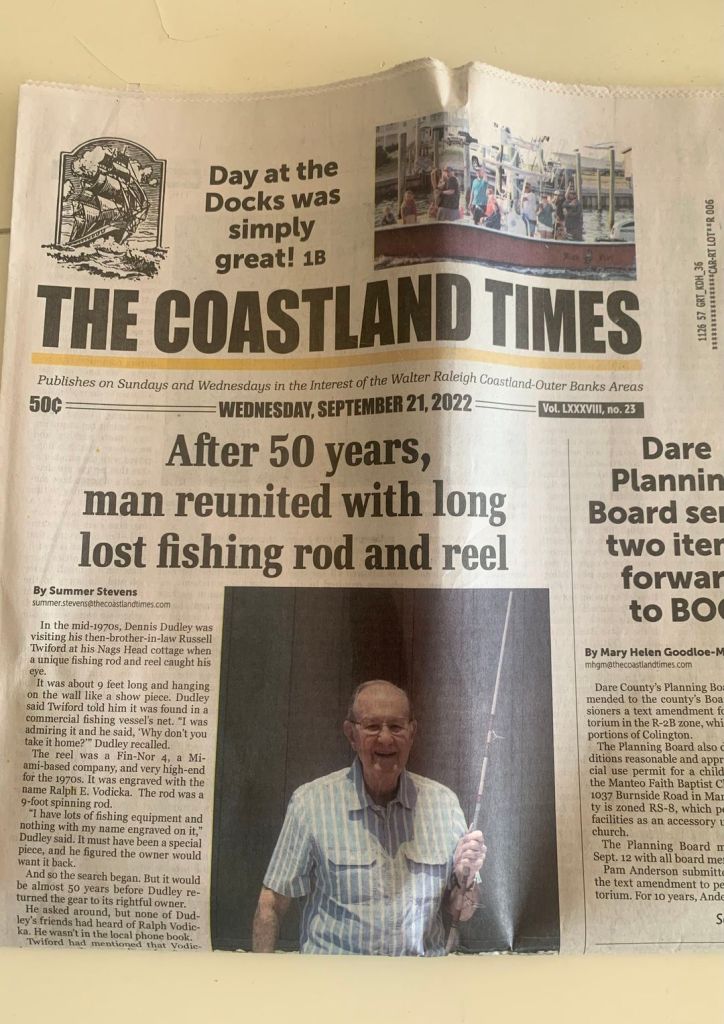
Take a look at this picture. This was front-page news, above-the-fold breaking information that came out this week in my local paper.

Yes, it is an article about a man being reunited with his favorite fishing pole after a 50-year separation. You can just see the look of joy on his face! You can hear the rush of excitement in the voices of the man who found the rod and the man who lost the rod. Can I just say that I love where I live?

Our front-page news is often like this. Usually, it is a beautiful picture of waterfowl, a big fish, or a Boy Scout taking an oath. These things constitute ‘big doin’s’ in this part. My husband and I always chuckle when the paper comes. We are blessed and delighted to live in this simple place.

Many of us have a yearning for this kind of simplicity in a community. Headlines and news programs literally scream at us with words that are harsh, complex, divisive, and distressing. We live in a broken world and our media reflects that on a daily/hourly basis. Oh, to go to a place and time that is easier!

Our lectionary passage speaks about “rich simplicity.” Paul connects simplicity with “being yourself before God” in this pastoral epistle to Timothy, probably written in A.D. 62-66.

1 Timothy 6 (The Message)

6-8 A devout life does bring wealth, but it’s the rich simplicity of being yourself before God. Since we entered the world penniless and will leave it penniless, if we have bread on the table and shoes on our feet, that’s enough.

What a picture Paul paints here. If we can keep our needs and wants in line with what we actually need to live, that’s enough. This surely begs the question about “stuff.” How much stuff do you have? How much stuff do you need? I have a friend who deeply dislikes all the storage units that have popped up on our island. Sometimes they are needed when you are between house moves, but a lot of it is just stuff we have acquired and can’t fit into our houses.

My closet reflects this. It is always a good exercise to look through your things and consider that if you haven’t worn something in months (years?) it probably isn’t that necessary to you.

Paul then moves on to the love of money:

9-10 But if it’s only money these leaders are after, they’ll self-destruct in no time. Lust for money brings trouble and nothing but trouble. Going down that path, some lose their footing in the faith completely and live to regret it bitterly ever after.

Can it get any plainer? Lust for money brings trouble and nothing but trouble. Have you ever compromised your principles because the lure of money got the better of you? If people didn’t do that, there wouldn’t be a lottery program in every state. What can we do?

Paul says to run.

11-12 But you, Timothy, man of God: Run for your life from all this. Pursue a righteous life—a life of wonder, faith, love, steadiness, courtesy. Run hard and fast in the faith. Seize the eternal life, the life you were called to, the life you so fervently embraced in the presence of so many witnesses.

Run for your life from all of this. Run toward the goal that is Christ Jesus. Run to the beauty that is righteousness. Run toward wonder, faith, love, steadiness and courtesy. You remember courtesy, don’t you? Just run.

In essence, Paul says just to keep it simple, and run toward the life to which God called you. Be yourself before God.

But clean out your closets first!

Photo via The Coastland Times

Protective Shield

One of the best things about living in the Outer Banks is the constant sound of birds and waterfowl. When I was growing up, we camped every summer all along the Eastern seaboard. I loved to sit on the beach and listen to the sounds of seagulls calling to one another. That sound was always associated in my mind with vacation, my parent’s love, family fun, and the freedom that camping with friends brought.

I recently came home from a long trip away and as I stepped out of my car, the first sound I heard was a seagull laughing. I was home.

In this lovely Psalm, we are reminded of the strength of a bird’s pinions. The word pinions refers to the wings including the flight feathers. According to scientists at HawkQuest, an environmental education nonprofit in Colorado, a bald eagle’s gripping strength is ten times stronger than the average grip of an adult human hand. A bald eagle can exert upwards of 400 pounds per square inch (psi). God’s creation is amazing, isn’t it? Such majesty and strength in something that is literally as light as a feather.

As you read this psalm today, I want you to think of a time when you felt attacked, defeated, or threatened by something that looked too big to combat. It might be a person, situation, an illness, a bad decision, or a false accusation. It might be depression or divorce. Whatever has you in a hunter’s trap, know this: God is bigger, stronger, and more powerful than any of that.

Psalm 91 (Common English Bible)

Living in the Most High’s shelter,
    camping in the Almighty’s shade,
I say to the Lord, “You are my refuge, my stronghold!
    You are my God—the one I trust!”

God will save you from the hunter’s trap
    and from deadly sickness.
God will protect you with his pinions;
    you’ll find refuge under his wings.
    His faithfulness is a protective shield.
Don’t be afraid of terrors at night,
    arrows that fly in daylight,
    or sickness that prowls in the dark,
    destruction that ravages at noontime.

God’s faithfulness to you is your protective shield. You can take comfort in knowing that God is your refuge. He is your stronghold. He is your protector.

14 God says, “Because you are devoted to me,
    I’ll rescue you.
    I’ll protect you because you know my name.
15 Whenever you cry out to me, I’ll answer.
    I’ll be with you in troubling times.
    I’ll save you and glorify you.
16     I’ll fill you full with old age.
    I’ll show you my salvation.”

So, cry out! Seek the Lord in your distress and you will be found. God will save you and glorify you! Thanks be to God.

Pinion Protection by Michelle Robertson

Be Perfect

A study on the Sermon on the Mount has bought me to a startling command from Jesus. Most of us are familiar with the “love your neighbor” teachings, as well as the “Love your enemies and pray for those who persecute you” part, but I had really not noticed how this section ends. Take a look at verse 48:

Matthew 5 (NIV)

43 “You have heard that it was said, ‘You shall love your neighbor and hate your enemy.’ 44 But I say to you: Love your enemies and pray for those who persecute you, 45 so that you may be children of your Father in heaven, for he makes his sun rise on the evil and on the good and sends rain on the righteous and on the unrighteous. 46 For if you love those who love you, what reward do you have? Do not even the tax collectors do the same? 47 And if you greet only your brothers and sisters, what more are you doing than others? Do not even the gentiles do the same? 

48 Be perfect, therefore, as your heavenly Father is perfect.

Do you think that is even possible? To be perfect as our Heavenly Father is perfect? That seems like a big ask.

Jesus relates this to the instructions to love and pray for our enemies for a reason. Imagine what the world would be like if we took that one verse to heart and truly did strive every day to love people who hate us. And we know that when we pray for people who persecute us, that prayer changes US.

In researching a sermon on this passage, I stumbled upon these wise words from Thomas Merton, an American Trappist Monk. Merton wrote over 50 books on spirituality, faith, comparative religion, and theology.

“Do not be too quick,” he wrote, “to assume that your enemy is a savage just because he is your enemy. Perhaps he is your enemy because he thinks you are a savage. Or perhaps he is afraid of you because he feels you are afraid of him. And perhaps if he believed you were capable of loving him, he would no longer be your enemy.


Do not be too quick to assume that your enemy is an enemy of God just because he is your enemy. Perhaps he is your enemy precisely because he can find nothing in you that gives glory to God. Perhaps he fears you because he can find nothing in you of God’s love and God’s kindness and God’s patience and mercy and understanding of the weakness of men.


Do not be too quick to condemn the man who no longer believes in God. For it is perhaps your own coldness and avarice and mediocrity and materialism and sensuality and selfishness that have killed his faith.”

There is much to ponder here. Do you have an enemy? Do you love that person? Can you pray for that person?

When we focus on this kind of accepting and grace filled agape love, we indeed move the needle a little closer to the perfection of the Heavenly Father. One thing is certain … we will surely never achieve it if we don’t even try.

Perfect Sunrise by Wende Pritchard