Holy Mackerel

Many years ago I participated in a baptismal rededication in the Jordan River while on a trip to Israel with 14 travelers. As the officiating pastor, I had to be in the cold January water for everyone’s immersion, and the last fellow to come was about 6’5, and weighed in at 280 lbs. When I dunked him over, the chill of the water and the power of the Holy Spirit combined in that moment, and he completely lost his footing. Hard as I tried, I could not pull him up. I then lost my footing and found myself under water, pushing him back up on his feet. After a bit of floundering, with both of us going downstream for a few minutes, he finally popped up and yelled, “Holy Mackerel!” I don’t know what the mackerel had to do with it, but it was a holy moment for sure. It took me about a week to warm up.

In our Luke passage today, we see Jesus at his baptism at the very same site where I almost drowned the big fellow. All four gospels record this momentous event, which signaled the beginning of Jesus’ ministry. Luke tells it in a very compact way, beginning with the people wondering if John was the messiah, to which John responds that the one more powerful than he will come and baptize with the Holy Spirit and fire. And then a few sentences later, Luke simply says this:

Luke 3:21-22 (New International Version)

“When all the people were being baptized, Jesus was baptized, too. And as Jesus was praying, heaven was opened, and the Holy Spirit descended on him in boldly form like a dove. And a voice came from heaven: ‘You are my Son, whom I love; with you I am well pleased.”

That’s kind of amazing, isn’t it? To think people were actually there at Jesus’ baptism! Christ’s baptism is important to us for several reasons.

First, we are immediately struck by Jesus’ humility. To submit to being baptized by a mere human is an expression of deep humility, and he did it for our sake. God is the agent of our baptism. God is at the center of this sacrament. God brings the cleansing of our sin and the blessing and the new life that starts in baptism. And here was God, in the form of Jesus, being baptized by a man. He who was sinless submitted to being baptized by a man. I think Jesus’ humility was an act of courageous obedience to the will of God. He was baptized because of his obedience to his Father, and in doing so, set the example for us. What God desires from us is humble obedience also. Jesus shows us how to submit to the Father’s authority in his baptism.

Another amazing thing about this story is that it reveals Jesus’ divinity, and it is one of the few portrayals of the Trinity in scripture. Remember that the concept of the Trinity—God in three persons, the Father, the Son, and the Holy Spirit—wasn’t developed by the church until a few hundred years after Jesus’ resurrection. And frankly, the Trinity is a very difficult thing to explain. How can something be one and three all at once? If I had the perfect explanation for the Trinity, I am sure I wouldn’t be sitting here writing this, but rather I would be the Dean at Yale Divinity School or a famous Christian author. But the best analogy I can offer is that the Trinity is like water in the way that it can be flowing water, ice, and steam. But these three things are all water, just in different forms and functions. On the other hand, maybe we can just simply accept the Trinity the way children do…simply. Kids usually get things right. 

The word Trinity does not appear anywhere in the Bible, but at Jesus’ baptism, we see all three persons of the Godhead present. Jesus is in the water, the Holy Spirit appears in the form of a dove, and God speaks. This is important, because we are taught by Jesus himself that anytime we see him, we are seeing a mirror image of God. While fully human, Jesus is also fully divine, and this gives us an accurate picture of the character of God. The picture we see is a picture of divine love … a perfect and complete love.

But for me, the best part of Jesus’ baptism is that it helps us understand our real identity. This passage brings us that “I yam what I yam” moment, to quote Pop-Eye the sailor man. Part of the baptism ritual is something we call “naming and claiming”. We say to the parents, ”What name is given this child?” Or to an adult, “What is your given name?” and the name is spoken aloud. Then we claim that person as a child of God, and in a closer context, a member of this church family. We claim them as God’s, and we claim them as their own. In doing so, we all receive our identity.

Remember that Jesus’ baptism was the beginning of his earthy ministry, like an initiation moment that sent him out to do God’s will and God’s bidding. He was about 30 years old, and to that point had probably been working as a carpenter, like his father Joseph, and probably took over that family business when Joseph died. We know that as a young boy he stayed behind in the Temple when his family went on a pilgrimage to Jerusalem, that he was obedient to his parents, and he grew in wisdom and stature and in favor with God and man. But now, at his baptism, the heavens open up, the Holy Spirit descends as a dove, and God says, “You are my son, whom I love; with you I am well pleased.”

You, my friends, are the children of God. You are called to live a life worthy of that title. You have been named and claimed by the great and mighty King. Today is a day to remember who we are, and Whose we are. We are called to humble obedience to God’s will and purpose in our lives, so that all who see us may see our good works and give thanks to our Father.

We are Christ’s body at work in the world, reminding the world that it is loved.

Looking for Holy Mackerel by Michelle Robertson

Do Not Give Up

Have you ever been afraid to try something again that scared or defeated you the first time you did it?

Many of you know that I struggle with claustrophobia. It has most definitely gotten worse as I’ve gotten older. Claustrophobia has prevented me from doing some pretty cool things, like climbing the clock tower at the top of Old Main at Penn State University. I took one look up the narrow, enclosed staircase and my brain went “NOPE” loud enough for the clock to hear it. So I sat at the bottom and waited for everyone to tell me how amazing the views of campus were from up there.

Yesterday, I had an opportunity to climb one of our famous lighthouses in the Outer Banks. My family is visiting, and my daughter wanted to climb the Currituck Lighthouse like she did growing up. I did not have a problem with it in those years, but it does get narrower as you ascend and there is of course only one staircase for people going both ways, so it can get crowded in the summer. As we were driving up there with three very excited grandkids, I told my husband I probably couldn’t climb it. I did not have a problem with the 220 steps (each way) but was anticipating the closeness of the brick walls at the top. He reminded me that I used to do it with ease, but my brain said, “that was then.”

Then I remembered an obscure scripture from 2 Chronicles that encourages us to be strong and not give up:

2 Chronicles 15 (New International Version)

1 The Spirit of God came on Azariah son of Oded. 

He went out to meet Asa and said to him, “Listen to me, Asa and all Judah and Benjamin. The LORD is with you when you are with him. If you seek him, he will be found by you, but if you forsake him, he will forsake you. 

For a long time Israel was without the true God, without a priest to teach and without the law. 

But in their distress they turned to the LORD, the God of Israel, and sought him, and he was found by them. 

In those days it was not safe to travel about, for all the inhabitants of the lands were in great turmoil. 

One nation was being crushed by another and one city by another, because God was troubling them with every kind of distress. 

But as for you, be strong and do not give up, for your work will be rewarded.” 

Israel had walked away from the covenant with God and was full of false idols. The people had forgotten God and lived in great turmoil. There was no one to lead or teach them and they did not remember God’s love and divine mercy. Then the Spirit of God came to Azariah, who gave Asa the word of encouragement that if they were strong and did not give up, God would honor his part of the covenant even when though they had forgotten theirs.

Are you about to give up on something? Are you feeling weak and afraid today? Do you feel like you just can’t keep pushing that rock uphill? Read the full chapter to see what happens next and put yourself back in God’s hands.

As for me, I decided to at least try the climb, promising my brain that if panic started to settle in, I would turn around and go back down. I am glad to say that the risk was rewarded, and I made it to the top. The views were spectacular! I did not have one moment of discomfort on the climb … well, at least not from claustrophobia. Two Hundred and twenty steps straight up left me out of breath! But it was worth it because the view was breathtaking.

As you go about your day, remember these words: be strong, and do not give up, for your work will be rewarded.

Be Strong

Weeds of Worry

Let’s talk about parables today. These simple stories were told in order to illustrate a moral or spiritual lesson and were a favorite way of communicating for Jesus. Scholars disagree about the number of parables he told, with the numbers ranging from anywhere from 30 to 50. When his disciples asked him why he so often spoke in parables, he responded by saying that he was trying to create a readiness to receive him in the hearts and minds of the hearers:

Matthew 13:10 (The Message)

10 The disciples came up and asked, “Why do you tell stories?”

11-15 He replied, “You’ve been given insight into God’s kingdom. You know how it works. Not everybody has this gift, this insight; it hasn’t been given to them. Whenever someone has a ready heart for this, the insights and understandings flow freely. But if there is no readiness, any trace of receptivity soon disappears. That’s why I tell stories: to create readiness, to nudge the people toward a welcome awakening. In their present state they can stare till doomsday and not see it, listen till they’re blue in the face and not get it.

They asked him this question after he told a crowd of people a harvest story, which later would be known as the Parable of the Sower:

13 1-3 At about that same time Jesus left the house and sat on the beach. In no time at all a crowd gathered along the shoreline, forcing him to get into a boat. Using the boat as a pulpit, he addressed his congregation, telling stories.

3-8 “What do you make of this? A farmer planted seed. As he scattered the seed, some of it fell on the road, and birds ate it. Some fell in the gravel; it sprouted quickly but didn’t put down roots, so when the sun came up it withered just as quickly. Some fell in the weeds; as it came up, it was strangled by the weeds. Some fell on good earth and produced a harvest beyond his wildest dreams.

“Are you listening to this? Really listening?”

We get to listen in now as Jesus explains the meaning of this beautiful little story to his disciples. God, of course, is the farmer and we are the ground:

18-19 “Study this story of the farmer planting seed. When anyone hears news of the kingdom and doesn’t take it in, it just remains on the surface, and so the Evil One comes along and plucks it right out of that person’s heart. This is the seed the farmer scatters on the road.

20-21 “The seed cast in the gravel—this is the person who hears and instantly responds with enthusiasm. But there is no soil of character, and so when the emotions wear off and some difficulty arrives, there is nothing to show for it.

22 “The seed cast in the weeds is the person who hears the kingdom news, but weeds of worry and illusions about getting more and wanting everything under the sun strangle what was heard, and nothing comes of it.

23 “The seed cast on good earth is the person who hears and takes in the News, and then produces a harvest beyond his wildest dreams.”

Road, gravel, weeds, or good earth. It is obvious what type of ground Jesus wants us to be. Only in good soil can a seed be planted, watered, and grown to a full harvest.

Have you ever been gravel? Has your need to pursue your own self-interests left your heart as solid as the surface of a road? Are you so busy with worldly concerns that God’s seed falls among your weeds of worry?

Be good soil today. Open your heart and mind to receive God’s word and his instruction for your life. Insights and understanding will flow from your very being, and you will be ready to do as God instructs. When we do that, the harvest is full and plentiful.

And that’s the good news.

Weeds of Worry by Michelle Robertson

Labels

A recent trip to the vet to refill my dog’s prescriptions gave me a good chuckle as I stood at the reception counter. I looked down as I was handing my credit card over and spotted sticky labels that are used to alert the staff about potential behaviors an animal might have (see picture below). I spotted the “Aggressive,” “May Bite,” and “Might Bite” labels right away. Immediately I thought that it might be easier if people came appropriately labeled. It would give you a heads up about who to avoid and who is safe for interaction.

Of course, labeling is a terrible idea for people. Communities that have fought for decades against stereotyping have taught us this. Negative stereotypes are obviously harmful, but positive stereotypes can be damaging as well, as they force people into a “box” where not everyone belongs. Teachers know this better than anyone, I think. Labeling students as lazy, slow, good at math, or compliant robs each one of their individuality. It is better to let people speak for themselves and take a moment to look beyond the outer information to see what is hidden underneath.

This thinking is biblical. God reminded Samuel that outer appearances may tell one story, but looking into the inner self is wiser. In our Scripture this morning, Samuel has been sent by God to anoint the next king of Israel. He has been directed to observe Jesse’s many fine sons, among whom is God’s choice:

2 Samuel 16 (The Message)

16 God addressed Samuel: “So, how long are you going to mope over Saul? You know I’ve rejected him as king over Israel. Fill your flask with anointing oil and get going. I’m sending you to Jesse of Bethlehem. I’ve spotted the very king I want among his sons.”

2-3 “I can’t do that,” said Samuel. “Saul will hear about it and kill me.”

God said, “Take a heifer with you and announce, ‘I’ve come to lead you in worship of God, with this heifer as a sacrifice.’ Make sure Jesse gets invited. I’ll let you know what to do next. I’ll point out the one you are to anoint.”

Samuel did what God told him. When he arrived at Bethlehem, the town fathers greeted him, but apprehensively. “Is there something wrong?”

“Nothing’s wrong. I’ve come to sacrifice this heifer and lead you in the worship of God. Prepare yourselves, be consecrated, and join me in worship.” He made sure Jesse and his sons were also consecrated and called to worship.

When they arrived, Samuel took one look at Eliab and thought, “Here he is! God’s anointed!”

But God told Samuel, “Looks aren’t everything. Don’t be impressed with his looks and stature. I’ve already eliminated him. God judges persons differently than humans do. Men and women look at the face; God looks into the heart.”

Jesse then called up Abinadab and presented him to Samuel. Samuel said, “This man isn’t God’s choice either.”

Next Jesse presented Shammah. Samuel said, “No, this man isn’t either.”

10 Jesse presented his seven sons to Samuel. Samuel was blunt with Jesse, “God hasn’t chosen any of these.”

11 Then he asked Jesse, “Is this it? Are there no more sons?”

“Well, yes, there’s the runt. But he’s out tending the sheep.”

Samuel ordered Jesse, “Go get him. We’re not moving from this spot until he’s here.”

12 Jesse sent for him. He was brought in, the very picture of health—bright-eyed, good-looking.

God said, “Up on your feet! Anoint him! This is the one.”

13 Samuel took his flask of oil and anointed him, with his brothers standing around watching. The Spirit of God entered David like a rush of wind, God vitally empowering him for the rest of his life.

Samuel left and went home to Ramah.

You can see from this story that if Samuel had followed his intuition, David would not have been selected as king. This is a great reminder to look upon the heart, not the appearance, of people we encounter. Who knows what relationships might form if we were to do that! Our neighborhoods might be more peaceful, our workplaces might have more harmony, and politicians might actually have to run on issues rather than character assassinations.

It wasn’t until I got home and looked at the picture again that I noticed the label that said, “May Give Kisses.” Our challenge today it to encounter a stranger and label them “May Give Kisses” and deal with them accordingly.

A greater challenge is to wear that one ourselves.

May Give Kisses

The Unforced Rhythms of Grace

Where do you go for real rest? Are you able to find complete and total relaxation anywhere?

I have been spending some time on the beach in the last few weeks, and my observation is that it can be hard to rest. Folks have waited an entire year for this one week of vacation on the Outer Banks. They drive for hours and hours to get here, unload the car, run out for groceries, plan meals, set up highchairs and beds, etc. Then the week starts and meals have to be executed, chairs, toys, and umbrellas have to be schlepped across the hot sand for a few hours each day of not sitting because the little ones want to explore. Then dinner and bath time take up the evening and it all starts again the next day.

I have been on vacations that were so busy, I needed a vacation from my vacation when I got home. Have you ever felt that way?

Maybe this is why we say “Rest In Peace” when someone dies. Death may bring the only real rest to our busy lives!

Jesus wants us to know that in him, we can find true rest. This is a kind of mental rest that we crave when we have burned out on too much worldly activity. Work, the constant pursuit of wealth, the distracting and distressing cacophony of social media, the internal pressure to do better, all take a toll on us. We can even get burned out on religion. My denomination is in the process of an historic schism, and I am here to tell you that we are all burned out with the arguing, name-calling, and lack of focus on what really matters. I confess that I am really, really tired.

Jesus calls us to rest.

In him we can re-learn what really matters and learn the “unforced rhythms of grace.” When we walk and work with Jesus, he helps to carry the burden and promises that we won’t have to bear too much.

Matthew 11 (The Message)

28-30 “Are you tired? Worn out? Burned out on religion? Come to me. Get away with me and you’ll recover your life. I’ll show you how to take a real rest. Walk with me and work with me—watch how I do it. Learn the unforced rhythms of grace. I won’t lay anything heavy or ill-fitting on you. Keep company with me and you’ll learn to live freely and lightly.”

If you are tired, worn out, and burned out, go to Jesus. Get away for an hour and recover your life! Meditation on God’s promises can be like a week of “vacation” for your soul. When you sit quietly in God’s presence, he will teach you to live lightly.

The Unforced Rhythm of Grace by Michelle Robertson

How Do You Eat an Elephant?

I have a saying that I use quite often in counseling, especially in those cases where “whatifitis” has completely taken over. You know what whatifitis sounds like, right? “But what if the surgery doesn’t work and the hospital won’t treat him and kicks him out and we get a bill we can’t pay?” “But what if my daughter isn’t paying attention and spins out of control in the car and lands in a ditch upside down and the ditch has an alligator, and her window is down?” Whatifitis has robbed many a person of peace with its cacophony of scenarios. Whatifitis can keep us cautious, but it can also paralyze us.

My mother was a very successful school business administrator in a large school district. She oversaw a multi-million budget. I remember a time when she came home from a school board meeting completely frustrated. She had finally lost her cool with the nay-sayers who were trying to shut down a much needed but expensive project. She told the board that their whatifitis was going to kill the school and she said they could what-if themselves to death, but that wouldn’t move the school forward in the direction it needed to go or fix the immediate problem. The project passed.

So the thing I say to people who are struggling under the weight of “what ifs?” is “How do you eat an elephant? One bite at a time.” It is a reminder to us to not take on the enormity of a big problem, but instead to choose one small part of it to tackle and move methodically through it, one bite at a time. By focusing on a small, achievable part, we can avoid being overwhelmed by things.

In our Scripture today, Jesus is addressing the newly recruited disciples and laying out his plan for the harvest work of making disciples that they will undertake. It is a huge mission, and these former fishermen and a tax collector are becoming overwhelmed with the size and scope of their new calling. So Jesus advises them to start small:

Matthew 10 (The Message)

40-42 “We are intimately linked in this harvest work. Anyone who accepts what you do, accepts me, the One who sent you. Anyone who accepts what I do accepts my Father, who sent me. Accepting a messenger of God is as good as being God’s messenger. Accepting someone’s help is as good as giving someone help. This is a large work I’ve called you into, but don’t be overwhelmed by it. It’s best to start small. Give a cool cup of water to someone who is thirsty, for instance. The smallest act of giving or receiving makes you a true apprentice. You won’t lose out on a thing.”

What good advice, regardless of the project! In the aftermath of a tragedy, start small. In the new beginning of a venture, start small. If you want to make a change in your lifestyle, start small. Nobody ever ran a marathon on the first day.

If you are trapped in a sticky web of what ifs, try to break the project down into manageable bites. Jesus reminds us that the smallest act of giving or receiving makes you his apprentice. He is intimately linked with us in our work, and we are never alone. Thanks be to God!

Start Small by Michelle Robertson

Celebrate the Victories

Deception. Revenge. A double-cross. A beautiful queen. A wrathful king. Political intrigue. A nation hanging in the balance.

Believe it or not, this is not a description of the latest Netflix series or an update on the Harry and Meghan story. No, this twisting plot is from the Old Testament, and is found in a book that never mentions God once.

Intrigued?

Esther was a beautiful Jewess who was given to the Persian King Xerxes after she won a beauty pageant that was held to find a new queen. Her benefactor and older cousin Mordecai received a position in the palace as well, infuriating a jealous and insecure man named Haman. Haman then plotted to annihilate the jews in order to rid himself of this competition. But the plot backfired when Esther, now the queen, leveraged the king’s favor and asked him to save her people:

Esther 7 (Contemporary English Version)

7 The king and Haman were dining with Esther and drinking wine during the second dinner, when the king again said, “Esther, what can I do for you? Just ask, and I will give you as much as half of my kingdom!”

Esther answered, “Your Majesty, if you really care for me and are willing to help, you can save me and my people. That’s what I really want, because a reward has been promised to anyone who kills my people. Your Majesty, if we were merely going to be sold as slaves, I would not have bothered you.”

“Who would dare to do such a thing?” the king asked.

Esther replied, “That evil Haman is the one out to get us!”

Haman was terrified, as he looked at the king and the queen.

In a beautiful twist of events, Haman’s scheme to hang Mordecai is used against him:

Then Harbona, one of the king’s personal servants, said, “Your Majesty, Haman built a tower seventy-five feet high beside his house, so he could hang Mordecai on it. And Mordecai is the very one who spoke up and saved your life.”

Earlier, Mordecai had uncovered a plot to assassinate the king, and acted quickly enough to save the king’s life. Xerxes is infuriated to learn that Haman is now plotting to execute Mordecai.

“Hang Haman from his own tower!” the king commanded. 10 Right away, Haman was hanged on the tower he had built to hang Mordecai, and the king calmed down.

20 Mordecai wrote down everything that had happened. Then he sent letters to the Jews everywhere in the provinces 21 and told them:

Each year you must celebrate on both the fourteenth and the fifteenth of Adar, 22 the days when we Jews defeated our enemies. Remember this month as a time when our sorrow was turned to joy, and celebration took the place of crying. Celebrate by having parties and by giving to the poor and by sharing gifts of food with each other.

And thus began the celebration known as Purim, which commemorates this turn of events that saved a nation and celebrates the woman who used her influence to bring it all about. Esther understood that she had been brought into the kingdom “for such a time as this,” and trusted that the time would come when she could save her people. And so she did.

This story is a great reminder to us today to celebrate the victories that come in the midst of hardship. It is important to acknowledge even small steps forward when you are in the midst of a trying time. Every kindness shown to you, every good health report, a child getting all “A”s on their report card, the completion of one more chemo … celebrating these moments center your faith on the One who provides them. Purim is a Jewish feast designed to remember when a time of sorrow had turned to joy, and celebrants are encouraged to share that joy by giving to the poor and sharing gifts of food. Perhaps we also could give a gift of generosity when we receive a small triumph.

Do you have something to celebrate today? Can you recall a time when God put you in a place of influence to do something good for someone? God’s invitation is to pause and remember … and mark your joy with a gift of generosity. We give thanks to God in ALL things! He is our provider, our sustainer, and our rescuer.

Family Time by Michelle Robertson

Engraved on the Heart

Today’s Scripture comes from a time in Old Testament history when God was about to restore Israel and Judah and bring his people home. He had allowed the infiltration of foreign armies to come in and decimate them, but the time was coming soon for the people to be returned from the diaspora and reclaim their land. A lot had happened since they left, and their understanding of the Law, the covenant, and their relationship with God had been diluted during their time in Babylon and beyond. But God remembered his covenant and told the prophet Jeremiah that the return to their promised land was upon them:

Jeremiah 31 (Common English Bible)

27 The time is coming, declares the Lord, when I will plant seeds in Israel and Judah, and both people and animals will spring up. 28 Just as I watched over them to dig up and pull down, to overthrow, destroy, and bring harm, so I will watch over them to build and plant, declares the Lord. 29 In those days, people will no longer say:

Sour grapes eaten by parents
    leave a bitter taste in the mouths of their children.
30 Because everyone will die for their own sins:
    whoever eats sour grapes
    will have a bitter taste in their own mouths.

Several generations had been born and had died during the time that they were away from Israel and Judah. The sins of the fathers had taken a toll on the children. But God’s new covenant with his people would be different. 

31 The time is coming, declares the Lord, when I will make a new covenant with the people of Israel and Judah. 32 It won’t be like the covenant I made with their ancestors when I took them by the hand to lead them out of the land of Egypt. They broke that covenant with me even though I was their husband, declares the Lord. 

33 No, this is the covenant that I will make with the people of Israel after that time, declares the Lord. I will put my Instructions within them and engrave them on their hearts. I will be their God, and they will be my people. 34 They will no longer need to teach each other to say, “Know the Lord!” because they will all know me, from the least of them to the greatest, declares the Lord; for I will forgive their wrongdoing and never again remember their sins.

God desired now to put his instructions within each person, engraving the Law and his promises on their hearts. No longer would they have to depend on the priest to mete out scriptural teaching … God desired that everyone know him. And knowing him came with forgiveness of their past sins, which God promised to forget.

This scripture is a great reminder to us today of the importance of personal bible study, daily devotions, prayer, and meditation. We cannot rely on the pastor or priest for Scriptural instruction, but rather are invited to know God in our hearts and minds for ourselves. Considering that multiple Bible translations are right in your phone, that task has never been easier. How much of God’s word do you have engraved on your heart?

God desires to KNOW you and be known by you. Isn’t it amazing to think that the Creator of the universe wants a relationship with you? Thanks be to God.

Looking for a summer “beach read” devotional book? Psalms by the Sea is available at Amazon.

Day-O

Have you ever had an ear worm song (also known as sticky music) stuck in your head at night that became so loud, it woke you up from your dreams? I have been plagued by the repetitive playing of “Day-O (The Banana Boat Song)” in my mind for weeks now. This popular hit from the 1950’s was actually written decades earlier. It tells the story of Jamaican dock workers who toil through the night to load bananas onto the ships for transport. At sunrise, they are sent home after a tally is taken to inventory how many pounds were loaded. They work at night to avoid that harsh sun, so when “daylight comin'” they get to go home. Harry Belafonte’s velvet voice has been singing this to me for weeks now.

I suppose you could have worse songs stuck in your head. “It’s a Small World” comes to mind.

Not knowing the history and meaning of the song, I wondered why banana harvesters got to go home at daylight. I missed the whole “boat” part and thought it was strange for bananas to be cut down from trees at night, which would be a dangerous proposition. Then my sleep-deprived brain wandered into other places, like how good banana bread is and how lovely a simple banana spread with peanut butter tastes.

Daylight for me is a time of great productivity, not rest. Our beautiful sunrises here on the water wake me up with the hope and promise of a new day, and I spend my first hours of the day doing exactly what I am doing right now: reading Scripture, researching Scripture, and writing. Oh, and consuming large amounts of coffee. A friend asked me last week if I designate a certain time every day to write, and the answer is yes. I once read that Ernest Hemingway got up and wrote 500 words every day of his life and the structure and discipline of that (not to mention the results!) made an impression on me.

What do you do to welcome the new day?

Psalm 30 (English Standard Version)

I will extol you, O Lord, for you have drawn me up
    and have not let my foes rejoice over me.
O Lord my God, I cried to you for help,
    and you have healed me.
O Lord, you have brought up my soul from Sheol;
    you restored me to life from among those who go down to the pit.

Sing praises to the Lord, O you his saints,
    and give thanks to his holy name.
For his anger is but for a moment,
    and his favor is for a lifetime.
Weeping may tarry for the night,
    but joy comes with the morning.

The psalmist reminds us that sunrise is a good time to extol and praise the Lord when he draws us up from sleep. Even when the sunlight floods the room at 5:30am and you can’t get back to sleep, offering God your first word of thanks and appreciation sets the tone for the rest of the day. Yesterday’s weeping is replaced by a new day’s joy and the knowledge that you get a do-over. And it beats the alternative of not waking up.

What do you do first thing in the morning? Go out in joy today, and make it count.

Day-O by Michelle Robertson

Go Out in Joy

I have confessed before that I am a lover of words. Words capture my imagination and take me to new worlds. Words express my deepest fears and unspoken longings. It is no coincidence that all of my favorite pastimes involve words: daily rounds of Wordle, playing a scrabble game called Words with Friends, reading, writing, and of course, communicating with people all day long through the spoken and written word. Words have the power to transport us, correct us, redeem us, and empower us.

Sometimes a particular word will come to my attention, and I try to find ways to use it just because it is so cool. Currently I am stuck on malarkey, pernicious, and obfuscation. I challenge myself to use new words in a sentence once a day if I can. What a bunch of malarkey, you say? Better than resorting to obfuscation! Using language that is unclear can be pernicious over time. Say what you mean and mean what you say, I say!

And of course I am a huge lover of the Word that was with God, the Word that was God, from the very beginning of existence.

So when I read today’s lectionary, the beauty of the words jumped out at me and made me want to just post the Scripture without commentary. Who can possibly add to these vibrant images of rain and snow coming down from heaven to water the earth? What words could enhance the picture of water bringing forth seed to the sower and bread to the eater? Isaiah is a master wordsmith. Just pause for a moment and drink this in:

Isaiah 55 (New Revised Standard Version)

For as the rain and the snow come down from heaven
    and do not return there until they have watered the earth,
making it bring forth and sprout,
    giving seed to the sower and bread to the eater,
11 so shall my word be that goes out from my mouth;
    it shall not return to me empty,
but it shall accomplish that which I purpose
    and succeed in the thing for which I sent it.

God promised his children that just as the rain comes to earth for a purpose, so does his word. Rain waters replenish the soil and help things grow before they return to heaven. God’s word is poured out on his people and accomplishes its purpose before it returns to him. You can count on this.

12 For you shall go out in joy
    and be led back in peace;
the mountains and the hills before you
    shall burst into song,
    and all the trees of the field shall clap their hands.

The notion of going out in joy and being led back in peace to God’s promises is a pure moment of refreshment to the weary soul and a reminder of hope to all who wait for the deliverance that God’s word brings. God’s word is an everlasting sign that shall not be cut off. From the earth to eternity and back again, God’s promises are good.

13 Instead of the thorn shall come up the cypress;
    instead of the brier shall come up the myrtle,
and it shall be to the Lord for a memorial,
    for an everlasting sign that shall not be cut off.

God is pouring out his word to you today. It might be a word of hope or correction. It might be a call to action or an invitation to rest. Whatever it is, it will not return to him void.

Are you listening?

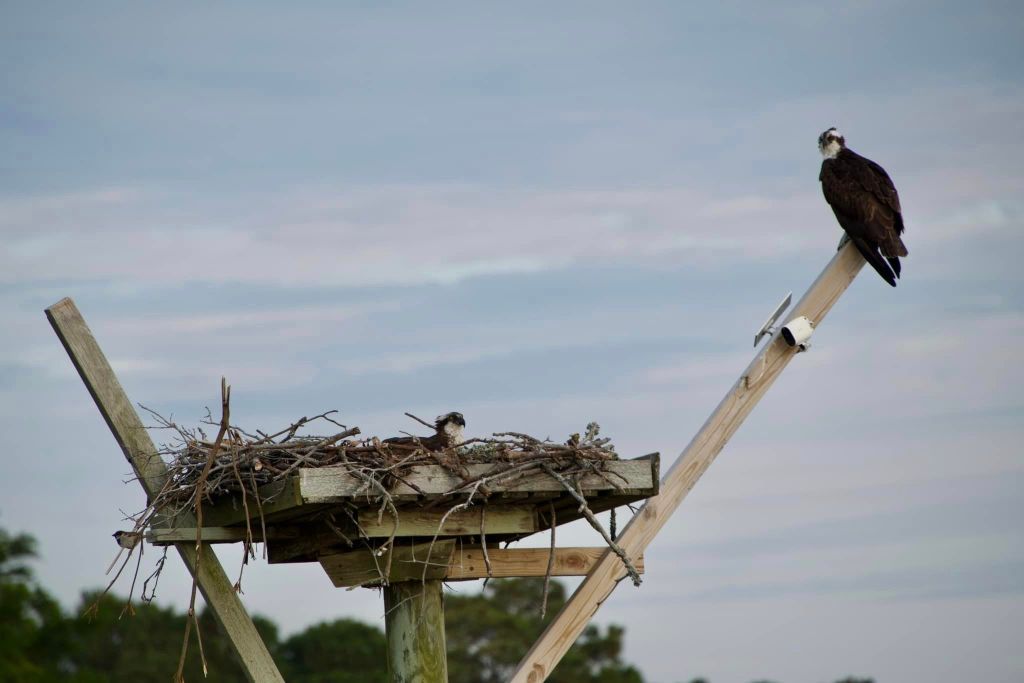
Baby Osprey by Michelle Robertson