Shalom in the Sheepfold

 Have you ever noticed how many times the Bible talks about sheep? References to sheep, sheepfolds, and gates are abundant in the Old Testament. Psalm 23 gives us beautiful language that speaks about God’s safe and protected meadows: The Lord is my shepherd. I lack nothing. He lets me rest in grassy meadows; he leads me to restful waters; he keeps me alive. He guides me in proper paths for the sake of his good name” (Psalm 23:1-3, Common English Bible). Let’s read the entire psalm in the New King James Version. As you do, try to see the word pictures in your mind:

Psalm 23 (New King James Version)
The Lord is my shepherd;
I shall not want.
He makes me to lie down in green pastures;
He leads me beside the still waters.
He restores my soul;
He leads me in the paths of righteousness
For His name’s sake.

Yea, though I walk through the valley of the shadow of death,
I will fear no evil;
For You are with me;
Your rod and Your staff, they comfort me.

You prepare a table before me in the presence of my enemies;
You anoint my head with oil;
My cup runs over.
Surely goodness and mercy shall follow me
All the days of my life;
And I will dwell in the house of the Lord
[e]Forever.

 God’s sheepfold has always been a place of abundance, rest, and safety. David’s beautiful psalm speaks directly into our need to be rescued from the valley of the shadow of death and ensconced in a place where we need fear no evil.

 In a similar manner, Ezekiel 34 speaks of keeping the sheep of Israel protected from predators and famine. As you read this, note the beautiful undertones of shalom that come with God’s provision and presence:

Ezekiel 34 (Common English Bible)

 I will make a covenant of peace for them, and I will banish the wild animals from the land. Then they will safely live in the desert and sleep in the forest. 

26 I will give them and those around my hill a blessing by sending the rain in its season.

They will be rains of blessing. 27 The trees in the field will bear fruit, and the earth will yield its harvest. They will be safe on their fertile land, and they will know that I am the Lord when I break the bars of their yoke and deliver them from those who enslaved them. 

28 The nations will no longer prey on them, and wild animals will no longer devour them. They will live in safety, with no one to trouble them” (Ezekiel 34: 25-28).

The war that continues to rage in Gaza makes us long for peace in that region. The still-held hostages, the constant bombing, and the loss of life and property grieves our hearts. Daily we pray for a resolution in Israel and daily we wait. It is good to remember God’s promise of shalom as we wait for the end to come.

Oh, how we long for this peace in our land as well!  

Come, Lord Jesus, come.

Let There Be Peace on Earth by Michelle Robertson

By Name

Isn’t it a wonderful experience when you are new to a group, and you find someone who consistently remembers your name? There can’t be any quicker way to feel welcomed than to have someone call your name from across the room. If you are someone gifted with the ability to remember names easily, thank your loving Father for that gift!

My husband and I used to struggle with names when we were in the Navy. In all fairness, the names around us changed every couple of months as people deployed and were assigned to other squadrons, while others came in and took their place. It was pretty easy to remember the pilots, since their names were conveniently displayed on their flight suits. But in social occasions where spouses were included and name tags weren’t worn, we had to develop a way of figuring out someone’s name without letting them know. Kenn would say to the person, “Have you ever met my wife, Betsy?” and I would immediately extend my hand for a handshake and say, “Hi, I’m Betsy!” They then had to respond with a greeting and their name. I could see Kenn leaning in as they gave their name. We had to reverse this when I served a large church many years later. Everyone knew my name, but I had a bit of a struggle keeping up with the close to 4,000 members’ names. There were many potluck suppers where I did the “Have you ever met my husband Kenn?” and then leaned in to hear them introduce themselves. Try this at your next awkward social gathering! It works like a charm.

We continue our examination of John 10 this morning with a special emphasis on verse 3. Jesus states that the sheep not only listen to the shepherd’s voice, but he calls his own sheep by name and leads them out:

John 10 (Common English Bible)

1 I assure you that whoever doesn’t enter into the sheep pen through the gate but climbs over the wall is a thief and an outlaw. 2 The one who enters through the gate is the shepherd of the sheep. 3 The guard at the gate opens the gate for him, and the sheep listen to his voice. He calls his own sheep by name and leads them out. 4 Whenever he has gathered all of his sheep, he goes before them and they follow him, because they know his voice. 5 They won’t follow a stranger but will run away because they don’t know the stranger’s voice.” 6 Those who heard Jesus use this analogy didn’t understand what he was saying.

Embedded in this complex story of sheep, thieves, and fences is a beautiful nod to the reverence of baptism. In our United Methodist understanding of this sacrament, baptism is a time of “naming and claiming”. We need to be clear that God knows every child by name at their conception. Psalm 139 confirms this:

You are the one who created my innermost parts; you knit me together while I was still in my mother’s womb” (Psalm 139:13, Common English Bible).

But in baptism, we invite the entire community to participate in the naming of that person and acknowledge that Jesus has claimed them as one of his sheep. Notice that our liturgy asks only for the first and middle name of the person. I believe that is because we take on a new last name in that water-washed moment. We all share that same last name as family members in the Body of Christ. I am no longer Haas. You are no longer Smith or Jones. Our new last name is Beloved.

What does it mean to you to know that Jesus knows your name? You are his Beloved.

Revel in that.

He Knows Your Name by Michelle Robertson

Baby Gates

How many of you use baby gates to keep your little ones safe? We have them in our house for two reasons. We have grandchildren who are under 2 years old, and the 13 wood steps from the ground level to the living level are dangerous for them. We also use them every day to keep our dog from attempting to do the stairs alone. At almost 14, our old girl has taken several spills, and now needs a guiding hand to safely go up and down. We are grateful for gates that keep everyone save and contained.

In John 10, Jesus declared himself to the Gate for the sheepfold. He determines who may come and go into the pen, with the priority of keeping the thieves and outlaws out. He allows the sheep who follow his voice to enter through his gate to find the pasture, where life can be experienced to the fullest. Those who come only to steal, kill, and destroy will be locked out.

John 10 (Common English Bible)

7 So Jesus spoke again, “I assure you that I am the gate of the sheep. 8 All who came before me were thieves and outlaws, but the sheep didn’t listen to them. 9 I am the gate. Whoever enters through me will be saved. They will come in and go out and find pasture. 10 The thief enters only to steal, kill, and destroy. I came so that they could have life—indeed, so that they could live life to the fullest.

 The Gospel of John does not contain any parables, but this metaphorical rendering comes close. John calls this teaching a paroimia, which refers to an illustration used to deliberately be vague as to its real meaning. (See John 10:6, where our Common English Bible version uses the word “analogy”.) Remember that we have established in previous devotionals that the revelation of the truth of Jesus as the Son of God was dangerous for him at this point. He had so much work to do before he took on the work of the crucifixion. So the paroimia served to allude to the truth of his nature without being too confrontational to the Pharisees.

 The image of gates and fences when applied to a first century sheepfold might leave us with a visual of a rickety structure of wood or branches on a rocky Judean hill. But when applied to Jesus, it is more appropriate to envision a twenty-foot high gate of steel embedded in the Great Wall of China. Jesus’ gate was impenetrable. Jesus’ fences were secure. If you entered through the open gate, your life was guaranteed to be protected and defended by Jesus himself.

For his first followers, then, Jesus offered safety from the dead adherence of the Law and its false claims. He offered them a new life of salvation through the true Messiah of Israel.

 For modern day readers, the safety of entering through Jesus’ gate is a promise of eternal salvation. If you consider this illustration as referring to the gates of heaven, it makes sense that Jesus is the gate. In John 14:6 we read: Jesus answered, “I am the way, the truth, and the life. No one comes to the Father except through me” (John 14:6). But for his first followers, Jesus offered himself as the way back to knowing and understanding the Father, something that the thief and outlaw Pharisees could not do. They had forgotten about God in their never-ending pursuit of the Law. 

Truly, this passage confronts us with a model of community envisioned by Jesus where all may come in. His model is grounded in the word “open.” This invites us to reflect on our own community’s practices. The illustration of open gates opens up a question for us today. How open are the gates of the church? Do people feel as thought they can come in, just as they are, or do the “gatekeepers” of doctrine and tradition prevent people from entering in? What does Jesus, our Open Gate, want? And as we expand the call to openness, what can we discern about the openness of our social structures, our neighborhoods, and our borders? Are the practices and policies that control these entities in line with Jesus’ vision?

Jesus is an open gate.

Which are you?

Safe Pastures by Kathy Schumacher

Objection, Your Honor

This morning we are going to talk about two groups of people who historically did not get along. Think Hatfields and McCoys. Think Sharks and Jets. Think Penn State and Michigan football fans.

Think Jesus and the Pharisees. (If you’re thinking, “But wait! Jesus isn’t a group!” may I present the Holy Trinity for your consideration …)

A quick study of the New Testament reveals the constant conflict and tension between Jesus and the Pharisees. The Pharisees were laymen, not priests, who related to Jesus as a rabbi since they, too, were teachers. But their focus was on keeping the religious laws, including their interpretations of the religious laws, which led them farther and farther away from the purpose of the law, which was to keep the community safe in a covenant relationship with God. They had great influence with the people, and they spent a tremendous amount time arguing with Jesus and trying to discount his authority. They shepherded the crowds away from the true Good Shepherd with their bias and rejection of Jesus. Read this exchange from the Gospel according to John:

John 8 (Common English Bible)

12 Jesus spoke to the people again, saying, “I am the light of the world. Whoever follows me won’t walk in darkness but will have the light of life.”


13 Then the Pharisees said to him, “Because you are testifying about yourself, your testimony isn’t valid.”


14 Jesus replied, “Even if I testify about myself, my testimony is true, since I know where I came from and where I’m going. You don’t know where I come from or where I’m going. 15 You judge according to human standards, but I judge no one. 16 Even if I do judge, my judgment is truthful, because I’m not alone. My judgments come from me and from the Father who sent me. 17 In your Law it is written that the witness of two people is true. 18 I am one witness concerning myself, and the Father who sent me is the other.”

Of course the Pharisees objected! They defaulted to their faulty understanding of the law and claimed that Jesus’ testimony wasn’t valid. Jewish law stated that a man’s witness when he was testifying about himself was not legally valid if it was the only evidence. Two corroborating witness needed to speak on an issue for it to be admissible in court. Jesus responds to their invalidation of his proclamation by invalidating their perspective of the law. Indeed, his entire self-revelation was an invalidation of their misguided messianic expectations, and this is an important moment in that argument. God was the giver of the Law. God was the enforcer of the Law. And here was the Law, standing right in front of them, incarnated as Jesus. The truth of the matter was that Jesus stood in the witness box with his Father as co-defendant and the Holy Spirit as his advocate; thus there were three witnesses.

Jesus’ relationship with God provided all the validation he needed to speak. He is the only one who had seen God and could make God known to the world. But remember that the understanding of the Holy Trinity was an unknown concept at this time. We believe in a triune being of God, Son, and Holy Spirit. But the Pharisees only saw a man from Nazareth, Joseph’s son, and judged him accordingly.

The Pharisees’ love of order, law, and the minutia of little rules had led them far astray from the love and grace of the Father. Because they had lost touch with their creating and sustaining God, they could not recognize God’s redeeming son. They walked in spiritual darkness, blinded to their own blindness.

But before we judge them too harshly, we should stop and see if there is some pharisaical thinking lurking in our own hearts. Perhaps this can be a reminder to us when we are dealing with a perceived injustice or insult to look a little farther and see what lies beyond the situation. We would do well to remember that our accuser is a child of God, in need of redemption. Mercy, not judgement, is sometimes the better path.

Is there someone in your life with whom you experience constant conflict and tension? Look deeper. Go farther. Listen longer. And pray for guidance. May the Holy Spirit Advocate come and settle your heart.

Cold as Ice by Kathy Schumacher

Survive or Thrive

Name something that you consume every day that you could not live without. Be honest! For me, it is coffee. Surely it is an addiction, as any abstinence from coffee gives me a terrific headache and I don’t feel well. I learned this during two pregnancies back in the dark ages when doctors (many of whom had never been pregnant) insisted that coffee was dangerous to the fetus. So each time, for nine months, I did not have a drop, which meant that in addition to morning sickness, I dealt with coffee withdrawn for the first two months. Modern thinking now allows for a cup of coffee in the morning for pregnant women, and for the sake of my coffee-loving daughters, I am grateful that they turned that thing around. It was brutal!

Your thing might be fruit, or cigarettes, or candy, or bread. I bet for a lot of us, bread is something we consume once a day. It would be missed if we were deprived of it. In ancient times, bread was essential to life, as grain was a main source of nutrition, and it was easily obtained. This was the case in Jesus’ time.

In our passage today, Jesus took advantage of the cultural norm of bread consumption to make a startling point about himself:

John 6:30 (Common English Bible)

30 They asked, “What miraculous sign will you do, that we can see and believe you? What will you do? 31 Our ancestors ate manna in the wilderness, just as it is written, ‘He gave them bread from heaven to eat.

32 Jesus told them, “I assure you, it wasn’t Moses who gave the bread from heaven to you, but my Father gives you the true bread from heaven. 33 The bread of God is the one who comes down from heaven and gives life to the world.”

34 They said, “Sir, give us this bread all the time!”

35 Jesus replied, “I am the bread of life. Whoever comes to me will never go hungry, and whoever believes in me will never be thirsty. 36 But I told you that you have seen me and still don’t believe. 37 Everyone whom the Father gives to me will come to me, and I won’t send away anyone who comes to me. 38 I have come down from heaven not to do my will, but the will of him who sent me. 39 This is the will of the one who sent me, that I won’t lose anything he has given me, but I will raise it up at the last day. 40 This is my Father’s will: that all who see the Son and believe in him will have eternal life, and I will raise them up at the last day.”

John used heavenly descent language to hammer home the point that while both manna and Jesus came down from heaven, Jesus is the true bread. Descent language is used to solidify the connection between the manna miracle and Jesus’ revelation of himself as the Bread of Life. The manna of Exodus 16 was bread that came down from heaven, but Jesus’ claims of his own heavenly descent, coupled with the “I am” statement of v.35, show him to be the true bread from heaven. Jesus, not the manna, is God’s life-giving gift to the world.

 What does this mean to you today? Jesus’ revelation that he was the Bread of Life is a sign of God’s sustaining and providing presence in our lives. It means we will never go spiritually hungry if we fill ourselves with God’s Word. We are assured that if we drink of the Living Water we will never thirst for salvation and forgiveness again. This is the word of hope that this starving, parched world needs! 

 Yet sadly, the world seeks to fill itself with the empty calories of popularity, politics, social media, hours filled watching Netflix, YouTube, and streaming services, mindless pleasure-seeking, greed, celebrity, and a host of other things that may fill us for a moment but won’t last enough to help us thrive. Even the church can be guilty of taking the pleasant short cuts of performance-based worship and personality-cult preachers who, like candy, might satisfy you for an hour on Sunday, but won’t last until Monday morning. A steady diet of such fluff leaves your soul malnourished and your teeth rotten. But Jesus offers us the kind of soul-sustenance that helps us to thrive. When we feast on the bread that is Jesus, through daily in-depth Bible study, meditation, prayer, giving, serving others, and true worship, we fill ourselves with the kind of wholesome nutrition that enables us to find happiness, peace, and contentment.

We thrive.

This is why it is important to keep doing what we are doing every morning. When we grab that first cup of coffee and sit down to consume Scripture, we are filling ourselves with good stuff that will last through eternity. Thank you so much for reading! May we thrive in God’s Word together.

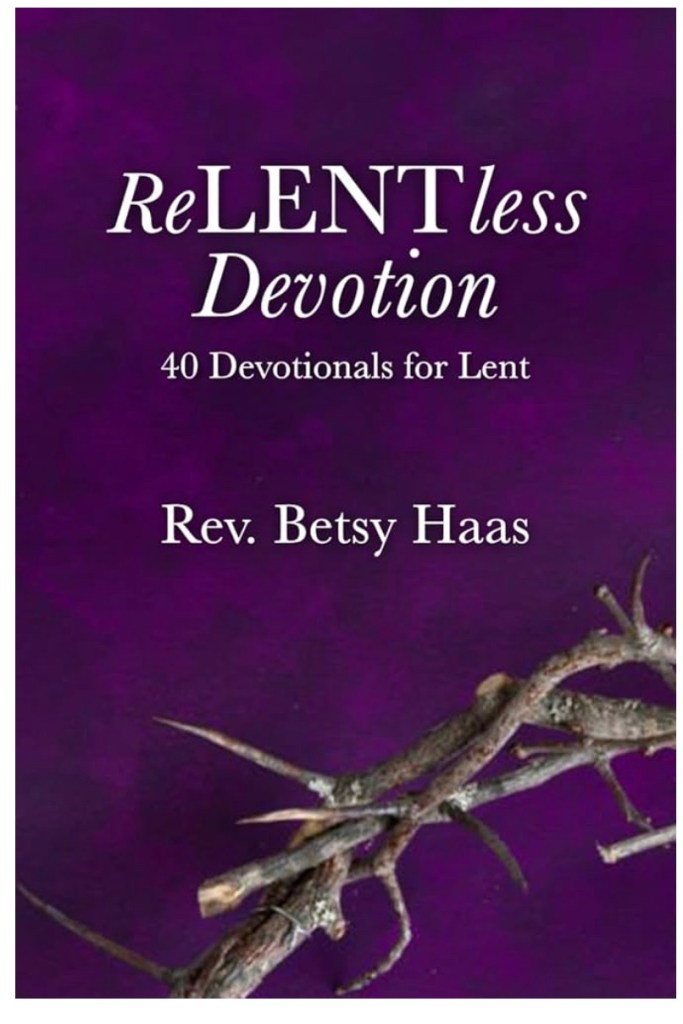
Need a Lent devotional? ReLENTless Devotion is now available at Amazon. You can order one HERE.

Thrive by Becca Ziegler

Twinkling Light

Would you think me very strange if I confessed that we have left one small Christmas tree up in our family room, and every night I look forward to plugging it in? This tree is our only real attempt at decorating, as we now travel to be with family at our daughter’s homes for Christmas. This year we extended our stay for an extra week or so, and when we returned, we realized that we had just not had enough time to enjoy this festive assemblage of colorful twinkling lights and elaborate gold-laced White House ornaments, a gift that we have received every year from my in-laws. At some point we will move it back into storage, but not today.

In John 8:12, Jesus redefines the true nature of True Light:

John 8:12 (Common English Bible)

1Jesus spoke to the people again, saying, “I am the light of the world. Whoever follows me won’t walk in darkness but will have the light of life.”

“Jesus spoke to the people again” alerts us to the fact that this is a continuation of his speech in the Temple in Jerusalem. To set this into context, Jesus made this speech in the Temple during the Festival of Tabernacles. This fall harvest festival was a time of commemorating God’s glory appearing in the wilderness after the exodus to guide the people, and it celebrated God’s residing in the Temple. Leviticus sets the stage for this festival of booths: So that your future generations will know that I made the Israelites live in huts when I brought them out of the land of Egypt; I am the Lord your God” (Leviticus 23:43). The people erected booths and stayed for a week to celebrate God’s provision of harvest every year. Light played an important part in the celebration.

 We recall that in Exodus 13:21, God went before the nation of Israel into the wilderness as a pillar of fire at night. This theophany was celebrated each year in the hope and expectation that God would return to the Temple as a bright, shining, fiery light. We share this eschatological hope with our Jewish forebearers: We, too, have a hope and expectation that Jesus will return in a blaze of glory to reclaim his Temple and us, his people.

 Light is an important image in the Old Testament. God’s first creation was light (Genesis 1:3-4). God appeared to Moses from a burning bush (Exodus 3:1-3). Psalm 119 speaks of God’s word being a “light unto our paths.” Light is equated to wisdom in Ecclesiastes 2:13, and Isaiah 60 proclaims that the nation should arise and shine, for “our light has come”, a prophecy which Christians believe was completed at the Lord’s birth (Isaiah 60:1). 

 During the festival, four large lampstands in the Temple Court of the Women were lit at the end of the first day. These lamp stands produced a tremendous amount of light, so much so that it was said that there was not a courtyard in Jerusalem that didn’t reflect it. Festival goers danced around the lamp stands with burning torches, which must have made the Temple seem as though it went from night to day in that moment. It must have been beautiful! It was in the midst of this very Jewish celebration that Jesus stood up and declared himself to be the Light of the World.

It was bold. It was truth! And it was audacious. 

Have you ever felt compelled to speak the truth into a setting or situation where it was not wanted? Have you ever been confronted with a truth you did not want to hear? How did it go?

Jesus’ startling proclamation that he was the Light of the World invites us to our own startling reality: if he is the Light, we need to reflect that light in our lives. How can we live so that others see his light in us? What changes would we have to make in our behavior to stay true to that light?

We are called to be the light that illuminates the path to Jesus. Shine on, my friends!

Lent begins in less than a month! Order your copy of ReLENTless Devotion here.

Pathway to Light by Michelle Robertson

Pick it Up

Today’s devotional is the continuation of our lesson on 2 Kings 2, found here. To recap, Elijah is about to be called up to heaven, and his mentee Elisha is getting ready to continue ministry without his esteemed mentor and friend. Just before Elijah leaves, he asks young Elisha what he can do for him before he is taken. Elisha doesn’t ask for wealth, or fame, or prosperity, or authority: He simply asks for a “double portion” of the spirit of God that has empowered the great prophet to do ministry under very adverse circumstances.

2 Kings 2 (New International Version)

When they had crossed, Elijah said to Elisha, “Tell me, what can I do for you before I am taken from you?”

“Let me inherit a double portion of your spirit,” Elisha replied.

1“You have asked a difficult thing,” Elijah said, “yet if you see me when I am taken from you, it will be yours—otherwise, it will not.”

Up to this point, Elijah has been unsuccessfully trying to shake off Elisha. Twice he has asked him to remain behind so he can go along to do God’s bidding. Three times Elisha refused and pledged to never leave Elijah’s side. He knows what is coming. Everyone knows what is coming. But his perseverance and faithfulness pass the test and he was at Elijah’s side when Elijah was taken up to heaven in a whirlwind:

11 As they were walking along and talking together, suddenly a chariot of fire and horses of fire appeared and separated the two of them, and Elijah went up to heaven in a whirlwind. 12 Elisha saw this and cried out, “My father! My father! The chariots and horsemen of Israel!” And Elisha saw him no more. Then he took hold of his garment and tore it in two.

Verse 11 records that they were walking along and talking together. Oh, to be a fly on that wall and listen in! What could they have discussed, I wonder? The apostasy of Israel? How to dodge and eliminate corrupt kings? How to perform miracles? How to call down fire?

Whatever the content, we can safely assume that this conversation was a “passing down of the mantle” moment for them, as Elijah imparted wisdom and instruction to his young protégée. But don’t miss what happens immediately after Elijah was taken:

13 Elisha then picked up Elijah’s cloak that had fallen from him and went back and stood on the bank of the Jordan. 14 He took the cloak that had fallen from Elijah and struck the water with it. “Where now is the Lord, the God of Elijah?” he asked. When he struck the water, it divided to the right and to the left, and he crossed over.

After rending his clothes in two, (a common sign of grief and sorrow in those times) he picked up Elijah’s cloak. Remember that this is the same cloak that Elijah used earlier in the chapter to part the waters. Elisha now uses the same cloak to divide the water so that he can continue his journey, performing his first miracle within minutes of Elijah’s departure.

15 The company of the prophets from Jericho, who were watching, said, “The spirit of Elijah is resting on Elisha.”

That action solidified his new status as Elijah’s successor, and those watching immediately saw that the spirit of God had effectively been passed from the older man to the younger man. But let’s not miss the fact that Elisha had to pick up the cloak. It didn’t fall around his shoulders as Elijah was riding off in a fiery chariot. Elijah didn’t carefully place it on him before leaving. No, it fell to the ground, and it was up to Elisha to pick it up. Only then did the spirit of Elijah rest upon him.

I think we all want God’s power to bring needed change into our lives. We all want to get over our addictions, move past our grievances, feel happier, succeed in life, raise amazing kids, have fulfilling marriages … and these things are possible, but only if we choose to pick up the cloak and submit to God’s way of resolving these things. And remember that in order to pick something up, we have to empty our hands of stuff we are holding on to, like old resentments, bad habits, unconfessed sin, things that happened in the past, and especially the need to be in control.

A double portion of God’s power and strength is available to anyone. Will you open your hands to receive it?

Morning’s Glow by Michelle Robertson

The Double Portion

A long time ago I served a large church that had a sizable youth group. One of the many programs the church offered to support these kids was called ”The Elijah Project.” This program paired youth with willing adult volunteers who signed up to serve as “spiritual mentors.” It was a great way for our older folks to connect with the teenagers and offer their love, wisdom, prayer, and friendship. One volunteer took it to the extreme and started inline roller skating with his youth partner. That was a great idea until he fell and broke his ankle, but the bond that was established lasted well into the teenager’s adulthood.

It was called the Elijah Project in honor of the wonderful example of mentoring that we discover in the 2 Kings. Elijah was a spiritual mentor to Elisha, and the bond between them was strong. They were inseparable, as we will see in today’s passage.

2 Kings 2:1-9 (New International Version)

2 When the Lord was about to take Elijah up to heaven in a whirlwind, Elijah and Elisha were on their way from Gilgal.Elijah said to Elisha, “Stay here; the Lord has sent me to Bethel.”

But Elisha said, “As surely as the Lord lives and as you live, I will not leave you.” So they went down to Bethel.

The company of the prophets at Bethel came out to Elisha and asked, “Do you know that the Lord is going to take your master from you today?”

“Yes, I know,” Elisha replied, “so be quiet.”

Elijah is known as one of Israel’s greatest prophets. He called down fire to defeat the prophets of Baal, escaped from the evil Queen Jezebel, prophesied a three-year drought, spoke against the apostasy of Israel and its corrupt kings, and was fed by ravens in the desert. He took on the task of mentoring Elisha, who in his own right became one of Israel’s greatest prophets and miracle workers. Elisha was completely devoted to Elijah and never left his side.

Then Elijah said to him, “Stay here, Elisha; the Lord has sent me to Jericho.”

And he replied, “As surely as the Lord lives and as you live, I will not leave you.” So they went to Jericho.

The company of the prophets at Jericho went up to Elisha and asked him, “Do you know that the Lord is going to take your master from you today?”

“Yes, I know,” he replied, “so be quiet.”

Elisha’s humanity in this moment is evident. The prophets are telling him a truth he doesn’t want to face, so basically he tells them to shut up. How often do we stick our fingers in our ears against an impending truth that we’re not ready to face? Col. Jessup was right. We can’t handle the truth.

Then Elijah said to him, “Stay here; the Lord has sent me to the Jordan.”

And he replied, “As surely as the Lord lives and as you live, I will not leave you.”So the two of them walked on.

Fifty men from the company of the prophets went and stood at a distance, facing the place where Elijah and Elisha had stopped at the Jordan. Elijah took his cloak, rolled it up and struck the water with it. The water divided to the right and to the left, and the two of them crossed over on dry ground.

If your memory of Moses is kicking in about now, you are correct in thinking that there are many similarities between him and Elijah. Both met God at Mt. Sinai. Both were empowered by God to separate the waters. Both were chased out of their countries by pagan kings, wandered in the wilderness for forty days, and fasted for forty days. Both were cherished and powerful prophets of God.

When they had crossed, Elijah said to Elisha, “Tell me, what can I do for you before I am taken from you?”

“Let me inherit a double portion of your spirit,” Elisha replied.

This request is bold, audacious, or brilliant … or maybe all three. We can understand it better if we consider a few things. First, he may have been referring to receiving the portion of inheritance that would naturally come to the first born son, as outlined in Deuteronomy 21:17. In effect, then, he is asking to be considered as Elijah’s successor in ministry, just as a first born son has the right to expect. Second, we know from 1 Kings 19:19 that Elisha had already been designated as Elijah’s successor. So this request for a double portion of God’s spirit as it had been manifested in Elijah is a way of asking for the strength and the spiritual power fulfill that calling.

Let’s stop there and ask ourselves if we have asked God for the spiritual power to fulfill his will for our lives. This is an important question that leads us to another important question: Have you accepted God’s will for your life? Are you willing to “go where sent”? Is God calling you to change your attitude, behavior, habits, etc.?

Elisha gives us a beautiful example of submission. In that single request for a double portion, he demonstrated his humble willingness to do the task for which he has been called and indicated that he wants to do it all in God’s power. Indeed, Elijah indicated that he has asked a difficult thing. It’s not difficult by any means for God to give a double portion, but it is difficult to ask for it, because asking means you are willing to take on the responsibility that comes along with it.

We will stop there for today and pick up the rest of this amazing story next time. But for now, I leave you with this: God is calling. Are you willing?

Give us your double portion, Lord!

Double Portion of Wonder by Michelle Robertson

Find Rest

Like the rest of the world, my family has dealt with the “crud” since before Christmas. It was a full blown assault on the sinuses, throat, and chest for a week, and when that passed, all that was left was the cough. The cough decided to extend its visit and take up residency in our lungs. For weeks, my husband and I have shared a nightcap of NyQuil at bedtime and laid our heads on our pillows and hoped it would work. Many nights, rest only came in between fits of coughing. I have, however, perfected the art of sleeping upright with my head elevated on two pillows and a cough drop lodged between my cheek and my gums. Oy!

David’s psalm really resonated with me this morning as the cough is finally waning and rest has returned. He speaks of finding rest in God only, and I can relate. Rest in this context is a complete cessation of the mental and emotional turmoil that agitates us to the point that it prevents any real rejuvenation of the mind and soul.

Have you ever had a night/week/month like that?

Psalm 62 (Common English Bible)

Oh, I must find rest in God only,
    because my hope comes from him!
Only God is my rock and my salvation—
    my stronghold!—I will not be shaken.
My deliverance and glory depend on God.
    God is my strong rock.
    My refuge is in God.
All you people: Trust in him at all times!
    Pour out your hearts before him!
    God is our refuge!
 Selah

Right off the bat we see a connection between rest and hope. I think that is important. In those middle of the night awakenings, when we mull over problems, offenses, despair, grief, and grievances, hope has remained asleep and does not assert itself to say, “Enough! We will sort this out tomorrow.”

Hope reminds us that God is our rock and salvation. Hope tells us we will not be shaken. Hope proclaims that God is our refuge, and we can trust that!

Human beings are nothing but a breath.
    Human beings are nothing but lies.
    They don’t even register on a scale;
    taken all together they are lighter than a breath!
10 Don’t trust in violence;
    don’t set false hopes in robbery.
When wealth bears fruit,
    don’t set your heart on it.

David reminds us that people do not deserve the trust that God does, and in the end, God is the only one we can count on. David rebukes his enemies and says that when we take matters into our own hands it often does not work out well. The only thing we should set our hearts on is God’s strength.

11 God has spoken one thing—
    make it two things—
    that I myself have heard:
    that strength belongs to God,
12     and faithful love comes from you, my Lord—
    and that you will repay
    everyone according to their deeds.

There is something charming and conversational in verse 11 where David says, “God has spoken one thing … make that two things…” That made me smile, as it sounds like a middle schooler urgently making a case on why they should be allowed to do something. There is a familiar humanity to that way of speaking. Indeed, David is trying to persuade us that God is our strength and faithful love. That deserves a second try!

Is God your rock? Do you have hope? Are you tired and need the kind of rest that can only be found in God? When you lay your head on the pillow tonight, give it all over to him and dwell in his hope. If you can do that, I bet you’ll find peace.

Refuge by Wende Pritchard

Lent Begins Feb. 14th

Are you ready to enter into a season of reflection and rededication? Lent is that beautiful season when we slow our pace a bit and retool our spirits. Following the Lenten Disciplines of study, meditation, self-examination, self-denial, repentance, fasting, prayer, and worship will bring us closer to God.

I invite you to journey to the cross with me this year. ReLENTless Devotion is a 40 day devotional book that will take us all the way to Easter. Come along, and let’s get there together! ReLENTless Devotion is available at Amazon.