A friend of mine broke her wrist after falling in a parking lot after church. I immediately flashed back to times when I broke a bone and I truly commiserated with her. The process of healing is long and complicated. In my case, learning to walk with a boot and crutches was tricky and exhausting. Many people assured me, though, that a broken bone heals stronger. Have you ever heard that? Apparently it is true, but only applies to the time in the healing process when your body forms a callus around the break, indeed making it stronger for a time.
This made me think about things that actually do get stronger after they break.
I believe that people can get stronger after they suffer a break of sorts. Case in point is a dear friend who came out of a prolonged and contentions divorce much, much stronger due to the break in her marriage. She found her voice in the process, is able to stand up for herself in ways she never could before, found the courage to leave her abusive husband, and discovered God’s redemptive and saving power in ways she would never have experienced had she not been broken so badly. So, there is that. Have you ever been broken and then healed stronger?
In our lectionary passage today, Peter addressed the crowd after healing a lame man. Watch what happened and how the crowd reacts:
Acts 3: 7-10 Common English Bible
7 Then he grasped the man’s right hand and raised him up. At once his feet and ankles became strong. 8 Jumping up, he began to walk around. He entered the temple with them, walking, leaping, and praising God. 9 All the people saw him walking and praising God. 10 They recognized him as the same one who used to sit at the temple’s Beautiful Gate asking for money. They were filled with amazement and surprise at what had happened to him.
The once broken and damaged feet and ankles became strong, and the man began his witness walk. He was a living, breathing example of the power of God to change and make new. Are you that person? Has God taken your brokenness and made you new? How are you proclaiming his power with your own witness walk?
12 Seeing this, Peter addressed the people: “You Israelites, why are you amazed at this? Why are you staring at us as if we made him walk by our own power or piety? 13 The God of Abraham, Isaac, and Jacob—the God of our ancestors—has glorified his servant Jesus. This is the one you handed over and denied in Pilate’s presence, even though he had already decided to release him. 14 You rejected the holy and righteous one, and asked that a murderer be released to you instead. 15 You killed the author of life, the very one whom God raised from the dead. We are witnesses of this.
Peter takes this opportunity to preach about Jesus’ crucifixion and resurrection. It is important to note that he did not allow any of the attention to remain on himself, but immediately deflected their wonder to the power of Christ.
16 His name itself has made this man strong. That is, because of faith in Jesus’ name, God has strengthened this man whom you see and know. The faith that comes through Jesus gave him complete health right before your eyes.
We know that we are healed in the strong and powerful name of Jesus. We know that when we have faith in Jesus’ name, strength comes to us by his grace.
17 “Brothers and sisters, I know you acted in ignorance. So did your rulers.18 But this is how God fulfilled what he foretold through all the prophets: that his Christ would suffer. 19 Change your hearts and lives! Turn back to God so that your sins may be wiped away.
Peter’s final words are good for us today. How do you respond to Easter? How do you understand healing? How do you account for the strength that you have obtained from God? Changing our hearts is the only way to respond. May our minds be set on turning back to God today as we continue our witness walk in everything we say and do.
I gave my four-year-old grandson a bath last week and watched as he happily played with his Little People bath toys. I noticed that he was stuffing them all in the rinsing cup until it was full. “Why are all the Little People in the cup?” I asked. “Oh,” he replied. “They’re in cup jail.” “Good heavens!” I said. “What did they do to be put in cup jail?” I asked. He looked me straight in the eye. “They made baaaad choices,” he responded solemnly.
Well, you just can’t argue with that.
My daughters are constantly advising their children to make good choices. When a bad choice seems to be asserting itself, they caution them to “make a better choice.” Even the four-year-old understands the consequences of bad choices.
In Paul’s letter to the church in Galatia, he gave the same parenting advice. Remember how much Paul loved his churches, and truly felt a parental responsibility for each one of them. Listen to what he says in this well-known warning about reaping and sowing.
Galatians 6:7-8(Common English Bible)
7 Make no mistake, God is not mocked. A person will harvest what they plant. 8 Those who plant only for their own benefit will harvest devastation from their selfishness, but those who plant for the benefit of the Spirit will harvest eternal life from the Spirit.
God pays attention to everything we say and do, and when those choices don’t fall in line with his word and his will for our lives, you can be sure there will be ramifications. I have a friend who spent a year denouncing an organization that she belonged to and basically burned every bridge on her way out. She returned to that organization recently and was hurt when someone asked her in surprise why she had come to the meeting. Reaping and sowing are basic to life. When you sow discord and rejection, you risk reaping discord and rejection.
Think for a moment about how you treat others. When you sow anger, discrimination, harsh words, and carelessness, these things will come back to you tenfold. Overindulgence in consuming things that are ultimately harmful to your body will result in actual harm to your body. Lying, cheating, and gossip often backfire and expose you to ridicule and alienation. Are these things worth the temporary pleasure?
A better choice is to sow the seeds of love and acceptance. A better choice is to choose healthy things for your body ,mind, and soul. A better choice is to plant seeds for the benefit of God’s kingdom. That will result in a harvest of eternal life and help you to avoid cup jail.
And trust me, you don’t want to end up in cup jail.
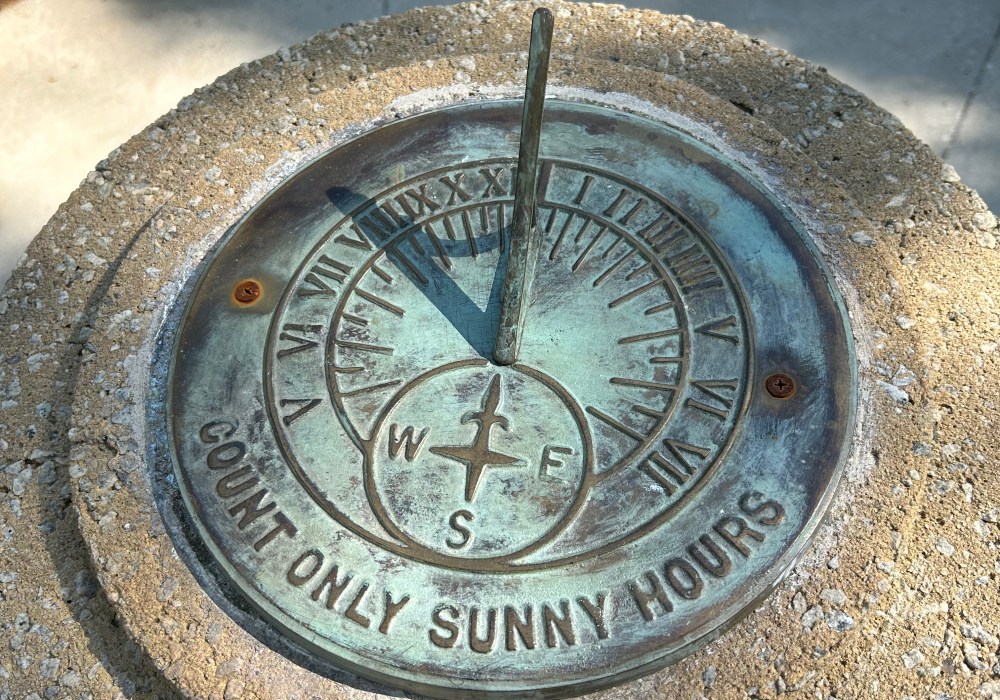
A few weeks ago, my husband and I were walking our dog in Celebration FL and passed by an old sun dial in a park. I stopped to look at it and was surprised to see that it was inscribed with the words, “Count only sunny hours.” Surely this is a good instruction for how to tell time on a sun dial, but isn’t that a perfect instruction for life? We should only count the sunny hours. This is not to discount the dark hours of grief and loss that we experience in life. To pretend that we are never hurt or disappointed would be disingenuous and serve no purpose. But it is in those darkest moments that we need to shine light, if for no other reason than to see our way out.
Isaiah 43 (New Revised Standard Version) Do not remember the former things or consider the things of old. 19 I am about to do a new thing; now it springs forth; do you not perceive it? I will make a way in the wilderness and rivers in the desert. 20 The wild animals will honor me, the jackals and the ostriches, for I give water in the wilderness, rivers in the desert, to give drink to my chosen people, 21 the people whom I formed for myself so that they might declare my praise.
We look to God, the creator and giver of all light, to help lead us out of dark days. When he sent his son to be the Light of the world, he gave us the ultimate and permanent way out. God provides the sunny hours to encourage, uplift, and recenter us after the hard ones.
Psalm 18 (New Revised Standard Version) It is you who light my lamp; the Lord, my God, lights up my darkness. 29 By you I can outrun a troop, and by my God I can leap over a wall. 30 This God—his way is perfect; the promise of the Lord proves true; he is a shield for all who take refuge in him.
We had a death in our extended family that caught us completely off guard. The last ten days have been a topsy-turvy whirlwind of grief, memories, a celebration of life, plans made, changed, re-made … death left a small tsunami in its wake, but we will be okay.
I was drawn to these words from Isaiah in the lectionary this week. They were spoken in a time of great trial for Israel, yet they lead the hearer to look forward and not dwell in the immediate or the past. As you know, the best way to drive a car is to focus looking out the windshield, not the rear view mirror.
Isaiah 25 (New International Version) On this mountain the Lord Almighty will prepare a feast of rich food for all peoples, a banquet of aged wine— the best of meats and the finest of wines. 7 On this mountain he will destroy the shroud that enfolds all peoples, the sheet that covers all nations; 8 he will swallow up death forever. The Sovereign Lord will wipe away the tears from all faces; he will remove his people’s disgrace from all the earth. The Lord has spoken.
Something called the Marriage Supper of the Lamb occurs a few times in the Bible (see Revelation 19:9) which is a great feast that takes place at the end of days. This passage suggests that it will take place on earth, not in heaven. It will be resplendent with fine wines and fat meats, but the best part is that it will be a feast for all peoples.
Just last week we studied the Last Supper in Matthew 26. If you attended a Maundy Thursday service, you probably heard this Scripture read aloud. Do you remember when Jesus said, “I will not drink of this fruit of the vine from now until that day when I drink it new with you in my Father’s kingdom”? I wonder if it is this Marriage Supper of the Lamb, held on a beautiful high mountain with all people, where we will take our first communion with the Risen Lord when he returns to redeem his people. I don’t know about you, but I’m looking forward to that.
9 In that day they will say,
“Surely this is our God; we trusted in him, and he saved us. This is the Lord, we trusted in him; let us rejoice and be glad in his salvation.”
I don’t know what you’re going through right now but take heart. There will come a day when every tear is dried, every groan is silenced, every bad thing gone from your life, and we will sup and commune with our Sacrificial Lamb, who indeed came to save us. You can trust this, because God is trustworthy.
20 1-2 Early in the morning on the first day of the week, while it was still dark, Mary Magdalene came to the tomb and saw that the stone was moved away from the entrance. She ran at once to Simon Peter and the other disciple, the one Jesus loved, gasping for breath. “They took the Master from the tomb. We don’t know where they’ve put him.”
3-10 Peter and the other disciple left immediately for the tomb. They ran, neck and neck. The other disciple got to the tomb first, outrunning Peter. Stooping to look in, he saw the pieces of linen cloth lying there, but he didn’t go in. Simon Peter arrived after him, entered the tomb, observed the linen cloths lying there, and the kerchief used to cover his head not lying with the linen cloths but separate, neatly folded by itself. Then the other disciple, the one who had gotten there first, went into the tomb, took one look at the evidence, and believed. No one yet knew from the Scripture that he had to rise from the dead. The disciples then went back home.
11-13 But Mary stood outside the tomb weeping. As she wept, she knelt to look into the tomb and saw two angels sitting there, dressed in white, one at the head, the other at the foot of where Jesus’ body had been laid. They said to her, “Woman, why do you weep?”
13-14 “They took my Master,” she said, “and I don’t know where they put him.” After she said this, she turned away and saw Jesus standing there. But she didn’t recognize him.
15 Jesus spoke to her, “Woman, why do you weep? Who are you looking for?”
She, thinking that he was the gardener, said, “Sir, if you took him, tell me where you put him so I can care for him.”
16 Jesus said, “Mary.”
Turning to face him, she said in Hebrew, “Rabboni!” meaning “Teacher!”
17 Jesus said, “Don’t cling to me, for I have not yet ascended to the Father. Go to my brothers and tell them, ‘I ascend to my Father and your Father, my God and your God.’”
18 Mary Magdalene went, telling the news to the disciples: “I saw the Master!” And she told them everything he said to her.
18 Jesus, having prayed this prayer, left with his disciples and crossed over the brook Kidron at a place where there was a garden. He and his disciples entered it.
2-4 Judas, his betrayer, knew the place because Jesus and his disciples went there often. So Judas led the way to the garden, and the Roman soldiers and police sent by the high priests and Pharisees followed. They arrived there with lanterns and torches and swords. Jesus, knowing by now everything that was imploding on him, went out and met them. He said, “Who are you after?”
They answered, “Jesus the Nazarene.”
5-6 He said, “That’s me.” The soldiers recoiled, totally taken aback. Judas, his betrayer, stood out like a sore thumb.
7 Jesus asked again, “Who are you after?”
They answered, “Jesus the Nazarene.”
8-9 “I told you,” said Jesus, “that’s me. I’m the one. So if it’s me you’re after, let these others go.” (This validated the words in his prayer, “I didn’t lose one of those you gave.”)
10 Just then Simon Peter, who was carrying a sword, pulled it from its sheath and struck the Chief Priest’s servant, cutting off his right ear. Malchus was the servant’s name.
11 Jesus ordered Peter, “Put back your sword. Do you think for a minute I’m not going to drink this cup the Father gave me?”
12-14 Then the Roman soldiers under their commander, joined by the Jewish police, seized Jesus and tied him up. They took him first to Annas, father-in-law of Caiaphas. Caiaphas was the Chief Priest that year. It was Caiaphas who had advised the Jews that it was to their advantage that one man die for the people.
15-16 Simon Peter and another disciple followed Jesus. That other disciple was known to the Chief Priest, and so he went in with Jesus to the Chief Priest’s courtyard. Peter had to stay outside. Then the other disciple went out, spoke to the doorkeeper, and got Peter in.
17 The young woman who was the doorkeeper said to Peter, “Aren’t you one of this man’s disciples?”
He said, “No, I’m not.”
18 The servants and police had made a fire because of the cold and were huddled there warming themselves. Peter stood with them, trying to get warm.
The Interrogation
19-21 Annas interrogated Jesus regarding his disciples and his teaching. Jesus answered, “I’ve spoken openly in public. I’ve taught regularly in meeting places and the Temple, where the Jews all come together. Everything has been out in the open. I’ve said nothing in secret. So why are you treating me like a traitor? Question those who have been listening to me. They know well what I have said. My teachings have all been aboveboard.”
22 When he said this, one of the policemen standing there slapped Jesus across the face, saying, “How dare you speak to the Chief Priest like that!”
23 Jesus replied, “If I’ve said something wrong, prove it. But if I’ve spoken the plain truth, why this slapping around?”
24 Then Annas sent him, still tied up, to the Chief Priest Caiaphas.
25 Meanwhile, Simon Peter was back at the fire, still trying to get warm. The others there said to him, “Aren’t you one of his disciples?”
He denied it, “Not me.”
26 One of the Chief Priest’s servants, a relative of the man whose ear Peter had cut off, said, “Didn’t I see you in the garden with him?”
27 Again, Peter denied it. Just then a rooster crowed.
The King of the Jews
28-29 They led Jesus then from Caiaphas to the Roman governor’s palace. It was early morning. They themselves didn’t enter the palace because they didn’t want to be disqualified from eating the Passover. So Pilate came out to them and spoke. “What charge do you bring against this man?”
30 They said, “If he hadn’t been doing something evil, do you think we’d be here bothering you?”
31-32 Pilate said, “You take him. Judge him by your law.”
The Jews said, “We’re not allowed to kill anyone.” (This would confirm Jesus’ word indicating the way he would die.)
33 Pilate went back into the palace and called for Jesus. He said, “Are you the ‘King of the Jews’?”
34 Jesus answered, “Are you saying this on your own, or did others tell you this about me?”
35 Pilate said, “Do I look like a Jew? Your people and your high priests turned you over to me. What did you do?”
36 “My kingdom,” said Jesus, “doesn’t consist of what you see around you. If it did, my followers would fight so that I wouldn’t be handed over to the Jews. But I’m not that kind of king, not the world’s kind of king.”
37 Then Pilate said, “So, are you a king or not?”
Jesus answered, “You tell me. Because I am King, I was born and entered the world so that I could witness to the truth. Everyone who cares for truth, who has any feeling for the truth, recognizes my voice.”
38-39 Pilate said, “What is truth?”
Then he went back out to the Jews and told them, “I find nothing wrong in this man. It’s your custom that I pardon one prisoner at Passover. Do you want me to pardon the ‘King of the Jews’?”
40 They shouted back, “Not this one, but Barabbas!” Barabbas was a Jewish freedom fighter.
The Thorn Crown of the King
19 1-3 So Pilate took Jesus and had him whipped. The soldiers, having braided a crown from thorns, set it on his head, threw a purple robe over him, and approached him with, “Hail, King of the Jews!” Then they greeted him with slaps in the face.
4-5 Pilate went back out again and said to them, “I present him to you, but I want you to know that I do not find him guilty of any crime.” Just then Jesus came out wearing the thorn crown and purple robe.
Pilate announced, “Here he is: the Man.”
6 When the high priests and police saw him, they shouted in a frenzy, “Crucify! Crucify!”
Pilate told them, “You take him. You crucify him. I find nothing wrong with him.”
7 The Jews answered, “We have a law, and by that law he must die because he claimed to be the Son of God.”
8-9 When Pilate heard this, he became even more scared. He went back into the palace and said to Jesus, “Where did you come from?”
Jesus gave no answer.
10 Pilate said, “You won’t talk? Don’t you know that I have the authority to pardon you, and the authority to—crucify you?”
11 Jesus said, “You haven’t a shred of authority over me except what has been given you from heaven. That’s why the one who betrayed me to you has committed a far greater fault.”
12 At this, Pilate tried his best to pardon him, but the Jews shouted him down: “If you pardon this man, you’re no friend of Caesar’s. Anyone setting himself up as ‘king’ defies Caesar.”
13-14 When Pilate heard those words, he led Jesus outside. He sat down at the judgment seat in the area designated Stone Court (in Hebrew, Gabbatha). It was the preparation day for Passover. The hour was noon. Pilate said to the Jews, “Here is your king.”
15 They shouted back, “Kill him! Kill him! Crucify him!”
Pilate said, “I am to crucify your king?”
The high priests answered, “We have no king except Caesar.”
16-19 Pilate caved in to their demand. He turned him over to be crucified.
The Crucifixion
They took Jesus away. Carrying his cross, Jesus went out to the place called Skull Hill (the name in Hebrew is Golgotha), where they crucified him, and with him two others, one on each side, Jesus in the middle. Pilate wrote a sign and had it placed on the cross. It read:
jesus the nazarene the king of the jews.
20-21 Many of the Jews read the sign because the place where Jesus was crucified was right next to the city. It was written in Hebrew, Latin, and Greek. The Jewish high priests objected. “Don’t write,” they said to Pilate, “‘The King of the Jews.’ Make it, ‘This man said, “I am the King of the Jews.”’”
23-24 When they crucified him, the Roman soldiers took his clothes and divided them up four ways, to each soldier a fourth. But his robe was seamless, a single piece of weaving, so they said to each other, “Let’s not tear it up. Let’s throw dice to see who gets it.” This confirmed the Scripture that said, “They divided up my clothes among them and threw dice for my coat.” (The soldiers validated the Scriptures!)
24-27 While the soldiers were looking after themselves, Jesus’ mother, his aunt, Mary the wife of Clopas, and Mary Magdalene stood at the foot of the cross. Jesus saw his mother and the disciple he loved standing near her. He said to his mother, “Woman, here is your son.” Then to the disciple, “Here is your mother.” From that moment the disciple accepted her as his own mother.
28 Jesus, seeing that everything had been completed so that the Scripture record might also be complete, then said, “I’m thirsty.”
29-30 A jug of sour wine was standing by. Someone put a sponge soaked with the wine on a javelin and lifted it to his mouth. After he took the wine, Jesus said, “It’s done . . . complete.” Bowing his head, he offered up his spirit.
31-34 Then the Jews, since it was the day of Sabbath preparation, and so the bodies wouldn’t stay on the crosses over the Sabbath (it was a high holy day that year), petitioned Pilate that their legs be broken to speed death, and the bodies taken down. So the soldiers came and broke the legs of the first man crucified with Jesus, and then the other. When they got to Jesus, they saw that he was already dead, so they didn’t break his legs. One of the soldiers stabbed him in the side with his spear. Blood and water gushed out.
35 The eyewitness to these things has presented an accurate report. He saw it himself and is telling the truth so that you, also, will believe.
36-37 These things that happened confirmed the Scripture, “Not a bone in his body was broken,” and the other Scripture that reads, “They will stare at the one they pierced.”
* * *
38 After all this, Joseph of Arimathea (he was a disciple of Jesus, but secretly, because he was intimidated by the Jews) petitioned Pilate to take the body of Jesus. Pilate gave permission. So Joseph came and took the body.
39-42 Nicodemus, who had first come to Jesus at night, came now in broad daylight carrying a mixture of myrrh and aloes, about seventy-five pounds. They took Jesus’ body and, following the Jewish burial custom, wrapped it in linen with the spices. There was a garden near the place he was crucified, and in the garden a new tomb in which no one had yet been placed. So, because it was Sabbath preparation for the Jews and the tomb was convenient, they placed Jesus in it.
I recently had a fun conversation with a friend from my old church about Christmas Eve services. We were a large church that became huge on Christmas Eve, and at one point we had to offer four services to accommodate all of the worshippers. Calculating the amount of people that I personally would serve at one of three communion stations, my friend estimated that I would need to say, “the body and blood of Christ given to you” several hundred times that night. At our pre-Christmas Eve dinner with church members at our favorite Mexican restaurant, somebody suggested that for the ones gathered there, I could save myself and simply say, “Here!” That got a good laugh. Unfortunately, my oldest daughter was seated at the end of the table and missed the conversation. So imagine her surprise (and displeasure!) when she came forward in Mom’s line and was met with, “Here!”
Think for a moment about the power of taking communion. I bet you have received it in many places and in many forms, from the casual retreat setting to the most formal of presentations in a church. I once took communion at Notre Dame cathedral in Paris, which may count as the most elaborate setting for communion. But probably the most profound communions I have received have been the day I was confirmed in my childhood church in Gibbsboro, N.J., the first time I served it as a newly ordained pastor at my church in Peachtree City, GA, and the communion settings of the Walk to Emmaus retreats. Communion is one of two sacraments in the United Methodist Church, and truly is the place were God meets us right where we are. I hope you feel the power and the presence of the Holy Spirit every time you receive the body and blood of Christ, given for you.
Our passage today marks the moment when the Last Supper became the Lord’s Supper for now until eternity. Read it and feast:
Mark 14 (New International Version)
12 On the first day of the Festival of Unleavened Bread, when it was customary to sacrifice the Passover lamb, Jesus’ disciples asked him, “Where do you want us to go and make preparations for you to eat the Passover?”
13 So he sent two of his disciples, telling them, “Go into the city, and a man carrying a jar of water will meet you. Follow him. 14 Say to the owner of the house he enters, ‘The Teacher asks: Where is my guest room, where I may eat the Passover with my disciples?’ 15 He will show you a large room upstairs, furnished and ready. Make preparations for us there.”
16 The disciples left, went into the city and found things just as Jesus had told them. So they prepared the Passover.
17 When evening came, Jesus arrived with the Twelve. 18 While they were reclining at the table eating, he said, “Truly I tell you, one of you will betray me—one who is eating with me.”
19 They were saddened, and one by one they said to him, “Surely you don’t mean me?”
20 “It is one of the Twelve,” he replied, “one who dips bread into the bowl with me. 21 The Son of Man will go just as it is written about him. But woe to that man who betrays the Son of Man! It would be better for him if he had not been born.”
22 While they were eating, Jesus took bread, and when he had given thanks, he broke it and gave it to his disciples, saying, “Take it; this is my body.”
23 Then he took a cup, and when he had given thanks, he gave it to them, and they all drank from it.
24 “This is my blood of the covenant, which is poured out for many,” he said to them. 25 “Truly I tell you, I will not drink again from the fruit of the vine until that day when I drink it new in the kingdom of God.”
26 When they had sung a hymn, they went out to the Mount of Olives.
Amidst the disciples’ confusion, Judas’ betrayal, the ritual remembrance of the Passover, (when God delivered his children from death at the last plague in Egypt) and the gathering of friends for one last meal, Jesus abruptly breaks the bread and raises the cup, instituting the new covenant and the Eucharist. When we gather in our churches tomorrow night for Maundy Thursday services, we will remember this exact moment. “Maundy” comes from the Latin word for “mandate, command” and refers to the new commandment that followed this evening’s actions, as recorded in John 13:34-35 “34 “A new command I give you: Love one another. As I have loved you, so you must love one another. 35 By this everyone will know that you are my disciples, if you love one another.”
How well do we follow that new commandment? Do we live up to our communion invitation to participate in Christ by loving as he loved?
I hope you are able to attend a Maundy Thursday service. When you receive that broken body and shed blood, remember the new covenant. Then go out and be the new covenant for the world.
Come to the Table by Kitty Hawk United Methodist Church
I hope that you have been practicing Lenten disciplines for the last several weeks. I want to expand on an old idea by combining two disciplines into one. We are encouraged to meditate, and we are encouraged to study Scripture. What would happen if we practiced Scripture Meditation?
This discipline involves the common practices of meditation, where we create an emotional and spiritual space in our hearts to hear and feel the Lord, while being guided specifically by Scripture to direct our thoughts to the place where that Scripture leads. Thus we would concentrate and think deeply on an assigned passage as we discover who God is and whose we are. Our objective is to arrive at a place of new understandings that lead to changed behavior as a result of our efforts.

In its simplest understanding, meditation is a process of shutting out the world in order to usher in God’s voice and obey it. Our desert foreparents had the ability to meditate day and night on God’s creation and provision. As early as Genesis, we discover that “Isaac went out to meditate in the field in the evening” (Genesis 24:63). As you are fighting traffic in your daily commute to work, or struggling with the cacophony of child rearing, this might sound ideal! Not to mention impossible! But with focus and discipline, we too can create that field for ourselves.

 In his marvelous work, Celebration of Discipline, Richard Foster presents a four-fold approach to the discipline of study that I think works beautifully in this context. If we follow these steps as stepping stones in our Scripture Meditation, our fields will reveal themselves.

Shall we try it? Let's read this Holy Week passage and then we'll unpack the four steps of Scripture Meditation:

John 12 (New International Version)

20 "Now there were some Greeks among those who went up to worship at the festival. 21 They came to Philip, who was from Bethsaida in Galilee, with a request. “Sir,” they said, “we would like to see Jesus.” 22 Philip went to tell Andrew; Andrew and Philip in turn told Jesus.

23 Jesus replied, “The hour has come for the Son of Man to be glorified. 24 Very truly I tell you, unless a kernel of wheat falls to the ground and dies, it remains only a single seed. But if it dies, it produces many seeds. 25 Anyone who loves their life will lose it, while anyone who hates their life in this world will keep it for eternal life. 26 Whoever serves me must follow me; and where I am, my servant also will be. My Father will honor the one who serves me.

27 “Now my soul is troubled, and what shall I say? ‘Father, save me from this hour’? No, it was for this very reason I came to this hour. 28 Father, glorify your name!”

Then a voice came from heaven, “I have glorified it, and will glorify it again.” 29 The crowd that was there and heard it said it had thundered; others said an angel had spoken to him.

30 Jesus said, “This voice was for your benefit, not mine. 31 Now is the time for judgment on this world; now the prince of this world will be driven out. 32 And I, when I am lifted up from the earth, will draw all people to myself.” 33 He said this to show the kind of death he was going to die.

34 The crowd spoke up, “We have heard from the Law that the Messiah will remain forever, so how can you say, ‘The Son of Man must be lifted up’? Who is this ‘Son of Man’?”

35 Then Jesus told them, “You are going to have the light just a little while longer. Walk while you have the light, before darkness overtakes you. Whoever walks in the dark does not know where they are going. 36 Believe in the light while you have the light, so that you may become children of light.” When he had finished speaking, Jesus left and hid himself from them."

The first step is repetition. As you contemplate each Scripture, read it several times in several different translations. Commit it to memory if you can.

The second step is concentration. Really focus in on the setting, the dialogue, the characters in the passage and ask yourself, what is happening? Concentrate on what God is saying to you.

Comprehension is the third step. Do you understand the context? What is the point?

Lastly, we reflect on the Scripture. This is the critical take-away process of internalizing the message through our meditation. What did God say to you? More importantly, what are you going to do about it?

 By using Scripture meditation this way, may we concentrate on God’s message to us and deepen our relationship with Jesus.
Not the trees themselves: Truly, palm trees swaying in the warm breezes on a sunny beach are some of the prettiest things you will ever see. But I don’t like seeing palm trees in the Outer Banks in North Carolina. Florida, yes, Puerto Rico, okay, but Colington Harbour? Nope. God did not design the palm tree to live in the harsh weather conditions of our barrier islands, and so people who plant them in hopes of making our chilly island more “tropical” end up having to create burlap blankets for them to wear all winter long and some don’t survive because they really don’t belong here.
You had no idea that I am so narrow minded, did you??
Palm Sunday is this Sunday, and it is one of my favorite days. While palm trees don’t belong in the Outer Banks, palm branches surely belong in the hands of young children as they parade up and down the aisles of our churches. The sweet smiles, awkward waving, and innocent cries of “ho-thanna” make the celebration complete. Our hearts join in on the declaration that Jesus is our king and deserving of a king’s entrance. We almost have to turn a blind eye to the fact that in less than a week, it will all turn dark. But on Palm Sunday, we rejoice.
Mark 11:1-11 (New International Version)
1 As they approached Jerusalem and came to Bethphage and Bethany at the Mount of Olives, Jesus sent two of his disciples, 2 saying to them, “Go to the village ahead of you, and just as you enter it, you will find a colt tied there, which no one has ever ridden. Untie it and bring it here. 3 If anyone asks you, ‘Why are you doing this?’ say, ‘The Lord needs it and will send it back here shortly.’”
An unbroken colt fulfilled the prophecy of Zechariah 9:9:
Rejoice greatly, Daughter Zion! Shout, Daughter Jerusalem! See, your king comes to you, righteous and victorious, lowly and riding on a donkey, on a colt, the foal of a donkey.
By choosing an unbroken animal, the Creator God in Jesus established his dominance over all the beasts of the field in one striking visual. Rather than come on a prancing stallion, as an army general might, Jesus sets the scene for the humility and servanthood that his leadership will bring.
4 They went and found a colt outside in the street, tied at a doorway. As they untied it, 5 some people standing there asked, “What are you doing, untying that colt?” 6 They answered as Jesus had told them to, and the people let them go. 7 When they brought the colt to Jesus and threw their cloaks over it, he sat on it. 8 Many people spread their cloaks on the road, while others spread branches they had cut in the fields. 9 Those who went ahead and those who followed shouted,
“Hosanna!”
“Blessed is he who comes in the name of the Lord!”
10 “Blessed is the coming kingdom of our father David!”
“Hosanna in the highest heaven!”
11 Jesus entered Jerusalem and went into the temple courts. He looked around at everything, but since it was already late, he went out to Bethany with the Twelve.
The darkness that is quickly coming is prefigured in this last sentence. Jesus couldn’t stay around to enjoy his parade because “it was already late.” His appointed time was coming, shortening his moment of looking around at everything.
How will we respond to this? I suggest you take a look at your hands. Lay them open in your lap, palms up. In this position, may we ask God to give us every good gift he has planned for us as we seek the coming kingdom of our father David. And remember that in order to open your palms, you have to let go of everything else you are holding on to.
What do you need to let go in order to receive God’s blessing?
We are rounding the corner toward Holy Week, when the events of Jesus’ last days will begin to cascade. I read recently that one third of what we read and know of Jesus’ ministry happens in this one week. It makes your head spin. But for today, as you read the plotting, the scheming, the indignant rebukes of men sitting in judgment, and the final betrayal plan, pay attention to the unnamed woman who speaks not a word, but provides the only moment of pure adoration:
Mark 14:1-11 (New International Version)
14 Now the Passover and the Festival of Unleavened Bread were only two days away, and the chief priests and the teachers of the law were scheming to arrest Jesus secretly and kill him. 2 “But not during the festival,” they said, “or the people may riot.”
3 While he was in Bethany, reclining at the table in the home of Simon the Leper, a woman came with an alabaster jar of very expensive perfume, made of pure nard. She broke the jar and poured the perfume on his head.
John identifies this woman as Mary, the sister of Martha and Lazarus. She is not to be confused with the sinful woman who anointed Jesus’ feet with perfume and then wiped her tears from his feet with her hair. (See Luke 7: 37 for that story.) In this Scripture, she is observed by others who are dining at Simon the Leper’s home, and they are highly critical of her actions.
4 Some of those present were saying indignantly to one another, “Why this waste of perfume? 5 It could have been sold for more than a year’s wages and the money given to the poor.” And they rebuked her harshly.
Now remember which Mary this is. This is Lazarus’ sister, who observed Jesus’ resurrecting her brother from the dead. This Mary rebuked Jesus for being late when she sent for him to come and heal her ailing brother, arriving after he had died. This Mary put her understanding of Jesus’ power in a very small box, thinking that once her brother was gone, it was over. This Mary then watched as Jesus called Lazarus to come out of the grave, proving that Jesus was the resurrection and the LIFE. So Mary knew what to do. She anointed Jesus’ body for the burial that was impending, in the full hope and expectation of the resurrection that he had promised.
6 “Leave her alone,” said Jesus. “Why are you bothering her? She has done a beautiful thing to me. 7 The poor you will always have with you, and you can help them any time you want. But you will not always have me. 8 She did what she could. She poured perfume on my body beforehand to prepare for my burial. 9 Truly I tell you, wherever the gospel is preached throughout the world, what she has done will also be told, in memory of her.”
10 Then Judas Iscariot, one of the Twelve, went to the chief priests to betray Jesus to them. 11 They were delighted to hear this and promised to give him money. So he watched for an opportunity to hand him over.
Mary’s example encourages us to take action. To not waste time planning, talking, arguing, and debating (I’m looking at you, church committees!) but simply to do.














 At Water’s Edge