Power Washed

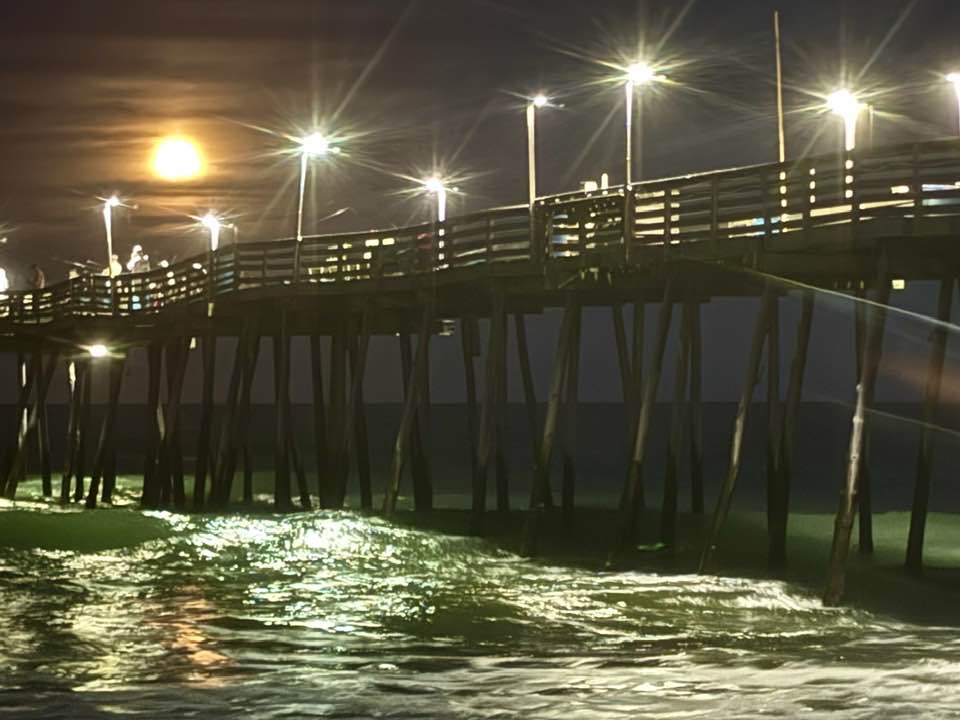
One of the things that is different when you live in a coastal area in a southern state is the amount of moisture in the air that you have to contend with. I mean, it beats snow any day, but the long summer months of sunshine and humidity take a toll on your house. We get our house power washed at least once a year in the Outer Banks to remove and prevent that green mossy mold stuff from taking over on the light gray siding. The house looks great afterward, but what I really enjoy is the clean windows. Our bedroom is on the third floor, making routine window washing impossible. So power wash day is a day of crisp clarity and improved vision. Every window in our house has a water view, so clean windows are important.

Today’s passage is about Jesus’ baptism. It may seem curious to you that the Son of God required a baptism, but in accordance with the fulfillment of the New Covenant, he asked his cousin John to do the honors. It was the confirmation of his human righteousness, setting the example for us about the necessity of baptism. It was a moment of heaven reaching down to earth, setting the example for us about God’s desire to be actively present in our lives. It was a moment of pure joy, setting the example for us about what happens when we submit to the Holy Spirit and yield to God’s plan.

Matthew 3 (Common English Bible)

13 At that time Jesus came from Galilee to the Jordan River so that John would baptize him. 14 John tried to stop him and said, “I need to be baptized by you, yet you come to me?”

15 Jesus answered, “Allow me to be baptized now. This is necessary to fulfill all righteousness.”

So John agreed to baptize Jesus. 16 When Jesus was baptized, he immediately came up out of the water. Heaven was opened to him, and he saw the Spirit of God coming down like a dove and resting on him. 17 A voice from heaven said, “This is my Son whom I dearly love; I find happiness in him.”

God’s love and God’s happiness come pouring out from heaven every time someone is baptized. Unlike Jesus’ baptism, it is a time to be power washed of all sin and declared to be a child of God. God has brought forth miracles in and through water. We remember these acts in our United Methodist baptismal liturgy:

Eternal Father:
When nothing existed but chaos,
you swept across the dark waters
and brought forth light.
In the days of Noah
you saved those on the ark through water.
After the flood you set in the clouds a rainbow.
When you saw your people as slaves in Egypt,
you led them to freedom through the sea.
Their children you brought through the Jordan
to the land which you promised.

(The Services of the Baptismal Covenant are found on pages 32-54 of The United Methodist Hymnal.)

United Methodists do not do baptism more than once, believing that God is the agent and God’s activity in that sacrament is good for life, even if we stumble and fall away from our commitment. But we do celebrate a reaffirmation of baptismal vows where we confess our sins and rededicate our baptisms as a way of making a new start and a fresh beginning.

Do you need a good power washing today? Spend some time in prayer, reflection, repentance, and rededication. And may the Holy Spirit wash you clean and bring you crystal clarity about your life. It’s never too late to start again.

Renewed by Michelle Robertson

Just Us

Today’s lectionary passage is known as the Servant’s song. Isaiah paints a beautiful portrait of the soon-to-come messiah and gives us insight about what the messiah will do and how the messiah will act. I imagine it came as a surprise to hear Israel’s savior described as a servant. The people were expecting a conquering warrior, one who would defeat their enemies and restore their nation. Indeed, when Jesus did come, his gentleness and meek nature confused the Jews and they chose to wait for a better messiah to come along, In fairness, if we were asked to describe Jesus’ messiahship in one word, few would choose ‘servant.’ Redeemer, Savior, Master, Healer, Teacher, Son of God, Lord, yes, but servant?

And yet, that is exactly what Jesus did. He came to serve.

Isaiah 42 (Common English Bible)

 But here is my servant, the one I uphold;
    my chosen, who brings me delight.
I’ve put my spirit upon him;
    he will bring justice to the nations.
He won’t cry out or shout aloud
    or make his voice heard in public.
He won’t break a bruised reed;
    he won’t extinguish a faint wick,
    but he will surely bring justice.
He won’t be extinguished or broken
    until he has established justice in the land.
The coastlands await his teaching.

Isaiah made it clear that justice was the focus of Jesus’ ministry. God made it clear that justice is part of his very character and nature. Justice requires right relationships with others where everyone is treated with dignity and fairness. Impartial judgment, accountability for the unjust, restoring wrongs, and upholding God’s moral law of loving God and loving neighbors are the foundation of justice. Listen to the words in Deuteronomy:

Deuteronomy 32 (New Revised Standard Version UE)

For I will proclaim the name of the Lord,
    ascribe greatness to our God!

The Rock, his work is perfect,
    and all his ways are just.
A faithful God, without deceit,
    just and upright is he
.

God is faithful and without deceit. His servant Jesus came to bring justice to the nations in his name. And Jesus calls us to serve one another in his name. In fact, being a servant to others is how Jesus defines greatness.

Matthew 20 (The Message)

24-28 When the ten others heard about this, they lost their tempers, thoroughly disgusted with the two brothers. So Jesus got them together to settle things down. He said, “You’ve observed how godless rulers throw their weight around, how quickly a little power goes to their heads. It’s not going to be that way with you. Whoever wants to be great must become a servant. Whoever wants to be first among you must be your slave. That is what the Son of Man has done: He came to serve, not be served—and then to give away his life in exchange for the many who are held hostage.”

Godless rulers throw their weight around, allowing power to go to their heads. They are the servants of “just us.” Look around you and you will find them everywhere. But we are called to a higher response: We are called to be the servants of justice.

How will you live that out today? What can you do to bring fairness, equity, and impartiality to someone who needs justice?

This is a call to action. May we be people of Micah 6:8 who “act justly, love mercy, and walk humbly with the Lord.”

Walk Humbly by Kathy Schumacher

Your Light Has Come

Epiphany is celebrated on January 6 every year. It is a day that recalls the arrival of the Wise Men in Bethlehem. They followed the glorious Epiphany star that had arisen over the town on the night of Jesus’ birth and remained there as a guide in the darkness. It became symbolic of the light that beckoned people to step out of their own darkness into the glory of Christ.

When we say we have “had an epiphany,” we are letting others know that a lightbulb has gone off in our brain and we’ve had an enlightenment.

Today’s lectionary passage takes us back to Isaiah’s words, which foreshadow the Messiah’s arrival as a light that would come upon the darkness of the earth:

Isaiah 60 (Common English Bible)

Arise! Shine! Your light has come;
    the Lord’s glory has shone upon you.
Though darkness covers the earth
    and gloom the nations,
    the Lord will shine upon you;
    God’s glory will appear over you.
Nations will come to your light
    and kings to your dawning radiance.

Verse 3 places us squarely at the scene in Bethlehem, where we kneel in wonder with the kings. Isaiah describes the glory of Christ as a “dawning radiance”. Let’s pause there for just a moment. It is the daily dawning radiance that dispels the darkness of night. Imagine our world without the sun! We would not survive. We need its warmth, its brilliance, and its constant presence in our days to light up our pathways. That is exactly what Christ does. He is the constant presence in the darkness of today’s reality that lights our pathway … straight back to him.

Lift up your eyes and look all around:
    they are all gathered; they have come to you.
Your sons will come from far away,
    and your daughters on caregivers’ hips.
Then you will see and be radiant;
    your heart will tremble and open wide,
    because the sea’s abundance will be turned over to you;
    the nations’ wealth will come to you.

Isaiah reminds us that we can be radiant, too. God’s glory shines through us when we lift up one another in “care, prayer, and share.”

We are invited to care for the things God cares about … the marginalized, the hungry, the animals, the poor, the addicted, the imprisoned, the planet … these are the things God cares about.

We are invited to pray for the hurts and concerns of those around us and pray for forgiveness of our sins. We can lift up our nation and pray for our future. We can pray for our leaders, our children, and those in faraway places.

And God is counting on us to share our abundance with people who don’t have anything. Food banks, homeless shelters, nursing homes filled with lonely people … these are places where we can share ourselves and be a light in someone’s darkness.

Countless camels will cover your land,
    young camels from Midian and Ephah.
They will all come from Sheba,
    carrying gold and incense,
    proclaiming the Lord’s praises.

How will you respond to this call to be a dawning radiance today? Arise and shine! Your light has come.

Light Path by Michelle Robertson

No Longer My Own

I am no longer my own, but yours.

Put me to what you will, place me with whom you will. Put me to doing, put me to suffering. Let me be put to work for you or set aside for you, praised for you or criticized for you.

Let me be full, let me be empty. Let me have all things, let me have nothing.

I freely and fully surrender all things to your glory and service.

And now, O wonderful and holy God, Creator, Redeemer, and Sustainer, you are mine, and I am yours. So be it. And the covenant which I have made on earth, let it also be made in heaven. Amen.

This wonderful prayer is known as the Wesley Covenant Prayer and is recited in many United Methodist churches on the first Sunday of the new year. Wesley wrote it as a reflection of his parents’ affection for puritan values, and it was adopted from that tradition. In many ways, this prayer reaffirms our baptismal vows to reject the evil forces and spiritual wickedness of the world and put our whole trust in God’s grace. Ponder that for a moment. What does it mean to put your whole trust in God? The covenant prayer is a statement of being wholly and completely sold out to our Lord with no holding back. We find its biblical roots in Luke 9:23:

Luke 9 (Common English Bible)

23 Jesus said to everyone, “All who want to come after me must say no to themselves, take up their cross daily, and follow me.

The Covenant Prayer is a prayer of affirmation.

It is a prayer of hope

It is a prayer of faith.

It is a prayer of surrender.

Read it again slowly and then let us agree to make this our prayer for 2026. We are no longer our own, but his. Let that be ratified in heaven.

Reflect and Rejoice

Watch Night

What are your plans for tonight? Will you glam up and attend a party or get into comfy pajamas and watch the ball drop from Times Square? I am an advocate for the latter. When my mother was in an Assisted Living facility we would spend New Year’s Eve with her. That place did it right. At 4:00 in the afternoon they reset all the public clocks to 11:00 p.m. and we gathered in the common room for the countdown to “midnight.” We shared a festive toast as the clock struck 12:00 and then everyone rolled back to their rooms for the rest of the night. Perfection! But my preference on New Year’s Eve is to attend a Watch Night service if I can find one.

The tradition of Watch Night can be traced to the early 18th century in Moravian churches, when churchgoers began marking the occasion with a worship service of prayer, proclamation, and singing to reflect upon the year past and to contemplate the one to come. Our own John Wesley adopted the practice for his  Methodist followers. Wesley believed that Methodists and all Christians should reaffirm their covenant with God annually, so he created a service in which an individual renews his/her covenant with God.

In 1755 Wesley held his first covenant service using words written earlier by Richard Alleine. Wesley published this service in a pamphlet in 1780, and this form was used without alteration for nearly a century in England. It has been modified somewhat in more recent years.

The covenant hymn, “Come, Let Us Use the Grace Divine,” was written for this service by Charles Wesley. The service is included in The Book of Worship under the title “An Order of Worship for Such as Would Enter Into or Renew Their Covenant with God–For Use in a Watch Night Service, on the First Sunday of the Year, or Other Occasion.” (from umc.org)

Watch Night was given new significance among African Americans on December 31, 1862, when, according to tradition, slaves in the Confederate states gathered in churches and private homes on the night before U.S. Pres. Abraham Lincoln’s Emancipation Proclamation was expected to go into effect, pending his signing of the document. The soon-to-be-free slaves stayed awake all night and watched the night turn into a new dawn while waiting for news that the Emancipation Proclamation had been issued, thus making all the slaves legally free.

I hope you consider a Watch Night service if one is available to you or find one online. Marking this night with prayers, a good sermon, meditation, hymns, and quiet reflection is far preferable to any party or gathering you might be considering. And the hang-over is much better in the morning.

Psalm 63 (New International Version)

You, God, are my God,
    earnestly I seek you;
I thirst for you,
    my whole being longs for you,
in a dry and parched land
    where there is no water.

I have seen you in the sanctuary
    and beheld your power and your glory.
Because your love is better than life,
    my lips will glorify you.
I will praise you as long as I live,
    and in your name I will lift up my hands.
I will be fully satisfied as with the richest of foods;
    with singing lips my mouth will praise you.

On my bed I remember you;
    I think of you through the watches of the night.


The Watches of the Night by Michelle Robertson

Resolve

New Year’s resolutions aren’t my favorite thing. Researchers tell us that within six weeks, most of our resolve fizzles out, and we are back to our old habits. Why bother?

I am much more in favor of making life changes based on the Scriptures that speak to us. Take a look at today’s passage. This calls us to change our lifestyle immediately in response to the Gospel … and become sheep.

Now for those of you who follow a certain political rhetoric that implies that sheep are mindless, subpar creatures who blindly follow what their leader tells them, you are right. And I, for one, just want to be a sheep. The Lord’s sheep.

Matthew 25 (The Message)

The Sheep and the Goats

31-33 “When he finally arrives, blazing in beauty and all his angels with him, the Son of Man will take his place on his glorious throne. Then all the nations will be arranged before him and he will sort the people out, much as a shepherd sorts out sheep and goats, putting sheep to his right and goats to his left.

34-36 “Then the King will say to those on his right, ‘Enter, you who are blessed by my Father! Take what’s coming to you in this kingdom. It’s been ready for you since the world’s foundation. And here’s why:

I was hungry and you fed me,
I was thirsty and you gave me a drink,
I was homeless and you gave me a room,
I was shivering and you gave me clothes,
I was sick and you stopped to visit,
I was in prison and you came to me.’

37-40 “Then those ‘sheep’ are going to say, ‘Master, what are you talking about? When did we ever see you hungry and feed you, thirsty and give you a drink? And when did we ever see you sick or in prison and come to you?’ Then the King will say, ‘I’m telling the solemn truth: Whenever you did one of these things to someone overlooked or ignored, that was me—you did it to me.’

And BAM … there it is. There is the only New Year’s resolution you need. There is the Master’s instruction for self-improvement for 2026. Visit the prisoners. Drop in on the sick. Clothe the cold people. Volunteer and support your community homeless shelter. Feed the hungry through your community food bank. Be the change.

41-43 “Then he will turn to the ‘goats,’ the ones on his left, and say, ‘Get out, worthless goats! You’re good for nothing but the fires of hell. And why? Because—

I was hungry and you gave me no meal,
I was thirsty and you gave me no drink,
I was homeless and you gave me no bed,
I was shivering and you gave me no clothes,
Sick and in prison, and you never visited.’

44 “Then those ‘goats’ are going to say, ‘Master, what are you talking about? When did we ever see you hungry or thirsty or homeless or shivering or sick or in prison and didn’t help?’

Just as following the voice of the Master brings blessings into your life, refusing to do as he bids will result in consequences you don’t want to face. In the end, we will all be held accountable to the Gospel demands. Let that sink in.

45 “He will answer them, ‘I’m telling the solemn truth: Whenever you failed to do one of these things to someone who was being overlooked or ignored, that was me—you failed to do it to me.’

46 “Then those ‘goats’ will be herded to their eternal doom, but the ‘sheep’ to their eternal reward.”

Let us covenant to do better in 2026 in all of these sheepish things. May we give of ourselves in ways we never have before, and may others be blessed by our efforts.

Nativity Play Sheep at Community Presbyterian Church, Celebration, FL

The Misfits

The day after Christmas is known as Boxing Day in the British Commonwealth. It is said to originate from two different sources. One legend says that Boxing Day was a day when the servants of Lords received a box of small gifts and Christmas dinner leftovers. They were given the day off to travel to their homes with said boxes. Another tradition suggests that it is a reference to the Feast of St. Stephen, whose feast day falls on December 26th. Stephen was one of the men selected in the Book of Acts to ensure that the distribution of alms was done equitably, including the Greek widows who were being neglected. On the Feast of St. Stephen, clergymen took the alms that were dropped in boxes at the church on Christmas Day and deliver them to the poor in the village.

In both cases, Boxing Day is a celebration of offering charity to the marginalized.

What a lovely reminder as we bridge Christmas and New Years Day. Those who have received much are invited to give much.

Luke 14 (The Message)

12-14 Then he turned to the host. “The next time you put on a dinner, don’t just invite your friends and family and rich neighbors, the kind of people who will return the favor. Invite some people who never get invited out, the misfits from the wrong side of the tracks. You’ll be—and experience—a blessing. They won’t be able to return the favor, but the favor will be returned—oh, how it will be returned!—at the resurrection of God’s people.”

In this parable, Jesus seems to speak right into the type of Christmas that many of us experienced. We gave to our friends. We supped with our family. We received riches. We offered things to people who are able to offer things back.

But the way to be a blessing on Boxing Day is to box something up and give it to someone who had a scant or non-existent Christmas. Christ instructs us to invite the misfits and those from the wrong side of the tracks. Who would you invite?

Your community has homeless people living in it. Your community has families who rely on assistance to make the most meager ends meet. There is need where you live.

What will you do on this Boxing Day?

God calls us to share what we have. Dig deep. Open up your eyes, your heart, and your wallet. Christmastide has only just begun, and it is always better to give than to receive. And this kind of favor is returned as you are blessed by your giving. You get to be a blessing today, and you will be blessed again at the Resurrection.

Happy Boxing Day!

Christmas Garden

For Unto Us

It’s here. It’s now. Tonight is the night to lay aside all of your burdens and cares and go into a warm sanctuary and simply worship. Listen to the music. Absorb the message. Take home the most precious gift the world has ever received. All you have to do is simply show up.

Simply be.

Simply adore.

Simply receive.

My prayer for you this Christmas is that you meet your Savior at his mangy manger and give him your heart. For unto us, he was born!

Merry Christmas, dear readers!

Betsy

Snugly Wrapped

Imagine this story. A very young woman is taken from her hometown by her fiancé to satisfy the tax register requirements of a hostile government. She is extremely pregnant and near term. The only means of transportation is an old donkey that stumbles over the rocky paths and hilly terrain. As her body prepares for the impending birth, her pain and discomfort increase with each step. This miserable journey was about 90 miles. Let that sink in.

The local hostel is filled with people who are also being forced to register for taxation. But the weary couple finds a space out in the barn, where at least there is some shelter from the wind.

Luke 2 (Common English Bible)

2 In those days Caesar Augustus declared that everyone throughout the empire should be enrolled in the tax lists. This first enrollment occurred when Quirinius governed Syria. Everyone went to their own cities to be enrolled. Since Joseph belonged to David’s house and family line, he went up from the city of Nazareth in Galilee to David’s city, called Bethlehem, in Judea. He went to be enrolled together with Mary, who was promised to him in marriage and who was pregnant. While they were there, the time came for Mary to have her baby. She gave birth to her firstborn child, a son, wrapped him snugly, and laid him in a manger, because there was no place for them in the guestroom.

A rough feed-box served as a bassinet for her baby. It is hard to imagine giving birth under such circumstances. No doctor, no midwife, no pain medications, no sterile bed, no sutures … just the man who refused to send you away (as was his right) encouraging life out of your travel-worn body as you experience the excruciating pain of delivery. Firstborns usually require long labors. Hers must have felt like a lifetime.

But with the instinct of every new mother, this teenage girl found cloths and wrapped her son snugly. Perhaps these cloths came from her own body, as she removed her head wrap and scarves to provide his first baby blanket. Perhaps the only donkey saddle she had was a worn-out blanket, which she now swaddled around her baby’s shivering shoulders. Her love for her son wrapped him as well. She finally knew the fulfillment of the ancient prophecies and the proclamation of the angel Gabriel nine months earlier. The comfort of those words wrapped her snugly as she fell into an exhausted sleep.

Nearby shepherds were living in the fields, guarding their sheep at night. The Lord’s angel stood before them, the Lord’s glory shone around them, and they were terrified.

10 The angel said, “Don’t be afraid! Look! I bring good news to you—wonderful, joyous news for all people. 11 Your savior is born today in David’s city. He is Christ the Lord. 12 This is a sign for you: you will find a newborn baby wrapped snugly and lying in a manger.”13 Suddenly a great assembly of the heavenly forces was with the angel praising God. They said, 14 “Glory to God in heaven, and on earth peace among those whom he favors.”

There was nothing snugly about the sudden and terrifying appearance of a host of fiery angels suddenly appearing and hovering over the ground like some horrific scene from a science fiction novel. The humble shepherds, dozing by their warm nighttime fires, were jerked to their feet and filled with an overwhelming desire to flee down the hill toward safety. But the winged creature spoke to them with the strangest direction: Don’t be afraid. Go and see. Your Savior is born. Look for the snugly blanket.

And so they did.

Close your eyes for a moment and think about Mary. Now imagine people in our own lifetime who are cold, homeless, traveling a road they did not choose for themselves, frightened, oppressed by a hostile government, and anything but snugly. Jesus came to bring warmth and security for even the least of these. Ask yourself this: How can we help? What will I do?

Don’t be afraid. Go and see, then go and tell. Take a snugly blanket with you to offer to someone cold, in the name of Jesus. It is the best way we can honor what his mother did for him.

Snugly

Joseph Knew

Ann Weems is the author of a marvelous book of poetry called Kneeling in Bethlehem. It is one of my favorite Christmas reading resources. She looks at things from an angle that is unique and thoughtful. Of all the poems in her book, I like “Getting to the Front of the Stable” the best.

To set the stage for today’s devotional, take a look at your nativity set if you have one in the house. If not, remember or imagine ones you have seen in the past. Where is Joseph, the father of the son of God? Where stands this man who made the extraordinary decision to stay with Mary when the culture and the world said to divorce her and send her and the baby off to a life of shame? Most likely your Joseph is stuck at the back of the stable, upstaged by wise strangers, smelly shepherds, glory-blinding angels, and even barn animals.

Who put Joseph in the back of the stable? 
Who dressed him in brown, put a staff in his hand, 
and told him to stand at the back of the crèche, 
background for the magnificent light of the Madonna? 
(Ann Weems, “Getting to the Front of the Stable,” Kneeling in Bethlehem, pp. 52-53.)

We only get to talk about Joseph every three years in the lectionary cycle when we delve into Matthew’s account of the nativity. Read this with intention, as you won’t see it again for another 36 months:

Matthew 1:18-25 (Common English Bible)

18 This is how the birth of Jesus Christ took place. When Mary his mother was engaged to Joseph, before they were married, she became pregnant by the Holy Spirit. 19 Joseph her husband was a righteous man. Because he didn’t want to humiliate her, he decided to call off their engagement quietly. 20 As he was thinking about this, an angel from the Lord appeared to him in a dream and said, “Joseph son of David, don’t be afraid to take Mary as your wife, because the child she carries was conceived by the Holy Spirit.21 She will give birth to a son, and you will call him Jesus, because he will save his people from their sins.” 

Joseph had the right to outcast Mary and her unborn child. His decision to do so quietly speaks volumes of his integrity. The fact that he didn’t speaks to his faith in God.

One thing Joseph knew already was his own family lineage. Matthew gives us a neatly divided family tree from Joseph’s line, which includes women, of all things. Among those women listed were Rahab the prostitute and Bathsheba the adulteress. Perhaps Joseph knew that their inclusion in his family tree was evidence of God’s saving mercy and powerful forgiveness. Perhaps he knew that women hardly stood a chance in the patriarchal society that so easily cast them aside. Perhaps he knew God’s power and might in his own ordinary life and trusted that God would protect him and his little family if he just yielded this moment to the angel’s promise.

22 Now all of this took place so that what the Lord had spoken through the prophet would be fulfilled:

23 Look! A virgin will become pregnant and give birth to a son,
        And they will call him, Emmanuel.

(Emmanuel means “God with us.”)

24 When Joseph woke up, he did just as an angel from God commanded and took Mary as his wife. 25 But he didn’t have sexual relations with her until she gave birth to a son. Joseph called him Jesus.

One thing Joseph knew for sure was his Scriptures. So when the angel promised that this unborn child was the long-awaited messiah, he already had a vision of what that meant to the world. Was he startled to find himself at the center of the fulfillment of that prophecy? You betcha. But isn’t God always working in mysterious and startling ways?

It’s time to give Joseph the prominence he is due. Get up from your chair and move him to the front!

God-chosen, this man Joseph was faithful 
in spite of the gossip in Nazareth, 
in spite of the danger from Herod. 
This man, Joseph, listened to angels 
and it was he who named the Child 
Emmanuel. 

Is this a man to be stuck for centuries 
in the back of the stable? 
Actually, Joseph probably stood in the doorway 
guarding the mother and child 
or greeting shepherds or kings. 

When he wasn’t in the doorway, 
he was probably urging Mary to get some rest, 
gently covering her with his cloak, 
assuring her that he would watch the Child. 
Actually he probably picked the Child up in his arms 
and walked him in the night, 
patting him lovingly 
until he closed his eyes. 

This Christmas, let us give thanks to God 
for this man of incredible faith 
into whose care God placed the Christ Child. 
As a gesture of gratitude, 
let’s put Joseph in the front of the stable 
where he can guard and greet 
and cast an occasional glance 
at this Child 
who brought us life.

Joseph knew that his trust in God would be rewarded, reinforced, and protected. Do you trust God the same way? Maybe it’s time to yield.

Let Mum Rest available at Catholic Supply