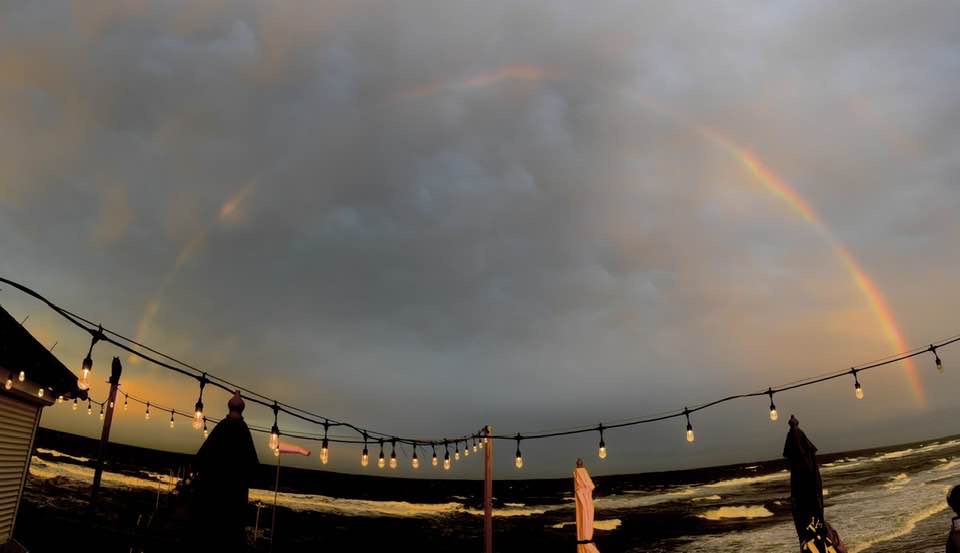
Willful Hearts

Many years ago when my kids were little, we vacationed here on the Outer Banks and spent most of our days at the beach. I remember a day when after getting the umbrella up, the chairs laid out and the towels and sand toys distributed, I left to go on my usual solo walk. About a mile out I saw a dolphin’s body that had washed ashore which was a very upsetting sight. When I returned, I mentioned it to my husband. Immediately my oldest asked to go see it. Knowing how disturbing this would be to her little eyes, I told her no. She returned to playing in the sand behind our chairs in the shade of the umbrella, and my husband and I returned to our books. About ten minutes later, I realized she was gone. Sure enough, she had decided to walk down the beach to see the dolphin for herself, regardless of my answer. It was possibly the most terrifying five minutes of my life as we frantically searched the beach until we found her. I asked her what she was doing, walking away like that, and she retorted that she hadn’t liked my answer, so she decided to go find the dolphin anyway. Kids!

And yet we often treat God the same way. We don’t like his answers, so we stubbornly charge off on our own to satisfy our needs. Even though in our minds we know that God provides everything good for us, we still follow our own willful hearts and ignore his advice and warnings.

Psalm 81 addresses this problem.

Psalm 81 (Common English Bible)

I am the Lord your God,
    who brought you up from Egypt’s land.
    Open your mouth wide—I will fill it up!

11 But my people wouldn’t listen to my voice.
    Israel simply wasn’t agreeable toward me.
12 So I sent them off to follow their willful hearts;
    they followed their own advice.
13 How I wish my people would listen to me!
    How I wish Israel would walk in my ways!
14 Then I would subdue their enemies in a second;
    I would turn my hand against their foes.
15 Those who hate the Lord would grovel before me,
    and their doom would last forever!
16 But I would feed you with the finest wheat.
    I would satisfy you with honey from the rock.”

This psalm was written by Asaph for a festal event such as the Feast of Tabernacles where the wilderness journey was recounted and a reading of the Law occurred. This section tells the story of Israel’s stubborn refusal to hear and obey that Law, and the consequences of that behavior. Clearly God allowed them to walk away to pursue their own agendas, knowing that it was the only way they would learn the bitter reality of disobedience.

God longs to satisfy us with honey from the rock if only we would listen to his counsel. What is God telling you today? Is he telling you to stop something? Start something? Come back to him?

Don’t walk away anymore. It will only lead to heartache. Open your mouth wide and God will fill it with goodness.

Walk in God’s Ways by Kathy Schumacher

Set Yourself Free

A woman who had come for counseling struggled to get her truth out. This often happens in counseling. People fear condemnation and judgment, but more so, they are terrified to hear themselves speak the truth out loud. Truth is like squirting an entire tube of toothpaste onto a plate. Once it is all out, it is impossible to get back into the tube. Finally, as she stumbled and hesitated, I reminded her that I once did five years of jail ministry and thus I am impervious to shocking confessions. Truly, the things that I heard in that setting will rank as some of the most disconcerting moments of my entire ministry. Clergy visitation in prison is a constitutional right, and clergy who take on this task are simply heeding the words of Scripture that tell us to attend to those in prison. But it is far from easy and it can leave a mark.

I kind of fell into it backwards: A church member’s teenage son had shot a friend and killed him in their home. She called me in a panic and asked me to see him in the jail. I visited once a week for the next five years, and the Christian guards started asking me to see other inmates who had requested a clergy visit. A stream of offenders flowed in and out of the clergy room every week, and I listened, counseled, read Scripture, cried, and prayed for these lost souls. One inmate confessed a crime so heinous, it left a deep wound in my soul that I can never forget. But obedience to God’s directive to be his representative in a black clergy shirt week after week left me no choice. I met with him the following week and continued our visits until he was transferred to a state facility.

Today’s Scripture from Hebrews is one of the many places we are told to remember the prisoners. I love how the Scripture begins with the injunction to keep loving each other like family. Can you love an inmate like a brother? Can you love a stranger like family? How about someone who has brought you pain?

Hebrews 13 (Common English Bible)

13 Keep loving each other like family. Don’t neglect to open up your homes to guests, because by doing this some have been hosts to angels without knowing it. Remember prisoners as if you were in prison with them, and people who are mistreated as if you were in their place. Marriage must be honored in every respect, with no cheating on the relationship, because God will judge the sexually immoral person and the person who commits adultery.Your way of life should be free from the love of money, and you should be content with what you have. After all, he has said, I will never leave you or abandon you. This is why we can confidently say,

The Lord is my helper,
    and I won’t be afraid.
What can people do to me?

Remember your leaders who spoke God’s word to you. Imitate their faith as you consider the way their lives turned out. Jesus Christ is the same yesterday, today, and forever!

Ironically, the inmates I visited and the woman in my counseling office had something in common: They were all prisoners. She was imprisoned by her sin and the suffocating box she had trapped herself into. She was as chained as anyone I saw in the jail, and yet the key to her liberation was just as easy to find as it was for the inmates. True confession, deep honesty with yourself and with God, a determination to turn away from the behavior, and a willingness to make reparation to the person you have hurt will lead you to your freedom.

In all of this, the Lord is our helper. There is no need to be afraid. Jesus’ promise to never leave or abandon us means that there is nothing we can do to separate ourselves from his forgiveness and grace.

Are you in a jail of your own making? You know the way out. Set yourself free.

Freedom

Mine! Mine! Mine!

I am watching seagulls vie for position on my neighbor’s dock pilings this morning. One barely gets settled when another one flies in aggressively and knocks the first off his pins. I think the writers of the movie Finding Nemo captured the seagull personality perfectly when they showed them selfishly hoarding their fish while yelling, “Mine! Mine! Mine!” These creatures are single minded, self-centered, and the epitome of greed. One might even say that they are bird-brained.

Today’s Scripture is a beautiful parable on greed from the Gospel according to Luke. Jesus tells a story about a greedy farmer that has a wonderful punchline.

Luke 12 (The Message)

13 Someone out of the crowd said, “Teacher, order my brother to give me a fair share of the family inheritance.”

14 He replied, “Mister, what makes you think it’s any of my business to be a judge or mediator for you?”

15 Speaking to the people, he went on, “Take care! Protect yourself against the least bit of greed. Life is not defined by what you have, even when you have a lot.”

16-19 Then he told them this story: “The farm of a certain rich man produced a terrific crop. He talked to himself: ‘What can I do? My barn isn’t big enough for this harvest.’ Then he said, ‘Here’s what I’ll do: I’ll tear down my barns and build bigger ones. Then I’ll gather in all my grain and goods, and I’ll say to myself, Self, you’ve done well! You’ve got it made and can now retire. Take it easy and have the time of your life!’

20 “Just then God showed up and said, ‘Fool! Tonight you die. And your barnful of goods—who gets it?’

21 “That’s what happens when you fill your barn with Self and not with God.”

How about you? Are you filling your barn with selfishness? Do you have so much stuff that you need extra storage spaces to contain it? When was the last time you wore that coat/used that expensive kitchen appliance/set the table with that fancy china? Do you look at a world in need and think “Mine! Mine! Mine!”?

Don’t be a bird-brain. Treasures stored up on earth spoil and decay. Fill your barn with God and give away all that you can. Life is not defined by what you have, even when you have a lot. Life is defined by being as generous to others as God has been to you.

Proverbs 11 (Common English Bible)

Those who give generously receive more,
    but those who are stingy with what is appropriate will grow needy.
25 Generous persons will prosper;
    those who refresh others will themselves be refreshed.

Birds of a Feather

Safe Harbour

Hurricane Erin is making her presence known along the Outer Banks today. Two days ago, visitors had to evacuate Hatteras Island for fear of high waves and ocean over wash that will make roads impassable for days. While a direct hit is not forecasted, any storm system off our waters creates hazardous conditions for us here on this fragile strip of land. It is often in these times that we see our communities pull together to help one another as we collectively seek safe harbor.

I had an unusual opportunity to offer safety to a total stranger on Monday. A post on our local Colington Harbour Facebook page asked for a safe dock for a large catamaran sailboat that was currently traveling from Annapolis to Hatteras. The decision was made to pull into Colington for the duration of the storm, and the sailor was looking for a place to tie up for a few days. I happen to have a large unused dock, so I quickly offered it. In less than an hour, this beautiful boat was safely secured to my dock. It gave me great joy to share my blessing with them. I too have known the need for safe harbor in my life.

Today’s reading is from Psalm 107. I hope you will take a moment to read it in its entirety today. This beautiful psalm was probably written during or just after the Babylonian exile, when a grateful people were able to return to Israel. It describes four different scenarios of deliverance, from being lost in the wilderness, to those who are imprisoned, to those sick and near death, and finally from those enduring dangerous seas. It is this portion that we will consider today.

Psalm 107 ( Common English Bible)

Some of the redeemed had gone out on the ocean in ships,
    making their living on the high seas.
24 They saw what the Lord had made;
    they saw his wondrous works in the depths of the sea.
25 God spoke and stirred up a storm
    that brought the waves up high.
26 The waves went as high as the sky;
    they crashed down to the depths.
The sailors’ courage melted at this terrible situation.
27     They staggered and stumbled around like they were drunk.
    None of their skill was of any help.
28 So they cried out to the Lord in their distress,
    and God brought them out safe from their desperate circumstances.
29 God quieted the storm to a whisper;
    the sea’s waves were hushed.
30 So they rejoiced because the waves had calmed down;
    then God led them to the harbor they were hoping for.
31 Let them thank the Lord for his faithful love
    and his wondrous works for all people.
32 Let them exalt God in the congregation of the people
    and praise God in the assembly of the elders.

Surely this psalm is a great reminder today of God’s faithful love for us. When we cry out to him in a storm, he hears us and rushes to our side. Even in those moments when the ginormous waves threaten to overcome us, God is our safe harbor. Jesus literally commanded with waves and the winds to be still, and he can command the storm of your life to release you if you cry out to him. Are you in desperate circumstances today? God is your safe harbor.

This psalm ends with a reminder to give thanks to our deliverer. Offering God our gratitude for his interventions in our lives is how this story ends. How does your story end? Has God delivered you? Are you still waiting? Give thanks.

Safe Harbour

Defensive Wounds

Are you intrigued by forensic science? I am. I blame Brit Box and years of too much CSI for my fascination about forensic science. My affection for writer Patricia Cornwell feeds this addiction as well. This branch of investigative police work is amazing in its ability to solve crimes, reveal the truth, and allow the dead to speak for themselves. Body temperature, wound size and angles, and something called defensive wounds tell the tale of how the decedent met their end in no uncertain terms. Defensive wounds are injuries the person sustained while defending themself against the attacker. They can provided needed evidence such as skin under the fingernails that can reveal the DNA of the assailant and prove that the incident wasn’t just an accident. Defensive wounds speak the truth.

I thought about defensive wounds the other day during a counseling session with a church member. She sat on the couch and described many years of painful interactions with a family member whom she deeply loves. They have both been hurt by other family members, and it was obvious that the one that she loves has turned that hurt into attacks against my church member. The reason is clear: This woman is a safe place for all of her loved one’s pain. Unconditional love can come at that cost. The wounds she carries after years of this are a type of defensive wound. She is scarred by multiple attacks and bruised by her attempts to continually fight off and defend herself against her beloved attacker.

You know, Jesus carried defensive wounds as well. He was defending you.

Isaiah 53 (New International Version)
Surely he took up our pain
    and bore our suffering,
yet we considered him punished by God,
    stricken by him, and afflicted.
But he was pierced for our transgressions,
    he was crushed for our iniquities;
the punishment that brought us peace was on him,
    and by his wounds we are healed.
We all, like sheep, have gone astray,
    each of us has turned to our own way;
and the Lord has laid on him
    the iniquity of us all.

Isaiah’s prophecy of a saving messiah was fulfilled on the cross. There, Jesus willingly suffered the piercing of his hands and feet and the gouging of his side by a sword for our sins. He suffered and suffocated so that the pain of sin that we bear might be borne on him so that we might live. Our iniquity left its mark, and his defensive wounds on our behalf bought us eternal life. That’s what unconditional love can do.

At the end of our counseling session we both felt that by listening to and acknowledging the pain that has prompted all the attacks, the loved one may eventually find peace. Rather than continuing to defend and explain herself, my church member will try with God’s help to become a sanctuary for pain rather than its target. Knowing that Jesus walked that lonely valley before gives her strength.

How about you? Are you suffering with your own defensive wounds? It is time to simply listen rather than justify and explain? Have you borne the iniquity of your situation long enough?

Jesus understands. May the peace he bought on the cross for you be yours today and always.

Fresh Air by Kathy Weeks

Loving Unlovables

A friend recently shared a problem she is having with a family member. After recounting several upsetting incidents that have occurred over the course of many years, she looked across the dinner table and said, “I know I should be praying for her, because we’re supposed to pray for our enemies, but frankly, I think I’d rather cut off my arm!” We collapsed into a fit of giggles that embarrassed our husbands and then tackled the issues of 1. how difficult it is to pray for people who have been deliberately hurtful to us, and 2. the difficulty of trying to wash your hair or fold a fitted bed sheet with only one arm. I can’t do it with two.

Let’s take a look at that scripture in its entirety and see if we can’t find a way to comply with one of Jesus’ harder commandments, and help my friend keep her arm intact:

Matthew 5:43-48 (New International Version )

Love for Enemies

43 “You have heard that it was said, ‘Love your neighbor and hate your enemy.’ 44 But I tell you, love your enemies and pray for those who persecute you, 45 that you may be children of your Father in heaven. He causes his sun to rise on the evil and the good and sends rain on the righteous and the unrighteous. 46 If you love those who love you, what reward will you get? Are not even the tax collectors doing that? 47 And if you greet only your own people, what are you doing more than others? Do not even pagans do that? 48 Be perfect, therefore, as your heavenly Father is perfect.

In the broader context, Jesus is making an imprint on his new and very radical theology of how the people of God are to behave. From the first sentence, he is righting the wrong of the old way, by reversing how we are to treat enemies. Love, not hate, is the new way.

But the point of this radicalism comes in the next sentence: pray for those who persecute you so that YOU may be children of your Father in heaven. Did you notice that the instruction to pray is not so that your enemy might be changed? No indeed, the point of this prayer is so that YOU might be changed.

God brings the warmth of the sun and the replenishing rains to provide for the good and the evil alike. This is a reminder to us that God sees potential for change in everyone. He has always been in the saving and transformation business. How easy it would be for him to simply cast out the unrighteous, but instead he includes them into his kingdom by holding the door of repentance wide open.

Being good to your friends and hanging out with your own kind is something non-believers do with great ease. There has to be a difference between those who follow Christ and those who don’t. So what Jesus is saying here is that we are not to be like others around us, but we are to be like him in everything we do. We are called to love unconditionally, forgive without hesitation, encourage and build one another up, and be patient and long-suffering when need be.

I shared with my friend that I had a person who was extremely critical of me, and publicly so, at the very beginning of my ministry. Her words and her actions were devastating and caused me great pain. I confided to an elder church member about it, and he calmly reminded me to “pray for my enemies.” And so I did, for three solid years. I prayed she would be blessed, whole, and healthy. Some days I prayed that I wouldn’t see her at church, because every time I saw her, I had to greet her with a kindness I didn’t always feel. Other days I prayed she would receive me differently, and that maybe we would someday be friends. I just prayed.

One day we found each other in the church on a Saturday when volunteers had gathered to do some work. She was on a ladder and saw me walking down the aisle of the sanctuary. She called out to me and asked if we could talk. In tears, she asked me to forgive her for those words she had spoken many years ago and told me how much she appreciated that I had been civil to her even though she had hurt me.

I told her that I had forgiven her a long time ago, and as those words came out of my mouth, I realized that in all of those years of “praying for my enemy,” my prayers hadn’t changed the situation, but it definitely changed ME.

Prayer changes us. Prayer opens us, helps us to let go of stuff, reminds us that the stuff is really God’s anyway, and allows us to be the face of Jesus to the enemy. My friend may never have reconciliation with her family member, but by praying without ceasing for them, she is sure to receive peace and release.

And keep her arm.

Peace and Release by Kathy Schumacher

Control Your Rudder

The beautiful majesty of sailboats heading out to the Albemarle Sound is a pleasure we get to experience every Wednesday night in Colington Harbour. At 6:00PM we see sailboats from every canal making their way to the harbor and circle up until all are gathered. It is a stunning sight, one which I can see from my westward-facing deck. I’ll never forget the first week we lived here. I was washing dishes and looking out the eastward-facing window when suddenly I saw a huge “pole” moving behind the houses across the street. For a brief moment I had a “War of the Worlds” flashback and imagined that this was the first landing of some kind of alien invasion. It turned out to be the mast of a large, fast-moving sailboat that was going to the weekly community sail. What a relief!

Check out what James has to say about sail boats:

James 3 (New International Version )

Taming the Tongue

3 When we put bits into the mouths of horses to make them obey us, we can turn the whole animal. 4 Or take ships as an example. Although they are so large and are driven by strong winds, they are steered by a very small rudder wherever the pilot wants to go. 5 Likewise, the tongue is a small part of the body, but it makes great boasts. Consider what a great forest is set on fire by a small spark. 6 The tongue also is a fire, a world of evil among the parts of the body. It corrupts the whole body, sets the whole course of one’s life on fire, and is itself set on fire by hell.

Yikes! Your tongue is a rudder with the potential to steer you wrong. It’s a world of evil! So wrong, it might corrupt your whole body, set your life on fire, and is itself set on fire by hell. That’s quite the wakeup call this morning.

That is enough to make you want to just stop talking. For some of us, that would actually be a great idea.

How many times have you wished you hadn’t said something? How often do you wish you could just take something back? Do words of anger bring hours/days/years of regret? Do you dwell in the remorse of knowing your judgmental words brought pain and shame on someone you love?

Well then, shut up.

Seriously. Shut up. The reason God gave us twice as many ears as a mouth is so that we would listen twice as hard and speak half as often. If you were to be honest, wouldn’t you like to go back to some (many) points of time and simply choose not to respond instead of spouting off at someone?

Last week I talked with a woman who would give anything to go back in time and choose to shut up rather than spew out. The incident she was recounting was one where she “flew off the handle” and said things she can never take back. It escalated to include many more people and has compromised her integrity. She is now dealing with the aftershocks of her words. Another woman regrets her harsh appraisal of her teenage daughter, fearing that her judgment has propelled her child into an unhealthy situation.

If only we could take it all back. If only we would use our “rudder” appropriately. If only we would learn to shut up.

Today’s scripture challenges us to speak less and listen with our two ears to that inner voice that is warning us to not say something. God invites us to listen carefully to what others are saying and resist the urge to respond with anything that is not loving, uplifting, kind, useful, and encouraging. And if that isn’t possible to do, then simply choose to shut up, smile and nod.

You will never regret the harsh thing you didn’t say. Sail on and use that rudder wisely.

Sunset Sail to the Sound

Root Mats

Sand dunes grow. They are a complex, living infrastructure of sand, water, vegetation, and wind. Along the Outer Banks, the dunes protect the inner parts of the island from the encroaching seas. We boast of having the largest sand dune on the East Coast here in Nags Head, called Jockey’s Ridge. This massive, moving dune is so big, it has swallowed up a mini-golf course in its eastward trajectory.

The Outer Banks beaches have undergone extensive beach nourishment along our coastline. Erosion, seas and winds have threatened our beaches for decades, and so our towns have responded with a nourishment program that effectively extended the beach by pumping off-shore sand onto the shoreline.

The Baby Dune effort began in hopes of stabilizing the protective dunes. Baby dunes are intentionally planted with vegetation such as sea oats, hearty grasses, and dense patches of dune mats that take root and hold the dune together. If the vegetation is damaged, the dune will fail, the water will breach, and roads and homes are affected. 

The most threatening thing to baby dune growth is people. People ignore the “Keep Off” signs and walk over the dune rather than go a few hundred yards away to a groomed beach access. Beach goers, not wind, are the biggest threat to the stability of this fragile ecosystem. 

Colossians 2 (The Message)

My counsel for you is simple and straightforward: Just go ahead with what you’ve been given. You have received Christ Jesus, the Master. Now LIVE him. You’re deeply rooted in him. You’re constructed upon him. You know your way around the faith. Now do what you’ve been taught. School’s out; quit studying the subject and start LIVING it! And let your living spill over into thanksgiving. 

This passage talks about taking root in Christ. One of the interesting things about the dune grasses and vegetation mats is that their roots aren’t exceptionally deep, but they spread over the top of the dune and provide anchoring to the top layer of sand. Their extensive system of creeping underground stems keeps the dune intact in the winds.

Much in the same way, rooting ourselves in Christ protects our lives and keeps us intact when the winds of change begin to blow hard. In the midst of adversities, when in the blink of an eye something changes, those matted, secure roots of faith, fellowship, meditation, prayer, worship, and Scripture reading can provide resistance.

A friend of mine suddenly lost her mother last week. The death was unexpected and has caught the family terribly off guard. As she is slowly negotiating her new reality, it is her roots in Christ and the interconnected family around her that is keeping her together right now. Another friend is struggling with her spouse’s addiction. The vegetation mat of hope, help, and knowing she is not alone is keeping her strong in her storm.

I don’t know what kind of figurative or literal hurricane you are going through this morning but hear this: You are meant to just go ahead with what you’ve been given. You are meant to receive all that Christ died to give you. You are well constructed on him, and no wind of change, no matter how strong, is going to blow you over. Now do what you’ve been taught! Stay strong, stand firm, and let your living spill over into thanksgiving, even in the storm.

God’s got you…and he will never let go.

Sea Grass by Michelle Robertson

Give Me Patience

Six and a half hours into the five hour drive, I realized that my four-year-old grandson had asked me, “Are we there yet?” at least a dozen times. I could sympathize. That is a long time to be stuck incarcerated in seatbelt, much less a car seat with an over the shoulders harness. Having no real sense of time or distance yet, it surely was frustrating for him.

Finally I figured out a way to slow down the questions. The next time (approximately 3 minutes later) he asked, I said, “Look out your window. Do you see your house?” He would crane his head around both sides of his car seat and answer, “No, Nana! I don’t see my house!” And I would say, “Well, there’s your answer!”

Patience. It is a difficult thing to teach a child, especially when we’ve lost it ourselves. I have often confessed that my favorite prayer is, “Lord, give me patience. AND GIVE IT TO ME RIGHT NOW.”

James 5 counsels patience to an impatient world:

James 5:7-11

Therefore, brothers and sisters, you must be patient as you wait for the coming of the Lord. Consider the farmer who waits patiently for the coming of rain in the fall and spring, looking forward to the precious fruit of the earth. You also must wait patiently, strengthening your resolve, because the coming of the Lord is near. Don’t complain about each other, brothers and sisters, so that you won’t be judged. Look! The judge is standing at the door!

10 Brothers and sisters, take the prophets who spoke in the name of the Lord as an example of patient resolve and steadfastness.11 Look at how we honor those who have practiced endurance. You have heard of the endurance of Job. And you have seen what the Lord has accomplished, for the Lord is full of compassion and mercy.

I wonder how much we actually think about the coming of the Lord. Jesus has promised to return, and his Second Coming will usher in a new rule, a new world, and a new Kingdom on earth. But we walk around so consumed with our daily chores and burdens, we forget to anticipate that his return might be any day now.

We’re not home just yet.

Impatience is a distractor that basically has no purpose. It doesn’t produce much beyond frustration, lack of focus, anger, and a feeling of annoyance. When children get impatient, we try to just distract them long enough for the thing to transpire. But as adults, we give into impatience and turn waiting into seething and seething into action. We take the matter into our own hands when we should have left well enough alone.

James encourages us to stay steady and strong. He reminds us that those who have staying power and have endurance will discover that God is working to bring it all together for us in the end, just as he did for the old prophet mentors.

What are you pushing hard at right now? We often try to rush and hurry things that are better left to develop and grow on their own. A child who is slow to learn, an idea you are trying to promote, a marriage that has lost its charm, a dream you can’t wait to realize, a purchase you can’t afford without a credit card … life moves slowly at times, and we impatiently force things that we shouldn’t.

James instructs us today to allow things to mature and be realized in their own time. God will bring rain that will do its slow but sure work to whatever it is you are trying to handle on your own. The farmer knows to wait. Be patient like that, and before you know it, you will be home.

The Farmer Waits by Becca Ziegler

Take it Off

A recent Sunday at my church was a day filled with lots of children’s events, thus bringing out lots of children. As I waited by the back door, three kids ran past me to get to the sanctuary. They were from different families, and all three were shoeless.

I have adjusted to acolytes in flip flops, a common sight in my church but not common elsewhere. I love our laid back Outer Banks style. I love comfortable footwear on 10 year olds carrying the candlelighter with the seriousness of a welder powering up his flame. I especially love happy, shoeless kids running through the sanctuary to take their seat and wait for the fun to begin. I was two seconds away from taking off my own heeled pumps when I had a last minute “maybe-that’s-not-appropriate” thought flash through my mind.

Or is it?

I think the shoeless kids feel some kind of connection to the idea of “special, set apart and sacred” and want to have full physical contact with that holy ground that is the sanctuary. The joy of running on the old, worn, red carpet in a place that feels homey and safe is a delight to behold. Maybe we should all take off our shoes! Moses did:

Exodus 3 (Contemporary English Version)

God Speaks to Moses

3 One day, Moses was taking care of the sheep and goats of his father-in-law Jethro, the priest of Midian, and Moses decided to lead them across the desert to Sinai,[a] the holy mountain. 2 There an angel of the Lord appeared to him from a burning bush. Moses saw that the bush was on fire, but it was not burning up. 3 “This is strange!” he said to himself. “I’ll go over and see why the bush isn’t burning up.”

4 When the Lord saw Moses coming near the bush, he called him by name, and Moses answered, “Here I am.”

5 God replied, “Don’t come any closer. Take off your sandals—the ground where you are standing is holy. 6 I am the God who was worshiped by your ancestors Abraham, Isaac, and Jacob.”

Moses was afraid to look at God, and so he hid his face.

Why the command to take off his shoes? Perhaps it was a way to warm Moses up for the BIG ASK that God was about to deliver. God would tell Moses that he was to go from that place at Mt. Sinai to confront Pharaoh and demand he set his people free from slavery in Egypt. Taking off his shoes was a reminder to Moses that God’s presence had made this place holy ground. Middle eastern tradition required the removal of one’s shoes before entering houses and temples, and so God was asking Moses to humble himself before both God and his plan. The shoes that bore the contaminants and dirt of the non-sacred places were to be set aside so that God could deal with him in a pure and vulnerable state.

This is what the children innately understand. Their purity and vulnerability are a sign to the big folks that we should emotionally and spiritually take off our shoes and garments and stand soul-naked each time we enter God’s presence. All of the fakery, the conceit, the embellishments, and the hypocrisy need to fall away before God can be encountered. When we submit to this stripping down of our facades, God can finally reveal his presence and plan to us.

What do you need to “take off” so that God can reveal your next step to you? What accessories are you hiding behind that block you from entering into God’s presence fully and humbly? Are there conceits that have you so conceited that the humble, holy ground has no appeal to you? Are you trotting around in shoes covered with the contaminants and dirt of the non-sacred places you frequent? Lay it down. Let it go. Take off your shoes and get over yourself.

God calls us to his Holy Ground today. Let us run barefoot into his presence and be ready to receive whatever he has planned for us.

Mykonos Holy Ground-A private family chapel.