One of the joys of watching an engaging series on television is the familiarity of the characters and setting. From Downton Abbey to Friends to Law and Order, our understanding of time and place serves as a shortcut to the unfolding plot line. For example, remembering Lady Mary’s indiscretion with the Turkish envoy Mr. Pamuk in the first episode of Downton Abbey sets the scene many seasons later for her reluctance to accept the possibility of a happy life with Matthew. Story threads like that give the viewer a sense of being woven right into the narrative along with the perfect table place settings and the growls and scowls of Mr. Carson. We instantly get the reference and feel included in the tale.
Hearers of the proclamations of John the Baptizer when he testified to the nature of Jesus would have felt the same kinship with the story. He described Jesus as the “Lamb of God,” a reference to the figure of the sacrificial lamb that appeared in many parts of the Hebrew lexicon.
John 1 (Common English Bible)
29 The next day John saw Jesus coming toward him and said, “Look! The Lamb of God who takes away the sin of the world!30 This is the one about whom I said, ‘He who comes after me is really greater than me because he existed before me.’ 31 Even I didn’t recognize him, but I came baptizing with water so that he might be made known to Israel.”
There was a lamb in the Garden of Eden that lost its life providing clothing so that Adam and Eve could cover their original sin. There was a lamb offered by an angel to Abraham to serve as a substitute sacrifice in Isaac’s place. A lamb provided the Passover blood that marked the homes of the jews in Egypt, protecting them from the slaughter of the angel of death who had come with the final plague against Pharaoh. The Levitical practices of altar sacrifices required many lambs to give up their lives. Isaiah prophesied about the lamb born to be shorn and slaughtered for the sins of the nation. Sacrificial lambs were a familiar trope for the Hebrew nation, and John the Baptizer used that institutional knowledge to point to Jesus as the one and only Lamb of God, who will take away the sins of the world once and for all.
32 John testified, “I saw the Spirit coming down from heaven like a dove, and it rested on him. 33 Even I didn’t recognize him, but the one who sent me to baptize with water said to me, ‘The one on whom you see the Spirit coming down and resting is the one who baptizes with the Holy Spirit.’ 34 I have seen and testified that this one is God’s Son.”
We’ll be reading from The Gospel of John for a few weeks, so let’s pause for a moment and consider this marvelous book. John’s gospel presents the story of Jesus in a much different manner than the other three synoptic gospels. They are aligned in sequence, frame, and form, while John’s Gospel takes a different approach to the same story. John does not include a birth narrative, Jesus’ baptism, the wilderness temptation, the parables, the Last Supper, the agony in Gethsemane, nor Jesus’ ascension. While Matthew, Mark, and Luke focus on Jesus’ ministry in Galilee, John takes us straight to Jerusalem. He emphasized Jesus’ miracles and gave us eyewitness testimonies, like the one we read today. Note that John does not record the baptism itself but offers John the Baptizer’s eyewitness account of the event.
Who is the Lamb of God to you? What sin does he come to take away forever from your life? Will you allow his sacrifice to make you clean? What is your testimony about Jesus?
We don’t want to miss the point. In every iteration of the sacrificial lamb, God allowed its shed blood to provide safety, protection, a new start, and freedom. Like the representative body and blood of communion, we are offered an opportunity to accept Jesus’ sacrifice and be made new. How will you accept that gift today?
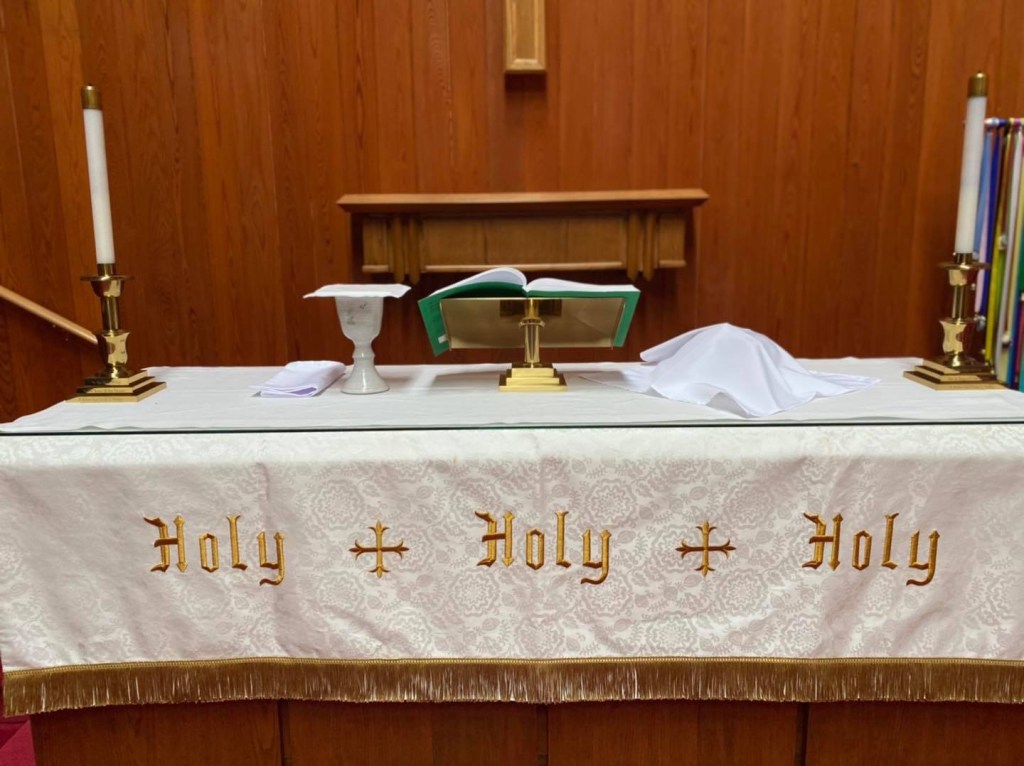
This is My Blood, Poured Out for You by Kitty Hawk UMC
 At Water’s Edge