How does your community assist those in need of food and basic supplies? Here in the Outer Banks we have several options, including a Beach Food Pantry as well as a Mobile Pantry that travels from location to location. These agencies are supported by private donations and local farmers who supply fresh produce every week. Volunteers sort, bag, and assist patrons who use these agencies to make ends meet in a high cost area where housing is extremely expensive. Our United Methodist Conference also provides gleaning opportunities at nearby farms where volunteers gather up fallen produce after a harvest and deliver it to regional food banks for distribution. Gleaning is hard but rewarding work and is a favorite activity for our church youth groups.
Gleaning is a biblical concept, commanded by God in Leviticus 19:9-10:
9 When you harvest your land’s produce, you must not harvest all the way to the edge of your field; and don’t gather up every remaining bit of your harvest. 10 Also do not pick your vineyard clean or gather up all the grapes that have fallen there. Leave these items for the poor and the immigrant; I am the Lord your God.
This was a law of compassion, allowing the poor to work for their sustenance with dignity and without the need to ask for charity. Offered as a form of public assistance, it trained the farmer to have a generous heart and reminded those who were fortunate enough to have a field that produced crops that the field was actually the Lord’s in the first place. That is why we talk about “God’s tithe and our offering” when the plate is passed on Sunday morning in church. Everything we have belongs to God. We are only returning a small portion back to God to do God’s work in the world.
Deuteronomy 23 is a reciprocal reminder to the poor and the traveler that generosity should not be abused, but respected.
Deuteronomy 23 (Common English Bible)
24 If you go into your neighbor’s vineyard, you can eat as many grapes as you like, until full, but don’t carry any away in a basket.25 If you go into your neighbor’s grain field, you can pluck ears by hand, but you aren’t allowed to cut off any of your neighbor’s grain with a sickle.
God’s point is much the same as when manna was provided in the desert. Moses was instructed to tell the people to only gather up what was needed for one day, trusting that God would provide “our daily bread” every day. Hoarding was unnecessary in a community of faith where provisions were shared. It was this law that enabled Jesus and his disciples to pick wheat grain and eat it as they traveled through Galilee. The Pharisees accused them of breaking the sabbath law, but not of stealing.
What part of providing for the poor are you taking in your community? Are you faithfully returning God’s tithe? Is God training you to have a generous heart? Do you trust God to provide for your daily needs?
We are called to do what we can to give what is God’s to God’s people. No one should go hungry in the land of milk and honey.
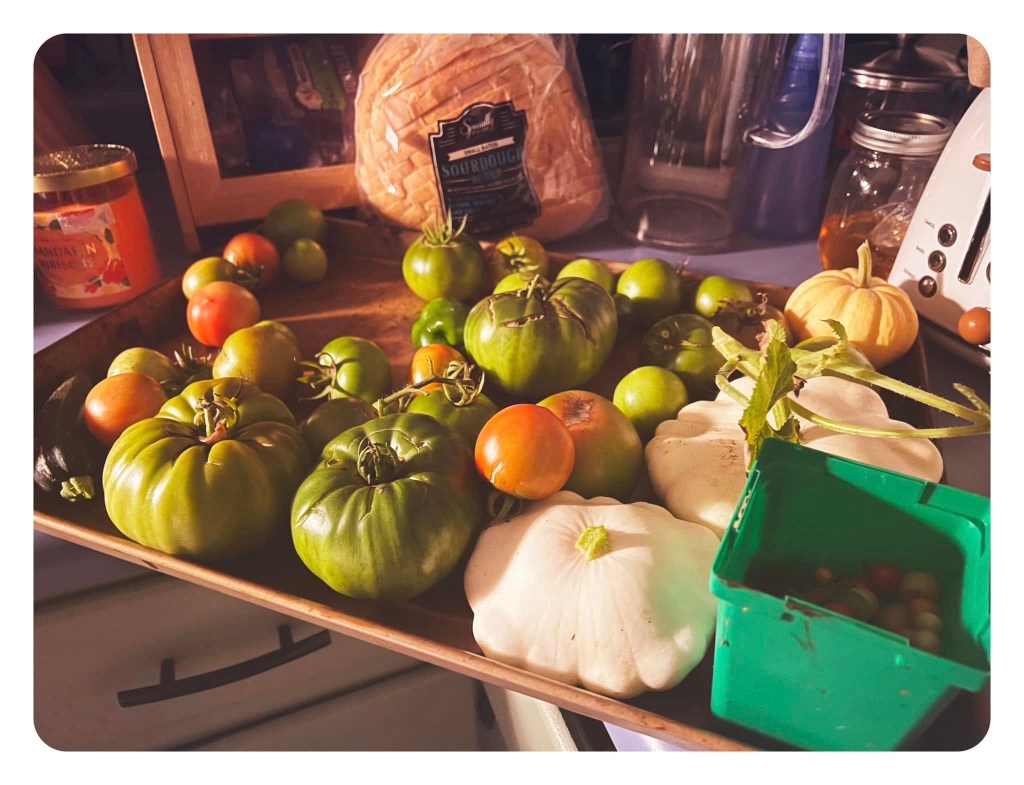
Harvest in the Land O’Plenty by Becca Ziegler
 At Water’s Edge