Do you ever wonder why priests and pastors lift certain things up during worship? You’ve probably watched as the chalice, the paten, the bread, the offering plates, etc. are lifted up as words of blessing are spoken. Many of these traditions are hand-me-downs from ancient rituals observed by our desert fore-parents, who were sometimes following Levitical laws. We remember that the tribe of Levi were the ones who were the designated priests for the nation of Israel, so the book of Leviticus is chock-full of priestly knowledge and instruction.
In today’s passage, instructions are given for the observance of the Feast of Weeks, also known as the Pentecost. You will remember that it was this same festival that was being observed in Acts when the Holy Spirit came upon the disciples gathered there and empowered them to speak and understand each other’s languages. It is understood that the church began that day. The festival of Pentecost was so named as it fell 50 days after the Feast of the First Fruits. The other two festivals that were prescribed in this chapter are the Passover and the Feast of the Unleavened Bread.
Leviticus 23:15-21
15 You must count off seven weeks starting with the day after the Sabbath, the day you bring the bundle for the uplifted offering; these must be complete. 16 You will count off fifty days until the day after the seventh Sabbath. Then you must present a new grain offering to the Lord. 17 From wherever you live, you will bring two loaves of bread as an uplifted offering. These must be made of two-tenths of an ephah of choice flour, baked with leaven, as early produce to the Lord.
The precision with which these instructions were given seems almost daunting.
18 Along with the bread you must present seven flawless one-year-old lambs, one bull from the herd, and two rams. These will be an entirely burned offering to the Lord, along with their grain offerings and drink offerings, as a food gift of soothing smell to the Lord. 19 You must also offer one male goat as a purification offering and two one-year-old lambs as a communal sacrifice of well-being. 20 The priest will lift up the two sheep, along with the bread of the early produce, as an uplifted offering before the Lord. These will be holy to the Lord and will belong to the priest.
The image of the priest lifting up two sheep is an impressive one. I have trouble lifting up two metal offering plates on Sundays … and that’s not because they are full! But imagine the power of this image to the worshippers. As we lift things up in worship, we are reminding ourselves of the One who provided those gifts in the first place. By lifting them up to heaven, we consecrate our gifts back to God, our Provider. So while we aren’t required to bring our goats, lambs, and sheep to the altar any longer (thank heavens) we are invited to lift up our hearts to the Lord at every holy occasion and give generously of our means..
21 On that very same day you must make a proclamation; it will be a holy occasion for you. You must not do any job-related work. This is a permanent rule wherever you live throughout your future generations.
Do you observe the Sabbath? Do you avoid work on that day? Is Sunday a holy occasion?
God deserves an offering of our hearts and minds at least one day a week. May we make that our permanent rule.
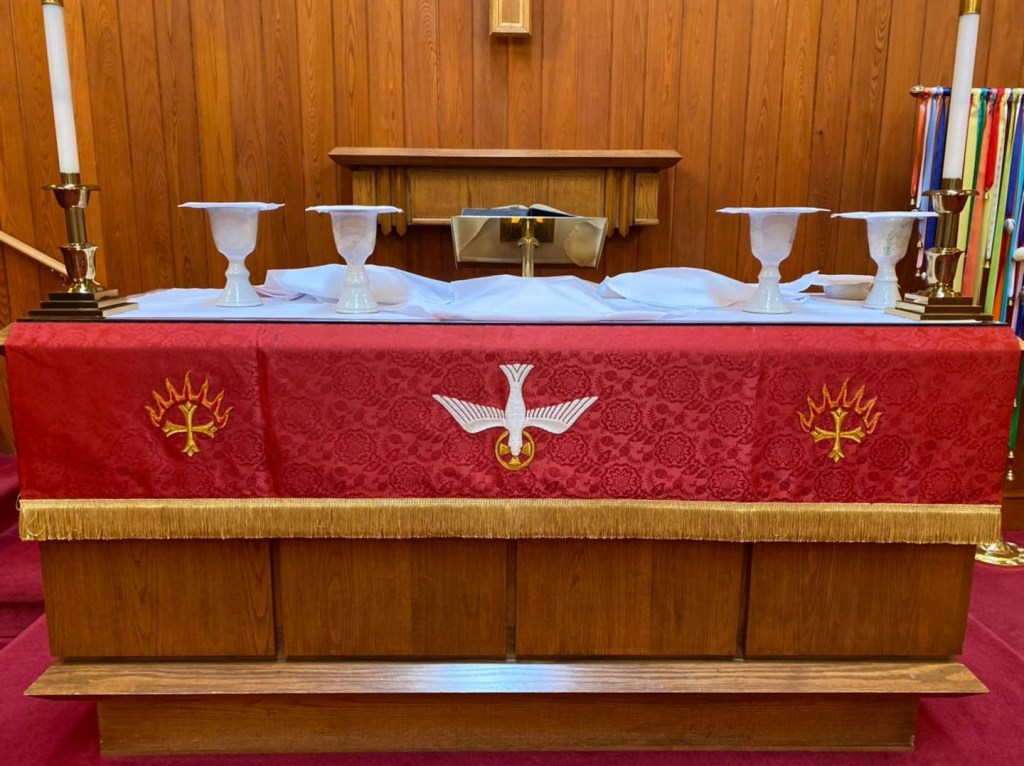
We Lift Up Our Hearts by Kitty Hawk United Methodist Church
 At Water’s Edge