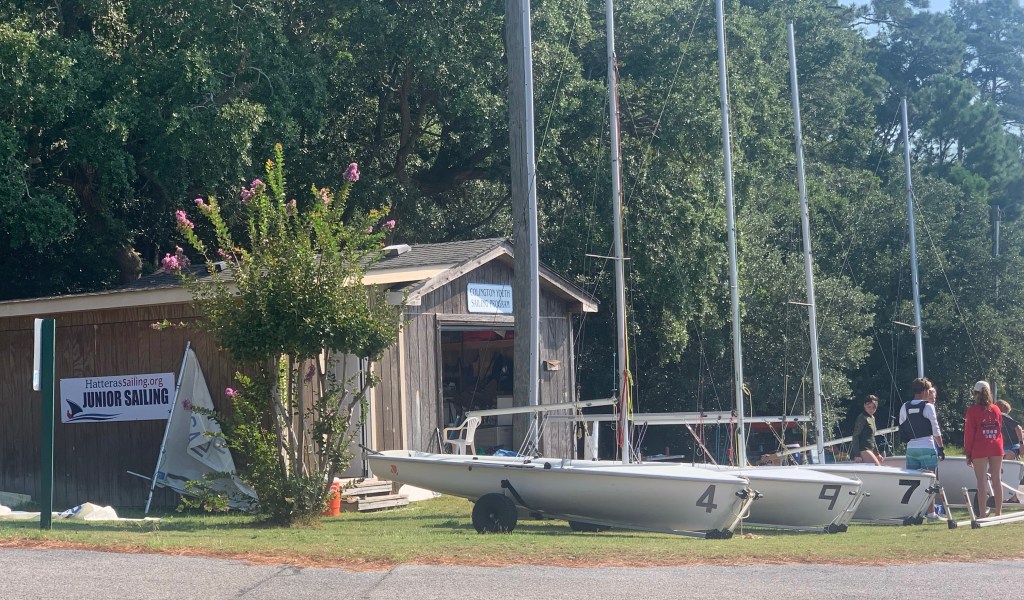
I’m finding it hard to concentrate on my writing today because a Youth Sailing Camp is happening right outside my window. There are 9 small white sailboats, a low, red motorized safety boat that is carrying the instructors, and three adult-manned jet skis making their way around the harbor. It is fascinating.
Today is the first day of camp, and earlier this morning I circled the parking lot at the marina on my run and saw the camp kids lining up in their life vests on the pier. The first thing the instructor did was to have them jump in the water. I think this was a way to get them used to being in the water before they even stepped into a boat.
Later this afternoon, I looked out and was horrified to see a sailboat laying on its side in the water. I squinted to see if a child was in the water and frantically searched to see if the red rescue boat was on the way. Where were the jet skis??? Is everything okay? Then I noticed another sailboat fall over, and one by one, they all capsized. It seems that the first day of school includes a capsizing drill, and everyone followed the instructions on how to get back in their boats and get them flipped upright again. But these classes should come with warnings for the onlookers!
As we continue our reading of Paul’s letter to his church in Thessalonica, I see the same kind of intentional training going on in his writing. He was getting them used to negotiating the often turbulent waters of this new faith community set in the middle of other faith and anti-faith communities that were not accepting of their good news. We can imagine him checking out the rigging of their boats and tightening their life jackets as he assured them that from the beginning of his relationship with them, everything had been above board and was ship-shape:
1 Thessalonians 2 (Common English Bible)
2 As you yourselves know, brothers and sisters, our visit with you wasn’t a waste of time. 2 On the contrary, we had the courage through God to speak God’s good news in spite of a lot of opposition, although we had already suffered and were publicly insulted in Philippi, as you know. 3 Our appeal isn’t based on false information, the wrong motives, or deception. 4 Rather, we have been examined and approved by God to be trusted with the good news, and that’s exactly how we speak. We aren’t trying to please people, but we are trying to please God, who continues to examine our hearts.
By reminding them that he and his companions Silas and Timothy had been examined and approved by God, Paul took any human factor out of the equation. The church needn’t be concerned, because Paul’s motives were pure, and he spoke no falsehoods or deceptions to them. So when they were opposed, they knew they had the backing of God.
5 As you know, we never used flattery, and God is our witness that we didn’t have greedy motives. 6 We didn’t ask for special treatment from people—not from you or from others— 7 although we could have thrown our weight around as Christ’s apostles. Instead, we were gentle with you like a nursing mother caring for her own children. 8 We were glad to share not only God’s good news with you but also our very lives because we cared for you so much.9 You remember, brothers and sisters, our efforts and hard work. We preached God’s good news to you, while we worked night and day so we wouldn’t be a burden on any of you. 10 You and God are witnesses of how holy, just, and blameless we were toward you believers. 11 Likewise, you know how we treated each of you like a father treats his own children.
12 We appealed to you, encouraged you, and pleaded with you to live lives worthy of the God who is calling you into his own kingdom and glory.
I love Paul’s use of parental imagery here. He spoke of being as gentle as a nursing mother and said that they treated the Thessalonians the same way a father treats his children. His language is not patronizing, but paternal. There is an inherent familial love that comes through his words, and by addressing them as brothers and sisters, he established the kind of relationship he wants to build and maintain with them. He was growing a great big family of followers. In verse 12, he finally made his appeal: he wanted his new family to live lives worthy of God, who calls us all into the kingdom.
What does that say to you today? Are you living your life as someone who is in training for the kingdom, or are you close to capsizing with no rescue boat on the way? What do you need to do to get back in the boat and pull it upright again?
Our Christian life together is a journey of practicing drills so that we not only survive but thrive. There is always someone in a boat nearby, ready to extend a hand when the water gets too rough. Paul, Silas, and Timothy were there for their new church. May we, the church, be there for others.
Come Sail Aweigh
 At Water’s Edge